
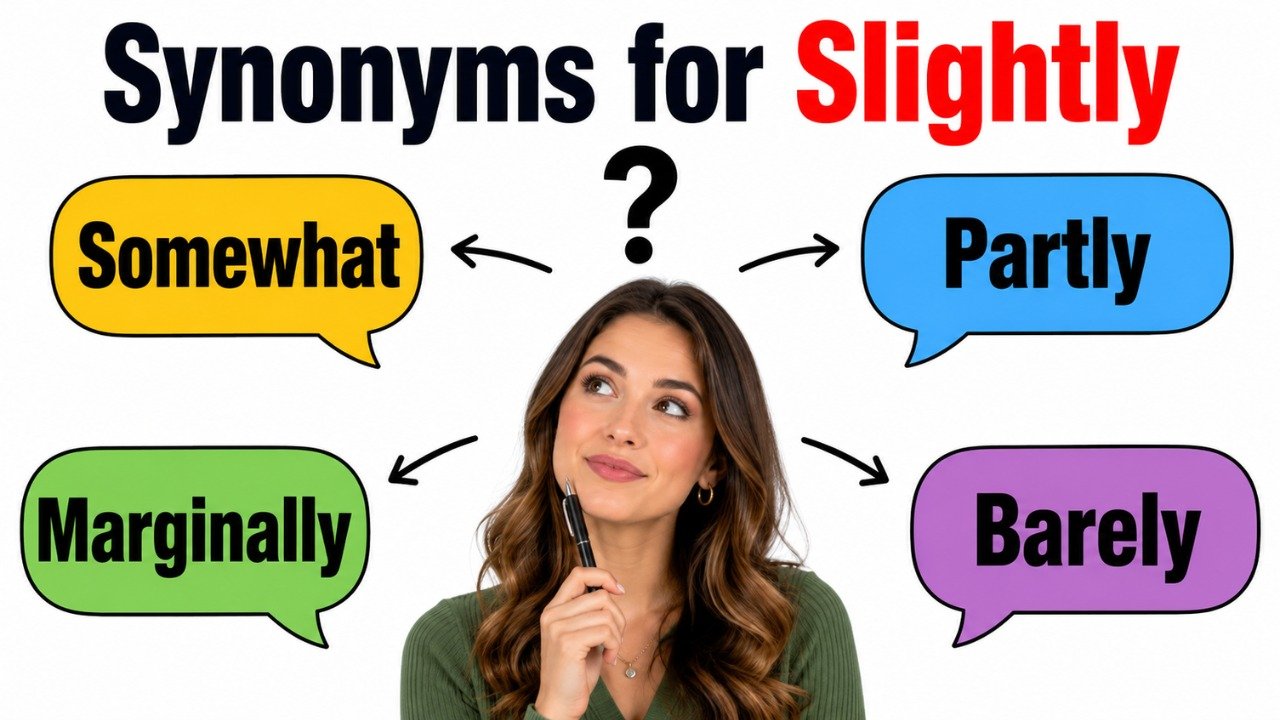
Quick Answer: Useful synonyms for slightly include somewhat, mildly, marginally, faintly, barely, a little, a bit, modestly, minimally, and fractionally. The best choice depends on context. Use somewhat for a general small degree, mildly for feelings or conditions, marginally for formal comparisons, faintly for weak sensations or appearances, a little or a bit for casual speech, minimally for very small changes, and fractionally for precise measurements or numerical differences.
Pronunciation and Word Details
Word: Slightly.
Pronunciation: /ˈslaɪtli/
Part of Speech: Adverb.
Meaning: To a small degree, amount, extent, or level.
US Pronunciation:
UK Pronunciation:
What Does “Slightly” Mean?
Slightly means to a small degree, amount, extent, or level. It is an adverb commonly used to describe a change, difference, feeling, appearance, position, condition, or quantity that is noticeable but not large.
The word often modifies adjectives, verbs, and comparative expressions.
With an adjective: The room felt slightly colder.
With a verb: She slightly adjusted the chair.
With a comparison: This version is slightly better.
With a physical description: His head was slightly tilted.
Slightly is useful when a speaker wants to show that something exists or has changed, but only by a limited amount.
Meaning, Tone, and Context of “Slightly”
Slightly has a neutral and flexible tone. It works naturally in everyday conversation, academic writing, professional communication, descriptions, reports, instructions, and technical explanations.
In casual speech, people often replace slightly with a little or a bit.
Casual: The soup is a bit salty.
Neutral: The soup is slightly salty.
In formal writing, alternatives such as marginally, minimally, or fractionally may be more appropriate when discussing measurable differences.
Formal: The second result was marginally higher.
Slightly can also soften statements. Saying that someone is slightly concerned sounds less intense than saying that the person is seriously concerned.
Softened statement: I am slightly worried about the delay.
It is therefore useful for expressing small differences without making the sentence sound dramatic or exaggerated.
When and How to Use “Slightly”
For a Small Degree
Use slightly when a quality exists only to a limited extent.
Example: The water feels slightly warm.
For Small Differences
Use slightly when comparing two things that are close but not identical.
Example: This jacket is slightly darker than the other one.
For Minor Changes
Use slightly when an action causes only a small adjustment.
Example: She slightly changed the angle of the screen.
For Feelings and Emotions
Use slightly when an emotion is present but not strong.
Example: He seemed slightly nervous before speaking.
For Physical Position
Use slightly when describing a small movement or position.
Example: The picture was hanging slightly to the left.
For Amounts and Measurements
Use slightly when a quantity is just above or below another quantity.
Example: The temperature was slightly below average.
For Polite Softening
Use slightly when you want criticism or disagreement to sound less severe.
Example: The explanation is slightly unclear.
For Appearance
Use slightly when describing a subtle visual difference.
Example: Her hair looked slightly lighter in the sunlight.
Best Synonyms for Slightly
Somewhat
Synonym: Somewhat means to a limited or moderate degree.
Example: The instructions were somewhat confusing.
Mildly
Synonym: Mildly means in a gentle, limited, or not severe way.
Example: She was mildly surprised by the announcement.
Marginally
Synonym: Marginally means by a very small amount or degree.
Example: Sales were marginally higher this month.
Faintly
Synonym: Faintly means weakly or only slightly noticeably.
Example: The flowers smelled faintly sweet.
A Little
Synonym: A little means to a small degree or amount.
Example: The room feels a little warmer now.
A Bit
Synonym: A bit means slightly and is especially common in conversation.
Example: I feel a bit tired this evening.
Modestly
Synonym: Modestly means by a relatively small or limited amount.
Example: Prices increased modestly during the period.
Minimally
Synonym: Minimally means to the smallest practical or noticeable degree.
Example: The design was minimally altered.
Fractionally
Synonym: Fractionally means by a very small numerical or measurable amount.
Example: The second measurement was fractionally lower.
Barely
Synonym: Barely means only just or by an extremely small degree.
Example: The sound was barely audible.
50 Synonyms for Slightly with Short Meanings
- Somewhat: To a limited degree.
- Mildly: To a gentle or small degree.
- Marginally: By a very small amount.
- Faintly: Weakly or subtly.
- Barely: Only just or almost not.
- Minimally: To a very small extent.
- Fractionally: By a tiny measurable amount.
- Modestly: By a limited amount.
- Partly: To some degree but not completely.
- Partially: To an incomplete degree.
- A little: To a small extent.
- A bit: Slightly, especially in casual speech.
- A touch: By a small degree.
- A shade: By a subtle degree.
- A little bit: To a small degree.
- To some extent: Partly or in a limited way.
- To a degree: To a certain limited extent.
- In some measure: To a limited extent.
- In a small way: To a minor extent.
- In a small degree: By a limited amount.
- To a small extent: Only somewhat.
- To a minor extent: By a small degree.
- To a limited extent: Not greatly or completely.
- In a limited way: Only to a restricted degree.
- In part: Partially rather than completely.
- Just a little: By only a small amount.
- Just a bit: By a small amount.
- Only slightly: By no more than a small degree.
- Only a little: By a small amount.
- Only a bit: To a limited degree.
- Ever so slightly: By an extremely small degree.
- Very slightly: By a particularly small amount.
- Scarcely: Almost not or only just.
- Hardly: Almost not at all.
- Subtly: In a delicate or barely noticeable way.
- Delicately: In a gentle or subtle manner.
- Lightly: With little force, intensity, or degree.
- Gently: In a soft or mild manner.
- Moderately: To a controlled or limited degree.
- Comparatively little: By a relatively small amount.
- Relatively little: To a small degree in comparison.
- Imperceptibly: By an amount that is almost impossible to notice.
- Inappreciably: By an extremely small or barely noticeable amount.
- Infinitesimally: By an extremely tiny degree.
- Minutely: By a very small amount.
- Narrowly: By only a small margin in certain comparisons.
- Approximately: Not exactly, but close in amount or measurement.
- Almost: Very nearly, though not completely.
- Just: Only by a small amount in certain contexts.
- A fraction: By a very small amount.
Read Also:
Synonyms for Nonsense
Synonyms for Slightly by Context
When Slightly Means to a Small Degree
Somewhat, a little, a bit, mildly, and to some extent are useful when describing a quality that exists at a low level.
Example: The task was somewhat difficult.
Example: The coffee tasted a little bitter.
Example: She appeared mildly uncomfortable.
Somewhat often sounds more neutral than a bit, while a little and a bit sound more conversational.
When Slightly Means by a Small Amount
Marginally, fractionally, minimally, and a fraction are especially useful when discussing measurable differences.
Example: The new figure was marginally higher.
Example: The temperature fell fractionally overnight.
Example: Costs were minimally reduced.
These alternatives are particularly useful in reports, comparisons, measurements, and analytical writing.
When Slightly Means Weakly Noticeable
Faintly, subtly, imperceptibly, and delicately work well for small sensory or visual effects.
Example: The room smelled faintly of flowers.
Example: The background color changed subtly.
Example: The light faded almost imperceptibly.
These words emphasize how difficult or easy the difference is to notice.
When Slightly Describes Feelings
Mildly, somewhat, a little, and a bit are natural choices for emotions or physical conditions.
Example: She felt mildly anxious.
Example: He was somewhat disappointed.
Example: I am a little tired.
Mildly often sounds neutral or professional, while a little and a bit are more conversational.
When Slightly Softens a Statement
Somewhat, a little, a bit, and to some extent can make criticism or disagreement less direct.
Example: Your explanation is somewhat unclear.
Example: The proposal seems a little unrealistic.
These alternatives help speakers express concerns without making the statement sound overly harsh.
Another Word for Slightly
A strong general replacement for slightly is somewhat because it expresses a limited degree without sounding strongly formal or casual. However, the best alternative depends on what is being described.
Use mildly for emotions or conditions, marginally for measurable comparisons, faintly for weak sensations, and a little for everyday conversation.
Original: The room was slightly warmer.
Better Option: The room was somewhat warmer.
Original: She felt slightly nervous.
Better Option: She felt mildly nervous.
Original: Profits were slightly higher.
Better Option: Profits were marginally higher.
Original: The fabric looked slightly blue.
Better Option: The fabric looked faintly blue.
When Not to Use “Slightly”
Slightly is useful, but another word may communicate the intended meaning more precisely.
Avoid slightly when the amount or degree is actually large. Saying something increased slightly would be misleading if the change was significant.
Weak: Prices increased slightly by a substantial amount.
Better: Prices increased considerably.
Slightly can also become repetitive when used several times in the same paragraph.
Weak: The room was slightly colder, slightly darker, and slightly quieter.
Better: The room was somewhat colder, noticeably darker, and a little quieter.
In technical comparisons, a more precise word such as marginally or fractionally may be stronger.
Weak: The second measurement was slightly lower.
Better: The second measurement was fractionally lower.
For extremely small differences that are difficult to notice, faintly, subtly, or imperceptibly may communicate the meaning better.
Weak: The color changed slightly.
Better: The color changed subtly.
Words Commonly Confused With Slightly
Slightly vs Somewhat: Slightly usually suggests a small degree, while somewhat can sometimes suggest a small to moderate degree.
Slightly vs Barely: Slightly means a small amount exists, while barely emphasizes that something almost does not exist or happen.
Slightly vs Mildly: Slightly describes a small degree generally, while mildly is especially common with emotions, symptoms, reactions, weather, and criticism.
Slightly vs Marginally: Slightly is general, while marginally often describes small measurable or comparative differences.
Slightly vs Faintly: Slightly describes degree broadly, while faintly often relates to weak sounds, smells, colors, memories, or visible effects.
Slightly vs Partly: Slightly refers to degree, while partly usually refers to proportion or incomplete completion.
Slightly vs Subtly: Slightly focuses on how small a difference is, while subtly focuses on how delicate or difficult to notice it is.
Slightly vs Minimally: Slightly simply means by a small amount, while minimally often emphasizes that the amount is close to the lowest possible level.
Which Synonym Should You Choose?
Choose somewhat when you need a flexible replacement for a limited degree.
Choose mildly when describing emotions, reactions, symptoms, discomfort, weather, or criticism.
Choose marginally when discussing small numerical, financial, statistical, or comparative differences.
Choose fractionally when a measurable difference is extremely small.
Choose faintly when describing weak smells, sounds, colors, memories, or visual impressions.
Choose subtly when a change or difference is delicate and not immediately obvious.
Choose a little when writing conversationally or speaking naturally.
Choose a bit when you want an informal and relaxed expression.
Choose minimally when emphasizing that very little change, effort, or difference occurred.
Choose barely when something only just reaches a certain condition or level.
For formal reports and analytical writing, marginally, minimally, and fractionally are often more precise than casual alternatives.
For essays and general writing, slightly, somewhat, and mildly usually sound natural.
For everyday conversation, a little and a bit are usually the easiest choices.
Real Life Examples of “Slightly” in Sentences
Original: The weather became slightly cooler after sunset.
Better Option: The weather became somewhat cooler after sunset.
Original: She looked slightly nervous before the interview.
Better Option: She looked mildly nervous before the interview.
Original: The second box is slightly heavier.
Better Option: The second box is marginally heavier.
Original: The flowers smelled slightly sweet.
Better Option: The flowers smelled faintly sweet.
Original: His chair was slightly closer to the table.
Better Option: His chair was a little closer to the table.
Original: The price was slightly lower than expected.
Better Option: The price was marginally lower than expected.
Original: The design looks slightly different.
Better Option: The design looks subtly different.
Original: She slightly adjusted the volume.
Better Option: She gently adjusted the volume.
Original: The final score was slightly higher.
Better Option: The final score was fractionally higher.
Original: I am slightly concerned about the delay.
Better Option: I am somewhat concerned about the delay.
Synonym Groups and Usage Differences
Small Degree Group
Somewhat, a little, a bit, mildly, and to some extent describe a limited level of something.
These choices work well when the exact amount is not important.
Example: The instructions were somewhat difficult to follow.
Measurement Group
Marginally, fractionally, minimally, and a fraction describe very small measurable differences.
They are especially useful with numbers, percentages, temperatures, prices, scores, and dimensions.
Example: The second reading was fractionally higher.
Sensory Group
Faintly, subtly, lightly, and delicately describe weak or gentle sensations and appearances.
They commonly appear with colors, smells, sounds, tastes, and visual effects.
Example: The room smelled faintly of fresh paint.
Casual Speech Group
A little, a bit, just a little, and just a bit are common in everyday conversation.
They often sound warmer and less formal than marginally or minimally.
Example: I feel a bit tired after the journey.
Extremely Small Degree Group
Barely, scarcely, imperceptibly, infinitesimally, and minutely describe extremely small degrees.
Some of these alternatives suggest that the difference is almost impossible to notice.
Example: The image shifted imperceptibly.
Softening Group
Somewhat, mildly, a little, and to some extent can make criticism, disagreement, or concern sound less severe.
Example: The conclusion is somewhat unclear.
Antonyms of Slightly
The opposite of slightly depends on whether the sentence refers to degree, amount, intensity, or change.
Greatly: By a large amount or degree.
Considerably: To a significant extent.
Significantly: By an important or noticeable amount.
Substantially: To a large or meaningful degree.
Extensively: Over a wide range or degree.
Strongly: With considerable intensity.
Deeply: To an intense or profound degree.
Severely: To a serious or intense degree.
Dramatically: By a striking or major amount.
Noticeably: To a degree that is clearly apparent.
Markedly: In a clearly noticeable way.
Completely: Fully rather than only to a small degree.
Comparison: Slightly vs Related Words
Slightly vs Somewhat
Slightly usually describes a relatively small degree. Somewhat can be broader and may suggest a small or moderate degree depending on context.
Example With Slightly: The road became slightly narrower.
Example With Somewhat: The instructions were somewhat difficult.
Slightly vs Mildly
Slightly can modify almost any suitable quality, while mildly is especially natural with feelings, reactions, weather, symptoms, and criticism.
Example With Slightly: The surface was slightly rough.
Example With Mildly: He seemed mildly irritated.
Slightly vs Marginally
Slightly is neutral and general. Marginally is more formal and commonly describes small comparative differences.
Example With Slightly: The second room was slightly larger.
Example With Marginally: The second result was marginally better.
Slightly vs Faintly
Slightly focuses on degree. Faintly suggests something can only weakly be sensed or noticed.
Example With Slightly: The wall was slightly blue.
Example With Faintly: The wall was faintly blue.
Slightly vs Barely
Slightly means a small amount is present. Barely suggests something is almost absent or only just meets a condition.
Example With Slightly: The door was slightly open.
Example With Barely: The door was barely open.
Slightly vs Subtly
Slightly describes the size of the difference. Subtly describes how delicate or difficult to notice that difference is.
Example With Slightly: Her expression changed slightly.
Example With Subtly: Her expression changed subtly.
Slightly vs A Little
Both can express a small degree, but a little is more conversational.
Example With Slightly: The room is slightly warmer.
Example With A Little: The room is a little warmer.
Common Phrases and Expressions With Slightly
Slightly Better: Better by a small degree.
Slightly Different: Different in only a minor way.
Slightly Higher: Higher by a small amount.
Slightly Lower: Lower by a small amount.
Slightly Larger: Larger by a limited amount.
Slightly Smaller: Smaller by a limited amount.
Slightly More: A small amount more.
Slightly Less: A small amount less.
Slightly Above: A little higher than a particular point or level.
Slightly Below: A little lower than a particular point or level.
Common Mistakes to Avoid
One common mistake is using slightly for a large or dramatic change. Slightly should normally indicate a relatively small degree.
Incorrect: The population increased slightly from one million to three million.
Better: The population increased substantially.
Another mistake is repeating slightly too often.
Repetitive: The room was slightly dark, slightly cold, and slightly uncomfortable.
Better: The room was somewhat dark, a little cold, and mildly uncomfortable.
Avoid choosing a synonym simply because it appears similar. Barely is not always interchangeable with slightly.
Different Meaning: She was slightly awake.
More Natural: She was barely awake.
Partly should also be used carefully because it usually describes incomplete proportion rather than a small degree.
Unclear: The soup was partly salty.
Better: The soup was slightly salty.
Marginally works well with comparisons, but it may sound unnecessarily formal in ordinary conversation.
Unnatural Conversation: I am marginally tired.
Natural Conversation: I am a little tired.
Choose the synonym according to meaning, tone, degree, and sentence context rather than replacing slightly mechanically.
Conclusion
Synonyms for slightly help express small degrees, subtle differences, minor changes, and limited intensity more precisely. Somewhat is a flexible general alternative, while mildly works well for emotions and conditions. Marginally and fractionally suit measurements and formal comparisons, faintly describes weak sensations, and subtly emphasizes barely noticeable changes. In casual conversation, a little and a bit often sound most natural. Choosing the right alternative depends on whether you are describing degree, measurement, appearance, emotion, or a subtle change.
FAQs About Synonyms for Slightly
What is the best synonym for slightly?
Somewhat is one of the best general synonyms for slightly because it expresses a limited degree and works naturally in many contexts.
What is a formal synonym for slightly?
Marginally is a strong formal alternative, especially for comparisons, measurements, reports, statistics, and analytical writing.
What is a casual way to say slightly?
A little and a bit are common casual alternatives.
Example: I am a bit tired.
Are slightly and somewhat the same?
They are similar, but slightly usually suggests a smaller degree. Somewhat can sometimes indicate a slightly stronger or more noticeable degree.
Can barely replace slightly?
Only in some sentences. Barely means only just or almost not, so it often expresses a much smaller degree than slightly.
What synonym for slightly works with emotions?
Mildly is particularly useful with emotions, reactions, concern, annoyance, surprise, and discomfort.
Example: She was mildly disappointed.
What synonym for slightly is best for measurements?
Marginally and fractionally are useful for small measurable differences. Fractionally is especially appropriate when the numerical difference is extremely small.
