
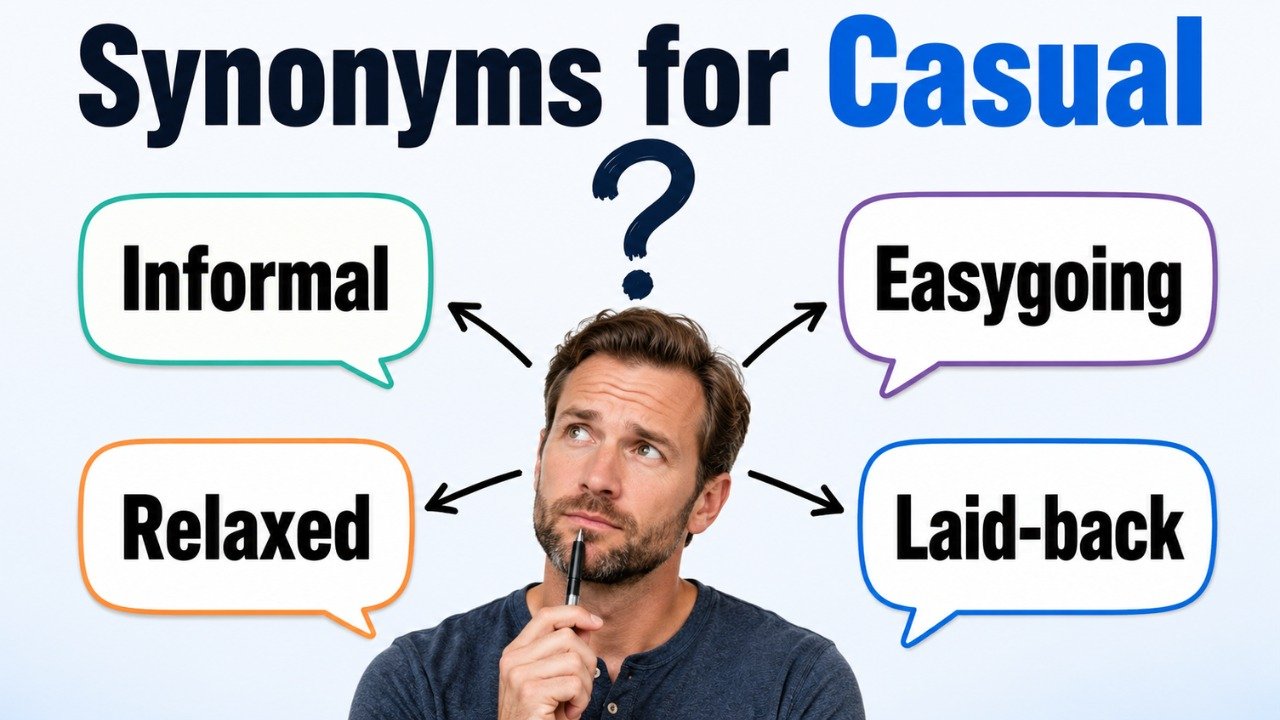
Quick Answer: The best synonyms for casual include informal, relaxed, easygoing, laid back, comfortable, carefree, unceremonious, nonchalant, occasional, and everyday. Among these synonyms for casual, informal works best for communication, clothing, and situations without strict formality. Relaxed and easygoing describe a calm atmosphere or personality, comfortable suits clothing and environments, nonchalant describes an unconcerned attitude, occasional works for something happening irregularly, and everyday describes ordinary styles or activities.
Pronunciation and Word Details
Word: Casual.
Pronunciation: /ˈkæʒuəl/
Part of Speech: Adjective, sometimes noun.
Meaning: Relaxed, informal, occasional, or showing little concern or preparation.
US Pronunciation:
UK Pronunciation:
What Does “Casual” Mean?
Casual means relaxed, informal, occasional, unplanned, or not showing much concern. It is most commonly used as an adjective, although it can also function as a noun in certain employment and clothing contexts.
The meaning changes according to the noun it describes. Casual clothing means clothing that is comfortable and not formal. A casual conversation is friendly and informal. A casual visitor is someone who visits without much planning or regularity. A casual remark is made without much thought or seriousness.
Casual can also describe a person’s manner. Someone with a casual attitude may appear calm and unconcerned. Depending on context, this can sound positive because the person seems relaxed, or negative because the person appears careless.
The word can therefore express informality, comfort, irregularity, lack of planning, or limited seriousness.
Meaning, Tone, and Context of “Casual”
Casual is generally a neutral and conversational word. It appears naturally in everyday speech, descriptive writing, workplace communication, fashion discussions, social situations, and general descriptions.
When casual means informal, its tone is usually positive or neutral. A casual meeting, casual outfit, or casual conversation suggests a comfortable situation without strict rules or ceremony.
When casual describes personality or behavior, the tone depends on context. A casual manner can suggest confidence, calmness, and ease. However, a casual attitude toward an important responsibility can imply carelessness or insufficient attention.
Casual can also mean occasional or irregular. A casual reader, casual visitor, or casual worker may participate only from time to time rather than continuously.
In more precise academic or professional writing, a specific synonym such as informal, occasional, incidental, indifferent, or unplanned may communicate the intended meaning more clearly.
When and How to Use “Casual”
For Informal Situations: Use casual when describing activities, conversations, events, or environments that are relaxed rather than formal.
Example: We had a casual conversation after the meeting.
For Clothing: Use casual for clothes designed for comfort and ordinary activities rather than ceremonies or formal occasions.
Example: The invitation suggested casual clothing for the afternoon event.
For a Relaxed Personality: Casual can describe someone who behaves naturally and without unnecessary formality.
Example: Her casual manner helped everyone feel comfortable.
For Occasional Activities: Casual can describe an activity done irregularly or without deep commitment.
Example: He is a casual reader who finishes a few books each year.
For Unplanned Events: Casual can indicate something that happens without careful preparation.
Example: A casual visit turned into a long evening of conversation.
For Limited Concern: Casual can describe behavior that seems unconcerned or insufficiently serious.
Example: His casual response surprised people who considered the issue important.
For Everyday Style: Casual works well when describing ordinary clothing, language, or habits.
Example: She prefers a casual style during the weekend.
Best Synonyms for Casual
Informal: Relaxed and not governed by formal rules or conventions.
Example: The discussion remained informal and friendly.
Relaxed: Calm, comfortable, and free from tension.
Example: The restaurant had a relaxed atmosphere.
Easygoing: Calm, flexible, and not easily worried or upset.
Example: Her easygoing personality made teamwork enjoyable.
Laid Back: Calm and not concerned with strict rules or pressure.
Example: He has a laid back approach to weekend plans.
Comfortable: Providing physical or emotional ease.
Example: She chose comfortable clothes for the journey.
Carefree: Free from worry, responsibility, or serious concern.
Example: They enjoyed a carefree afternoon by the lake.
Unceremonious: Simple and informal without ceremony or elaborate procedure.
Example: The gathering was friendly and unceremonious.
Nonchalant: Appearing calmly unconcerned or uninterested.
Example: He gave a nonchalant reply despite the surprising news.
Occasional: Happening from time to time rather than regularly.
Example: She remains an occasional contributor to the local magazine.
Everyday: Ordinary and suitable for regular daily use.
Example: These shoes are practical for everyday wear.
50 Synonyms for Casual with Short Meanings
- Informal: Relaxed and without strict formality.
- Relaxed: Calm and free from tension.
- Easygoing: Calm, flexible, and pleasant.
- Laid Back: Unhurried and not easily worried.
- Comfortable: Providing ease or physical comfort.
- Carefree: Free from worry or serious concern.
- Unceremonious: Simple and without formal ceremony.
- Nonchalant: Calmly unconcerned or seemingly indifferent.
- Everyday: Ordinary and suitable for regular use.
- Conversational: Natural and similar to ordinary speech.
- Familiar: Friendly, natural, and lacking formality.
- Friendly: Warm, approachable, and easy in manner.
- Natural: Relaxed and not forced or artificial.
- Unpretentious: Simple and not intended to impress.
- Simple: Without unnecessary formality or complexity.
- Leisurely: Relaxed and without hurry.
- Loose: Not strictly controlled or structured.
- Flexible: Able to change without strict restrictions.
- Ordinary: Normal rather than special or formal.
- Routine: Common and regularly encountered.
- Occasional: Happening from time to time.
- Irregular: Not occurring according to a fixed pattern.
- Periodic: Occurring at separate times.
- Intermittent: Happening with pauses between occurrences.
- Infrequent: Not happening very often.
- Temporary: Lasting for a limited period.
- Part Time: Involving fewer hours than a regular full schedule.
- Incidental: Occurring as a minor or secondary matter.
- Chance: Happening without deliberate arrangement.
- Accidental: Happening unintentionally.
- Unplanned: Not arranged beforehand.
- Spontaneous: Happening naturally without advance preparation.
- Random: Occurring without a planned pattern.
- Unexpected: Not anticipated beforehand.
- Passing: Brief and not deeply considered.
- Offhand: Made without preparation or serious thought.
- Cursory: Quick and lacking detailed attention.
- Superficial: Concerned mainly with the surface rather than depth.
- Brief: Lasting only a short time.
- Indifferent: Showing little interest or concern.
- Unconcerned: Not worried or troubled.
- Careless: Not giving enough attention or caution.
- Unworried: Free from concern or anxiety.
- Detached: Emotionally uninvolved or distant.
- Unruffled: Calm despite possible difficulty.
- Cool: Calm and controlled in manner.
- Low Key: Quiet, relaxed, and not attention seeking.
- Modest: Simple and not elaborate.
- Unstructured: Not organized according to a strict system.
- Easy: Relaxed, comfortable, and not demanding.
Read Also:
Synonyms for Soul
Synonyms for Casual by Context
When Casual Means Informal
When casual refers to communication, clothing, meetings, or social situations without strict formality, informal is usually the strongest replacement.
Useful alternatives include informal, relaxed, conversational, familiar, unceremonious, friendly, and easygoing.
Example: The manager encouraged an informal discussion before the presentation.
Example: They chose a relaxed setting for the family gathering.
Example: Her conversational writing style made the explanation easy to follow.
When Casual Means Relaxed
Casual can describe a calm personality, atmosphere, style, or approach. Relaxed, easygoing, laid back, comfortable, and low key work particularly well in this context.
Example: The office had a relaxed atmosphere on Friday afternoon.
Example: His easygoing personality makes him pleasant to work with.
Example: They planned a low key celebration with close friends.
When Casual Means Occasional
Casual sometimes describes something done only from time to time rather than regularly or professionally.
Useful synonyms include occasional, irregular, intermittent, infrequent, and part time.
Example: She is an occasional photographer who mainly takes pictures while traveling.
Example: His irregular visits became less frequent after he moved.
When Casual Means Unplanned
A casual encounter, visit, or observation may happen without advance planning.
Useful alternatives include chance, accidental, unplanned, spontaneous, random, and unexpected.
Example: A chance meeting at the library led to a long conversation.
Example: Their spontaneous visit became the highlight of the weekend.
When Casual Means Unconcerned
Casual can describe someone who seems unconcerned about something that others consider important.
Useful alternatives include nonchalant, indifferent, unconcerned, detached, offhand, and careless.
Example: His nonchalant reaction surprised everyone in the room.
Example: Her offhand remark sounded less thoughtful than she intended.
When Casual Means Ordinary
Casual can refer to clothing, products, habits, or activities intended for ordinary use.
Useful synonyms include everyday, ordinary, simple, comfortable, modest, and routine.
Example: She wanted comfortable shoes for everyday wear.
Example: The room had a simple style suitable for ordinary family life.
Another Word for Casual
The best single replacement for casual is often informal because it accurately describes communication, clothing, events, and situations that do not follow formal conventions. However, the strongest choice always depends on what casual means in the sentence.
Original: We had a casual discussion about the project.
Better Option: We had an informal discussion about the project.
Original: He has a casual personality.
Better Option: He has an easygoing personality.
Original: She made a casual visit to the office.
Better Option: She made an unplanned visit to the office.
Original: He gave the problem a casual glance.
Better Option: He gave the problem a cursory glance.
When Not to Use “Casual”
Casual is useful because it has several meanings, but that flexibility can also make it less precise. Avoid it when readers need to know exactly whether you mean informal, occasional, careless, relaxed, or unplanned.
In professional reports, formal essays, and detailed explanations, a more exact synonym often improves clarity.
Weak: The researcher made a casual observation of the results.
Better: The researcher made a cursory observation of the results.
The second sentence clearly indicates that the observation lacked detail.
Weak: She is a casual employee at the organization.
Better: She is a temporary employee at the organization.
Temporary may be clearer when the intended meaning relates to duration rather than working style.
Weak: He had a casual attitude toward the safety rules.
Better: He had a careless attitude toward the safety rules.
Careless communicates the negative meaning more directly.
Weak: We arranged a casual meeting by accident.
Better: We had a chance meeting.
Chance is more concise when the meeting was completely unplanned.
Weak: The report uses casual language throughout.
Better: The report uses informal language throughout.
Informal is more precise when discussing writing style or level of formality.
Words Commonly Confused With Casual
Casual vs Informal: Casual can mean informal, relaxed, occasional, or unconcerned. Informal mainly means not formal or official.
Casual vs Carefree: Casual can describe relaxed style or behavior, while carefree specifically means free from worry or responsibility.
Casual vs Careless: Casual is not automatically negative. Careless clearly suggests insufficient attention, caution, or responsibility.
Casual vs Occasional: Casual may mean occasional in activities or participation, but occasional specifically refers to something happening from time to time.
Casual vs Nonchalant: Casual can simply mean relaxed, while nonchalant suggests a person appears unconcerned even when concern might be expected.
Casual vs Relaxed: Relaxed emphasizes calmness and lack of tension. Casual can additionally describe informal clothing, irregular activity, or unplanned events.
Casual vs Cursory: Cursory means quick and lacking detail. Casual has a broader range of meanings and does not always imply insufficient attention.
Which Synonym Should You Choose?
Choose informal when describing language, meetings, clothing, conversations, or situations that do not follow formal conventions.
Choose relaxed when describing a calm atmosphere, style, attitude, or environment.
Choose easygoing when describing a person who is calm, flexible, friendly, and not easily upset.
Choose comfortable when discussing clothes, surroundings, seating, or situations that provide physical or emotional ease.
Choose everyday when referring to ordinary clothing, objects, habits, or activities used regularly.
Choose occasional when describing something that happens from time to time.
Choose spontaneous when an action occurs naturally without advance planning.
Choose chance when an encounter or event happens unexpectedly.
Choose nonchalant when someone appears surprisingly unconcerned.
Choose careless when the lack of seriousness has a clearly negative meaning.
Choose cursory when an examination, glance, or review is quick and lacks detail.
Choose conversational when discussing an informal and natural style of writing or speech.
Choose unceremonious when an event or action occurs without formal ceremony.
In reports and essays, choose the most precise synonym rather than relying on casual when the intended meaning could be misunderstood.
In emails and ordinary conversation, informal, relaxed, friendly, and easygoing often sound natural.
Real Life Examples of “Casual” in Sentences
Original: She wore casual clothes to the family gathering.
Better Option: She wore comfortable clothes to the family gathering.
Original: We had a casual conversation before dinner.
Better Option: We had an informal conversation before dinner.
Original: He gave the document a casual glance.
Better Option: He gave the document a cursory glance.
Original: Her casual attitude helped everyone relax.
Better Option: Her easygoing attitude helped everyone relax.
Original: He is only a casual visitor to the museum.
Better Option: He is only an occasional visitor to the museum.
Original: Their casual meeting happened outside the station.
Better Option: Their chance meeting happened outside the station.
Original: She gave a casual response to the criticism.
Better Option: She gave a nonchalant response to the criticism.
Original: They planned a casual dinner at home.
Better Option: They planned a relaxed dinner at home.
Original: His casual approach to the safety issue worried his coworkers.
Better Option: His careless approach to the safety issue worried his coworkers.
Original: The article uses a casual writing style.
Better Option: The article uses a conversational writing style.
Synonym Groups and Usage Differences
Informality Group
Informal, conversational, familiar, friendly, and unceremonious belong to the informality group. These words describe situations without strict rules, ceremony, or formal language.
Informal is the broadest choice. Conversational works especially well for speaking and writing styles. Unceremonious emphasizes the absence of ceremony.
Example: The speaker used a conversational tone to make the topic easier to understand.
Relaxation Group
Relaxed, easygoing, laid back, comfortable, low key, and leisurely describe calmness and freedom from pressure.
Relaxed works for people and environments. Easygoing is especially useful for personality. Leisurely often refers to activities performed without hurry.
Example: They enjoyed a leisurely breakfast before leaving the hotel.
Occasional Group
Occasional, irregular, intermittent, infrequent, periodic, and part time describe activities that are not continuous or constant.
Occasional is the most neutral choice for something happening sometimes. Intermittent suggests repeated pauses. Infrequent emphasizes rarity.
Example: She makes occasional visits to the countryside during the warmer months.
Unplanned Group
Chance, accidental, spontaneous, random, unexpected, and unplanned describe events that were not carefully arranged beforehand.
Chance often describes meetings or discoveries. Spontaneous usually has a more positive sense of acting naturally without preparation.
Example: A spontaneous decision led them to spend the afternoon exploring the town.
Unconcerned Group
Nonchalant, indifferent, unconcerned, detached, offhand, and careless describe different levels of limited concern or attention.
Nonchalant suggests visible calmness. Indifferent suggests lack of interest. Careless has the strongest negative meaning because it implies insufficient attention.
Example: His indifferent response suggested that the result did not matter to him.
Ordinary Style Group
Everyday, ordinary, simple, modest, comfortable, and unpretentious describe things that are practical rather than formal or elaborate.
Everyday works especially well for clothes and common objects. Unpretentious suggests simplicity without trying to impress others.
Example: The restaurant had an unpretentious atmosphere that made visitors feel welcome.
Antonyms of Casual
The opposite of casual changes according to the intended meaning. If casual means informal, formal is the clearest antonym. If it means relaxed, tense or serious may be appropriate. If it means careless, attentive or careful works better.
Formal: Following established conventions, rules, or ceremony.
Ceremonial: Connected with formal ceremony or tradition.
Official: Authorized or connected with a formal position or process.
Professional: Appropriate for a serious workplace or specialized activity.
Serious: Showing careful thought, concern, or importance.
Careful: Giving proper attention to details and possible risks.
Attentive: Watching or considering something closely.
Concerned: Showing interest, worry, or awareness.
Regular: Happening consistently according to a pattern.
Permanent: Intended to continue for a long or unlimited period.
Planned: Arranged or decided in advance.
Deliberate: Done intentionally and with careful thought.
Structured: Organized according to a clear system.
Elaborate: Detailed, carefully prepared, or highly developed.
Intense: Showing strong effort, emotion, or concentration.
Comparison: Casual vs Related Words
Casual vs Informal
Casual has several meanings, including relaxed, occasional, and unplanned. Informal specifically describes something that does not follow formal rules or conventions.
Example With Casual: We planned a casual dinner at home.
Example With Informal: The meeting was informal, so no official presentation was required.
Casual vs Relaxed
Casual can describe style, frequency, attitude, or level of formality. Relaxed focuses mainly on calmness and freedom from tension.
Example With Casual: She chose a casual outfit for the gathering.
Example With Relaxed: She felt relaxed after finishing her work.
Casual vs Easygoing
Casual can describe many things, while easygoing most commonly describes personality or behavior.
Example With Casual: His casual manner suited the friendly event.
Example With Easygoing: His easygoing personality makes him easy to work with.
Casual vs Nonchalant
Casual can have a positive or neutral meaning. Nonchalant usually emphasizes appearing unconcerned about something.
Example With Casual: She gave the room a casual glance before entering.
Example With Nonchalant: She remained nonchalant even after hearing the unexpected announcement.
Casual vs Careless
Casual does not necessarily imply a mistake or failure. Careless clearly suggests insufficient attention or responsibility.
Example With Casual: He wore casual clothes during the weekend.
Example With Careless: His careless handling of the documents caused several pages to disappear.
Casual vs Occasional
Casual can mean occasional when describing participation or interest, but its meaning is much broader.
Example With Casual: He is a casual tennis player.
Example With Occasional: He makes occasional visits to the tennis club.
Casual vs Spontaneous
Casual may describe something unplanned, while spontaneous emphasizes an action that happens naturally and immediately without preparation.
Example With Casual: They stopped for a casual visit on their way home.
Example With Spontaneous: They made a spontaneous decision to stay for dinner.
Casual vs Everyday
Casual may describe relaxed clothing, while everyday means suitable for ordinary and regular use.
Example With Casual: She prefers casual dresses for weekend events.
Example With Everyday: These shoes are durable enough for everyday use.
Common Phrases and Expressions With “Casual”
Casual Conversation: An informal and relaxed exchange of ideas.
Casual Clothing: Comfortable clothes that are not formal.
Casual Dress: A relaxed style of clothing suitable for informal situations.
Casual Remark: A comment made without much preparation or serious thought.
Casual Glance: A quick look without detailed examination.
Casual Acquaintance: Someone known slightly rather than closely.
Casual Visit: A relaxed, occasional, or unplanned visit.
Casual Relationship: A relationship with limited formality or commitment.
Casual Attitude: A relaxed or sometimes insufficiently serious approach.
Casual Observer: Someone who notices or watches something without detailed involvement.
Common Mistakes to Avoid
One common mistake is assuming that casual always means informal. Informal is only one meaning. Casual can also mean occasional, relaxed, unplanned, ordinary, or unconcerned.
Another mistake is replacing casual with careless in every sentence. Careless has a negative meaning and implies insufficient attention. A casual outfit is simply informal, not careless.
Avoid repeating casual when a paragraph discusses several different ideas. More specific synonyms improve clarity.
Repetitive: The casual event had a casual atmosphere, and everyone wore casual clothes.
Improved: The informal event had a relaxed atmosphere, and everyone wore comfortable clothes.
Do not use nonchalant when you simply mean relaxed. Nonchalant suggests that someone appears unconcerned, which can create a different emotional meaning.
Avoid using occasional when the intended meaning is informal.
Incorrect Choice: She wore occasional clothing to dinner.
Better Choice: She wore informal clothing to dinner.
Be careful with casual and cursory. A cursory review is quick and lacking detail. A casual review could mean informal or not especially serious, which is less precise.
In formal writing, choose specific words such as informal, occasional, incidental, unplanned, or careless when the exact distinction matters.
Conclusion
The best synonyms for casual depend on whether the word describes informality, relaxation, frequency, planning, clothing, or attitude. Informal works well for language and social situations, relaxed and easygoing suit calm environments and personalities, occasional describes irregular activity, spontaneous and chance fit unplanned events, while nonchalant and careless describe limited concern. Understanding these differences helps you choose more precise synonyms for casual and create clearer, more natural sentences in conversation, professional writing, essays, and everyday communication.
FAQs About Synonyms for Casual
What is the best synonym for casual?
Informal is often the best general synonym for casual when describing clothing, conversation, events, or situations without strict formality. The best choice still depends on context.
What is another word for casual clothing?
Comfortable, informal, everyday, relaxed, and simple can describe casual clothing. Everyday works well for clothes intended for regular use.
What is another word for a casual personality?
Easygoing, relaxed, laid back, friendly, and carefree can describe a casual personality. Easygoing is especially natural for someone who is calm and flexible.
What is a formal synonym for casual?
Informal is the most precise choice when casual refers to a lack of formality. In more specific contexts, occasional, incidental, unplanned, or cursory may be more appropriate.
Can casual mean careless?
Yes, casual can sometimes suggest insufficient concern or attention. However, careless is stronger and more clearly negative.
What is a synonym for casual conversation?
Informal conversation, friendly conversation, relaxed conversation, and conversational exchange are useful alternatives depending on the sentence.
What is the opposite of casual?
Formal is the most common opposite when casual means informal. Other antonyms include serious, careful, regular, planned, structured, professional, and ceremonial depending on context.
