
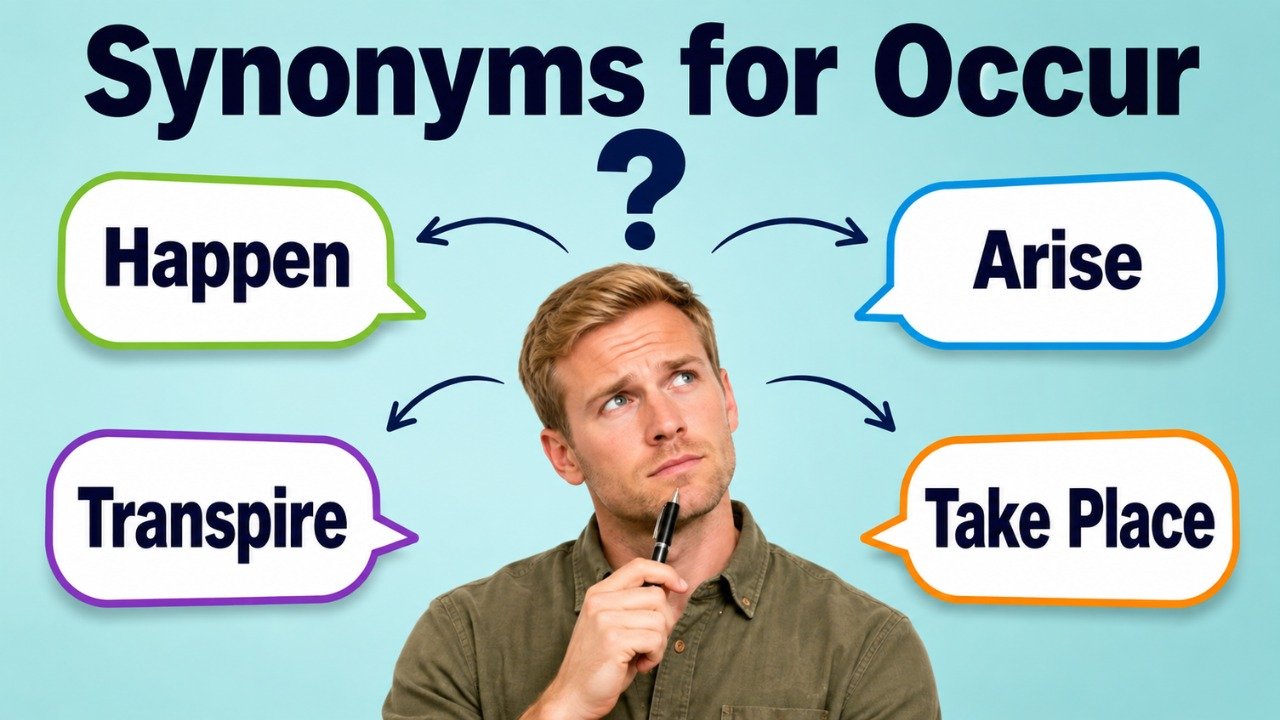
Quick Answer: The best synonyms for occur include happen, take place, arise, transpire, emerge, develop, appear, unfold, recur, and come about. Use happen in casual speech, take place for planned events, arise for problems or situations, transpire in formal accounts, emerge when something gradually becomes visible, and recur when an event happens repeatedly. When occur means to exist somewhere, use be found or be present. When an idea occurs to someone, come to mind or dawn on is usually the clearest alternative.
Pronunciation and Word Details
Word: Occur.
Pronunciation: /əˈkɜːr/
Part of Speech: Verb.
Meaning: To happen, exist, appear, or come into someone’s mind.
US Pronunciation:
UK Pronunciation:
What Does “Occur” Mean?
Occur means to happen, take place, exist, appear, or enter someone’s mind.
Occur is an intransitive verb, which means it normally does not take a direct object. The event, condition, problem, or thought that happens becomes the subject of the sentence.
Example: The accident occurred early in the morning.
In this sentence, occur means happen.
The word can also describe something that exists or is found in a particular place.
Example: This mineral occurs naturally in several regions.
Occur may refer to a problem, idea, possibility, or situation beginning to exist.
Example: Technical difficulties may occur during installation.
Another common use appears in the expression occur to someone. This structure means that an idea, thought, or realization enters a person’s mind.
Example: It occurred to her that the door might be unlocked.
Occur can describe planned events, unexpected incidents, natural processes, recurring conditions, discoveries, changes, thoughts, and existing features. The intended meaning depends on the subject and sentence context.
Meaning, Tone, and Context of “Occur”
Occur has a neutral to formal tone. It is common in professional writing, academic essays, scientific explanations, reports, policies, instructions, news reports, and technical documents.
In casual conversation, happen often sounds more natural.
Formal Context: The incident occurred near the entrance.
Casual Context: The incident happened near the entrance.
Occur is especially useful when the writer wants to sound objective. It focuses attention on the event rather than the person responsible for it.
Example: Several errors occurred during data processing.
In scientific writing, occur can describe natural existence, repeated processes, reactions, conditions, or observable patterns.
Example: The reaction occurs only under specific conditions.
In medical and safety contexts, it may describe symptoms, side effects, risks, or incidents.
Example: Mild discomfort may occur after the procedure.
In historical or factual writing, occur often introduces the time and place of an event.
Example: The meeting occurred during a period of political change.
When used with thoughts, realizations, or ideas, occur has a reflective or intellectual tone.
Example: It suddenly occurred to him that he had misunderstood the question.
Occur is usually neutral rather than emotional. More expressive verbs such as erupt, emerge, strike, or unfold may create a stronger or more specific effect.
When and How to Use “Occur”
For Events
Use occur when describing an event that happens at a particular time or place.
Example: The ceremony will occur in the main hall.
Take place may sound more natural when the event is planned.
Example: The ceremony will take place in the main hall.
For Unexpected Incidents
Occur works well for accidents, errors, failures, delays, and unexpected problems.
Example: A power failure occurred during the storm.
For Natural Processes
Use occur when discussing events or conditions that happen in nature.
Example: Flooding occurs when the river rises above its banks.
For Scientific Observations
Occur can describe reactions, patterns, behaviors, or measurable changes.
Example: The chemical reaction occurs at high temperatures.
For Existing Features
Use occur when something exists or is naturally found in a place, substance, population, or environment.
Example: The species occurs mainly in coastal forests.
For Problems That Arise
Occur can describe difficulties or issues that begin during an activity.
Example: Connection problems may occur during periods of heavy demand.
For Repeated Events
Use occur with frequency words to describe recurring actions or conditions.
Example: These changes occur every few months.
For Simultaneous Events
Occur can describe two or more events happening at the same time.
Example: The two processes occur simultaneously.
For Thoughts and Realizations
Use occur to someone when an idea or realization enters the mind.
Example: It occurred to me that we had met before.
For Formal Reports
Occur is useful in objective reports because it sounds neutral and precise.
Example: The damage occurred before the inspection began.
For Cause and Result
Occur can describe an event that happens because of a condition or action.
Example: Errors can occur when instructions are unclear.
For Possibilities and Risks
Use may occur, can occur, or could occur when describing possible events.
Example: Delays may occur during severe weather.
Best Synonyms for Occur
Happen: To take place or become real.
Example: The problem happened shortly after the update.
Take Place: To happen, especially at an arranged time or location.
Example: The conference will take place in the city center.
Arise: To begin, appear, or become a problem.
Example: Additional questions may arise during the discussion.
Transpire: To happen or become known, especially in formal accounts.
Example: The investigation revealed what had transpired that evening.
Come About: To happen or develop, often through a series of causes.
Example: The change came about after months of discussion.
Emerge: To appear, become visible, or become known gradually.
Example: Several concerns emerged during the review.
Develop: To begin and grow over time.
Example: A serious fault developed in the system.
Unfold: To happen gradually through a series of events.
Example: The situation unfolded over several hours.
Recur: To happen again, especially repeatedly.
Example: The same error may recur if the setting is not corrected.
Appear: To become visible, noticeable, or present.
Example: Small cracks began to appear in the wall.
50 Synonyms for Occur with Short Meanings
- Happen: To take place or become real.
- Take Place: To happen at a particular time or location.
- Arise: To begin or become present.
- Transpire: To happen, especially in a formal account.
- Come About: To happen through certain causes or developments.
- Come to Pass: To happen or become reality.
- Unfold: To develop through a sequence of events.
- Develop: To begin and grow gradually.
- Emerge: To appear or become known.
- Appear: To become visible or noticeable.
- Surface: To become known or noticeable after being hidden.
- Materialize: To appear or become real.
- Ensue: To happen as a result of an earlier event.
- Follow: To happen after another event.
- Result: To happen as the consequence of something.
- Befall: To happen to someone, usually unpleasantly.
- Eventuate: To occur as a final result.
- Crop Up: To appear unexpectedly.
- Turn Up: To appear or be discovered unexpectedly.
- Come Up: To arise or become a subject or problem.
- Present Itself: To appear as a possibility, problem, or opportunity.
- Manifest: To become visible or clearly noticeable.
- Break Out: To begin suddenly, especially a conflict, fire, or illness.
- Erupt: To begin suddenly and forcefully.
- Begin: To start happening.
- Start: To commence or come into existence.
- Commence: To begin in a formal sense.
- Originate: To begin from a particular source.
- Recur: To happen again repeatedly.
- Repeat: To happen or be done again.
- Return: To appear or happen again.
- Happen Again: To occur for another time.
- Exist: To be real or present.
- Be Present: To exist in a place or situation.
- Be Found: To exist naturally or be discovered somewhere.
- Be Seen: To be observable or noticeable.
- Be Observed: To be noticed during examination.
- Be Detected: To be discovered through testing or inspection.
- Be Recorded: To appear in an official or written record.
- Be Reported: To be described or documented as happening.
- Be Encountered: To be experienced or discovered unexpectedly.
- Be Experienced: To happen to a person or group.
- Strike: To enter the mind suddenly.
- Dawn On: To become understood gradually or suddenly.
- Cross One’s Mind: To be briefly thought about.
- Enter One’s Mind: To become a thought or idea.
- Come to Mind: To be remembered or considered.
- Suggest Itself: To appear as an idea or possible solution.
- Become Apparent: To become clear or noticeable.
- Reveal Itself: To become visible, known, or understandable.
Read Also:
Synonyms for Hobby

Synonyms for Occur by Context
When Occur Means Happen
Happen, take place, transpire, come about, and come to pass are useful when occur refers to an event becoming real.
Happen is the most common alternative in everyday conversation.
Example With Occur: The error occurred during the final test.
Example With Happen: The error happened during the final test.
Take place is often used for planned or organized events.
Example: The meeting will take place on Monday morning.
Transpire sounds formal and is often used when describing a sequence of past events.
Example: Investigators examined what had transpired before the accident.
Come to pass has a literary or reflective tone.
Example: The predicted change eventually came to pass.
When Occur Means Arise
Arise, emerge, crop up, come up, surface, and present itself work well for problems, questions, opportunities, or unexpected situations.
Arise is common in formal and professional writing.
Example: Difficulties may arise during the transition.
Crop up is more conversational and emphasizes an unexpected problem.
Example: A few minor issues cropped up during installation.
Surface suggests that something existed earlier but has only recently become known.
Example: New concerns surfaced after the report was published.
Present itself is useful for opportunities, problems, and possibilities.
Example: A better solution may present itself later.
When Occur Means Exist
Exist, be present, be found, and be encountered are suitable when something naturally exists in a place, environment, substance, or population.
Example With Occur: This plant occurs in wetland areas.
Example With Be Found: This plant is found in wetland areas.
Be present often appears in technical, medical, and scientific descriptions.
Example: Small amounts of the substance may be present in the water.
Be encountered is appropriate when people discover or experience something during an activity.
Example: Similar conditions are encountered in mountain regions.
When Occur Means Appear
Appear, emerge, materialize, manifest, become apparent, and reveal itself describe something becoming visible, noticeable, or known.
Appear is the simplest general choice.
Example: Small marks appeared on the surface.
Emerge suggests gradual development or discovery.
Example: A clear pattern emerged from the results.
Manifest is more formal and often refers to symptoms, qualities, problems, or emotions becoming visible.
Example: The condition may manifest through several symptoms.
Become apparent emphasizes growing clarity.
Example: The full extent of the damage became apparent later.
When Occur Means Develop
Develop, unfold, originate, begin, commence, and start describe the beginning or progress of an event.
Develop is useful for problems, conditions, situations, and processes that grow over time.
Example: A disagreement developed between the two groups.
Unfold emphasizes a sequence of connected events.
Example: The situation unfolded rapidly after the announcement.
Originate identifies the beginning or source.
Example: The problem originated in the main control unit.
Commence is formal and often used for scheduled procedures or activities.
Example: Construction will commence after approval is received.
When Occur Means Happen Suddenly
Break out, erupt, strike, flare up, and materialize can describe sudden events.
Break out is common for fires, wars, arguments, illnesses, and violence.
Example: A fire broke out in an empty building.
Erupt suggests a sudden and forceful beginning.
Example: An argument erupted during the meeting.
Strike may describe disasters, illnesses, thoughts, or sudden realizations.
Example: A severe storm struck the region overnight.
When Occur Means Happen Again
Recur, repeat, return, and happen again are suitable for events, symptoms, errors, and patterns that occur more than once.
Recur is the strongest formal alternative.
Example: The symptoms may recur after treatment ends.
Repeat is broad and clear.
Example: The same mistake was repeated during the second test.
Return often describes a problem or condition that had disappeared for a period.
Example: The pain returned later that evening.
When Occur Means Follow as a Result
Ensue, result, follow, eventuate, and arise from describe events connected by cause and consequence.
Ensue means to happen immediately or naturally after something else.
Example: Confusion ensued after the instructions were changed.
Result emphasizes a direct consequence.
Example: Serious damage resulted from the leak.
Follow shows sequence but does not always prove cause.
Example: Several weeks of discussion followed the announcement.
Eventuate is formal and refers to the final result of a process.
Example: The negotiations eventuated in a formal agreement.
When Occur Means Come to Mind
Come to mind, dawn on, strike, cross one’s mind, enter one’s mind, and suggest itself are useful when occur refers to thoughts or realizations.
Come to mind is the most natural general alternative.
Example With Occur: It occurred to me that the date might be wrong.
Example With Come to Mind: It came to mind that the date might be wrong.
Dawn on emphasizes gradual or sudden realization.
Example: It dawned on her that she had left the document at home.
Strike suggests a sudden and powerful thought.
Example: It suddenly struck him that the answer was much simpler.
Cross one’s mind describes a brief thought.
Example: The possibility crossed my mind, but I dismissed it.
Another Word for Occur
The best single replacement for occur is usually happen. It is clear, natural, and suitable for most events or incidents.
However, the best alternative depends on the sentence. Take place works for planned events, arise suits problems, exist fits natural presence, recur describes repeated events, and come to mind works for thoughts.
Original: The problem may occur during installation.
Better Option: The problem may arise during installation.
Original: The ceremony will occur in the main hall.
Better Option: The ceremony will take place in the main hall.
Original: This species occurs throughout the region.
Better Option: This species is found throughout the region.
Original: It occurred to me that we needed another copy.
Better Option: It came to mind that we needed another copy.
When Not to Use “Occur”
Occur is correct in many contexts, but it can sound overly formal, vague, repetitive, or less precise than another verb.
In Casual Conversation
Happen usually sounds more natural when discussing ordinary events.
Weak: What occurred at the meeting?
Better: What happened at the meeting?
For Planned Events
Take place may be more natural for meetings, ceremonies, conferences, lessons, and performances.
Weak: The concert will occur on Friday evening.
Better: The concert will take place on Friday evening.
For Problems Beginning
Arise, develop, or emerge may explain the situation more precisely.
Weak: Several concerns occurred during the review.
Better: Several concerns emerged during the review.
For Natural Existence
Use exist, be found, or be present when referring to something located in a place or substance.
Weak: The mineral occurs in this mountain range.
Better: The mineral is found in this mountain range.
The original sentence is correct in scientific writing, but the replacement may be clearer for general readers.
For Repeated Events
Recur is more specific when the same condition, symptom, or problem returns.
Weak: The error may occur again.
Better: The error may recur.
For Gradual Situations
Develop or unfold may better show that something changes over time.
Weak: A serious disagreement occurred over several months.
Better: A serious disagreement developed over several months.
For Sudden Beginnings
Break out or erupt may create a clearer image.
Weak: A fire occurred in the storage area.
Better: A fire broke out in the storage area.
For Thoughts and Realizations
Do not use happen as a direct replacement in the expression occur to someone.
Weak: It happened to me that the answer was incorrect.
Better: It occurred to me that the answer was incorrect.
Better: I realized that the answer was incorrect.
When the Cause Matters
Occur does not explain why something happened. Use result from, arise from, or stem from when showing cause.
Weak: The damage occurred from excessive pressure.
Better: The damage resulted from excessive pressure.
When the Sentence Is Vague
Occur can hide the exact nature of an event.
Weak: A situation occurred during the test.
Better: A communication failure interrupted the test.
When the Word Is Repeated
Replace repeated uses with more specific verbs.
Weak: The error occurred first, then a delay occurred, and another failure occurred.
Better: The error appeared first, a delay followed, and another failure developed.
Words Commonly Confused With Occur
Occur vs Happen: Both describe events becoming real. Happen is more common in casual speech, while occur sounds more formal and objective.
Occur vs Take Place: Occur can describe planned or unexpected events. Take place is especially natural for scheduled or organized events.
Occur vs Arise: Occur means happen generally. Arise usually describes a problem, question, need, opportunity, or situation beginning to exist.
Occur vs Exist: Occur can mean to be found naturally in a place. Exist means to be real or present more generally.
Occur vs Appear: Occur emphasizes happening or existing. Appear emphasizes becoming visible or noticeable.
Occur vs Emerge: Occur means happen. Emerge suggests that something gradually becomes visible, known, or important.
Occur vs Develop: Occur can describe a single event. Develop suggests growth or change over time.
Occur vs Recur: Occur means happen once or more. Recur specifically means to happen again, often repeatedly.
Occur vs Transpire: Occur is neutral and formal. Transpire often refers to what happened during a past event or what later became known.
Occur vs Ensue: Occur does not necessarily show sequence. Ensue means to happen after and often because of another event.
Occur vs Result: Occur simply means happen. Result emphasizes that an event happened because of a particular cause.
Occur vs Befall: Occur describes an event generally. Befall means that something, usually unpleasant, happens to a particular person or group.
Occur vs Come About: Occur states that something happened. Come about often invites attention to the causes or process behind the event.
Occur vs Come to Mind: Occur to someone and come to mind both describe a thought appearing. Come to mind is usually more conversational.
Which Synonym Should You Choose?
Choose happen for casual speech, everyday writing, and general events.
Choose take place for planned meetings, ceremonies, conferences, lessons, performances, and public events.
Choose occur for formal reports, academic essays, policies, scientific writing, and objective descriptions.
Choose arise when discussing questions, problems, needs, disputes, concerns, or opportunities.
Choose emerge when something gradually becomes known, visible, important, or noticeable.
Choose surface when hidden information, concerns, or problems become known.
Choose develop when a condition, disagreement, problem, or situation grows over time.
Choose unfold when describing a sequence of connected events.
Choose transpire in formal accounts of past events, especially when the full facts become known later.
Choose come about when explaining how a change, result, or situation happened.
Choose appear when something becomes visible or noticeable.
Choose materialize when an expected event, person, result, or opportunity finally appears.
Choose manifest when symptoms, qualities, feelings, or problems become visible.
Choose recur when a symptom, error, event, or pattern happens repeatedly.
Choose return when something reappears after being absent.
Choose break out for fires, wars, arguments, illnesses, and violence that begin suddenly.
Choose erupt when the beginning is sudden, emotional, or forceful.
Choose ensue when one event follows another as a result.
Choose result when the sentence needs to emphasize a consequence.
Choose exist when discussing whether something is real or present.
Choose be found for species, minerals, substances, features, or conditions in a location.
Choose be observed in scientific reports and research findings.
Choose be detected when testing or examination reveals something.
Choose come to mind in ordinary conversation when describing a thought.
Choose dawn on when someone gradually or suddenly understands something.
Choose strike when a realization enters the mind with sudden force.
Choose cross one’s mind for a brief or passing thought.
Real Life Examples of “Occur” in Sentences
Original: The meeting will occur in the main conference room.
Better Option: The meeting will take place in the main conference room.
Original: Several errors occurred during the final test.
Better Option: Several errors arose during the final test.
Original: The problem occurred after the system update.
Better Option: The problem developed after the system update.
Original: This type of tree occurs naturally in coastal areas.
Better Option: This type of tree is found naturally in coastal areas.
Original: A disagreement occurred between the two managers.
Better Option: A disagreement arose between the two managers.
Original: The same symptoms may occur again.
Better Option: The same symptoms may recur.
Original: It occurred to me that the office might be closed.
Better Option: It dawned on me that the office might be closed.
Original: A fire occurred in the storage building.
Better Option: A fire broke out in the storage building.
Original: A clear pattern occurred in the research results.
Better Option: A clear pattern emerged from the research results.
Original: Confusion occurred after the announcement.
Better Option: Confusion ensued after the announcement.
Synonym Groups and Usage Differences
General Event Group
Happen, occur, take place, transpire, and come about all describe events becoming real.
Happen is conversational. Occur is formal and neutral. Take place fits planned events. Transpire suits formal accounts. Come about focuses on development or cause.
Example: The change came about after several months of consultation.
Problem Group
Arise, crop up, come up, surface, and present itself describe problems or concerns becoming active.
Arise is formal. Crop up is casual and unexpected. Surface suggests a hidden issue. Present itself may describe either a problem or an opportunity.
Example: New concerns surfaced during the investigation.
Appearance Group
Appear, emerge, materialize, manifest, and become apparent describe something becoming visible or known.
Appear is broad. Emerge suggests gradual development. Materialize often describes something expected. Manifest is formal and often used for symptoms or qualities.
Example: Several warning signs began to manifest.
Development Group
Develop, unfold, originate, begin, start, and commence focus on the beginning or progress of an event.
Develop implies gradual change. Unfold suggests a sequence. Originate identifies the source. Commence is formal.
Example: The dispute originated in a misunderstanding.
Sudden Event Group
Break out, erupt, strike, and befall describe events that happen suddenly or forcefully.
Break out fits fires, conflicts, and diseases. Erupt suggests intensity. Strike often describes disasters or realizations. Befall usually introduces an unpleasant event affecting someone.
Example: Violence erupted after the disagreement.
Recurrence Group
Recur, repeat, return, and happen again describe repeated events.
Recur is formal and common for symptoms or errors. Repeat is broad. Return suggests an event was absent before coming back.
Example: The technical fault recurred the following week.
Existence Group
Exist, be present, be found, be observed, and be encountered describe something being real or located somewhere.
Exist is broad. Be present is common in technical writing. Be found often describes natural location. Be observed suits research.
Example: The substance is present in small quantities.
Consequence Group
Ensue, follow, result, and eventuate describe events connected to previous actions.
Ensue emphasizes sequence and consequence. Follow mainly shows order. Result clearly identifies an effect. Eventuate refers to a final outcome.
Example: Several delays resulted from the equipment failure.
Thought Group
Come to mind, dawn on, strike, cross one’s mind, enter one’s mind, and suggest itself describe thoughts or realizations.
Come to mind is neutral. Dawn on suggests realization. Strike is sudden. Cross one’s mind is brief. Suggest itself often describes a possible answer.
Example: A simpler solution suggested itself during the discussion.
Antonyms of Occur
Occur has no single opposite that works in every context. The most suitable antonym depends on whether the sentence describes an event, existence, repetition, or appearance.
Not Happen: To remain unrealized.
Fail to Occur: To be expected but not happen.
Be Prevented: To be stopped before happening.
Be Avoided: To be kept from happening.
Be Averted: To be prevented, especially a danger or crisis.
Cease: To stop happening.
End: To reach a conclusion.
Stop: To no longer continue.
Terminate: To end formally or completely.
Disappear: To stop being visible or present.
Vanish: To disappear completely or suddenly.
Be Absent: To not exist in a particular place.
Be Missing: To not be present where expected.
Be Eliminated: To be completely removed.
Be Suppressed: To be prevented from appearing or developing.
Be Resolved: To be settled so that a problem no longer continues.
Remain Unrealized: To never become real.
Be Impossible: To be unable to happen.
Not Recur: To fail to happen again.
Be Discontinued: To be stopped permanently.
Comparison: Occur vs Related Words
Occur vs Happen
Occur and happen share the same basic meaning. Occur sounds more formal, while happen is more conversational.
Example With Occur: The incident occurred shortly after midnight.
Example With Happen: The incident happened shortly after midnight.
Occur vs Take Place
Occur may describe planned or unplanned events. Take place is especially suitable for scheduled events.
Example With Occur: The accident occurred near the bridge.
Example With Take Place: The ceremony will take place near the bridge.
Occur vs Arise
Occur means to happen generally. Arise means that a question, issue, problem, or need begins to exist.
Example With Occur: Several changes occurred during the project.
Example With Arise: Several problems arose during the project.
Occur vs Exist
Occur can mean to be found naturally in a location. Exist means to be real or present in a broader sense.
Example With Occur: The plant occurs in warm climates.
Example With Exist: Similar plants exist in many climates.
Occur vs Emerge
Occur focuses on the event itself. Emerge emphasizes gradual appearance or discovery.
Example With Occur: A change occurred in the final results.
Example With Emerge: A clear pattern emerged from the final results.
Occur vs Develop
Occur may happen at a particular moment. Develop usually describes gradual growth or change.
Example With Occur: A fault occurred during testing.
Example With Develop: A fault developed after several hours of use.
Occur vs Recur
Occur means happen. Recur means happen again or repeatedly.
Example With Occur: The symptom may occur after exercise.
Example With Recur: The symptom may recur several weeks later.
Occur vs Transpire
Occur is neutral and factual. Transpire is more formal and often refers to a sequence of events that becomes known afterward.
Example With Occur: The incident occurred during the evening.
Example With Transpire: Witnesses later explained what had transpired during the evening.
Occur vs Ensue
Occur does not necessarily show cause or sequence. Ensue describes something that follows an earlier event.
Example With Occur: Confusion occurred during the evacuation.
Example With Ensue: Confusion ensued after the alarm sounded.
Occur vs Appear
Occur describes something happening or existing. Appear describes something becoming visible or noticeable.
Example With Occur: Errors may occur in the final calculation.
Example With Appear: Errors may appear in the final report.
Occur vs Come About
Occur states that something happened. Come about often focuses on how or why it developed.
Example With Occur: A major change occurred last year.
Example With Come About: The major change came about after public consultation.
Occur vs Come to Mind
Occur to someone is a formal way to describe a thought appearing. Come to mind sounds more natural in conversation.
Example With Occur: It occurred to her that the information was incomplete.
Example With Come to Mind: The possibility came to mind while she reviewed the report.
Common Phrases and Expressions With “Occur”
Occur Naturally: To exist or happen without artificial intervention.
Example: These minerals occur naturally in the soil.
Occur Frequently: To happen often.
Example: Delays occur frequently during severe weather.
Occur Rarely: To happen only occasionally.
Example: Serious complications occur rarely.
Occur Suddenly: To happen without warning.
Example: Power failures can occur suddenly.
Occur Simultaneously: To happen at the same time.
Example: The two reactions occur simultaneously.
Occur Over Time: To develop gradually during a period.
Example: Changes in the surface occur over time.
Occur as a Result: To happen because of a particular cause.
Example: Damage may occur as a result of excessive pressure.
Occur to Someone: To enter a person’s mind as an idea or realization.
Example: It occurred to me that we had used the wrong address.
Occur Again: To happen for another time.
Example: The same problem could occur again.
Occur During: To happen within a particular activity or period.
Example: The error occurred during installation.
Occur Within: To happen inside a particular time, place, or system.
Example: Most changes occur within the first few hours.
Occur in Nature: To exist as part of the natural world.
Example: Similar patterns occur in nature.
Common Mistakes to Avoid
Using Occur as a Transitive Verb
Occur is usually intransitive and does not take a direct object.
Incorrect: The storm occurred several accidents.
Correct: Several accidents occurred during the storm.
Correct: The storm caused several accidents.
Misspelling Occurred
The correct past tense has two r letters.
Incorrect: The error occured yesterday.
Correct: The error occurred yesterday.
Misspelling Occurring
The present participle also has two r letters.
Incorrect: The changes are occuring rapidly.
Correct: The changes are occurring rapidly.
Confusing Occur With Happen To
Occur to someone usually describes an idea. Happen to someone usually describes an event or experience.
Example With Occur To: It occurred to me that I had forgotten the key.
Example With Happen To: What happened to the missing key?
Using Occur From Incorrectly
Occur from is often unnatural when showing cause. Use result from, arise from, or occur because of.
Weak: The damage occurred from excessive heat.
Better: The damage resulted from excessive heat.
Better: The damage occurred because of excessive heat.
Using Occur for Every Planned Event
Take place often sounds more natural for scheduled activities.
Weak: The graduation will occur in June.
Better: The graduation will take place in June.
Using Take Place for Natural Existence
Take place cannot normally replace occur when the meaning is be found.
Incorrect: This species takes place in tropical forests.
Correct: This species occurs in tropical forests.
Correct: This species is found in tropical forests.
Confusing Occur and Recur
Use recur when an event happens again.
Less Precise: The symptom occurred again.
More Precise: The symptom recurred.
Using Occur Too Often
Repeated use makes writing sound mechanical.
Repetitive: The error occurred first, then a delay occurred, and a system failure occurred.
Improved: The error appeared first, a delay followed, and the system later failed.
Using Occur Without a Clear Subject
The reader should know exactly what happened.
Vague: It occurred during the afternoon.
Clear: The power failure occurred during the afternoon.
Ignoring Subject and Verb Agreement
Use occurs with a singular subject and occur with a plural subject.
Singular: The problem occurs during installation.
Plural: The problems occur during installation.
Using Occur When Appear Is More Precise
Use appear for visible signs or marks.
Weak: Several cracks occurred on the wall.
Better: Several cracks appeared on the wall.
Using Occur When Develop Is More Precise
Use develop when a condition grows gradually.
Weak: A serious infection occurred over several days.
Better: A serious infection developed over several days.
Adding Unnecessary Words
Avoid phrases such as unexpectedly occurred without warning because they repeat the same idea.
Wordy: The failure unexpectedly occurred without warning.
Better: The failure occurred without warning.
Better: The system failed unexpectedly.
Conclusion
The strongest synonyms for occur include happen, take place, arise, transpire, emerge, develop, unfold, recur, and come about. Happen suits casual conversation, while occur works well in formal reports and academic writing. Use take place for planned events, arise for problems, emerge for gradual discoveries, and recur for repeated events. When occur describes natural existence, be found is clearer. When an idea occurs to someone, come to mind or dawn on often sounds more natural.
FAQs About Synonyms for Occur
What Is the Best Synonym for Occur?
Happen is the best general synonym for occur. It is natural, clear, and suitable for most events.
What Is a Formal Synonym for Occur?
Transpire, arise, eventuate, ensue, and take place are useful formal alternatives. The correct choice depends on the event and context.
What Is the Difference Between Occur and Happen?
Both words describe an event becoming real. Occur sounds more formal and objective, while happen is more common in everyday conversation.
What Is Another Word for Occur Naturally?
Exist naturally, be found naturally, be present, and grow naturally are useful alternatives, depending on the subject.
What Is a Synonym for Occur Again?
Recur is the strongest synonym for occur again. Repeat, return, and happen again are also correct.
What Does “It Occurred to Me” Mean?
It means that an idea or realization entered your mind.
Example: It occurred to me that I had forgotten the appointment.
What Is the Opposite of Occur?
Fail to happen, be prevented, cease, disappear, and remain unrealized are possible opposites, depending on the context.
