
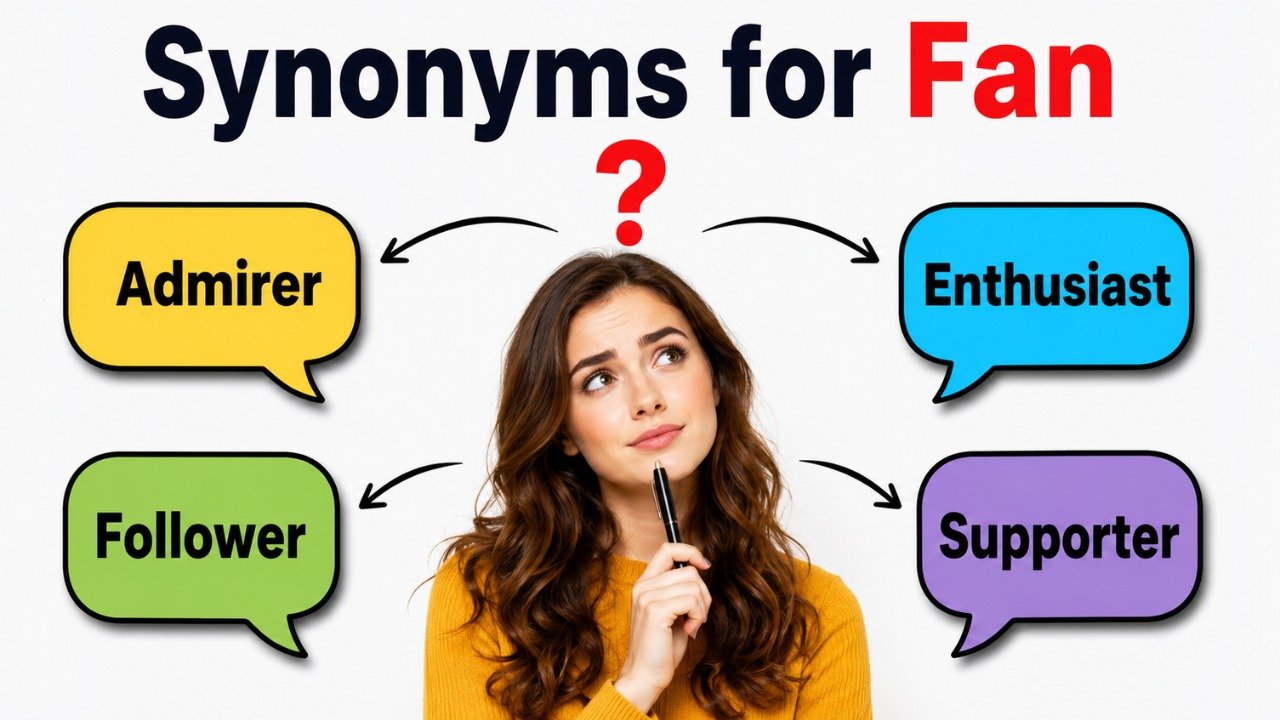
Quick Answer: The best synonyms for fan include admirer, enthusiast, supporter, devotee, aficionado, follower, buff, backer, patron, and spectator. Use supporter for sports, teams, and public causes, enthusiast for a strong general interest, admirer for appreciation of a person or work, devotee for deep commitment, aficionado for knowledgeable passion, and advocate or backer in formal writing. The right choice depends on whether the person admires, follows, supports, watches, or has expert knowledge of something.
Pronunciation and Word Details
Word: Fan.
Pronunciation: /fæn/
Part of Speech: Noun and verb.
Meaning: A fan is a person who strongly admires or supports someone or something, while the word can also describe an air moving device or the action of spreading, cooling, or intensifying something.
US Pronunciation:
UK Pronunciation:
What Does “Fan” Mean?
Fan most commonly means a person who strongly admires, enjoys, follows, or supports someone or something.
As a noun, fan may describe someone interested in a sport, performer, writer, activity, subject, team, style, or form of entertainment.
Example: She is a devoted fan of historical novels.
In this sentence, fan describes someone who enjoys and regularly follows a particular type of literature.
Fan can also mean a device with rotating blades that moves air.
Example: He switched on the fan to cool the room.
As a verb, fan can mean to move air toward something, spread objects into a wide shape, or make a feeling, conflict, or fire stronger.
Example: She fanned herself with a folded piece of paper.
Example: The cards were fanned across the table.
Example: The speech fanned public anger.
The intended meaning usually becomes clear from the surrounding words. When fan refers to a person, its strongest alternatives include admirer, enthusiast, supporter, devotee, and aficionado. When it refers to a device, alternatives include blower, ventilator, and air circulator. As a verb, it may be replaced by spread, cool, stir, intensify, or encourage.
Meaning, Tone, and Context of “Fan”
Fan usually has a positive, friendly, and conversational tone when it describes an admirer or supporter.
It suggests genuine interest, appreciation, loyalty, or excitement. The strength of that interest can range from mild enjoyment to deep devotion.
Casual Context: Fan is common in everyday conversations about sports, books, films, music, food, hobbies, and public figures.
Example: I have been a fan of mystery stories since childhood.
Positive Context: The word often communicates admiration and emotional support.
Example: Her fans praised her thoughtful performance.
Neutral Context: Fan can simply identify someone who enjoys a subject without suggesting extreme devotion.
Example: He is a fan of traditional cooking.
Emotional Context: Words such as devoted fan, loyal fan, and lifelong fan express strong attachment.
Example: As a lifelong fan, she attended every local match she could.
Formal Context: Fan may sound too conversational in academic, legal, or highly professional writing. Supporter, admirer, follower, advocate, patron, or enthusiast may be more precise.
Example: The movement attracted supporters from several regions.
Technical Context: When fan refers to a machine, it has a neutral and practical tone.
Example: The cooling fan prevents the equipment from becoming too warm.
As a verb, fan can be literal or figurative. Literal uses involve air movement or spreading objects. Figurative uses often describe increasing conflict, fear, excitement, or anger.
Example: False claims may fan unnecessary anxiety.
When and How to Use “Fan”
For Admiring a Person
Use fan when someone appreciates a performer, writer, artist, athlete, speaker, or other public figure.
Example: She became a fan after reading his first novel.
For Supporting a Team
Use fan for someone who regularly follows and supports a sports team or club.
Example: The fans celebrated after the final match.
For Enjoying an Activity
Use fan when someone has a strong interest in a hobby, activity, style, or subject.
Example: He is a fan of outdoor photography.
For Expressing Personal Preference
The expression a fan of can show that someone likes or dislikes something.
Example: I am a fan of simple and practical designs.
Example: She is not a fan of crowded places.
For Describing Strong Loyalty
Add words such as devoted, loyal, avid, passionate, or lifelong when the interest is especially strong.
Example: He has remained a loyal fan throughout the team’s difficult seasons.
For Describing an Audience
Fans can refer collectively to the people who follow or admire a person, group, activity, or work.
Example: The writer answered questions from her fans.
For Moving Air
Use fan as a noun for a machine or object that creates airflow.
Example: The ceiling fan helped keep the room comfortable.
For Cooling Something
Use fan as a verb when someone moves air toward a person, object, or surface.
Example: She fanned the hot food before tasting it.
For Spreading Objects
Use fan when objects are arranged in a wide curved form.
Example: He fanned the photographs across the desk.
For Intensifying a Situation
Use fan figuratively when an action makes a feeling, disagreement, fire, or problem stronger.
Example: Careless comments could fan the conflict.
Best Synonyms for Fan
Admirer
Synonym: A person who feels appreciation, approval, or respect for someone or something.
Example: She has been an admirer of his writing for many years.
Enthusiast
Synonym: A person who is strongly interested in a subject, activity, or hobby.
Example: The event attracted gardening enthusiasts from across the region.
Supporter
Synonym: A person who encourages, follows, or gives assistance to a team, person, cause, or idea.
Example: Loyal supporters filled the stadium before the match.
Devotee
Synonym: A person with a deep and lasting interest in someone or something.
Example: As a devotee of classical literature, she reads several novels each month.
Aficionado
Synonym: A knowledgeable and enthusiastic admirer of a subject or activity.
Example: Coffee aficionados discussed different preparation methods.
Follower
Synonym: A person who regularly pays attention to, supports, or believes in someone or something.
Example: He is a longtime follower of local football.
Buff
Synonym: A person with a keen interest and considerable knowledge of a subject.
Example: The museum is popular among history buffs.
Backer
Synonym: A person who gives practical, emotional, or financial support.
Example: The project gained several influential backers.
Patron
Synonym: A person who regularly supports a person, place, activity, or creative field.
Example: The exhibition thanked its loyal patrons.
Spectator
Synonym: A person who watches an event, game, or performance.
Example: Thousands of spectators gathered to watch the race.
50 Synonyms for Fan with Short Meanings
- Admirer: Someone who feels respect or appreciation.
- Enthusiast: Someone with a strong interest in a subject.
- Supporter: Someone who encourages or stands behind a person or cause.
- Devotee: Someone deeply committed to an interest or activity.
- Aficionado: A knowledgeable and passionate admirer.
- Follower: Someone who regularly follows or supports another.
- Buff: Someone highly interested in a particular subject.
- Backer: Someone who provides support or assistance.
- Patron: Someone who regularly supports a person, place, or activity.
- Spectator: Someone who watches an event or performance.
- Booster: Someone who actively promotes or encourages something.
- Advocate: Someone who publicly supports an idea or cause.
- Champion: Someone who strongly defends or promotes something.
- Loyalist: Someone who remains faithful to a person or group.
- Partisan: A committed supporter of a side, group, or cause.
- Appreciator: Someone who recognizes and enjoys value or quality.
- Connoisseur: Someone with expert knowledge and refined appreciation.
- Lover: Someone who greatly enjoys a person, subject, or activity.
- Hobbyist: Someone who pursues an activity for pleasure.
- Fancier: Someone with a special interest in a subject or activity.
- Adherent: Someone who supports a belief, leader, or movement.
- Believer: Someone who has confidence in a person, idea, or cause.
- Disciple: A devoted follower of a person or teaching.
- Votary: A deeply devoted supporter or follower.
- Cheerleader: Someone who openly encourages and promotes another.
- Rooter: Someone who enthusiastically supports a team or competitor.
- Well Wisher: Someone who hopes for another person’s success.
- Audience Member: Someone watching or listening to a performance.
- Viewer: Someone who watches a program, event, or performance.
- Listener: Someone who regularly enjoys spoken or musical content.
- Reader: Someone who follows and enjoys written work.
- Attendee: Someone who is present at an event or performance.
- Regular: Someone who frequently visits a place or event.
- Concertgoer: Someone who regularly attends musical performances.
- Theatergoer: Someone who enjoys attending stage performances.
- Moviegoer: Someone who regularly watches films.
- Collector: Someone who gathers items connected with an interest.
- Superfan: Someone with an unusually strong level of enthusiasm.
- Fanatic: Someone whose enthusiasm is extremely intense.
- Groupie: An informal term for a highly devoted follower of performers.
- Club Member: Someone who belongs to an organized group of supporters.
- Season Ticket Holder: Someone who regularly attends a team’s events.
- Sports Follower: Someone who closely follows sporting events.
- Team Supporter: Someone who actively encourages a particular team.
- Loyal Supporter: Someone who continues giving steady support.
- Keen Admirer: Someone with strong and sincere appreciation.
- Ardent Supporter: Someone who supports a person or cause passionately.
- Devoted Follower: Someone who follows with lasting loyalty.
- Passionate Enthusiast: Someone with deep excitement about an interest.
- Dedicated Admirer: Someone whose admiration remains strong over time.
Read Also:
Synonyms for Wicked

Synonyms for Fan by Context
When Fan Means an Admirer
Use admirer, appreciator, lover, keen admirer, or dedicated admirer when appreciation is more important than active support.
Admirer: Suitable for respect or appreciation directed toward a person, talent, work, or quality.
Example: She is a longtime admirer of traditional architecture.
Appreciator: Suitable for someone who recognizes quality, value, beauty, or skill.
Example: The collection appeals to appreciators of fine craftsmanship.
Lover: Natural when describing broad enjoyment of a subject.
Example: He is a lover of poetry and historical fiction.
Keen Admirer: Expresses warm and noticeable appreciation.
Example: She became a keen admirer of the painter’s early work.
When Fan Means a Supporter
Use supporter, backer, booster, advocate, champion, loyalist, or partisan when the person actively encourages a team, cause, person, or idea.
Supporter: The safest general choice for sports, people, groups, and causes.
Example: Supporters gathered outside the venue before the event.
Backer: Best when the support includes practical help or resources.
Example: The community project received help from several backers.
Advocate: Best for someone who publicly argues in favor of a cause or policy.
Example: She is an advocate for greater access to education.
Champion: Best for a strong and active defender of an idea.
Example: He became a champion of workplace fairness.
Loyalist: Emphasizes continued loyalty even during difficult periods.
Example: The leader retained the support of committed loyalists.
When Fan Means an Enthusiast
Use enthusiast, devotee, aficionado, buff, hobbyist, fancier, or connoisseur when the person has a strong interest in a subject or activity.
Enthusiast: A broad and neutral alternative suitable for most interests.
Example: Travel enthusiasts attended the cultural exhibition.
Devotee: Suggests deeper commitment and regular involvement.
Example: The festival attracts devotees of traditional dance.
Aficionado: Suggests both enthusiasm and detailed knowledge.
Example: Tea aficionados compared flavor, aroma, and preparation.
Buff: An informal word for someone interested and informed about a subject.
Example: History buffs enjoyed the guided tour.
Connoisseur: Best for refined taste or expert judgment.
Example: The restaurant became popular with food connoisseurs.
When Fan Means a Follower
Use follower, adherent, believer, disciple, or votary when someone follows a person, teaching, movement, or belief.
Follower: A broad word for someone who regularly pays attention to or supports something.
Example: He has been a follower of the writer’s work for decades.
Adherent: A formal choice for a supporter of a belief or movement.
Example: The philosophy gained adherents in several communities.
Disciple: Suggests strong devotion to a person’s ideas or teachings.
Example: She became a disciple of the respected teacher.
Votary: A rare formal word for a deeply devoted follower.
Example: He was a votary of traditional craftsmanship.
When Fan Means a Member of an Audience
Use spectator, audience member, viewer, listener, attendee, concertgoer, theatergoer, or moviegoer when watching or attending is the main idea.
Spectator: Best for sporting events and public activities.
Example: Spectators watched the competition from the stands.
Audience Member: Best for performances, talks, and presentations.
Example: An audience member asked a thoughtful question.
Viewer: Best for visual content or recorded events.
Example: The documentary attracted viewers interested in nature.
Listener: Best for music, speeches, and spoken material.
Example: Regular listeners recognized the familiar melody.
Attendee: Best when physical presence at an event matters.
Example: Each attendee received a printed program.
When Fan Means an Air Moving Device
Use blower, ventilator, air circulator, cooling unit, or air mover when discussing equipment rather than an admirer.
Blower: A machine that forces air in a particular direction.
Example: The blower moved warm air through the building.
Ventilator: A device that helps circulate or replace air.
Example: A ventilator improved airflow in the enclosed space.
Air Circulator: A device designed to keep air moving around a room.
Example: The air circulator helped distribute cool air evenly.
Cooling Unit: A broader term for equipment used to reduce heat.
Example: The cooling unit prevented the equipment from overheating.
When Fan Is Used as a Verb
Use cool, flutter, spread, stir, intensify, inflame, encourage, or provoke depending on the context.
Cool: Best when air is moved to reduce heat.
Example: She cooled her face with a folded card.
Spread: Best when objects open into a broad arrangement.
Example: He spread the documents across the desk.
Stir: Best when air, dust, smoke, or emotion begins moving.
Example: The breeze stirred the curtains.
Intensify: Best for increasing feelings, disputes, or problems.
Example: The announcement intensified public concern.
Inflame: Best when making anger or conflict more severe.
Example: The accusation inflamed an already tense disagreement.
Another Word for Fan
Enthusiast is often the best single replacement for fan when describing someone with a strong interest in a subject, hobby, or activity. It is clear, positive, and suitable for both formal and conversational writing.
However, the best choice depends on the kind of interest involved. Use admirer for appreciation, supporter for teams or causes, devotee for deep commitment, aficionado for knowledgeable enthusiasm, and spectator for someone watching an event.
Original: She is a fan of modern poetry.
Better Option: She is an enthusiast of modern poetry.
Original: He has been a fan of the local team for many years.
Better Option: He has been a loyal supporter of the local team for many years.
Original: The chef has many fans among serious food lovers.
Better Option: The chef has many admirers among serious food lovers.
Original: She is a fan who knows every detail about traditional tea.
Better Option: She is an aficionado who knows every detail about traditional tea.
When Not to Use “Fan”
Fan is useful in everyday language, but it may be too general, informal, or imprecise in some contexts.
When Formal Support Is Intended
Use supporter, advocate, backer, or patron when describing serious public, professional, or financial support.
Weak: The organization has several important fans.
Better: The organization has several important backers.
When Knowledge Is the Main Point
Use aficionado, buff, expert, or connoisseur when someone has more than ordinary interest.
Weak: She is a fan of antique furniture and can identify every major style.
Better: She is a connoisseur of antique furniture and can identify every major style.
When Admiration Is Personal
Use admirer when someone appreciates a person’s talent, character, appearance, or work.
Weak: He is a fan of the professor’s teaching style.
Better: He is an admirer of the professor’s teaching style.
When Someone Only Watches an Event
Not every spectator or audience member is necessarily a fan.
Weak: Every person attending the debate was a fan.
Better: Every person attending the debate was an audience member.
When Support Is Political or Ideological
Use supporter, advocate, adherent, or partisan when discussing beliefs, movements, or policies.
Weak: She is a fan of the proposed education policy.
Better: She is an advocate for the proposed education policy.
When Describing Equipment
Make sure the sentence clearly identifies fan as an air moving device.
Unclear: The fan was placed near the performer.
Better: The electric fan was placed near the performer to improve airflow.
When the Word Is Repeated Too Often
Repetition may make writing sound simple or vague.
Weak: The team’s fans met other fans at a gathering for fans.
Better: The team’s supporters met other enthusiasts at a gathering for loyal followers.
When Fanatic Sounds Too Strong
Fanatic is not always a neutral substitute. It may suggest unreasonable or excessive enthusiasm.
Weak: She is a gardening fanatic who casually grows a few flowers.
Better: She is a gardening enthusiast who casually grows a few flowers.
Words Commonly Confused With Fan
Fan vs Admirer: A fan regularly enjoys or follows someone or something. An admirer mainly feels appreciation, respect, or approval.
Example With Fan: She is a fan of the writer’s mystery novels.
Example With Admirer: She is an admirer of the writer’s elegant style.
Fan vs Enthusiast: Fan often refers to support or enjoyment directed toward something specific. Enthusiast emphasizes strong interest in a broader subject or activity.
Example With Fan: He is a fan of one particular football team.
Example With Enthusiast: He is a football enthusiast who watches teams from many regions.
Fan vs Supporter: Fan suggests enjoyment and emotional attachment. Supporter often suggests active encouragement, loyalty, or practical help.
Example With Fan: She enjoys watching the team play.
Example With Supporter: She supports the team by attending matches and community events.
Fan vs Follower: A fan admires or enjoys someone or something. A follower regularly pays attention to a person, movement, teaching, or activity.
Example With Fan: He is a fan of the author’s novels.
Example With Follower: He is a follower of the author’s ideas about education.
Fan vs Devotee: Fan can describe mild or strong interest. Devotee suggests deeper and more lasting commitment.
Example With Fan: She is a fan of classical dance.
Example With Devotee: As a devotee of classical dance, she practices and studies it every day.
Fan vs Aficionado: Fan is a broad everyday word. Aficionado suggests enthusiasm combined with detailed knowledge.
Example With Fan: He is a fan of traditional coffee.
Example With Aficionado: He is a coffee aficionado who studies preparation methods and flavor profiles.
Fan vs Spectator: A fan supports or admires someone or something. A spectator simply watches an event and may not support either side.
Example With Fan: The fan wore the team’s colors.
Example With Spectator: The spectator watched the match without favoring either team.
Fan vs Fanatic: Fan is usually neutral or positive. Fanatic suggests extreme enthusiasm and may carry a negative meaning.
Example With Fan: She is a fan of mystery stories.
Example With Fanatic: He is a fitness fanatic who organizes his entire schedule around training.
Which Synonym Should You Choose?
Choose admirer when appreciation, respect, or approval is the main meaning.
Choose enthusiast when describing a broad and positive interest in a subject, hobby, or activity.
Choose supporter when someone follows and encourages a team, person, group, or cause.
Choose devotee when the person shows deep, regular, and lasting commitment.
Choose aficionado when enthusiasm is supported by detailed knowledge or refined taste.
Choose buff in informal writing for someone who knows a great deal about a subject.
Choose follower when someone regularly follows a person, movement, teaching, or body of work.
Choose backer when someone provides practical or financial assistance.
Choose patron when someone regularly supports an institution, venue, creative field, or activity.
Choose advocate when someone publicly argues in favor of a cause or idea.
Choose champion when someone actively defends or promotes a cause.
Choose spectator when someone watches an event without necessarily supporting a participant.
Choose audience member for a person attending a speech, performance, or presentation.
Choose viewer or listener when referring to people who watch or hear content.
Choose superfan when describing unusually intense enthusiasm in casual writing.
Choose fanatic carefully because it may suggest excessive or unreasonable behavior.
For Formal Writing: Choose supporter, advocate, admirer, patron, adherent, or enthusiast.
For Academic Writing: Choose adherent, advocate, supporter, devotee, or appreciator depending on the context.
For Sports Writing: Choose supporter, loyalist, spectator, rooter, or season ticket holder.
For Hobbies: Choose enthusiast, hobbyist, buff, aficionado, fancier, or collector.
For Creative Work: Choose admirer, patron, reader, listener, viewer, or devotee.
For Casual Conversation: Choose fan, lover, buff, follower, or superfan.
For Professional Emails: Choose supporter, admirer, enthusiast, patron, or advocate.
For Strong Emphasis: Choose devotee, ardent supporter, passionate enthusiast, or dedicated admirer.
Real Life Examples of “Fan” in Sentences
Original: She is a fan of contemporary fiction.
Better Option: She is an enthusiast of contemporary fiction.
Original: He has always been a fan of the local team.
Better Option: He has always been a loyal supporter of the local team.
Original: The painter’s fans attended the new exhibition.
Better Option: The painter’s admirers attended the new exhibition.
Original: Every fan cheered when the match ended.
Better Option: Every supporter cheered when the match ended.
Original: She is a serious fan of traditional cooking methods.
Better Option: She is an aficionado of traditional cooking methods.
Original: The project attracted fans from several communities.
Better Option: The project attracted backers from several communities.
Original: He is a fan of historical documentaries.
Better Option: He is a history buff who enjoys documentaries.
Original: Hundreds of fans watched the outdoor performance.
Better Option: Hundreds of spectators watched the outdoor performance.
Original: She used a fan to circulate air around the room.
Better Option: She used an air circulator to move air around the room.
Original: The careless statement fanned public frustration.
Better Option: The careless statement intensified public frustration.
Synonym Groups and Usage Differences
Admiration Group
Admirer, appreciator, lover, keen admirer, and dedicated admirer focus on positive feelings toward a person, talent, work, or subject.
Admirer is the most direct choice for personal appreciation. Appreciator emphasizes recognition of value or quality. Lover is warmer and more conversational.
Example: The gallery attracted admirers and appreciators of traditional art.
Enthusiasm Group
Enthusiast, devotee, aficionado, buff, hobbyist, fancier, and connoisseur describe strong interest in a subject or activity.
Enthusiast is broad and neutral. Devotee suggests commitment. Aficionado and connoisseur suggest greater knowledge, while buff sounds informal.
Example: The event appealed to gardening enthusiasts and experienced plant aficionados.
Support Group
Supporter, backer, booster, advocate, champion, loyalist, and partisan describe active encouragement or commitment.
Supporter is suitable for most contexts. Backer may involve practical help. Advocate and champion suggest public action. Partisan may suggest strong loyalty to one side.
Example: The proposal gained supporters, advocates, and financial backers.
Following Group
Follower, adherent, believer, disciple, and votary describe people connected to a person, teaching, movement, or belief.
Follower is broad. Adherent is formal. Disciple and votary suggest much deeper devotion.
Example: The teacher’s ideas attracted followers and committed adherents.
Audience Group
Spectator, audience member, viewer, listener, attendee, concertgoer, theatergoer, and moviegoer describe people who watch or attend.
These terms do not automatically communicate admiration. They identify how a person experiences an event or work.
Example: Audience members listened carefully while spectators outside watched the public display.
Loyalty Group
Loyal supporter, ardent supporter, devoted follower, club member, team supporter, and season ticket holder emphasize regular and continuing support.
These alternatives work especially well in sports and organized group contexts.
Example: Loyal supporters continued attending matches throughout the difficult season.
Intense Interest Group
Superfan, fanatic, groupie, passionate enthusiast, and devoted follower suggest unusually strong enthusiasm.
Superfan is informal but often positive. Fanatic may sound critical. Groupie can carry dismissive or negative associations and should be used carefully.
Example: The exhibition attracted devoted followers and passionate enthusiasts.
Antonyms of Fan
The opposite of fan depends on whether fan means an admirer, supporter, follower, or enthusiastic participant.
Critic: Someone who expresses disapproval or points out faults.
Opponent: Someone who actively resists a person, team, cause, or idea.
Detractor: Someone who publicly criticizes or reduces confidence in something.
Enemy: Someone openly hostile toward another person or group.
Rival: Someone competing against another person, team, or group.
Skeptic: Someone who doubts a claim, person, idea, or movement.
Disapprover: Someone who does not accept or support something.
Dissenter: Someone who disagrees with a commonly accepted view.
Adversary: A person or group acting against another.
Non Supporter: Someone who does not provide encouragement or assistance.
Indifferent Person: Someone who has little interest or emotional involvement.
Uninterested Observer: Someone who watches without enthusiasm or attachment.
Comparison: Fan vs Related Words
Fan vs Admirer
Fan suggests regular interest, enjoyment, or support. Admirer focuses more specifically on respect or appreciation.
Example With Fan: She is a fan of the actor’s recent performances.
Example With Admirer: She is an admirer of the actor’s discipline and skill.
Fan vs Enthusiast
Fan often points to a particular person, group, or work. Enthusiast frequently describes interest in a whole subject or activity.
Example With Fan: He is a fan of one local cycling team.
Example With Enthusiast: He is a cycling enthusiast who studies equipment and training methods.
Fan vs Supporter
Fan communicates enjoyment and emotional attachment. Supporter suggests encouragement, loyalty, or practical involvement.
Example With Fan: She enjoys watching the team every weekend.
Example With Supporter: She supports the team by attending events and helping its community programs.
Fan vs Devotee
Fan can describe ordinary enjoyment. Devotee communicates deeper dedication and long term involvement.
Example With Fan: He is a fan of meditation.
Example With Devotee: He is a devotee of meditation who practices every morning.
Fan vs Aficionado
Fan is common and broad. Aficionado suggests knowledge, experience, and strong appreciation.
Example With Fan: She is a fan of handcrafted tea.
Example With Aficionado: She is a tea aficionado who understands different leaves and preparation methods.
Fan vs Buff
Both words describe strong interest, but buff is informal and often suggests accumulated knowledge.
Example With Fan: He is a fan of historical films.
Example With Buff: He is a history buff who notices small factual details.
Fan vs Spectator
A fan usually supports or admires someone. A spectator simply watches and may remain neutral.
Example With Fan: The fan celebrated the team’s victory.
Example With Spectator: The spectator watched both teams without showing a preference.
Fan vs Advocate
Fan suggests personal enjoyment or admiration. Advocate suggests public support for an idea, policy, or cause.
Example With Fan: She is a fan of flexible working arrangements.
Example With Advocate: She is an advocate for flexible working arrangements.
Fan vs Fanatic
Fan is generally neutral or positive. Fanatic describes extreme devotion and can imply a lack of balance.
Example With Fan: He is a fan of daily exercise.
Example With Fanatic: He is an exercise fanatic who rarely takes a rest day.
Common Phrases and Expressions With Fan
Fan Base: The complete group of people who support or admire someone or something.
Fan Club: An organized group of supporters or admirers.
Fan Favorite: A person, character, work, or choice especially popular with supporters.
Fan Following: A group of people who regularly follow and admire someone or something.
Loyal Fan: Someone who continues offering support over time.
Avid Fan: Someone with a strong and active interest.
Lifelong Fan: Someone who has maintained an interest for most of their life.
Big Fan: An informal expression for someone who likes something very much.
Fan Out: To spread in different directions or form a wide curved shape.
Fan the Flames: To make anger, conflict, excitement, or another intense situation stronger.
Common Mistakes to Avoid
Using Fan for Every Type of Support
Fan may sound too informal when the person provides professional, political, practical, or financial assistance.
Weak: The research program has several wealthy fans.
Better: The research program has several generous backers.
Confusing a Fan With a Spectator
A spectator watches an event, but a fan usually supports one side or participant.
Incorrect: Every neutral observer was a team fan.
Better: Every neutral observer was a spectator.
Treating Fan and Fanatic as Equal
Fanatic is much stronger and may suggest excessive devotion.
Incorrect: She is a gardening fanatic who grows one plant.
Better: She is a gardening fan who enjoys caring for one plant.
Using the Wrong Preposition
A person is usually a fan of someone or something.
Incorrect: He is a fan for mystery novels.
Correct: He is a fan of mystery novels.
Fan of is the most natural structure when describing personal interest.
Forgetting the Article Before Fan
A singular countable noun usually needs an article or another determiner.
Incorrect: She is fan of classical music.
Correct: She is a fan of classical music.
Confusing the Singular and Plural Forms
Fan refers to one person or device. Fans refers to more than one.
Incorrect: Hundreds of fan attended the event.
Correct: Hundreds of fans attended the event.
Using an Unclear Meaning
Because fan can mean an admirer or an air moving device, unclear sentences may cause confusion.
Unclear: The fan stood near the stage.
Better: The enthusiastic fan stood near the stage.
Better: The electric fan stood near the stage.
Repeating Fan Too Frequently
Use more precise alternatives when several sentences discuss different types of interest.
Repetitive: The writer’s fans met sports fans and theater fans.
Improved: The writer’s admirers met sports supporters and theater enthusiasts.
Using Groupie Without Considering Its Tone
Groupie can sound dismissive and may carry negative associations.
Weak: The respected scholar’s groupies attended the lecture.
Better: The respected scholar’s followers attended the lecture.
Using Fan When the Meaning Is Opposition
A person who disagrees with something is not usually called a fan unless the phrase not a fan is used informally.
Informal: I am not a fan of the new rule.
Formal: I do not support the new rule.
Conclusion
The best synonyms for fan include admirer, enthusiast, supporter, devotee, aficionado, follower, buff, backer, patron, and spectator. Choose admirer for appreciation, supporter for teams and causes, enthusiast for hobbies, and aficionado for knowledgeable interest. Devotee expresses deeper commitment, while spectator identifies someone who watches without necessarily giving support. Understanding the intended meaning helps you select a precise alternative and avoid confusion with the device and verb meanings of fan.
FAQs About Synonyms for Fan
What Is the Best Synonym for Fan?
Enthusiast is a strong general synonym. Admirer is better for appreciation, while supporter is more suitable for teams, people, and causes.
What Is a Formal Synonym for Fan?
Formal alternatives include admirer, supporter, devotee, advocate, adherent, patron, and enthusiast.
What Is Another Word for a Sports Fan?
Supporter, rooter, loyalist, spectator, team supporter, and season ticket holder are useful alternatives.
What Is Another Word for a Music Fan?
Music enthusiast, listener, devotee, aficionado, concertgoer, and admirer can replace music fan depending on the context.
Are Fan and Follower the Same?
Not always. A fan admires or enjoys someone or something, while a follower regularly pays attention to a person, movement, teaching, or body of work.
Is Fanatic a Synonym for Fan?
Yes, but fanatic is much stronger. It can suggest excessive or unreasonable enthusiasm, so it should be used carefully.
What Is the Opposite of Fan?
Common opposites include critic, opponent, detractor, skeptic, adversary, and disapprover.
