
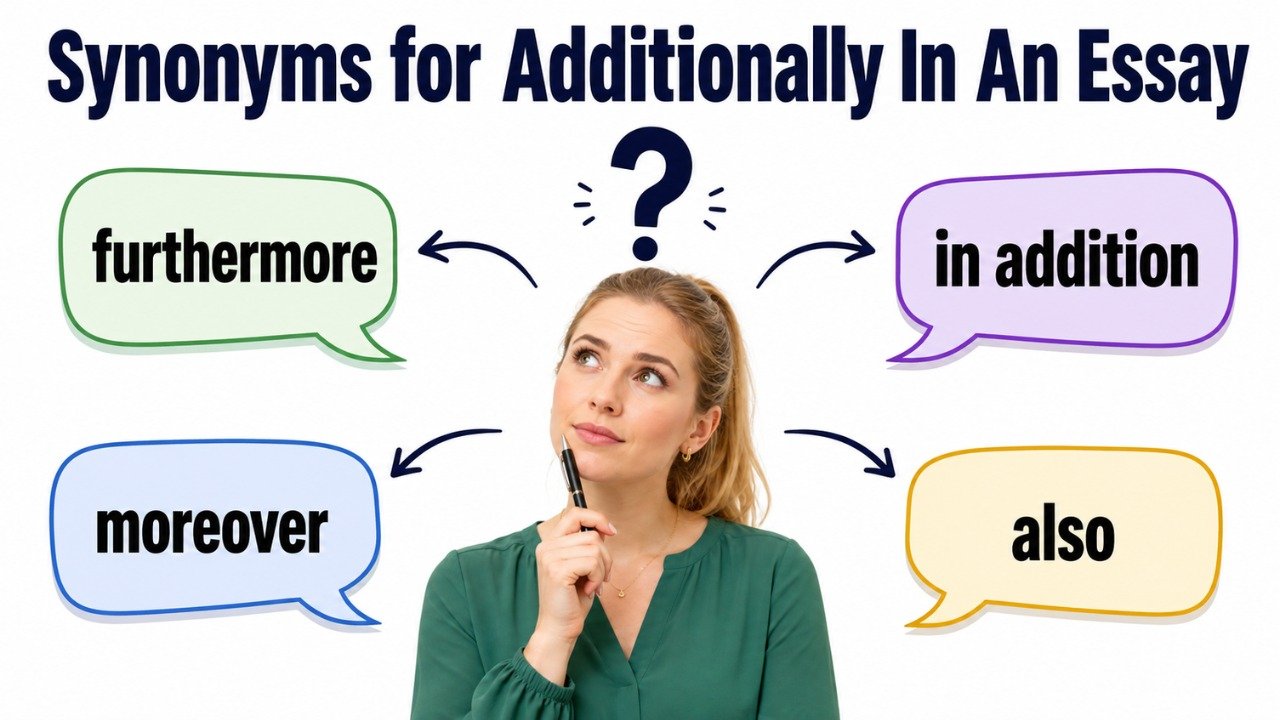
Quick Answer: The best synonyms for additionally in an essay are moreover, furthermore, in addition, also, besides, what is more, further, equally important, another consideration is, and coupled with this. Use moreover or furthermore in formal academic writing, in addition for a clear neutral transition, also for simple sentences, equally important to emphasize a point, and similarly when the new idea closely resembles the previous one.
Pronunciation and Word Details
Word: Additionally.
Pronunciation: /əˈdɪʃənəli/
Part of Speech: Adverb and conjunctive adverb.
Meaning: Additionally means in addition to what has already been stated.
US Pronunciation:
UK Pronunciation:
What Does “Additionally” Mean?
Additionally means that another fact, reason, example, argument, or piece of information is being added to a previous point.
It is an adverb that commonly functions as a transition word in essays, reports, articles, and formal explanations. Writers use it to show that the next idea supports, expands, or supplements the information that came before it.
Example: The policy could reduce costs. Additionally, it could improve efficiency.
In this example, additionally introduces a second benefit. The second sentence does not replace or contrast with the first one. It adds another related point.
Additionally can appear at the beginning, middle, or end of a sentence, although it is most natural at the beginning in formal essays.
Beginning Position: Additionally, regular exercise may improve concentration.
Middle Position: Regular exercise may additionally improve concentration.
End Position: Regular exercise may improve concentration additionally.
The final position is grammatically possible, but it often sounds less natural. In most academic writing, placing additionally at the beginning of the sentence creates a clearer connection.
Additionally can introduce several types of information.
An Extra Reason: Additionally, the proposal could create new jobs.
More Evidence: Additionally, recent observations support this conclusion.
Another Benefit: Additionally, the method requires fewer resources.
A Related Detail: Additionally, the participants completed a written survey.
A Supporting Argument: Additionally, the policy may improve public access.
The word does not automatically show contrast, cause, result, or example. It simply tells the reader that another relevant point is being added.
Meaning, Tone, and Context of “Additionally”
Additionally has a formal, neutral, and informative tone. It is more common in essays, reports, research papers, professional documents, and detailed explanations than in relaxed everyday conversation.
The word does not express strong emotion. Instead, it creates a logical connection between related ideas. It helps readers understand that the writer is continuing the same line of thought.
Academic Tone: Additionally works well when adding evidence, reasons, findings, interpretations, or supporting details.
Example: The results show a clear improvement in accuracy. Additionally, the response time decreased.
Professional Tone: The word is appropriate in reports, proposals, evaluations, and formal emails.
Example: The new process will reduce delays. Additionally, it will simplify record keeping.
Neutral Tone: Additionally does not show whether the added point is more important or less important than the previous one.
Example: The building contains a library. Additionally, it includes two study rooms.
Technical Context: It can introduce another feature, requirement, observation, or result.
Example: The device records temperature. Additionally, it measures humidity.
Explanatory Context: Writers use it to expand an explanation without changing the subject.
Example: The character feels isolated. Additionally, she struggles to communicate with her family.
In casual conversation, also, plus, and on top of that may sound more natural. In formal essays, additionally, moreover, furthermore, and in addition usually create a more polished tone.
Additionally is useful, but it should not appear before every new sentence. Repeating it too frequently can make an essay sound mechanical. Strong writing varies transitions and sometimes connects ideas without using a transition word at all.
When and How to Use “Additionally”
For Adding Another Supporting Point
Use additionally when a second point supports the same argument as the first one.
Example: Public transport reduces traffic congestion. Additionally, it can lower air pollution.
Both points support the value of public transport.
For Introducing More Evidence
Use additionally when you want to present another fact, finding, observation, or piece of evidence.
Example: The survey revealed growing public concern. Additionally, interview responses showed widespread dissatisfaction.
The second piece of evidence strengthens the first observation.
For Adding Another Reason
Use additionally when an argument depends on several related reasons.
Example: The plan is affordable. Additionally, it can be implemented quickly.
The sentence introduces another reason to support the plan.
For Presenting Another Benefit
Use additionally when describing multiple advantages.
Example: Reading improves vocabulary. Additionally, it can strengthen critical thinking skills.
The second benefit adds to the first without changing the direction of the discussion.
For Expanding an Explanation
Use additionally when the reader needs more information about the same subject.
Example: The novel explores social inequality. Additionally, it examines the effects of personal ambition.
The second sentence expands the analysis of the novel.
For Adding a Relevant Detail
Use additionally when a detail helps complete the reader’s understanding.
Example: Participants completed a questionnaire. Additionally, each participant attended a short interview.
The added detail explains another part of the procedure.
For Continuing a Formal List of Ideas
Use additionally when several ideas are presented across complete sentences or paragraphs.
Example: The program supports new teachers. Additionally, it provides training for experienced staff.
The transition signals that the discussion is continuing.
For Connecting Paragraphs
Additionally can appear at the beginning of a paragraph when the new paragraph develops another part of the same argument.
Example: Additionally, financial support may help students remain enrolled until graduation.
This use works best when the previous paragraph discussed another benefit of financial support.
Best Synonyms for Additionally
Moreover
Synonym: Adds another point and often suggests that the new point strengthens the argument.
Example: The policy is affordable. Moreover, it can be introduced without major disruption.
Furthermore
Synonym: Introduces another formal point that develops or supports the previous idea.
Example: The evidence is incomplete. Furthermore, several important records are missing.
In Addition
Synonym: Adds another related fact, reason, or detail in a clear and neutral way.
Example: The course develops writing skills. In addition, it improves research ability.
Also
Synonym: Adds another idea in a simple and direct way.
Example: The project reduced costs and also improved communication.
Besides
Synonym: Introduces another reason or consideration, often with a slightly conversational tone.
Example: The route is shorter. Besides, it is safer during bad weather.
What Is More
Synonym: Adds a point that may be surprising, persuasive, or especially significant.
Example: The solution is inexpensive. What is more, it requires very little maintenance.
Further
Synonym: Introduces another point, detail, argument, or stage of explanation.
Example: Further, the evidence suggests that early action produces better results.
Equally Important
Synonym: Adds a point that deserves the same level of attention as the previous one.
Example: Equally important, the policy must protect vulnerable groups.
Another Consideration Is
Synonym: Introduces another factor that should be examined.
Example: Another consideration is the effect of the proposal on small communities.
Coupled With This
Synonym: Connects an additional factor closely with the one already discussed.
Example: Coupled with this, improved training could increase employee confidence.
50 Synonyms for Additionally with Short Meanings
- Moreover: Adds another strong supporting point.
- Furthermore: Introduces further formal information.
- In Addition: Adds another related idea or detail.
- Also: Adds information in a simple way.
- Besides: Introduces another reason or consideration.
- What Is More: Adds an important or persuasive point.
- Further: Introduces more information or argument.
- Likewise: Adds a similar idea or example.
- Similarly: Shows that another point resembles the previous one.
- Equally: Adds a point of equal value or importance.
- Equally Important: Emphasizes another important consideration.
- Another Point Is: Introduces another part of an argument.
- Another Consideration Is: Adds another factor for examination.
- Another Factor Is: Introduces an additional influence or condition.
- Another Reason Is: Adds further support for a conclusion.
- Another Advantage Is: Introduces an additional benefit.
- Another Benefit Is: Adds another positive result.
- Added to This: Connects another related fact or effect.
- Coupled With This: Links an additional factor to the previous one.
- Along With This: Adds something that occurs or exists together.
- Together With This: Introduces a connected supporting detail.
- As Well: Adds another person, thing, quality, or action.
- Too: Adds another idea, usually in less formal writing.
- On Top of That: Adds a further point with emphasis.
- Not Only That: Introduces another notable fact.
- Beyond That: Moves to another related consideration.
- More Importantly: Adds a point of greater significance.
- Of Equal Importance: Introduces an equally significant idea.
- In the Same Way: Adds a similar action, result, or example.
- Correspondingly: Adds a related or matching development.
- By the Same Token: Introduces a parallel argument or conclusion.
- At the Same Time: Adds a fact that is also true.
- Concurrently: Shows that another event occurs during the same period.
- Simultaneously: Introduces something happening at the same time.
- Plus: Adds another point in informal or concise writing.
- As a Further Point: Introduces another stage of discussion.
- To Add to This: Presents further supporting information.
- To Elaborate Further: Adds explanation or detail.
- To Extend This Point: Develops the previous argument further.
- A Further Consideration Is: Introduces another issue for analysis.
- A Further Example Is: Adds another example as support.
- A Further Reason Is: Introduces another reason for a claim.
- A Related Point Is: Adds an idea connected to the discussion.
- In a Similar Vein: Introduces a point with a similar theme.
- In Conjunction With This: Adds a factor that works together with another.
- Supplementing This: Adds information that completes or strengthens a point.
- As an Added Point: Introduces another relevant idea.
- It Is Also Worth Noting: Draws attention to another useful fact.
- It Should Also Be Noted: Formally introduces another relevant observation.
- One May Also Consider: Adds another possibility or perspective for analysis.
Read Also:
Synonyms for Mindfulness
Synonyms for Additionally by Context
When Adding a Formal Academic Point
Moreover, furthermore, in addition, further, and it should also be noted work well in academic essays and formal reports.
Moreover: Often adds a point that strengthens the writer’s argument.
Example: The policy may improve attendance. Moreover, it could reduce long term costs.
Furthermore: Adds another formal point with a smooth sense of continuation.
Example: The data is limited. Furthermore, the sample does not represent the entire population.
In Addition: Adds information without suggesting that it is stronger or more important.
Example: The study examined income levels. In addition, it considered educational background.
Further: Works in concise formal writing, although it can sound more direct than furthermore.
Example: Further, the findings reveal differences between age groups.
It Should Also Be Noted: Highlights an extra fact that deserves attention.
Example: It should also be noted that several participants left the study early.
When Adding Another Supporting Reason
Another reason is, another factor is, another consideration is, and coupled with this are useful when developing an argument through several connected reasons.
Another Reason Is: Clearly tells the reader that further support is coming.
Example: Another reason is that public spaces encourage community interaction.
Another Factor Is: Best when discussing influences, causes, or conditions.
Example: Another factor is the rising cost of transportation.
Another Consideration Is: Suitable when the point requires evaluation rather than simple acceptance.
Example: Another consideration is whether the proposed system can serve rural areas.
Coupled With This: Connects two factors that work together.
Example: Coupled with this, better training may reduce workplace errors.
When Adding a Similar Idea
Similarly, likewise, in the same way, by the same token, and in a similar vein show that the new point resembles the previous one.
Similarly: Best for comparing similar situations, results, or patterns.
Example: Younger participants preferred digital resources. Similarly, older participants valued easy online access.
Likewise: Shows that a second subject shares a quality or action.
Example: The first group reported improved confidence. Likewise, the second group showed greater participation.
In the Same Way: Explains that two processes or examples operate similarly.
Example: In the same way, regular feedback can help employees improve their performance.
By the Same Token: Introduces a logically parallel argument.
Example: Flexible schedules can reduce stress. By the same token, rigid schedules may increase pressure.
In a Similar Vein: Introduces a related idea that follows the same general theme.
Example: In a similar vein, community programs can strengthen local cooperation.
When Emphasizing the Added Point
What is more, more importantly, equally important, of equal importance, and not only that give the added idea extra emphasis.
What Is More: Adds a persuasive or notable point.
Example: The method is affordable. What is more, it is easy to apply.
More Importantly: Signals that the new point matters more than the previous one.
Example: The proposal could save time. More importantly, it could improve patient safety.
Equally Important: Shows that the new point deserves the same attention.
Example: Equally important, teachers need enough time to prepare lessons.
Of Equal Importance: Offers a more formal version of equally important.
Example: Of equal importance is the need to protect personal information.
Not Only That: Adds emphasis but usually suits less formal writing.
Example: The plan is expensive. Not only that, it may take several years to complete.
When Adding an Example or Detail
A further example is, to elaborate further, to extend this point, and a related point is help writers add explanation rather than simply list information.
A Further Example Is: Clearly introduces another illustration.
Example: A further example is the use of public gardens in crowded neighborhoods.
To Elaborate Further: Adds explanation to an idea already introduced.
Example: To elaborate further, the participants were divided according to age and experience.
To Extend This Point: Develops the previous argument.
Example: To extend this point, equal access should include both physical and digital resources.
A Related Point Is: Introduces a detail that connects with the main discussion.
Example: A related point is that limited access may affect rural communities most severely.
When Writing in a Less Formal Style
Also, besides, as well, too, plus, and on top of that are more conversational alternatives.
Also: The safest neutral choice for straightforward writing.
Example: The room is quiet and also receives plenty of natural light.
Besides: Adds another reason, often in persuasive or conversational writing.
Example: The proposal is too costly. Besides, it does not address the main problem.
As Well: Usually appears at the end of a clause or sentence.
Example: The program supports teachers and students as well.
Too: Common in conversation and simple prose.
Example: The new system is faster, and it is easier to use too.
Plus: Concise but usually too informal for academic essays.
Example: The apartment is affordable. Plus, it is close to the university.
On Top of That: Adds emphasis but sounds conversational.
Example: The journey was long. On top of that, the weather was unpleasant.
Another Word for Additionally
Moreover is often the best single replacement for additionally in a formal essay. It adds another supporting point and can make the new information sound especially persuasive.
However, the best replacement depends on the relationship between the ideas. Use in addition for neutral addition, furthermore for formal development, also for simple sentence structure, and similarly when the new idea closely resembles the previous one.
Original: Additionally, the program may reduce operating costs.
Better Option: Moreover, the program may reduce operating costs.
Original: Additionally, the researchers collected written responses.
Better Option: In addition, the researchers collected written responses.
Original: The policy additionally protects temporary workers.
Better Option: The policy also protects temporary workers.
Original: Additionally, the second group showed improved results.
Better Option: Similarly, the second group showed improved results.
When Not to Use “Additionally”
Additionally should not be used simply because a sentence needs a transition. The relationship between the ideas must genuinely involve addition.
When the Sentence Shows Contrast
Use however, nevertheless, in contrast, or on the other hand when the new idea opposes the previous one.
Weak: The plan is affordable. Additionally, it may be difficult to implement.
Better: The plan is affordable. However, it may be difficult to implement.
The second sentence introduces a limitation, not an additional supporting point.
When the Sentence Shows a Result
Use therefore, consequently, thus, or as a result when one idea causes another.
Weak: The road was closed. Additionally, traffic was redirected.
Better: The road was closed. Consequently, traffic was redirected.
Traffic was redirected because the road was closed.
When Introducing an Example
Use for example, for instance, or to illustrate when the next statement gives a specific example.
Weak: Many activities improve concentration. Additionally, reading can help students focus.
Better: Many activities improve concentration. For example, reading can help students focus.
The second sentence illustrates the general claim.
When the Word Becomes Repetitive
Using additionally in every paragraph can make an essay sound mechanical.
Weak: Additionally, exercise supports physical health. Additionally, it may improve mood. Additionally, it can encourage better sleep.
Better: Exercise supports physical health. Moreover, it may improve mood. Regular activity can also encourage better sleep.
When a Simpler Word Is Clearer
Sometimes also is more natural, especially within a single sentence.
Weak: The course additionally teaches presentation skills.
Better: The course also teaches presentation skills.
When the Added Point Is More Important
Use more importantly if the new point deserves greater emphasis.
Weak: The change could reduce costs. Additionally, it could prevent serious injuries.
Better: The change could reduce costs. More importantly, it could prevent serious injuries.
When the Ideas Are Not Clearly Connected
Additionally cannot create a logical relationship between unrelated statements.
Weak: The survey included 200 participants. Additionally, ancient architecture remains popular among tourists.
Better: The survey included 200 participants. A separate section examined public interest in ancient architecture.
Words Commonly Confused With Additionally
Additionally vs Moreover: Additionally neutrally adds information. Moreover often adds a stronger point that supports or reinforces an argument.
Example With Additionally: The building has new classrooms. Additionally, it includes a larger library.
Example With Moreover: The new system is affordable. Moreover, it has already produced positive results.
Additionally vs Furthermore: Both are formal addition transitions. Furthermore often creates a stronger sense that the argument is continuing or developing.
Example With Additionally: The participants completed a survey. Additionally, they attended an interview.
Example With Furthermore: The evidence is incomplete. Furthermore, several records appear to be inaccurate.
Additionally vs In Addition: Both have nearly the same meaning. Additionally is a single adverb, while in addition is a prepositional transition phrase.
Example With Additionally: Additionally, students received printed instructions.
Example With In Addition: In addition, students received printed instructions.
Additionally vs Also: Additionally usually introduces a complete sentence or formal point. Also often appears inside a sentence and sounds more natural in simple writing.
Example With Additionally: Additionally, the course includes practical exercises.
Example With Also: The course also includes practical exercises.
Additionally vs Besides: Additionally is neutral and formal. Besides can sound more conversational and may suggest that the added reason should settle the issue.
Example With Additionally: Additionally, the location offers convenient transport links.
Example With Besides: The location is too expensive. Besides, it is far from the city center.
Additionally vs Similarly: Additionally adds any related point. Similarly adds a point that resembles or parallels the previous one.
Example With Additionally: The first group completed a questionnaire. Additionally, members attended individual interviews.
Example With Similarly: The first group improved after training. Similarly, the second group showed measurable progress.
Additionally vs Consequently: Additionally signals addition. Consequently signals a result caused by the previous idea.
Example With Additionally: The storm damaged several roads. Additionally, it interrupted power supplies.
Example With Consequently: The storm damaged several roads. Consequently, many journeys were delayed.
Additionally vs However: Additionally continues the same direction of thought. However introduces a contrast, limitation, or disagreement.
Example With Additionally: The method is efficient. Additionally, it requires little equipment.
Example With However: The method is efficient. However, it requires extensive training.
Which Synonym Should You Choose?
Choose moreover when adding a strong point that reinforces a formal argument.
Choose furthermore when continuing a detailed explanation or presenting further evidence.
Choose in addition when you need a neutral and versatile transition in essays, reports, or professional writing.
Choose also when adding a short point within the same sentence.
Choose similarly when the new idea follows the same pattern as the previous one.
Choose likewise when two people, groups, situations, or results share a similar quality.
Choose equally important when the added point deserves the same attention as the earlier one.
Choose more importantly when the new point has greater significance.
Choose another consideration is when introducing a factor that requires evaluation.
Choose another reason is when organizing a persuasive argument around several supporting reasons.
Choose a further example is when adding evidence through illustration.
Choose coupled with this when two factors combine to produce an effect.
Choose besides for persuasive or moderately conversational writing.
Choose plus or on top of that only in informal writing or dialogue.
For Formal Essays: Choose moreover, furthermore, in addition, further, or another consideration is.
For Academic Analysis: Choose moreover, furthermore, similarly, in a similar vein, or to extend this point.
For Research Reports: Choose in addition, further, it should also be noted, or a further consideration is.
For Professional Emails: Choose in addition, also, furthermore, or it is also worth noting.
For Simple Explanations: Choose also, in addition, or another point is.
For Persuasive Writing: Choose moreover, what is more, more importantly, or another reason is.
For Comparable Ideas: Choose similarly, likewise, in the same way, or by the same token.
For Casual Conversation: Choose also, besides, plus, too, or on top of that.
Real Life Examples of “Additionally” in Sentences
Original: Additionally, the school offers free evening classes.
Better Option: Moreover, the school offers free evening classes.
Original: The report additionally examines changes in household income.
Better Option: The report also examines changes in household income.
Original: Additionally, several participants reported improved confidence.
Better Option: Furthermore, several participants reported improved confidence.
Original: The plan will reduce waste. Additionally, it may lower costs.
Better Option: The plan will reduce waste. In addition, it may lower costs.
Original: Additionally, the second experiment produced similar findings.
Better Option: Similarly, the second experiment produced comparable findings.
Original: The proposal could improve efficiency. Additionally, it may increase workplace safety.
Better Option: The proposal could improve efficiency. More importantly, it may increase workplace safety.
Original: Additionally, the cost of maintenance should be examined.
Better Option: Another consideration is the cost of maintenance.
Original: The new process is faster. Additionally, it is easier for beginners to understand.
Better Option: The new process is faster. What is more, it is easier for beginners to understand.
Original: Additionally, regular feedback helps students recognize their weaknesses.
Better Option: A related point is that regular feedback helps students recognize their weaknesses.
Original: The policy supports local workers. Additionally, it encourages investment in smaller communities.
Better Option: The policy supports local workers. Coupled with this, it encourages investment in smaller communities.
Synonym Groups and Usage Differences
Formal Academic Addition Group
Moreover, furthermore, in addition, further, and it should also be noted are suitable for essays, reports, and research writing.
Moreover often strengthens an argument. Furthermore continues a formal explanation. In addition adds information neutrally. Further is concise, while it should also be noted highlights a detail that deserves attention.
Example: The study used a limited sample. Furthermore, the testing period was unusually short.
Neutral Addition Group
Additionally, in addition, also, along with this, and another point is add information without strong emotional emphasis.
These choices are useful when the writer wants to continue a discussion clearly without suggesting that the new point is more important.
Example: The center provides career advice. In addition, it offers interview training.
Similarity Group
Similarly, likewise, in the same way, by the same token, correspondingly, and in a similar vein introduce related or parallel ideas.
These expressions should be used only when there is a genuine similarity between the statements.
Example: The first group responded positively to the change. Likewise, the second group reported improved satisfaction.
Emphasis Group
What is more, more importantly, equally important, of equal importance, and not only that give special weight to the added point.
More importantly raises the importance of the new idea. Equally important gives both points the same status. What is more makes the addition sound persuasive or notable.
Example: The program is affordable. More importantly, it is accessible to people in remote areas.
Structural Addition Group
Another reason is, another consideration is, another factor is, another advantage is, and a further example is make the structure of an argument explicit.
These phrases are especially useful when readers need to follow several clearly separated reasons, benefits, or examples.
Example: Another factor is the amount of time required to train new staff.
Conversational Addition Group
Also, besides, plus, too, as well, and on top of that are common in everyday language and informal writing.
Also is the most neutral choice. Besides often adds a persuasive reason. Plus and on top of that sound casual and may not suit a formal academic essay.
Example: The restaurant was crowded. On top of that, the service was unusually slow.
Combined Factors Group
Coupled with this, together with this, along with this, in conjunction with this, and added to this show that multiple factors are connected.
These expressions work well when the combined effect matters more than each point separately.
Example: Rising costs, coupled with this decline in demand, created serious financial pressure.
Antonyms of Additionally
Additionally does not have one perfect opposite because it is a transition that signals addition. Its practical opposites are words and phrases that signal exclusion, replacement, separation, contrast, or an alternative.
Instead: Replaces one action, idea, or option with another.
Alternatively: Introduces a different possibility.
Rather: Shows preference for one idea over another.
Conversely: Introduces an opposite or reversed relationship.
However: Introduces a contrast or limitation.
Nevertheless: Adds a contrasting point that remains true despite the previous statement.
On the Contrary: Directly rejects or opposes an earlier idea.
Otherwise: Introduces a different condition or result.
Separately: Treats an issue apart from the previous point.
Independently: Shows that something exists or occurs without connection to another factor.
Except: Excludes a person, thing, or case.
Excluding: Leaves something out of a group or discussion.
Comparison: Additionally vs Related Words
Additionally vs Moreover
Additionally neutrally adds another idea. Moreover often suggests that the new idea makes an argument stronger or more convincing.
Example With Additionally: The program offers free materials. Additionally, it provides online support.
Example With Moreover: The program is affordable. Moreover, it has achieved strong results in several communities.
Additionally vs Furthermore
Additionally and furthermore both add information. Furthermore is often more formal and may suggest a deeper continuation of an argument.
Example With Additionally: Additionally, the participants completed a short survey.
Example With Furthermore: Furthermore, the results remained consistent across all age groups.
Additionally vs In Addition
These expressions are very close in meaning. Additionally is an adverb, while in addition is a phrase. Both are appropriate in formal essays.
Example With Additionally: Additionally, the proposal includes financial support.
Example With In Addition: In addition, the proposal includes financial support.
Additionally vs Also
Additionally commonly introduces a sentence. Also often appears before the main verb or after a form of be.
Example With Additionally: Additionally, the course teaches research skills.
Example With Also: The course also teaches research skills.
Additionally vs Likewise
Additionally adds any relevant information. Likewise adds information that is similar to the previous idea.
Example With Additionally: The first class included a written test. Additionally, students completed a presentation.
Example With Likewise: The first class showed strong improvement. Likewise, the second class achieved better results.
Additionally vs Besides
Additionally is formal and neutral. Besides is more conversational and may introduce an extra reason that supports a decision or judgment.
Example With Additionally: Additionally, the property has a large garden.
Example With Besides: The property is too expensive. Besides, it requires extensive repairs.
Additionally vs What Is More
Additionally simply adds a point. What is more adds emphasis and often makes the new point sound especially persuasive.
Example With Additionally: The method is simple. Additionally, it is inexpensive.
Example With What Is More: The method is simple. What is more, it can be applied without specialist equipment.
Additionally vs More Importantly
Additionally treats the new point as another relevant detail. More importantly tells the reader that the next idea has greater significance.
Example With Additionally: The new road will shorten travel times. Additionally, it may support local businesses.
Example With More Importantly: The new road will shorten travel times. More importantly, it may improve access to emergency care.
Common Phrases and Expressions With “Additionally”
Additionally, It Is Important to Note
Meaning: Introduces another fact that deserves attention.
Example: Additionally, it is important to note that the sample included only adult participants.
Additionally, the Evidence Suggests
Meaning: Adds another interpretation supported by evidence.
Example: Additionally, the evidence suggests that early intervention may improve outcomes.
Additionally, the Results Indicate
Meaning: Introduces another conclusion based on findings.
Example: Additionally, the results indicate a connection between sleep and concentration.
Additionally, Another Factor Is
Meaning: Adds another influence, cause, or condition.
Example: Additionally, another factor is the amount of training available to employees.
Additionally, One Must Consider
Meaning: Introduces another issue that requires evaluation.
Example: Additionally, one must consider the effect of the policy on rural communities.
Additionally, This Approach Allows
Meaning: Introduces another benefit or capability of a method.
Example: Additionally, this approach allows researchers to compare several groups.
Additionally, the Author Explains
Meaning: Adds another part of a literary or textual analysis.
Example: Additionally, the author explains how fear shapes the main character’s choices.
Additionally, the Study Shows
Meaning: Introduces another research finding.
Example: Additionally, the study shows that regular feedback can improve motivation.
Additionally, This Example Demonstrates
Meaning: Adds another interpretation of an example.
Example: Additionally, this example demonstrates the importance of effective communication.
Additionally, It May Be Argued
Meaning: Introduces another claim or perspective in an essay.
Example: Additionally, it may be argued that public transport improves social access.
Common Mistakes to Avoid
Forgetting the Comma After Additionally
When additionally begins a sentence, it is usually followed by a comma.
Incorrect: Additionally the policy may reduce unnecessary spending.
Correct: Additionally, the policy may reduce unnecessary spending.
Creating a Comma Splice
Do not use additionally with commas alone to join two complete sentences.
Incorrect: The plan is affordable, additionally, it is easy to implement.
Correct: The plan is affordable. Additionally, it is easy to implement.
Correct: The plan is affordable; additionally, it is easy to implement.
Writing “Additionally To”
Additionally to is usually unnatural in standard English. Use in addition to when it is followed by a noun or an ing form.
Incorrect: Additionally to lowering costs, the policy may save time.
Correct: In addition to lowering costs, the policy may save time.
Repeating Additionally Too Often
Using the same transition repeatedly can make an essay sound formulaic.
Repetitive: Additionally, the program saves time. Additionally, it reduces costs. Additionally, it improves accuracy.
Improved: The program saves time. Moreover, it reduces costs and improves accuracy.
Combining Additionally With Also
Using additionally and also together is usually redundant.
Incorrect: Additionally, the system also records temperature.
Better: Additionally, the system records temperature.
Better: The system also records temperature.
Using Additionally for Contrast
Additionally should not introduce an opposing idea.
Incorrect: The method is accurate. Additionally, it is extremely expensive.
Better: The method is accurate. However, it is extremely expensive.
Using Additionally for Cause and Result
Use a result transition when the second sentence follows logically from the first.
Incorrect: Demand increased rapidly. Additionally, prices rose.
Better: Demand increased rapidly. Consequently, prices rose.
Choosing an Informal Synonym in an Academic Essay
Plus and on top of that may sound too conversational for formal analysis.
Weak: Plus, the evidence does not support the main claim.
Better: Furthermore, the evidence does not support the main claim.
Adding a Transition Where None Is Needed
Not every sentence requires a linking word. The relationship may already be clear.
Wordy: Additionally, the survey included questions about age. Additionally, it asked about employment.
Better: The survey included questions about age and employment.
Using a Vague Added Point
Additionally should introduce a clearly related idea.
Weak: The policy affects schools. Additionally, weather patterns vary across the region.
Better: The policy affects schools. In addition, it changes how educational funding is distributed.
Conclusion
The strongest synonyms for additionally in an essay include moreover, furthermore, in addition, also, similarly, equally important, and another consideration is. Choose moreover for stronger arguments, in addition for neutral information, similarly for parallel ideas, and more importantly for greater emphasis. A good transition should accurately show how the new sentence relates to the previous one. Varying these alternatives can improve flow, prevent repetition, and make academic writing clearer and more natural.
FAQs About Synonyms for Additionally
What Is the Best Synonym for Additionally in an Essay?
Moreover is a strong formal synonym. In addition is often the best neutral alternative, while furthermore works well when continuing a detailed argument.
Can I Use Also Instead of Additionally?
Yes. Also is clear and natural, especially within a sentence. Additionally is usually more formal and often appears at the beginning of a sentence.
Is Moreover More Formal Than Additionally?
Both are formal, but moreover often sounds more argumentative. It commonly introduces a point that strengthens the writer’s claim.
Can I Start a Paragraph With Additionally?
Yes. Additionally can begin a paragraph when the new paragraph adds another point to the same argument. Make sure the connection is clear.
Should a Comma Follow Additionally?
A comma usually follows additionally when it appears at the beginning of a sentence.
What Is a Less Formal Alternative to Additionally?
Also, besides, plus, too, and on top of that are less formal choices. Also is the most versatile of these options.
How Can I Avoid Repeating Additionally in an Essay?
Vary it with moreover, furthermore, in addition, similarly, another consideration is, or more importantly. You can also combine related ideas without using a transition.
