
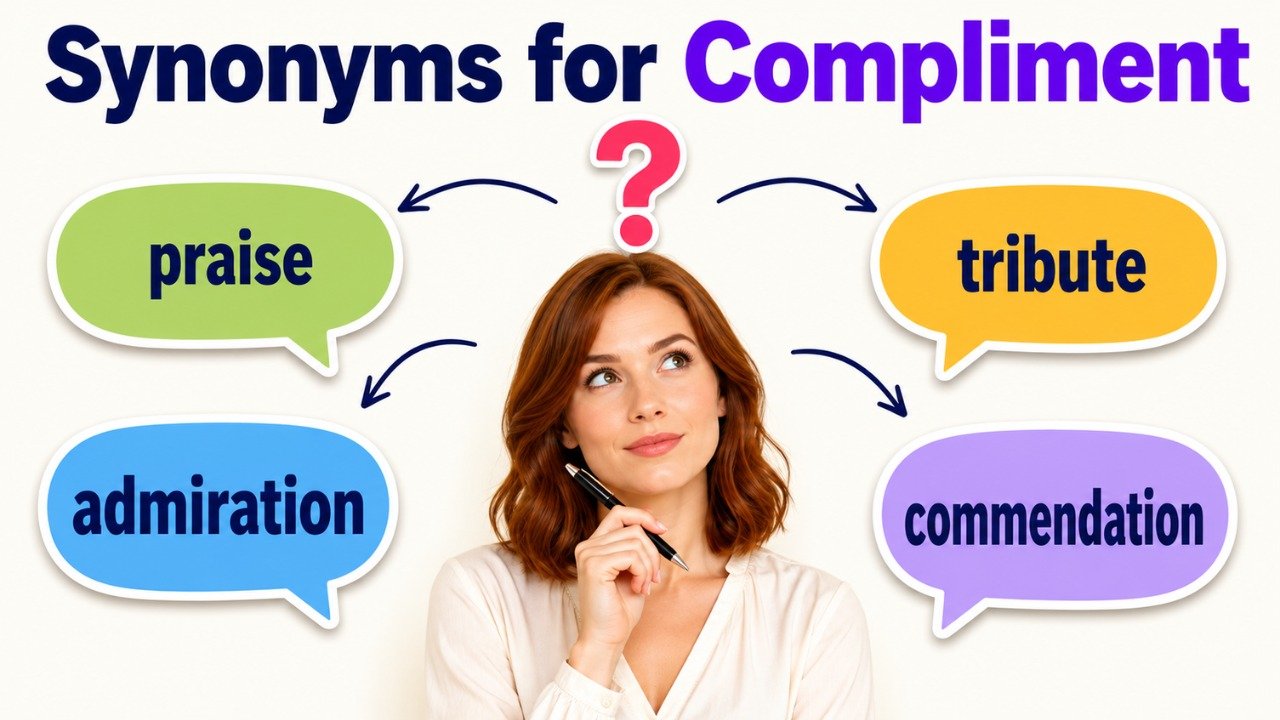
Quick Answer: The best synonyms for compliment include praise, admiration, commendation, appreciation, acclaim, flattery, tribute, accolade, approval, and applause. Use praise as the most common general alternative, commendation in formal or professional writing, appreciation when expressing gratitude, admiration for genuine respect, and acclaim for public recognition. Flattery is suitable when the praise may be exaggerated or intended to influence someone. Tribute works best for a meaningful public expression of respect, while a kind word sounds natural in casual conversation.
Pronunciation and Word Details
Word: Compliment.
Pronunciation: /ˈkɒmplɪmənt/.
Part of Speech: Noun and verb.
Meaning: A compliment is a kind or approving remark that expresses praise, admiration, or appreciation.
US Pronunciation:
UK Pronunciation:
What Does “Compliment” Mean?
Compliment means a positive remark or action that expresses praise, approval, admiration, or appreciation.
As a noun, compliment refers to the approving words themselves.
Example: Her compliment made him feel more confident.
As a verb, compliment means to say something positive about a person, achievement, quality, or object.
Example: The teacher complimented the student on her thoughtful answer.
A compliment may focus on appearance, personality, talent, effort, behavior, achievement, or good judgment.
Example: He complimented her on the clarity of her presentation.
The word can also describe polite respect or appreciation.
Example: The guests complimented the cook on the excellent meal.
Compliment is generally positive, but its meaning changes when it appears with words such as false, exaggerated, forced, or backhanded.
Example: His backhanded compliment sounded more insulting than kind.
In formal writing, compliment may be replaced by praise, commendation, recognition, or appreciation. In casual conversation, kind word, nice comment, or positive remark may sound more natural.
Meaning, Tone, and Context of “Compliment”
Compliment usually has a positive, friendly, polite, and encouraging tone. It communicates that someone has noticed and valued a quality, action, achievement, or appearance.
In casual conversation, a compliment is often short and personal.
Example: That color looks wonderful on you.
In professional communication, compliments usually focus on effort, ability, leadership, communication, or results.
Example: The manager complimented the team on its careful work.
In formal writing, words such as commendation, acclaim, appreciation, and recognition may sound more precise than compliment.
Example: The researcher received commendation for her detailed report.
Compliments can also be emotional. A sincere compliment may make someone feel respected, noticed, encouraged, or valued.
Example: His thoughtful compliment lifted her confidence.
The word can sometimes have a negative or doubtful tone. Flattery may sound excessive, dishonest, or motivated by personal gain.
Example: She suspected that his praise was merely flattery.
Compliment is commonly used in the following contexts.
Appearance: Praising clothing, style, hair, or general presentation.
Personality: Praising kindness, patience, honesty, or confidence.
Ability: Praising talent, intelligence, creativity, or skill.
Effort: Recognizing hard work, preparation, or persistence.
Achievement: Celebrating success or excellent performance.
Professional Conduct: Recognizing leadership, communication, or responsibility.
Hospitality: Praising food, service, organization, or a welcoming atmosphere.
Creative Work: Praising writing, art, music, design, or performance.
When and How to Use “Compliment”
For Praising Appearance
Use compliment when saying something positive about how a person looks or presents themselves.
Example: She complimented him on his elegant outfit.
For Recognizing Effort
A compliment can show that someone’s hard work has been noticed.
Example: The coach complimented the players on their determination.
For Praising Achievement
Use compliment when responding positively to a successful result.
Example: Her supervisor complimented her on completing the project early.
For Expressing Admiration
A compliment can communicate genuine respect for someone’s qualities or abilities.
Example: I complimented her on her calm leadership.
For Encouraging Someone
A thoughtful compliment can increase confidence and motivate a person.
Example: The teacher complimented the child on his improvement.
For Professional Communication
Use specific compliments in emails, meetings, reports, and workplace conversations.
Example: The director complimented the team on the accuracy of its work.
For Creative Work
Compliment someone when you value the quality, originality, or emotional effect of their work.
Example: Several readers complimented the writer on her vivid descriptions.
For Hospitality
Compliment is commonly used when praising food, decoration, service, or organization.
Example: The visitors complimented their host on the warm welcome.
For Polite Conversation
A sincere compliment can begin a friendly conversation or express appreciation.
Example: He complimented his colleague on her thoughtful presentation.
For Public Recognition
In public or ceremonial settings, praise, tribute, acclaim, or commendation may be stronger alternatives.
Example: The speaker paid tribute to the volunteers for their service.
Best Synonyms for Compliment
Praise
Synonym: Praise means expressing approval or admiration for someone or something.
Example: The teacher praised the student for her careful reasoning.
Admiration
Synonym: Admiration means warm approval and respect for someone’s qualities or achievements.
Example: He expressed admiration for her courage.
Commendation
Synonym: Commendation is formal praise given for excellent behavior, work, or achievement.
Example: The employee received commendation for her outstanding service.
Appreciation
Synonym: Appreciation means recognition of someone’s value, effort, kindness, or achievement.
Example: The team expressed appreciation for his support.
Acclaim
Synonym: Acclaim means enthusiastic public praise and approval.
Example: The performance received widespread acclaim.
Flattery
Synonym: Flattery is praise that may be excessive, insincere, or intended to influence someone.
Example: She ignored the obvious flattery and focused on the proposal.
Tribute
Synonym: A tribute is a public or meaningful expression of admiration, gratitude, or respect.
Example: The ceremony was a tribute to the retiring teacher.
Accolade
Synonym: An accolade is an award, honor, or expression of strong approval.
Example: The novel earned several important accolades.
Approval
Synonym: Approval means a positive opinion or acceptance of someone’s actions or choices.
Example: Her thoughtful decision gained the approval of her colleagues.
Applause
Synonym: Applause means public approval shown through clapping or enthusiastic praise.
Example: The speaker received warm applause from the audience.
50 Synonyms for Compliment with Short Meanings
- Praise: A positive expression of approval or admiration.
- Admiration: Warm respect for someone’s qualities or achievements.
- Commendation: Formal praise for excellent work or behavior.
- Acclaim: Enthusiastic public praise.
- Appreciation: Recognition of value, effort, or kindness.
- Approval: A favorable opinion or positive judgment.
- Flattery: Excessive or possibly insincere praise.
- Tribute: An expression of admiration, gratitude, or respect.
- Accolade: An honor or strong expression of approval.
- Applause: Public approval or enthusiastic praise.
- Recognition: Acknowledgment of someone’s work, ability, or achievement.
- Endorsement: Public or formal support and approval.
- Adulation: Excessive admiration or praise.
- Ovation: Enthusiastic public applause.
- Homage: Special honor or respect shown to someone.
- Plaudit: An expression of enthusiastic approval.
- Kudos: Informal praise for an achievement.
- Encomium: A formal speech or piece of writing that praises someone.
- Panegyric: Elaborate public praise in speech or writing.
- Testimonial: A statement expressing approval or appreciation.
- Salute: A public expression of respect or admiration.
- Congratulations: Words expressing pleasure about someone’s success.
- Acknowledgment: Recognition of someone’s contribution or value.
- Respect: A positive feeling based on someone’s qualities or achievements.
- Esteem: High regard and admiration.
- Encouragement: Supportive words that increase confidence.
- Kind Word: A friendly and positive comment.
- Admiring Remark: A statement expressing approval or respect.
- Positive Comment: A favorable statement about someone or something.
- Favorable Remark: A comment showing approval.
- Word of Praise: A brief expression of admiration or approval.
- Expression of Admiration: Words that communicate genuine respect.
- Pat on the Back: Informal praise or encouragement.
- Cheer: A shout or expression of support and approval.
- Celebration: Public recognition of success or achievement.
- Commend: To formally praise someone.
- Applaud: To express strong approval or admiration.
- Admire: To regard someone with respect and approval.
- Honor: To show respect or special recognition.
- Appreciate: To recognize the value or quality of someone or something.
- Congratulate: To express pleasure about someone’s success.
- Extol: To praise someone or something very highly.
- Laud: To praise formally or publicly.
- Hail: To publicly praise or recognize someone.
- Glorify: To praise someone or something excessively.
- Celebrate: To publicly recognize a success or positive quality.
- Recognize: To acknowledge an achievement, effort, or contribution.
- Endorse: To express public approval or support.
- Speak Highly Of: To describe someone in a very positive way.
- Sing the Praises Of: To praise someone or something enthusiastically.
Synonyms for Compliment by Context
When Compliment Means Praise
Praise is the strongest general synonym for compliment. It can describe positive words about appearance, ability, effort, character, or achievement.
Useful alternatives include praise, approval, appreciation, admiration, and a positive comment.
Example With Compliment: The teacher complimented Maya on her excellent essay.
Example With Praise: The teacher praised Maya for her excellent essay.
Example With Approval: The teacher expressed approval of Maya’s careful work.
When Compliment Means Formal Recognition
Commendation, recognition, and accolade are suitable when praise is official, professional, or connected with an achievement.
Example With Compliment: The director gave him a compliment for his service.
Example With Commendation: The director gave him a commendation for his service.
Example With Recognition: He received recognition for his valuable contribution.
When Compliment Means Admiration
Admiration and esteem are useful when the speaker respects a person’s qualities, character, or abilities.
Example With Compliment: Her words were a compliment to his patience.
Example With Admiration: Her words expressed admiration for his patience.
Example With Esteem: His colleagues held him in high esteem.
When Compliment Means Appreciation
Appreciation and acknowledgment work well when the praise focuses on effort, kindness, help, or support.
Example With Compliment: She complimented the volunteers on their hard work.
Example With Appreciation: She expressed appreciation for the volunteers’ hard work.
Example With Acknowledgment: The speech included an acknowledgment of the volunteers’ contribution.
When Compliment Means Public Praise
Acclaim, applause, ovation, plaudit, and accolade describe strong or public approval.
Example With Compliment: The actor received many compliments after the performance.
Example With Acclaim: The actor received widespread acclaim after the performance.
Example With Applause: The actor received enthusiastic applause after the performance.
When Compliment Means Excessive Praise
Flattery and adulation are appropriate when the praise sounds exaggerated, insincere, or excessive.
Example With Compliment: His compliment sounded designed to influence the manager.
Example With Flattery: His flattery sounded designed to influence the manager.
Example With Adulation: The leader appeared uncomfortable with the excessive adulation.
When Compliment Means a Meaningful Expression of Respect
Tribute, homage, salute, and honor are suitable when admiration is serious, ceremonial, or emotional.
Example With Compliment: The event was a compliment to her years of service.
Example With Tribute: The event was a tribute to her years of service.
Example With Homage: The exhibition paid homage to her creative influence.
When Compliment Means Encouragement
Encouragement, a kind word, and a pat on the back work well when the goal is to build confidence.
Example With Compliment: A compliment helped the student feel more confident.
Example With Encouragement: A few words of encouragement helped the student feel more confident.
Example With Kind Word: A kind word can improve someone’s day.
When Compliment Is Used as a Verb
Commend, praise, applaud, admire, congratulate, recognize, and appreciate can replace compliment as a verb.
Example With Compliment: The manager complimented the team on its success.
Example With Commend: The manager commended the team for its success.
Example With Congratulate: The manager congratulated the team on its success.
Another Word for Compliment
Praise is the best single replacement for compliment in most contexts. Both words express approval or admiration, but praise is more flexible and can be used naturally as either a noun or a verb.
The best alternative still depends on the context. Use commendation for formal recognition, appreciation for gratitude, admiration for respect, and flattery when praise may be exaggerated or insincere.
Original: She gave him a compliment about his presentation.
Better Option: She praised his presentation.
Original: The manager complimented the staff on their hard work.
Better Option: The manager commended the staff for their hard work.
Original: His compliment showed that he valued her support.
Better Option: His appreciation showed that he valued her support.
Original: The performance received many compliments from critics.
Better Option: The performance received widespread acclaim.
When Not to Use “Compliment”
Compliment is useful, but a more precise synonym may communicate the intended meaning more clearly.
When the Praise Is Formal
Compliment may sound too casual when someone receives official recognition.
Weak: The officer received a compliment for her bravery.
Better: The officer received a commendation for her bravery.
When Describing Public Success
Acclaim or recognition is more precise when many people publicly praise a person or work.
Weak: The book received many compliments after publication.
Better: The book received widespread acclaim after publication.
When Expressing Gratitude
Appreciation may be better than compliment when the main idea is thankfulness.
Weak: We offered him a compliment for his support.
Better: We expressed our appreciation for his support.
When the Praise Is Exaggerated
Use flattery when the positive words appear insincere or designed to influence someone.
Weak: Her compliment was clearly intended to win his favor.
Better: Her flattery was clearly intended to win his favor.
When Honoring Someone Publicly
Use tribute, homage, or salute when the expression of respect is ceremonial or deeply meaningful.
Weak: The concert was a compliment to the late musician.
Better: The concert was a tribute to the late musician.
When Congratulating Someone
Congratulate is usually more natural when responding to a success, promotion, graduation, or achievement.
Weak: I complimented her for winning the competition.
Better: I congratulated her on winning the competition.
When the Sentence Is Vague
A general compliment may not explain what was praised.
Weak: The supervisor gave her a compliment.
Better: The supervisor praised her clear and accurate report.
When the Word Becomes Repetitive
Repeated use of compliment can make writing sound limited.
Weak: He complimented her work, and his compliment encouraged her to accept more compliments.
Better: He praised her work, and his kind words encouraged her to accept recognition confidently.
Words Commonly Confused With Compliment
Compliment vs Complement: Compliment means praise or an approving remark. Complement means something that completes, improves, or matches something else.
Compliment vs Praise: Compliment usually refers to a specific positive remark. Praise can be broader, stronger, or more detailed.
Compliment vs Flattery: A compliment is usually sincere. Flattery may be exaggerated or offered to gain an advantage.
Compliment vs Commendation: A compliment is often personal or casual. A commendation is formal recognition for excellent work, conduct, or achievement.
Compliment vs Admiration: A compliment is an expression of approval. Admiration is the feeling of respect that may lead someone to give a compliment.
Compliment vs Appreciation: A compliment praises a quality or action. Appreciation recognizes value, effort, kindness, or support.
Compliment vs Congratulation: A compliment praises a quality, appearance, effort, or action. A congratulation celebrates a particular success or happy event.
Compliment vs Tribute: A compliment is usually brief and personal. A tribute is a more meaningful or public expression of honor and respect.
Compliment vs Approval: A compliment expresses something positive. Approval communicates acceptance of a choice, plan, action, or behavior.
Compliment vs Recognition: A compliment is a positive remark. Recognition formally or publicly acknowledges achievement, service, or contribution.
Which Synonym Should You Choose?
Choose praise when you need the clearest general alternative for compliment.
Choose admiration when expressing sincere respect for a person’s character, ability, courage, or achievement.
Choose commendation in formal writing, professional reports, official notices, and workplace communication.
Choose appreciation when recognizing kindness, assistance, effort, or support.
Choose acclaim when describing enthusiastic public praise for a performance, publication, achievement, or creative work.
Choose flattery when the praise is excessive, strategic, doubtful, or insincere.
Choose tribute when honoring a person’s life, service, influence, or contribution.
Choose accolade when referring to an award, honor, or important expression of approval.
Choose applause when approval is public, enthusiastic, or shown by an audience.
Choose recognition in reports, professional emails, speeches, and formal discussions of achievement.
Choose kudos in relaxed conversation when offering informal praise for a good result.
Choose a kind word when the language should sound warm, natural, and conversational.
Choose encouragement when the positive words are intended to build confidence or motivation.
Choose congratulate when responding to a specific success or happy achievement.
Choose commend when praising someone formally as a verb.
Choose applaud when strongly approving an action, idea, decision, or achievement.
Choose extol or laud in formal essays when describing unusually strong praise.
Choose speak highly of in conversation when describing someone positively to another person.
Real Life Examples of “Compliment” in Sentences
Original: She complimented her colleague on the clear presentation.
Better Option: She praised her colleague for the clear presentation.
Original: The teacher gave the student a compliment about his progress.
Better Option: The teacher offered the student encouragement about his progress.
Original: The manager complimented the team on completing the work early.
Better Option: The manager commended the team for completing the work early.
Original: Her compliment showed that she respected his honesty.
Better Option: Her admiration showed that she respected his honesty.
Original: The chef received many compliments from the guests.
Better Option: The chef received enthusiastic praise from the guests.
Original: The writer accepted the compliment with gratitude.
Better Option: The writer accepted the praise with gratitude.
Original: The ceremony was a compliment to the retiring principal.
Better Option: The ceremony was a tribute to the retiring principal.
Original: His compliments sounded exaggerated and unnatural.
Better Option: His flattery sounded exaggerated and unnatural.
Original: The director complimented her for earning the award.
Better Option: The director congratulated her on earning the award.
Original: Reviewers complimented the performance for its emotional power.
Better Option: Reviewers acclaimed the performance for its emotional power.
Synonym Groups and Usage Differences
General Praise Group
This group includes praise, approval, appreciation, positive comment, favorable remark, and word of praise.
Use these alternatives for ordinary expressions of approval in conversation or writing.
Example: Her praise encouraged the young performer.
Admiration Group
This group includes admiration, respect, esteem, appreciation, and homage.
These words emphasize the positive feeling behind the compliment rather than only the spoken remark.
Example: He expressed deep admiration for her patience and courage.
Formal Recognition Group
This group includes commendation, recognition, accolade, acknowledgment, endorsement, and testimonial.
Use these terms in professional, academic, official, or ceremonial contexts.
Example: The researcher received formal recognition for her contribution.
Public Praise Group
This group includes acclaim, applause, ovation, plaudit, cheer, and celebration.
These synonyms describe visible, enthusiastic, or widespread approval.
Example: The final performance received a standing ovation.
Ceremonial Respect Group
This group includes tribute, homage, salute, and honor.
Use these words when praise is meaningful, public, respectful, or connected with someone’s service or influence.
Example: The gathering was a tribute to the volunteers’ dedication.
Excessive Praise Group
This group includes flattery, adulation, glorification, and panegyric.
These words can suggest that the praise is exaggerated, elaborate, or not completely sincere.
Example: The speaker’s excessive flattery made the audience uncomfortable.
Encouragement Group
This group includes encouragement, kind word, pat on the back, congratulations, and acknowledgment.
Use these alternatives when praise is intended to increase confidence or recognize progress.
Example: A few words of encouragement helped her continue.
Strong Praise Verb Group
This group includes commend, applaud, extol, laud, hail, honor, and celebrate.
These verbs are useful when describing the action of praising someone strongly or publicly.
Example: The community applauded the volunteers for their generosity.
Casual Praise Group
This group includes kudos, kind word, positive comment, cheer, and pat on the back.
These expressions sound natural in friendly and informal situations.
Example: He deserves kudos for solving the problem so quickly.
Antonyms of Compliment
The opposite of compliment depends on whether the intended meaning is praise, approval, admiration, or encouragement.
Insult: A rude or offensive remark.
Criticism: A statement identifying faults or weaknesses.
Censure: Strong formal disapproval.
Condemnation: Severe public or moral criticism.
Disapproval: A negative opinion about an action or choice.
Rebuke: A sharp expression of criticism.
Reprimand: An official statement of disapproval.
Reproach: Words expressing disappointment or blame.
Mockery: Unkind imitation or language intended to embarrass someone.
Ridicule: Speech or behavior that makes someone appear foolish.
Disparagement: Language that lowers someone’s reputation or value.
Complaint: A statement expressing dissatisfaction.
Blame: Responsibility assigned for a mistake or problem.
Denunciation: Strong public condemnation.
Offense: Words or behavior that cause hurt or anger.
Taunt: A remark intended to provoke or upset someone.
Dismissal: Treatment suggesting that someone’s effort or value is unimportant.
Discouragement: Words or actions that reduce confidence or motivation.
Comparison: Compliment vs Related Words
Compliment vs Praise
A compliment is usually a specific positive remark about someone’s appearance, ability, work, or character. Praise can be broader and may involve several positive statements.
Example With Compliment: She complimented him on his thoughtful speech.
Example With Praise: She praised his preparation, confidence, and thoughtful speech.
Compliment vs Flattery
A compliment is normally sincere and specific. Flattery may be exaggerated, vague, or offered to influence someone.
Example With Compliment: Your explanation was clear and helpful.
Example With Flattery: You are the most brilliant person who has ever explained this subject.
Compliment vs Commendation
A compliment is often personal and conversational. A commendation is formal praise connected with service, conduct, or achievement.
Example With Compliment: The manager complimented her on the report.
Example With Commendation: She received a formal commendation for her outstanding work.
Compliment vs Admiration
A compliment is the positive remark someone gives. Admiration is the respectful feeling that inspires that remark.
Example With Compliment: He complimented her on her courage.
Example With Admiration: He felt deep admiration for her courage.
Compliment vs Appreciation
A compliment praises a quality, choice, action, or appearance. Appreciation recognizes value, effort, support, or kindness.
Example With Compliment: Your presentation was extremely clear.
Example With Appreciation: I appreciate the time you spent preparing the presentation.
Compliment vs Congratulation
A compliment expresses approval. A congratulation responds to success, achievement, or good news.
Example With Compliment: Your performance was confident and engaging.
Example With Congratulation: Congratulations on winning the competition.
Compliment vs Tribute
A compliment is usually brief and directed toward a person. A tribute is a larger or more meaningful expression of honor.
Example With Compliment: She complimented the teacher on his patience.
Example With Tribute: Former students organized a tribute to the teacher’s long career.
Compliment vs Acclaim
A compliment may come from one person. Acclaim refers to enthusiastic approval from many people or public commentators.
Example With Compliment: One guest complimented the musician.
Example With Acclaim: The musician’s new performance received widespread acclaim.
Compliment vs Complement
Compliment refers to praise. Complement refers to something that completes, improves, or matches another thing.
Example With Compliment: She complimented him on his blue jacket.
Example With Complement: The blue jacket complements his gray trousers.
Common Phrases and Expressions With Compliment
Pay a Compliment: To express praise or admiration.
Give a Compliment: To say something positive about someone.
Accept a Compliment: To receive praise politely.
Return the Compliment: To respond by giving similar praise.
Take It as a Compliment: To interpret a comment positively.
Sincere Compliment: Honest and genuine praise.
Genuine Compliment: A positive remark that reflects true admiration.
Backhanded Compliment: A remark that appears positive but contains criticism or insult.
Compliment Someone On Something: To praise a particular quality, action, possession, or achievement.
Fishing for Compliments: Trying to make other people offer praise.
Unexpected Compliment: Positive feedback that was not anticipated.
Personal Compliment: Praise connected with someone’s appearance, character, or qualities.
Professional Compliment: Positive feedback about skill, effort, communication, or performance.
Highest Compliment: The strongest possible expression of praise.
Compliments of the Season: A traditional expression of good wishes during a festive period.
Common Mistakes to Avoid
Confusing Compliment and Complement
Compliment means praise. Complement means to complete, improve, or match something.
Incorrect: The scarf compliments her coat.
Correct: The scarf complements her coat.
Correct: She complimented him on his coat.
Using Compliment With the Wrong Preposition
Use compliment someone on something.
Incorrect: She complimented him for his jacket.
Better: She complimented him on his jacket.
When praising an achievement, praise someone for something may sound more natural.
Example: She praised him for his excellent work.
Confusing Compliment and Congratulate
Compliment someone on a quality or action. Congratulate someone on an achievement or happy event.
Incorrect: I complimented her on getting promoted.
Better: I congratulated her on getting promoted.
Giving Vague Compliments
Specific compliments sound more sincere and useful than general praise.
Vague: Your work is nice.
Better: Your explanation is clear, organized, and easy to follow.
Repeating Compliment Too Often
Use varied alternatives when several sentences discuss praise.
Repetitive: She gave him a compliment, and the compliment encouraged him to give her a compliment.
Improved: She praised his work, and her kind words encouraged him to express his appreciation.
Using Flattery as a Completely Positive Word
Flattery can suggest insincerity, exaggeration, or an attempt to gain favor.
Use compliment, praise, or admiration when the positive remark is genuine.
Using Commendation in Casual Conversation
Commendation may sound overly formal in an ordinary personal exchange.
Unnatural: I offer my commendation for your new haircut.
Natural: Your new haircut looks great.
Using Compliment for Every Kind of Approval
Choose a more precise word when the context involves gratitude, public praise, celebration, or official recognition.
Use appreciation for gratitude, acclaim for public praise, congratulations for success, and commendation for formal recognition.
Writing Backhanded Compliments Accidentally
Avoid adding criticism immediately after praise.
Backhanded: You explained that well for someone with little experience.
Sincere: You explained that difficult idea clearly.
Focusing Only on Appearance
Compliments can also recognize effort, character, creativity, judgment, kindness, improvement, and achievement.
Example: Your patience made everyone feel comfortable.
Conclusion
The best synonyms for compliment depend on the purpose and tone of the sentence. Praise is the clearest general alternative, while admiration expresses respect and appreciation recognizes effort or kindness. Commendation suits formal recognition, acclaim describes public approval, and tribute honors a meaningful contribution. Flattery should be used when praise appears exaggerated or insincere. By understanding these differences, you can use synonyms for compliment naturally in conversation, professional writing, essays, messages, and descriptions without making your language vague or repetitive.
FAQs About Synonyms for Compliment
What Is the Best Synonym for Compliment?
Praise is the best general synonym for compliment. It works naturally as both a noun and a verb.
Is Appreciation a Synonym for Compliment?
Yes. Appreciation is a useful alternative when the positive words recognize someone’s effort, kindness, value, or support.
What Is a Formal Synonym for Compliment?
Commendation is one of the strongest formal synonyms. Recognition, acclaim, and accolade may also fit formal contexts.
What Is an Informal Synonym for Compliment?
Kind word, kudos, positive comment, and pat on the back are useful informal alternatives.
Is Flattery the Same as a Compliment?
Not exactly. A compliment is usually sincere, while flattery may be exaggerated or intended to influence someone.
What Is the Difference Between Compliment and Complement?
Compliment means praise. Complement means something that completes, improves, or matches something else.
What Verb Can Replace Compliment?
Praise, commend, applaud, congratulate, admire, appreciate, and recognize can replace compliment depending on the context.
