
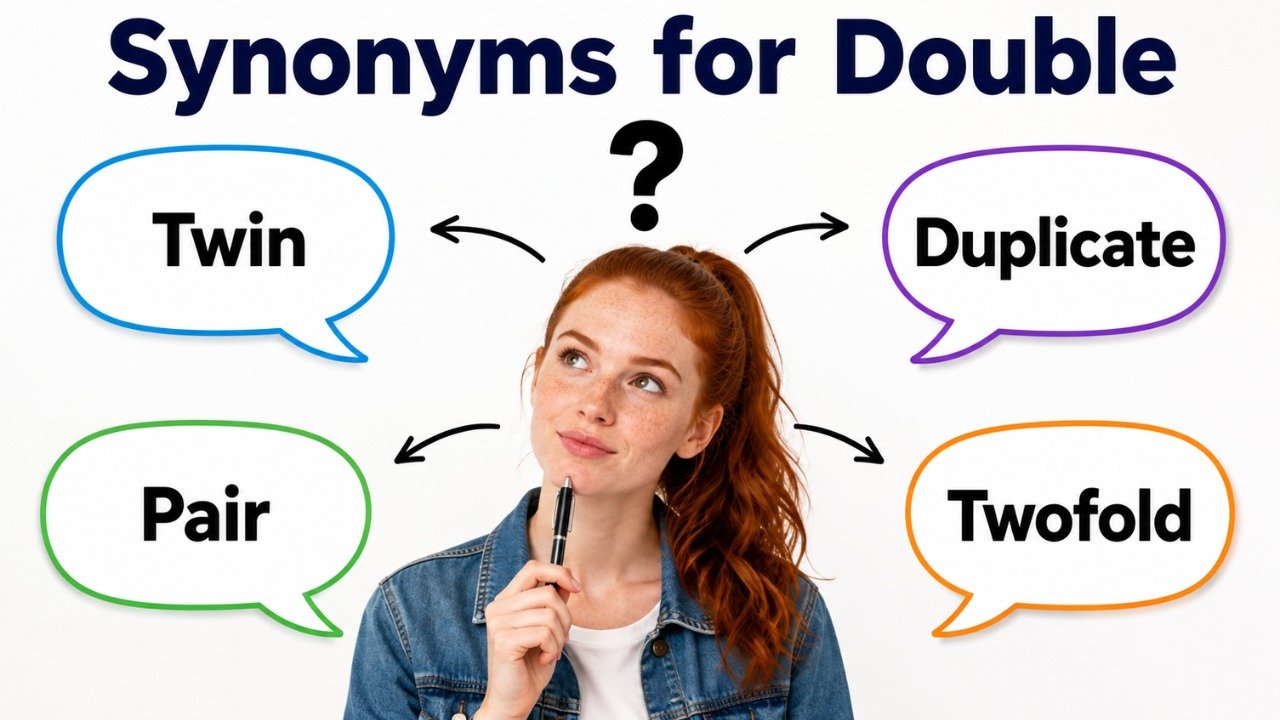
Quick Answer: The best synonyms for double include duplicate, twice, twofold, dual, paired, twin, replica, counterpart, repeat, and multiply by two. Use duplicate for an exact copy, twice for amounts and frequency, and twofold for formal writing about size, number, or degree. Dual describes something with two functions or parts, while paired and twin suit matching objects. Replica is best for a carefully made copy, counterpart describes a matching person or thing, and multiply by two is the clearest option in mathematical instructions.
Pronunciation and Word Details
Word: Double.
Pronunciation: /ˈdʌb.əl/
Part of Speech: Adjective, verb, noun, adverb, and determiner.
Meaning: Having two parts, being twice an amount, making a copy, or increasing something to two times its original size or number.
US Pronunciation:
UK Pronunciation:
What Does “Double” Mean?
Double means having two of something, being twice the original amount, making an exact or similar copy, or increasing something by two times.
The word can function as an adjective, verb, noun, adverb, or determiner. Its meaning changes according to the sentence.
As an adjective, double describes something that has two parts, two layers, two uses, or twice the usual amount.
Example: The room has double doors.
As a verb, double means to increase something until it becomes twice as large or numerous.
Example: The company plans to double its production.
As a noun, double can describe a copy, a matching person, a substitute performer, or an amount that is twice the usual size.
Example: The actor used a double during the difficult scene.
As an adverb or determiner, double means twice as much or twice as many.
Example: The larger package costs double the price.
Double may describe quantity, size, frequency, appearance, purpose, or repetition. The intended meaning usually becomes clear from the noun or verb that follows it.
Meaning, Tone, and Context of “Double”
Double is a common, neutral, and highly flexible word. It appears naturally in everyday speech, formal writing, mathematics, business, design, travel, entertainment, cooking, sports, and technical instructions.
The word is usually direct and conversational. It is not strongly emotional, polite, or impolite by itself. However, certain expressions containing double may carry stronger meanings.
In casual conversation, double often refers to twice an amount.
Example: I ordered double the usual portion.
In mathematics, double means multiplying a number by two.
Example: Double eight to get sixteen.
In business writing, double may describe a large increase in sales, costs, output, or demand.
Example: The organization hopes to double its membership.
In design and construction, it can describe two layers, sections, doors, windows, or functions.
Example: The building has double walls for added protection.
In entertainment, a double may be a person who resembles or replaces another performer.
Example: A double completed the action scene.
In formal writing, twofold, duplicate, dual, replica, or counterpart may sometimes express the intended meaning more precisely.
When and How to Use “Double”
For Twice the Amount
Use double when something is two times the original quantity, size, price, number, or strength.
Example: The larger container holds double the amount of water.
For Increasing a Number
Use double as a verb when a number or amount grows to twice its original level.
Example: The school hopes to double the number of available classes.
For Two Parts or Functions
Double can describe an object that contains two parts, layers, purposes, or features.
Example: The sofa serves a double purpose as seating and storage.
For Matching Objects
Use double when referring to two similar or matching items.
Example: The entrance is protected by double gates.
For an Exact Copy
Double can refer to a copy or version that closely matches the original.
Example: The artist created a double of the original figure.
For a Similar Person
A double may be a person who closely resembles someone else.
Example: Everyone thought the visitor was her double.
For a Substitute Performer
In performances, a double is someone who replaces another person during a particular scene or activity.
Example: A trained double performed the difficult movement.
For Repetition
Double may show that something occurs twice or contains repeated elements.
Example: The document had a double entry for the same payment.
For Emphasis
Double can emphasize that an amount, effort, or effect is much greater than before.
Example: The team worked at double speed to finish on time.
For Measurement
Double is useful when comparing a new measurement with an original one.
Example: The new table is double the width of the old one.
Best Synonyms for Double
Duplicate
Synonym: An exact or nearly exact copy of something.
Example: Keep a duplicate of the completed form.
Twice
Synonym: Two times as much, as many, or as often.
Example: This container is twice the size of the smaller one.
Twofold
Synonym: Twice as great, numerous, or important.
Example: The project produced a twofold increase in output.
Dual
Synonym: Having two parts, functions, purposes, or features.
Example: The device has a dual purpose.
Paired
Synonym: Arranged or used in a set of two.
Example: The room contains paired lamps beside the bed.
Twin
Synonym: One of two matching, connected, or very similar things.
Example: The building has twin towers.
Replica
Synonym: A carefully made copy of an original object.
Example: The museum displayed a replica of the ancient container.
Counterpart
Synonym: A person or thing that has a matching role, position, or function.
Example: She discussed the plan with her regional counterpart.
Repeat
Synonym: Something done, shown, or produced again.
Example: The second performance was a repeat of the first.
Multiply by Two
Synonym: To calculate twice the original number.
Example: Multiply the total by two to find the required amount.
50 Synonyms for Double with Short Meanings
- Duplicate: An exact or nearly exact copy.
- Twice: Two times as much or as often.
- Twofold: Twice as great or numerous.
- Doubled: Increased to two times the original amount.
- Dual: Having two parts, purposes, or functions.
- Paired: Arranged together in a set of two.
- Twin: One of two matching or closely connected things.
- Matching: Having the same or a very similar appearance.
- Identical: Exactly the same in every important detail.
- Equal: The same in quantity, size, value, or degree.
- Copy: Something made to resemble an original.
- Replica: A carefully produced copy of an object.
- Reproduction: A new version made from an original.
- Facsimile: An exact or highly accurate copy.
- Counterpart: A matching person or thing with a similar role.
- Second Copy: Another version of the same item.
- Repeat: Something performed or produced again.
- Repetition: The act of doing or saying something again.
- Echo: Something that closely repeats another sound, idea, or form.
- Mirror Image: An image or form that closely reflects another.
- Likeness: A strong similarity in appearance.
- Lookalike: A person or thing that closely resembles another.
- Stand In: A person who temporarily replaces someone else.
- Substitute: A person or thing used in place of another.
- Understudy: A performer prepared to replace another performer.
- Impersonator: A person who imitates someone else.
- Decoy: A substitute used to attract or misdirect attention.
- Doppelganger: A person who looks remarkably similar to another.
- Clone: A copy that closely matches the original.
- Replicate: To create a close or exact copy.
- Reproduce: To make another version of something.
- Copy Again: To produce another version from an original.
- Multiply by Two: To calculate twice the original number.
- Increase Twofold: To make something twice as large or numerous.
- Make Twice as Large: To increase size to two times the original.
- Make Twice as Many: To increase the number to two times the original.
- Pair: To place or use two things together.
- Couple: Two people or things considered together.
- Two Part: Consisting of two separate sections.
- Two Piece: Made from two main pieces.
- Binary: Consisting of or involving two parts or choices.
- Duplex: Having two connected units, sections, or functions.
- Twice the Amount: Two times the original quantity.
- Twice the Number: Two times the original count.
- Two Times the Quantity: A quantity multiplied by two.
- Extra Portion: An additional serving that increases the amount.
- Second Helping: Another serving of food.
- Carbon Copy: A person or thing that closely matches another.
- Duplicate Entry: Information entered more than once.
- Matching Set: Two or more items designed to look alike.
Read Also:
Synonyms For Acceptable

Synonyms for Double by Context
When Double Means Twice the Amount
Twice, twofold, doubled, twice the amount, and two times the quantity describe something that is two times greater than its original amount.
Twice is the most natural choice in ordinary comparisons.
Example: The new room is twice the size of the old room.
Twofold sounds more formal and is common in reports or analytical writing.
Example: The changes produced a twofold increase in participation.
Doubled emphasizes that a change has already happened.
Example: Attendance doubled during the final month.
Twice the amount is useful when discussing measurable quantities.
Example: The recipe requires twice the amount of water.
When Double Means an Exact Copy
Duplicate, copy, replica, reproduction, facsimile, clone, and carbon copy refer to something made from an original.
Duplicate is useful for documents, records, keys, files, and entries.
Example: Please keep a duplicate of the receipt.
Replica often describes a carefully made physical object.
Example: The display contains a replica of the original vessel.
Facsimile is formal and emphasizes accurate reproduction.
Example: The archive stores a facsimile of the old manuscript.
Carbon copy is often used figuratively for a person or thing that is almost identical to another.
Example: The smaller house is a carbon copy of the original design.
When Double Means Two Parts
Dual, paired, twin, binary, duplex, two part, and two piece describe something made from or involving two elements.
Dual is useful when something has two functions or features.
Example: The room has a dual purpose as an office and guest space.
Paired describes objects arranged together.
Example: Paired chairs were placed beside the window.
Twin suggests two matching or connected structures.
Example: The garden has twin entrances.
Duplex describes two connected units or a system with two parts.
Example: They moved into a duplex with separate living areas.
When Double Means to Increase by Two Times
Multiply by two, increase twofold, make twice as large, and make twice as many can replace double as a verb.
Multiply by two is best for calculations.
Example: Multiply the number by two to find the final total.
Increase twofold suits formal explanations and reports.
Example: The organization plans to increase production twofold.
Make twice as large is useful when describing physical size.
Example: The builder will make the opening twice as large.
Make twice as many works best for countable objects.
Example: The kitchen must make twice as many meals tomorrow.
When Double Means a Similar Person
Lookalike, doppelganger, likeness, carbon copy, and mirror image describe a person who resembles someone else.
Lookalike is the most natural everyday choice.
Example: The visitor was a convincing lookalike.
Doppelganger suggests a surprising or remarkable resemblance.
Example: People called him the singer’s doppelganger.
Mirror image emphasizes a very close visual similarity.
Example: The younger sister looked like a mirror image of the older one.
When Double Means a Substitute
Stand in, substitute, understudy, impersonator, and decoy describe someone or something used in place of another.
Stand in is common when a person temporarily replaces someone.
Example: A stand in attended the rehearsal.
Understudy is used for a performer prepared to replace another performer.
Example: The understudy learned every line of the main role.
Decoy describes a replacement used to distract or misdirect attention.
Example: The empty vehicle acted as a decoy.
Another Word for Double
Duplicate is often the best single replacement for double when the meaning is an exact or nearly exact copy. However, the strongest alternative depends on context.
Use twice for quantity, dual for two functions, replica for a copied object, counterpart for a matching role, and multiply by two for mathematical instructions.
Original: Please make a double of this document.
Better Option: Please make a duplicate of this document.
Original: The new room is double the size of the old room.
Better Option: The new room is twice the size of the old room.
Original: The table has a double purpose.
Better Option: The table has a dual purpose.
Original: Double the number before recording the result.
Better Option: Multiply the number by two before recording the result.
When Not to Use “Double”
Double can become vague when the reader does not know whether it refers to quantity, size, repetition, similarity, or two parts.
Use a more precise synonym when the exact meaning matters.
When discussing an exact copy, duplicate is usually clearer.
Weak: I placed a double in the folder.
Better: I placed a duplicate in the folder.
When comparing quantities, twice may sound more natural.
Weak: The new container holds double water.
Better: The new container holds twice as much water.
When describing two functions, dual is more precise.
Weak: The tool has a double use.
Better: The tool has a dual use.
When giving mathematical instructions, multiply by two avoids ambiguity.
Weak: Double the answer somehow.
Better: Multiply the answer by two.
Do not use double when you mean two separate but unrelated objects. Pair or two may be clearer.
Weak: She bought a double lamp.
Better: She bought a pair of lamps.
Avoid double when repetition rather than quantity is the main idea.
Weak: The document contains a double of the same paragraph.
Better: The document contains a repetition of the same paragraph.
Do not use double for a person unless the context clearly means a lookalike or substitute.
Weak: He is her double at work.
Better: He is her counterpart at work.
Words Commonly Confused With Double
Double vs Duplicate: Double can mean twice an amount, two parts, or a copy. Duplicate specifically refers to another copy of the same thing.
Double vs Twice: Double may function as an adjective, noun, or verb. Twice is mainly used to describe frequency or an amount that is two times greater.
Double vs Dual: Double often emphasizes quantity or two similar elements. Dual emphasizes two functions, purposes, systems, or qualities.
Double vs Twin: Double is a broad word for two or twice. Twin usually describes two matching, closely connected, or jointly created things.
Double vs Pair: Double may mean twice the amount or a copied version. Pair refers to two things considered or used together.
Double vs Copy: Double can refer to a similar person, repeated amount, or second version. Copy normally refers to something reproduced from an original.
Double vs Replica: A double may be any close copy or substitute. A replica is usually a deliberately created physical copy.
Double vs Twofold: Double is common in everyday language. Twofold is more formal and often describes an increase, effect, purpose, or division into two parts.
Double vs Counterpart: A double often resembles or replaces another person or thing. A counterpart has a similar position, role, or function.
Double vs Clone: Double is broad and neutral. Clone suggests an extremely close copy and may sound more technical or informal depending on context.
Which Synonym Should You Choose?
Choose duplicate when referring to documents, records, keys, files, entries, or exact copies.
Choose twice when comparing size, price, number, frequency, distance, or quantity in everyday language.
Choose twofold when writing formally about growth, change, benefits, risks, or effects.
Choose dual when something has two functions, purposes, systems, controls, or identities.
Choose paired when two objects are arranged, designed, or used together.
Choose twin when describing matching buildings, beds, engines, towers, or related structures.
Choose replica when discussing a carefully made copy of a physical object.
Choose counterpart when describing a person or thing with a similar role in another place or group.
Choose repeat when an action, event, statement, or performance happens again.
Choose copy when referring generally to something reproduced from an original.
Choose lookalike when describing a person who closely resembles someone else.
Choose stand in when someone temporarily replaces another person.
Choose understudy when discussing a performer prepared to replace the main performer.
Choose multiply by two in mathematical explanations, calculations, and instructions.
Choose increase twofold in formal reports about growth in sales, costs, demand, output, or participation.
Choose matching when appearance, color, style, or design is the main similarity.
Choose identical when two things are exactly the same in every relevant detail.
Choose equal when two amounts, measurements, values, or shares are the same.
Real Life Examples of “Double” in Sentences
Original: The new hall is double the size of the old one.
Better Option: The new hall is twice the size of the old one.
Original: Please keep a double of the signed form.
Better Option: Please keep a duplicate of the signed form.
Original: The desk performs a double function.
Better Option: The desk performs a dual function.
Original: The factory wants to double its daily output.
Better Option: The factory wants to increase its daily output twofold.
Original: The performer used a double during the difficult scene.
Better Option: The performer used a stand in during the difficult scene.
Original: The visitor looked like her double.
Better Option: The visitor looked like her doppelganger.
Original: Double the total before writing your answer.
Better Option: Multiply the total by two before writing your answer.
Original: The room contains double lamps beside the bed.
Better Option: The room contains paired lamps beside the bed.
Original: The second model is a double of the original.
Better Option: The second model is a replica of the original.
Original: The document includes a double entry.
Better Option: The document includes a duplicate entry.
Synonym Groups and Usage Differences
Quantity Group
Twice, twofold, doubled, twice the amount, and twice the number relate to quantity, size, frequency, or degree.
Twice is natural in conversation. Twofold is more formal. Doubled shows that an increase has already occurred.
Example: Demand doubled, creating a twofold increase over the original level.
Copy Group
Duplicate, copy, replica, reproduction, facsimile, clone, and carbon copy describe something created from an original.
Duplicate is common for documents and records. Replica suits physical objects. Facsimile suggests accuracy and formality.
Example: The archive keeps a facsimile and a duplicate of the original page.
Matching Group
Matching, identical, equal, twin, likeness, and mirror image emphasize similarity.
Matching means visually or functionally coordinated. Identical means exactly the same. Equal concerns amount, value, or measurement.
Example: The twin cabinets have matching handles and equal dimensions.
Two Part Group
Dual, paired, binary, duplex, two part, and two piece describe something containing two sections, features, or units.
Dual emphasizes two functions. Paired emphasizes arrangement. Binary is often technical.
Example: The dual system uses paired controls.
Increase Group
Multiply by two, increase twofold, make twice as large, and make twice as many express the action of doubling.
Multiply by two is mathematical. Increase twofold is formal. Make twice as many is useful with countable nouns.
Example: The plan will make twice as many spaces available.
Substitute Group
Stand in, substitute, understudy, impersonator, and decoy describe someone or something used in another’s place.
Stand in is temporary. Understudy is performance related. Decoy involves distraction or misdirection.
Example: The understudy served as a stand in during rehearsal.
Resemblance Group
Lookalike, doppelganger, carbon copy, mirror image, and likeness describe a strong visual similarity.
Lookalike is common and neutral. Doppelganger suggests an unusually close resemblance.
Example: The two strangers looked like mirror images of each other.
Repetition Group
Repeat, repetition, echo, second copy, and duplicate entry describe something that appears or happens again.
Repeat refers to a repeated action or event. Echo suggests a repeated sound, style, idea, or pattern.
Example: The final paragraph was an echo of an earlier statement.
Antonyms of Double
The opposite of double changes according to whether the word refers to quantity, copies, paired objects, or increase.
Single: Consisting of only one person, object, part, or unit.
Half: One of two equal parts of a whole.
Halved: Reduced to one half of the original amount.
Onefold: Existing as one amount or unit rather than two.
Sole: Being the only person or thing.
Unique: Existing as the only example of its kind.
Original: The first version from which a copy is made.
Unmatched: Not forming a pair with another item.
Unpaired: Not arranged or connected with another.
Different: Not the same as another person or thing.
Unequal: Not having the same amount, size, or value.
Reduced: Made smaller in size, number, quantity, or degree.
Decrease: To become or make something smaller.
Divide by Two: To calculate half of an amount.
Separate: Existing independently rather than as a connected pair.
Comparison: Double vs Related Words
Double vs Duplicate
Double has several meanings, including twice an amount, two parts, or a substitute person. Duplicate mainly means an additional copy.
Example With Double: The new package contains double the usual amount.
Example With Duplicate: Keep a duplicate of the payment record.
Double vs Twice
Double can describe, name, or perform an increase. Twice normally describes how many times something happens or how much greater it is.
Example With Double: The team plans to double its output.
Example With Twice: The team now produces twice as much output.
Double vs Twofold
Double is common in both formal and casual language. Twofold is more formal and frequently appears in reports, essays, and analytical explanations.
Example With Double: The number of participants may double.
Example With Twofold: The program produced a twofold increase in participation.
Double vs Dual
Double often refers to two of the same thing or twice an amount. Dual describes something with two functions, systems, purposes, or qualities.
Example With Double: The room has double windows.
Example With Dual: The room has a dual purpose.
Double vs Twin
Double is broad and can describe quantity, copies, or two parts. Twin refers to two closely matching or connected things.
Example With Double: The entrance has double doors.
Example With Twin: The entrance is framed by twin columns.
Double vs Pair
Double may describe twice an amount or an object with two elements. Pair specifically means two things considered or used together.
Example With Double: He ordered a double portion.
Example With Pair: She bought a pair of gloves.
Double vs Replica
A double may be a copy, substitute, or lookalike. A replica is usually a carefully made physical copy of an original object.
Example With Double: A double replaced the performer for one scene.
Example With Replica: The exhibition displayed a replica of the original statue.
Double vs Counterpart
A double resembles or replaces another person or thing. A counterpart has a corresponding position, function, or role.
Example With Double: The actor met someone who looked like his double.
Example With Counterpart: The manager spoke with her overseas counterpart.
Common Phrases and Expressions With “Double”
Double the Amount: Two times the original quantity.
Double the Size: Two times the original measurement or capacity.
Double the Price: Twice the original cost.
Double the Number: Twice the original count.
Double Purpose: Two different uses or functions.
Double Meaning: A word or statement that can be understood in two ways.
Double Portion: A serving that is twice the usual amount.
Double Room: A room designed to accommodate two people.
Double Doors: Two connected or matching doors placed together.
Double Entry: Information recorded twice, either intentionally or by mistake.
Double Check: To examine something again for accuracy.
Double Up: To share space, combine roles, or increase something by two.
Double Back: To return along the same path.
Double Standard: A rule applied differently to similar people or situations.
Double Take: A delayed reaction caused by surprise or disbelief.
Common Mistakes to Avoid
Confusing Double With Twice
Use double before a noun or as a verb. Use twice when describing frequency or comparison.
Incorrect: The new room is double bigger.
Correct: The new room is twice as big.
Correct: The new room is double the size.
Using Double With an Unclear Noun
Make sure the reader understands what has increased.
Vague: The project became double.
Clear: The project became double its original size.
Better: The project grew to twice its original size.
Confusing Double With Duplicate
Duplicate refers to a copy, while double has several broader meanings.
Unclear: Send me a double of the document.
Clear: Send me a duplicate of the document.
Using Double Instead of Dual
Use dual when two purposes, functions, or systems are involved.
Weak: The device has a double function.
Better: The device has a dual function.
Using Pair for Quantity
A pair always means two items considered together. It does not mean twice an amount.
Incorrect: The new container holds a pair amount of water.
Correct: The new container holds double the amount of water.
Repeating Double Too Often
Repeated use can make writing sound basic or imprecise.
Repetitive: The double doors led to a double room with double windows.
Better: The paired doors led to a room for two with twin windows.
Using Identical for Similar Objects
Identical means exactly the same. Use matching or similar when small differences exist.
Incorrect: The two handmade bowls are identical, although their patterns differ.
Better: The two handmade bowls are matching, although their patterns differ.
Using Replica for a Person
Replica usually describes an object. Lookalike or doppelganger is better for a person.
Unnatural: He is a replica of his brother.
Better: He is a lookalike of his brother.
Forgetting the Object After Double
As a verb, double usually needs a clear object or subject.
Vague: We need to double.
Clear: We need to double production.
Mixing Double and Twice Incorrectly
Do not use both terms together when one already expresses the full meaning.
Incorrect: The amount doubled twice as much.
Correct: The amount doubled.
Correct: The amount became twice as large.
Conclusion
Synonyms for double include duplicate, twice, twofold, dual, paired, twin, replica, counterpart, and repeat. Use twice for amounts and comparisons, duplicate for copies, and twofold for formal descriptions of growth or change. Dual is best for two functions, while paired and twin describe matching objects. Replica suits a carefully produced copy, and stand in describes a substitute person. Selecting the right alternative helps clarify whether double refers to quantity, repetition, similarity, structure, or an increase by two.
FAQs About Synonyms for Double
What Is the Best Synonym for Double?
Duplicate is the best synonym when double means a copy. Twice is best when it refers to amount, size, number, or frequency.
What Is a Formal Synonym for Double?
Twofold is a formal alternative for an amount or increase. Dual is suitable when something has two functions or parts.
Can Twice Replace Double?
Twice can replace double in many quantity comparisons. For example, double the size can become twice the size.
What Is Another Word for a Double Copy?
Duplicate, replica, reproduction, facsimile, and carbon copy can describe a second or copied version.
What Is Another Word for a Person’s Double?
Lookalike, doppelganger, stand in, impersonator, and carbon copy may describe a person who resembles another.
What Is the Difference Between Double and Dual?
Double often means twice an amount or two matching things. Dual means having two functions, systems, purposes, or qualities.
What Is the Opposite of Double?
Single is the most common opposite when referring to number or structure. Half, halved, unique, and original may be better in other contexts.
