
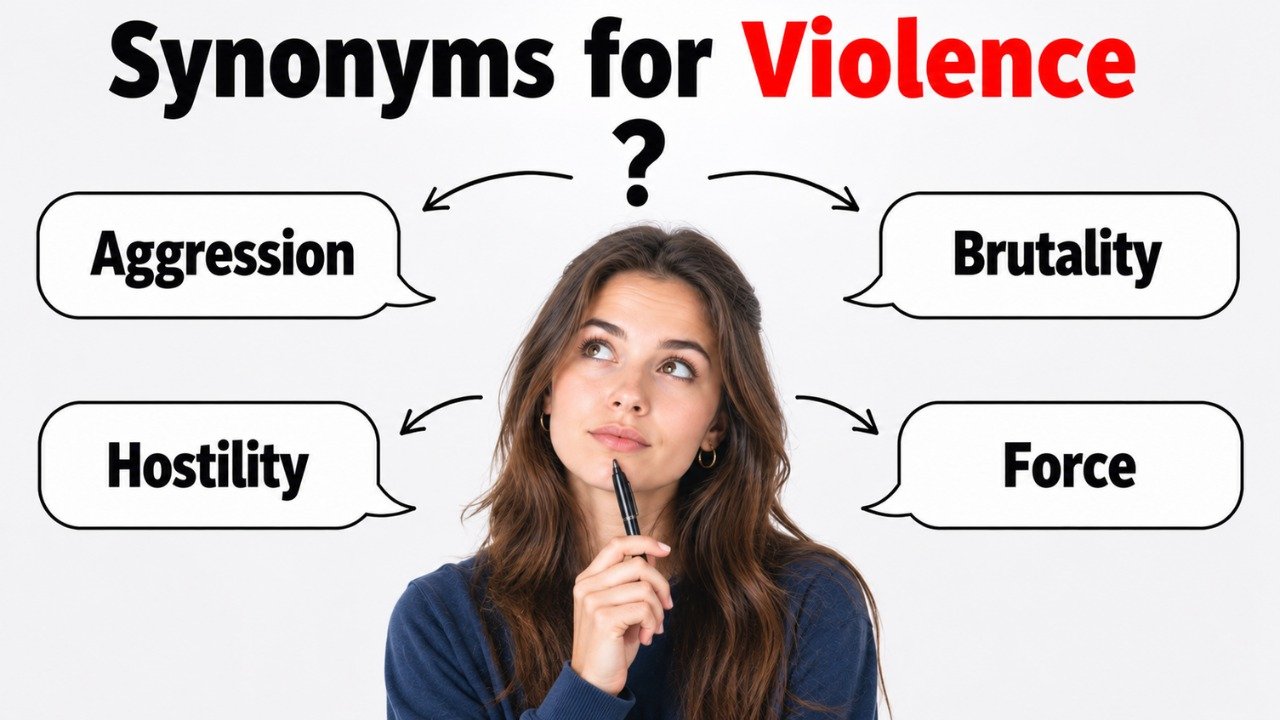
Quick Answer: The best synonyms for violence include force, aggression, brutality, bloodshed, assault, abuse, cruelty, conflict, coercion, and savagery. Use force for physical power, aggression for threatening or hostile behavior, and brutality for extreme cruelty. Assault is best when describing a direct physical attack, while abuse suits repeated harmful treatment. Bloodshed refers to injury or death during violent events. In formal reports, violence, assault, coercion, and armed conflict are precise choices. In casual speech, fighting, attack, and aggression often sound more natural.
Pronunciation and Word Details
Word: Violence.
Pronunciation: /ˈvaɪə.ləns/.
Part of Speech: Noun.
Meaning: The use of physical force or harmful behavior intended to injure, damage, threaten, or control.
US Pronunciation:
UK Pronunciation:
What Does “Violence” Mean?
Violence means the use of physical force or harmful actions that cause or may cause injury, damage, fear, or death. It is usually an uncountable noun.
The word can describe actions between individuals, groups, communities, or countries. It may refer to physical attacks, armed conflict, destruction of property, threatening behavior, or repeated abuse.
Physical Harm: The use of force to hurt another person.
Example: The organization created programs to reduce violence in the community.
Property Damage: Destructive behavior directed at buildings, vehicles, or other objects.
Example: The demonstration ended without violence or property damage.
Armed Conflict: Fighting that involves weapons or organized groups.
Example: Many families left the area because of continuing violence.
Domestic Harm: Physical or controlling behavior within a family or close relationship.
Example: The campaign raised awareness about domestic violence.
Emotional Emphasis: The word may also describe the extreme force or intensity of a movement, emotion, or natural event.
Example: The violence of the storm damaged several roofs.
Violence usually refers to harmful force, but the exact meaning depends on the sentence. In news writing, it may describe public disorder or armed conflict. In legal writing, it may refer to physical harm, threats, or criminal conduct. In social discussions, it may include abuse, intimidation, or coercive control.
Meaning, Tone, and Context of “Violence”
Violence is a strong and serious word. It usually has a negative emotional meaning because it is associated with harm, fear, injury, destruction, and loss.
Tone: Strong, serious, negative, and often emotional.
Formality: Suitable for both formal and everyday communication.
Academic Context: Used in research about crime, society, conflict, behavior, public safety, and prevention.
Legal Context: Used when discussing assault, threats, abuse, criminal force, or harmful conduct.
News Context: Used for fighting, public disorder, attacks, riots, and armed conflict.
Social Context: Used when discussing community safety, domestic abuse, bullying, and harmful behavior.
Historical Context: Used to describe wars, revolutions, persecution, and political conflict.
Conversational Context: Used when people discuss fights, attacks, or dangerous situations.
The word should be used carefully because it can describe many different levels of harm. A minor disagreement is not necessarily violence. Similarly, aggression may be verbal or emotional without becoming physically violent.
More specific words often improve clarity. Assault identifies a direct physical attack. Abuse describes harmful treatment over time. Bloodshed emphasizes injury or death. Brutality describes extreme cruelty. Coercion focuses on control through threats or force.
When and How to Use “Violence”
For Physical Attacks
Use violence when someone deliberately uses physical force to harm another person.
Example: The school has strict rules against violence.
For Public Disorder
Use violence when protests, crowds, or disturbances involve attacks, destruction, or dangerous behavior.
Example: Community leaders appealed for calm after the outbreak of violence.
For Armed Conflict
Use violence when discussing fighting between organized groups or countries.
Example: Years of violence forced thousands of residents to leave the region.
For Domestic Harm
Use violence when referring to physical or threatening behavior within a family or close relationship.
Example: Support services are available for people affected by domestic violence.
For Criminal Behavior
Use violence when a crime involves force, injury, or a serious threat of harm.
Example: The report examined crimes involving violence.
For Harmful Control
Use violence when physical force or threats are used to control, frighten, or punish another person.
Example: The policy recognizes that violence may be used as a form of control.
For Destruction
Use violence when harmful actions cause severe damage to property or surroundings.
Example: The sudden violence damaged several buildings in the town center.
For Extreme Natural Force
Violence can describe the powerful and destructive intensity of a storm, explosion, or movement.
Example: The violence of the wind surprised even experienced sailors.
For Strong Emotional Intensity
In literary writing, violence may describe an unusually powerful emotion or reaction.
Example: He was shocked by the violence of her response.
Best Synonyms for Violence
Force
Synonym: Physical power used to make something happen or to overcome resistance.
Example: The guard was trained to avoid unnecessary force.
Aggression
Synonym: Hostile, threatening, or attacking behavior.
Example: The program teaches students how to respond to aggression calmly.
Brutality
Synonym: Extreme physical cruelty or harsh treatment.
Example: Witnesses described the brutality of the attack.
Bloodshed
Synonym: Injury or death caused during fighting or violent conflict.
Example: Negotiators worked to prevent further bloodshed.
Assault
Synonym: A direct physical attack or an unlawful threat of physical harm.
Example: The victim reported the assault immediately.
Abuse
Synonym: Cruel, harmful, or controlling treatment of another person.
Example: The organization provides support for survivors of abuse.
Cruelty
Synonym: Deliberate behavior that causes pain or suffering.
Example: The law protects animals from cruelty.
Conflict
Synonym: Serious disagreement or fighting between people or groups.
Example: Both sides agreed to seek a peaceful end to the conflict.
Coercion
Synonym: The use of threats, pressure, or force to control someone.
Example: The agreement must be accepted freely and without coercion.
Savagery
Synonym: Extremely cruel, fierce, or violent behavior.
Example: The novel describes the savagery of the battle without celebrating it.
50 Synonyms for Violence with Short Meanings
- Force: Physical power used against someone or something.
- Aggression: Hostile or threatening behavior.
- Brutality: Extreme cruelty involving severe force.
- Bloodshed: Injury or death caused by violent conflict.
- Conflict: Serious disagreement that may involve fighting.
- Assault: A direct physical attack or threat of attack.
- Abuse: Harmful, cruel, or controlling treatment.
- Cruelty: Deliberate behavior that causes suffering.
- Savagery: Fierce and extremely cruel behavior.
- Coercion: Control through threats, pressure, or force.
- Hostility: Unfriendly or aggressive behavior.
- Fighting: Physical struggle between people or groups.
- Warfare: Organized armed conflict between opposing sides.
- Combat: Active fighting, especially during military conflict.
- Attack: An attempt to harm a person, group, or place.
- Battery: Unlawful physical contact or harmful force.
- Maltreatment: Cruel or improper treatment of someone.
- Mistreatment: Unfair, harmful, or abusive treatment.
- Persecution: Repeated cruel treatment based on identity or beliefs.
- Oppression: Cruel or unjust control over people.
- Intimidation: Behavior intended to frighten or control someone.
- Terror: Extreme fear caused by threats or violent actions.
- Destruction: Severe damage caused to objects or places.
- Devastation: Widespread and serious damage or suffering.
- Lawlessness: Behavior that ignores laws and social order.
- Disorder: A lack of control that may involve dangerous behavior.
- Unrest: Public tension, protest, or disturbance.
- Rioting: Violent disorder involving a crowd.
- Rampage: A period of uncontrolled and destructive behavior.
- Mayhem: Violent confusion, disorder, or destruction.
- Ferocity: Fierce and intense aggression.
- Viciousness: Deliberate cruelty or harmful aggression.
- Harshness: Severe or cruel treatment.
- Roughness: Forceful or physically severe behavior.
- Vehemence: Great emotional force or intensity.
- Intensity: An extreme degree of force or strength.
- Severity: The quality of being serious, harsh, or damaging.
- Physical Force: Bodily power used to control or injure.
- Violent Action: An act involving harmful physical force.
- Aggressive Behavior: Conduct that threatens or attacks others.
- Armed Conflict: Organized fighting involving weapons.
- Civil Conflict: Fighting between groups within one country.
- Domestic Abuse: Harmful behavior within a family or close relationship.
- Physical Abuse: Intentional physical harm or injury.
- Violent Conduct: Behavior involving force, harm, or threats.
- Violent Crime: Criminal activity involving force or serious threats.
- Violent Confrontation: A disagreement that develops into physical conflict.
- Violent Resistance: Physical force used to oppose authority or control.
- Violent Outburst: A sudden expression of destructive aggression.
- Violent Disturbance: Public disorder involving physical harm or destruction.
Read Also:
Synonyms for Everything

Synonyms for Violence by Context
When Violence Means Physical Force
These alternatives describe the use of bodily power against a person or object.
Force: Physical power used to control, move, or overcome resistance.
Example: Officers were instructed to use the minimum necessary force.
Physical Force: Bodily strength used against someone or something.
Example: The situation was resolved without physical force.
Roughness: Forceful handling that may cause discomfort or harm.
Example: The coach warned the players against unnecessary roughness.
Battery: Unlawful and harmful physical contact in a legal context.
Example: The charge involved both assault and battery.
When Violence Means an Attack
These words are useful when describing a direct attempt to harm someone.
Assault: A physical attack or a serious threat of attack.
Example: The authorities investigated the reported assault.
Attack: An act intended to harm a person, group, or place.
Example: Emergency workers responded quickly after the attack.
Aggression: Hostile behavior that may lead to an attack.
Example: Early intervention can prevent aggression from becoming physical.
Violent Action: A harmful act involving physical force.
Example: The policy prohibits threats and violent action.
When Violence Means Extreme Cruelty
These synonyms emphasize suffering, cruelty, or unusually harsh conduct.
Brutality: Severe and shocking cruelty.
Example: The report documented the brutality experienced by prisoners.
Cruelty: Intentional behavior that causes pain or suffering.
Example: The court considered evidence of repeated cruelty.
Savagery: Extremely fierce and cruel behavior.
Example: The story presents the savagery of war as a tragedy.
Viciousness: Deliberate and harmful cruelty.
Example: The viciousness of the attack shocked the community.
When Violence Means Armed Fighting
These alternatives work in discussions of war, organized conflict, or military action.
Warfare: Organized fighting between countries or groups.
Example: Years of warfare damaged the region’s economy.
Combat: Direct fighting between armed forces.
Example: The soldiers received training before entering combat.
Armed Conflict: Organized fighting involving weapons.
Example: Medical workers continued serving civilians during the armed conflict.
Bloodshed: Injury and death resulting from violent fighting.
Example: The peace agreement helped prevent more bloodshed.
When Violence Means Public Disorder
These words describe community disturbances, crowd violence, or social instability.
Rioting: Violent and destructive behavior by a crowd.
Example: Several streets were closed during the rioting.
Unrest: Public tension or disturbance that may become violent.
Example: Officials called for dialogue during the period of unrest.
Disorder: A breakdown of control or public peace.
Example: The event ended peacefully despite concerns about disorder.
Mayhem: Dangerous confusion involving destruction or violence.
Example: Poor planning created confusion, but the organizers prevented mayhem.
When Violence Means Harmful Treatment
These alternatives are useful when the harm is repeated, controlling, or directed at a vulnerable person.
Abuse: Harmful or controlling treatment.
Example: The training helps employees recognize signs of abuse.
Maltreatment: Cruel, improper, or neglectful treatment.
Example: The investigation found evidence of maltreatment.
Mistreatment: Unfair or harmful treatment of a person or animal.
Example: The complaint involved the mistreatment of workers.
Oppression: Cruel or unjust control of a group.
Example: The movement opposed years of political oppression.
When Violence Means Threatening Control
These words focus on fear, pressure, or control rather than direct physical injury.
Coercion: Forcing someone to act through threats or pressure.
Example: A valid decision must be made without coercion.
Intimidation: Frightening someone to influence their behavior.
Example: Witness intimidation can prevent people from reporting a crime.
Terror: Extreme fear created through threats or harmful acts.
Example: Residents lived in terror during the period of instability.
Hostility: Strong unfriendliness that may lead to aggression.
Example: Calm discussion reduced the hostility between the groups.
When Violence Means Extreme Intensity
Violence can sometimes describe powerful force rather than deliberate human harm.
Ferocity: Fierce force or intensity.
Example: The ferocity of the storm damaged the coastline.
Intensity: A very high degree of strength or force.
Example: The intensity of the explosion broke nearby windows.
Severity: The seriousness or damaging strength of an event.
Example: Experts underestimated the severity of the storm.
Vehemence: Strong emotional force in speech or behavior.
Example: She rejected the accusation with unexpected vehemence.
Another Word for Violence
The best general replacement for violence is aggression when the context involves hostile or threatening behavior. However, force is better for physical power, assault for a direct attack, and brutality for extreme cruelty.
The most accurate synonym depends on the type, severity, and setting of the harmful behavior.
Original: The school is working to prevent violence.
Better Option: The school is working to prevent aggressive behavior and physical fighting.
Original: The report described violence against the prisoners.
Better Option: The report described the brutality and mistreatment experienced by the prisoners.
Original: Violence began between the two groups.
Better Option: A violent confrontation began between the two groups.
Original: The agreement was accepted under violence.
Better Option: The agreement was accepted under coercion and threats.
When Not to Use “Violence”
Violence should not be used when a more specific word can identify the exact behavior. It may sound vague, exaggerated, repetitive, or inaccurate when the sentence does not involve physical harm, threats, or destructive force.
When Describing a Verbal Disagreement
Weak: There was violence during the discussion.
Better: There was a heated verbal argument during the discussion.
A strong disagreement is not automatically violence.
When the Action Is Specifically an Assault
Weak: The police investigated an incident of violence.
Better: The police investigated a reported assault.
Assault gives readers a clearer description of the incident.
When Referring to Repeated Harmful Treatment
Weak: The worker experienced violence from the supervisor.
Better: The worker reported repeated abuse and intimidation by the supervisor.
Abuse and intimidation may describe the pattern more accurately.
When Discussing Military Fighting
Weak: Violence continued between the two armies.
Better: Armed conflict continued between the two armies.
Armed conflict is more precise in formal or historical writing.
When Describing Extreme Cruelty
Weak: The report described violence in the prison.
Better: The report described brutality and maltreatment in the prison.
Brutality emphasizes the severity of the conduct.
When the Claim Is Too Broad
Weak: Entertainment causes violence.
Better: Researchers continue to examine factors that may influence aggressive behavior.
Broad claims about violence require evidence and careful wording.
When Repetition Weakens the Paragraph
Weak: Violence increased, violence affected families, and violence damaged the community.
Better: Violent incidents increased, families experienced greater fear, and the community suffered lasting harm.
Specific language makes the paragraph clearer and less repetitive.
When the Event Is Only Intense
Weak: The speaker answered with violence.
Better: The speaker answered with anger and vehemence.
Violence normally suggests harm or physical force. Vehemence describes powerful expression without necessarily suggesting an attack.
Words Commonly Confused With Violence
Violence vs Aggression: Violence usually involves physical force, injury, destruction, or a serious threat. Aggression includes hostile behavior that may be physical, verbal, or emotional. Aggression can lead to violence, but not all aggression is violent.
Violence vs Force: Force means physical power used to achieve a result. It may be lawful, controlled, or necessary in some contexts. Violence usually suggests harmful, excessive, or unlawful force.
Violence vs Assault: Violence is a broad category of harmful behavior. Assault is a specific attack or threat of physical harm. An assault is a form of violence, but violence includes many other actions.
Violence vs Abuse: Violence often refers to physical harm or destructive action. Abuse includes physical, emotional, verbal, sexual, or financial mistreatment. Some abuse is violent, but not every form of abuse involves direct physical force.
Violence vs Brutality: Violence is a general word for harmful force. Brutality describes violence or treatment that is exceptionally cruel, severe, or shocking.
Violence vs Conflict: Conflict means disagreement or opposition. It may be peaceful, verbal, political, or military. Violence occurs only when the conflict includes harmful force or destructive action.
Violence vs Hostility: Hostility is strong unfriendliness, anger, or opposition. It may create tension without becoming physically violent.
Violence vs Coercion: Violence involves harmful force or destructive behavior. Coercion involves making someone act through pressure, threats, or force. Coercion may occur without an actual physical attack.
Violence vs Bloodshed: Violence includes many harmful acts. Bloodshed specifically emphasizes injury or death during fighting.
Violence vs Cruelty: Violence focuses on harmful force. Cruelty focuses on deliberately causing suffering and may be physical or emotional.
Which Synonym Should You Choose?
Choose force when describing physical power used to control a person, object, or situation.
Choose aggression when discussing hostile, threatening, or attacking behavior that may not yet involve physical harm.
Choose brutality when the action is extremely cruel, severe, or shocking.
Choose assault when referring to a specific physical attack or serious threat of attack.
Choose abuse when describing repeated harmful, controlling, or degrading treatment.
Choose bloodshed when emphasizing injuries or deaths caused by conflict.
Choose armed conflict when writing about organized fighting between political, military, or social groups.
Choose warfare when discussing sustained military action between opposing sides.
Choose fighting for casual descriptions of a physical struggle.
Choose cruelty when the main idea is deliberate suffering rather than physical force alone.
Choose coercion when someone is controlled through pressure, threats, or force.
Choose intimidation when fear is used to influence another person.
Choose unrest when discussing public tension that may include protest or disorder.
Choose rioting when a crowd engages in destructive or violent behavior.
Choose persecution when a person or group experiences repeated cruel treatment because of identity, beliefs, or background.
Choose oppression when writing about long term unjust control by a powerful group.
Choose devastation when the main focus is widespread damage rather than the action itself.
Choose vehemence when describing strong emotion or forceful speech without physical harm.
Choose violence in general writing when several types of harmful force are being discussed together.
Real Life Examples of “Violence” in Sentences
Original: The city introduced new programs to reduce violence.
Better Option: The city introduced new programs to reduce aggression and physical fighting.
Original: Violence occurred after the sporting event.
Better Option: A violent confrontation occurred after the sporting event.
Original: The report examined violence in the home.
Better Option: The report examined domestic abuse and controlling behavior in the home.
Original: The leaders met to stop the violence.
Better Option: The leaders met to end the armed conflict and prevent further bloodshed.
Original: The prisoner described the violence he experienced.
Better Option: The prisoner described the brutality and mistreatment he experienced.
Original: The teacher discussed the causes of violence.
Better Option: The teacher discussed the causes of aggression and violent behavior.
Original: The protest ended in violence.
Better Option: The protest ended in rioting and public disorder.
Original: The agreement was obtained through violence.
Better Option: The agreement was obtained through coercion and intimidation.
Original: The violence of the storm destroyed several structures.
Better Option: The ferocity of the storm destroyed several structures.
Original: The novel explores the effects of violence on families.
Better Option: The novel explores the effects of conflict, abuse, and bloodshed on families.
Synonym Groups and Usage Differences
Physical Force Group
This group includes force, physical force, assault, battery, attack, and fighting. These words describe direct physical action.
Force is broad and may be controlled or lawful. Assault and battery are more specific legal terms. Attack emphasizes an attempt to cause harm. Fighting describes a physical struggle between opposing sides.
Example: The officers resolved the incident without using physical force.
Aggressive Behavior Group
This group includes aggression, hostility, intimidation, violent conduct, and aggressive behavior. These words describe threatening attitudes or actions.
Aggression may be physical or verbal. Hostility describes unfriendly opposition. Intimidation focuses on creating fear. Violent conduct refers to behavior involving harmful force.
Example: The training helps staff recognize aggression before it becomes physical.
Extreme Cruelty Group
This group includes brutality, cruelty, savagery, viciousness, harshness, and maltreatment.
Brutality describes severe and shocking cruelty. Savagery suggests uncontrolled fierceness. Viciousness emphasizes deliberate harmfulness. Maltreatment refers to improper or abusive treatment.
Example: The investigation uncovered serious cruelty and maltreatment.
Armed Conflict Group
This group includes warfare, combat, armed conflict, civil conflict, and bloodshed.
Warfare describes organized military activity. Combat refers to direct fighting. Armed conflict is a broad formal term. Civil conflict occurs within a country. Bloodshed focuses on injuries and deaths.
Example: Peace talks were arranged to bring the armed conflict to an end.
Abuse and Control Group
This group includes abuse, domestic abuse, physical abuse, coercion, oppression, and persecution.
Abuse describes harmful treatment. Coercion focuses on forced compliance. Oppression refers to unjust control over a group. Persecution describes repeated mistreatment based on identity or beliefs.
Example: The policy protects workers from abuse, coercion, and intimidation.
Public Disorder Group
This group includes unrest, rioting, disorder, lawlessness, mayhem, and violent disturbance.
Unrest describes public tension or instability. Rioting involves crowd violence. Disorder is broader and may not always involve attacks. Mayhem suggests dangerous confusion and destruction.
Example: Community leaders worked together to prevent unrest from becoming rioting.
Damage Group
This group includes destruction, devastation, mayhem, and violent action.
Destruction focuses on physical damage. Devastation describes widespread and serious damage. Mayhem combines confusion with destructive behavior.
Example: The violent disturbance caused extensive destruction in the area.
Intensity Group
This group includes ferocity, vehemence, intensity, and severity.
These words can describe powerful emotions, speech, weather, movement, or destructive events. They do not always imply deliberate physical harm.
Example: The ferocity of the storm surprised local residents.
Antonyms of Violence
The opposite of violence depends on whether the sentence concerns physical behavior, social conditions, emotional control, or conflict resolution.
Peace: Freedom from fighting, war, or violent disturbance.
Nonviolence: The rejection of physical force as a method of achieving change.
Calm: A state without anger, panic, or disorder.
Harmony: Peaceful agreement between people or groups.
Safety: Protection from injury, danger, or harm.
Gentleness: Kind and careful behavior without harmful force.
Restraint: The ability to control strong emotions or actions.
Cooperation: Working together toward a shared purpose.
Compromise: An agreement reached through mutual adjustment.
Reconciliation: The restoration of peaceful relations after conflict.
Protection: Action taken to keep someone safe from harm.
Care: Concern shown through kind and responsible treatment.
Kindness: Friendly and considerate behavior.
Order: A peaceful and controlled social condition.
Stability: A state of security without sudden conflict or disorder.
Comparison: Violence vs Related Words
Violence vs Aggression
Violence involves harmful physical force, serious threats, or destruction. Aggression is broader and may include hostile speech, gestures, or attitudes.
Example With Violence: The policy prohibits violence in the workplace.
Example With Aggression: The training teaches workers how to respond to verbal aggression.
Violence vs Force
Violence usually has a harmful or destructive meaning. Force is neutral and may refer to any physical power, including controlled or lawful action.
Example With Violence: The community condemned the violence.
Example With Force: The door required considerable force to open.
Violence vs Assault
Violence is a general category. Assault is a specific act involving an attack or credible threat of physical harm.
Example With Violence: The study examined violence among young adults.
Example With Assault: The witness reported the assault to the authorities.
Violence vs Abuse
Violence often involves physical harm. Abuse includes repeated physical, emotional, verbal, or controlling behavior.
Example With Violence: The argument developed into violence.
Example With Abuse: The support center assists people experiencing emotional abuse.
Violence vs Brutality
Violence describes harmful force generally. Brutality emphasizes extreme cruelty and severity.
Example With Violence: The conflict involved repeated violence.
Example With Brutality: Survivors spoke about the brutality they had experienced.
Violence vs Conflict
Conflict is disagreement or opposition and can remain peaceful. Violence occurs when harmful force or destruction becomes involved.
Example With Violence: Several people were injured during the violence.
Example With Conflict: The two departments resolved the conflict through discussion.
Violence vs Bloodshed
Violence may involve threats, attacks, or destruction. Bloodshed specifically refers to injury or death caused by fighting.
Example With Violence: Residents feared another outbreak of violence.
Example With Bloodshed: Negotiators acted quickly to prevent further bloodshed.
Violence vs Coercion
Violence uses harmful force. Coercion forces someone to act through threats, pressure, or fear.
Example With Violence: The law prohibits threats of violence.
Example With Coercion: The signature was obtained through coercion.
Violence vs Cruelty
Violence focuses on force and physical harm. Cruelty focuses on the deliberate creation of pain or suffering.
Example With Violence: The documentary examines the effects of violence.
Example With Cruelty: The law contains penalties for animal cruelty.
Common Phrases and Expressions With “Violence”
Act of Violence: A specific action involving harmful physical force.
Example: The attack was treated as a serious act of violence.
Cycle of Violence: A repeated pattern in which harmful behavior continues over time.
Example: Early support can help families break the cycle of violence.
Threat of Violence: A warning or suggestion that physical harm may occur.
Example: The employee reported a threat of violence.
Outbreak of Violence: A sudden beginning of attacks or public disorder.
Example: Authorities appealed for calm after the outbreak of violence.
Domestic Violence: Harmful or controlling behavior within a family or close relationship.
Example: The center provides confidential assistance to people affected by domestic violence.
Political Violence: Harmful force used for political goals or against political groups.
Example: The report examined the causes of political violence.
Armed Violence: Harmful action involving weapons.
Example: Community programs were introduced to reduce armed violence.
Violence Prevention: Actions intended to stop harmful behavior before it occurs.
Example: Education is an important part of violence prevention.
Violence Against Civilians: Harmful acts directed at people who are not taking part in fighting.
Example: The agreement called for an end to violence against civilians.
Violence Free: Without physical attacks, threats, or harmful behavior.
Example: Every child deserves a safe and violence free environment.
Common Mistakes to Avoid
Treating Every Conflict as Violence
Conflict can involve peaceful disagreement. Use violence only when harmful force, serious threats, or destruction are present.
Incorrect: The colleagues had violence over the schedule.
Correct: The colleagues had a disagreement over the schedule.
Using Violence as a Countable Noun
Violence is generally uncountable. Do not usually write violences or a violence.
Incorrect: Several violences occurred during the event.
Correct: Several violent incidents occurred during the event.
Also Correct: Several acts of violence occurred during the event.
Confusing Violence With Aggression
Aggression may include rude language, hostile gestures, or threatening behavior without physical harm.
Unclear: His rude comment was an act of violence.
Better: His rude comment was an act of verbal aggression.
Using Force as an Exact Replacement
Force does not always have a negative meaning. It can describe ordinary physical power.
Incorrect Meaning: She used violence to push the heavy table.
Better: She used force to push the heavy table.
Using Violence Too Broadly
Vague statements may hide important differences between assault, abuse, armed conflict, and public disorder.
Vague: The report discusses violence.
Clear: The report discusses domestic abuse, physical assault, and community fighting.
Repeating Violence Too Often
Use specific alternatives when the context is already clear.
Repetitive: Violence increased after the violence began in the neighboring area.
Improved: Violent incidents increased after unrest began in the neighboring area.
Choosing an Overly Dramatic Synonym
Brutality, savagery, and bloodshed have stronger meanings than violence. Use them only when the severity supports the description.
Exaggerated: The two students showed savagery during a verbal disagreement.
Accurate: The two students showed hostility during a verbal disagreement.
Confusing Violence With Vehemence
Vehemence means emotional force or intensity. It does not necessarily involve physical harm.
Incorrect: She rejected the proposal with violence.
Correct: She rejected the proposal with vehemence.
Misspelling the Word
The correct spelling is violence.
Incorrect: Violance.
Correct: Violence.
Making Unsupported General Claims
Statements about the causes of violence should be specific and supported by reliable evidence.
Weak: One single factor causes all violence.
Better: Violence may be influenced by several personal, social, and environmental factors.
Conclusion
Synonyms for violence include force, aggression, brutality, assault, abuse, bloodshed, conflict, coercion, and cruelty. Choose assault for a direct attack, aggression for hostile behavior, and brutality for extreme cruelty. Armed conflict and warfare suit military contexts, while abuse and coercion describe harmful control. Because violence is a broad and serious word, the best alternative should identify the exact action, level of harm, and setting. Specific wording makes reports, essays, explanations, and everyday communication clearer and more accurate.
FAQs About Synonyms for Violence
What Is the Best Synonym for Violence?
Aggression is a useful general alternative, but the best choice depends on context. Use assault for an attack, brutality for extreme cruelty, and force for physical power.
What Is a Formal Synonym for Violence?
Armed conflict, physical force, violent conduct, coercion, and brutality are suitable formal alternatives. Choose the word that accurately describes the action.
What Is a Stronger Word Than Violence?
Brutality, savagery, and bloodshed can sound stronger than violence. They should only be used when the situation involves extreme cruelty, fierce behavior, injury, or death.
Are Violence and Aggression the Same?
No. Aggression includes hostile or threatening behavior, while violence usually involves physical harm, destruction, or a serious threat of force.
What Is Another Word for Physical Violence?
Assault, physical abuse, battery, physical force, and violent attack are useful alternatives. Assault and battery may have specific legal meanings.
What Is the Opposite of Violence?
Peace and nonviolence are the most direct opposites. Other antonyms include calm, harmony, gentleness, restraint, cooperation, and reconciliation.
Is Violence a Countable or Uncountable Noun?
Violence is usually an uncountable noun. Write acts of violence, violent incidents, or forms of violence when referring to separate events.
