
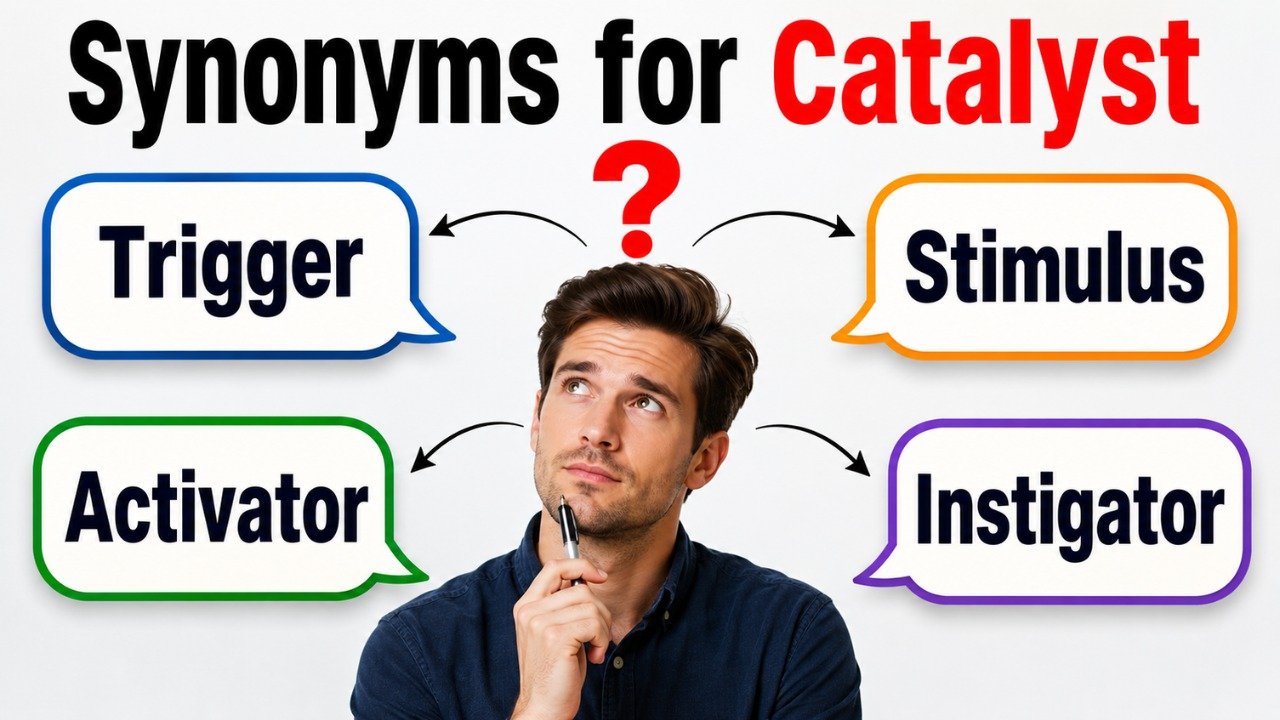
Quick Answer: The best synonyms for catalyst include trigger, stimulus, spark, impetus, driver, agent, initiator, accelerator, facilitator, and change agent. Trigger is the best general replacement for something that starts an event. Spark works naturally in conversation and creative writing. Impetus is suitable for formal essays and reports, while driver describes a force behind growth or progress. In chemistry, catalytic agent is the most accurate alternative. The right choice among the synonyms for catalyst depends on whether the word refers to a chemical substance, influential person, motivating force, or event that causes change.
Pronunciation and Word Details
Word: Catalyst.
Pronunciation: /ˈkæt.əl.ɪst/
Part of Speech: Noun.
Meaning: A substance, person, event, or influence that causes or speeds up change.
US Pronunciation:
UK Pronunciation:
What Does “Catalyst” Mean?
Catalyst means something that causes a process, event, reaction, or important change to begin or happen more quickly.
Catalyst is a noun. It has both a scientific meaning and a figurative meaning.
In chemistry, a catalyst is a substance that increases the speed of a chemical reaction without being permanently consumed by that reaction.
Example: The scientist added a catalyst to speed up the reaction.
In everyday and formal writing, catalyst refers to a person, event, idea, or influence that produces change.
Example: The public discussion became a catalyst for reform.
A person can be called a catalyst when that person encourages action, connects people, introduces an idea, or makes progress possible.
Example: Her leadership made her a catalyst for improvement within the organization.
An event can also serve as a catalyst if it causes people to reconsider a situation or take action.
Example: The sudden shortage was a catalyst for changes in production.
The word does not always mean the complete cause of an outcome. A catalyst may simply start, strengthen, or accelerate a process that was already possible.
Meaning, Tone, and Context of “Catalyst”
Catalyst has a neutral to formal tone. It is widely used in academic, scientific, professional, economic, political, educational, and conversational contexts.
In chemistry, catalyst is a precise technical term. It describes a substance that changes the rate of a reaction while remaining chemically unchanged at the end of the process, although it may temporarily participate during the reaction.
In business and professional writing, catalyst often describes something that encourages growth, innovation, development, or organizational change.
Example: New investment became a catalyst for regional growth.
In social and historical writing, catalyst can refer to an event that causes reform, conflict, protest, cooperation, or another major development.
Example: The announcement acted as a catalyst for public debate.
In casual conversation, catalyst may sound slightly formal. Words such as spark, trigger, push, or boost may sound more natural.
Example: Her encouragement gave him the push he needed.
Catalyst can describe positive or negative change. A new discovery may be a catalyst for progress, while a crisis may be a catalyst for instability.
The word usually emphasizes influence and movement. It suggests that something caused an existing possibility to become active, urgent, or faster.
When and How to Use “Catalyst”
For Chemical Reactions: Use catalyst for a substance that speeds up a chemical reaction without being permanently used up.
Example: The catalyst increased the reaction rate at a lower temperature.
For Social Change: Use catalyst for an event, person, or idea that begins or accelerates change in society.
Example: The speech became a catalyst for wider public discussion.
For Business Growth: Use catalyst for an investment, strategy, product, or decision that encourages development.
Example: Improved training served as a catalyst for higher productivity.
For Personal Development: Use catalyst for an experience or influence that motivates someone to change.
Example: The difficult experience became a catalyst for personal growth.
For Innovation: Use catalyst when an idea, discovery, or collaboration encourages new solutions.
Example: The research project was a catalyst for further innovation.
For Conflict or Problems: Use catalyst for something that triggers tension, disagreement, or instability.
Example: The unexpected decision acted as a catalyst for the dispute.
For Formal Analysis: Use catalyst in reports and essays when identifying an important influence behind an outcome.
Example: Better access to education was a major catalyst for economic progress.
For Influential People: Use catalyst for someone who encourages others to communicate, cooperate, or act.
Example: The new manager became a catalyst for positive change.
Best Synonyms for Catalyst
Trigger: Something that directly starts an event, reaction, or response.
Example: The announcement was the trigger for widespread concern.
Stimulus: Something that encourages activity, development, or a response.
Example: The funding provided a stimulus for local investment.
Spark: A small event, idea, or action that starts something larger.
Example: One question provided the spark for a productive discussion.
Impetus: A force or influence that makes an activity begin or move faster.
Example: The new evidence gave fresh impetus to the investigation.
Driver: A major factor that causes growth, movement, or change.
Example: Consumer demand is a key driver of production.
Agent: A person, force, or substance that causes a particular effect.
Example: Education can be an agent of social improvement.
Initiator: A person or thing that begins a process or activity.
Example: She was the initiator of the community project.
Accelerator: Something that increases the speed or rate of progress.
Example: Better communication became an accelerator of change.
Facilitator: A person or influence that makes a process easier.
Example: The coordinator acted as a facilitator during the negotiations.
Change Agent: A person or force that actively promotes improvement or transformation.
Example: The teacher became an effective change agent within the school.
50 Synonyms for Catalyst with Short Meanings
- Trigger: Something that directly starts an event or response.
- Stimulus: Something that encourages activity or development.
- Spark: A small cause that begins something larger.
- Impetus: A force that starts or accelerates movement.
- Driver: A major force behind change or growth.
- Driving Force: The main influence causing progress or action.
- Agent: A person, substance, or force producing an effect.
- Change Agent: Someone or something that promotes transformation.
- Initiator: A person or thing that begins a process.
- Instigator: Someone or something that starts an action, often conflict.
- Activator: Something that makes a process active.
- Accelerator: Something that increases the speed of development.
- Promoter: A person or influence that encourages progress.
- Facilitator: Something that makes an activity easier.
- Enabler: A person or condition that makes action possible.
- Influence: A force that affects decisions or outcomes.
- Force: A powerful influence causing action or movement.
- Cause: Something that directly produces a result.
- Precipitant: An event or factor that suddenly causes change.
- Provocation: An action that produces a strong response.
- Spur: Something that encourages immediate action.
- Impulse: A force or feeling that prompts action.
- Push: Encouragement or pressure that starts movement.
- Prod: A reminder or action that encourages progress.
- Encouragement: Support that motivates someone to act.
- Incentive: A benefit or reason that encourages action.
- Motivation: A reason or desire that produces effort.
- Inspiration: An influence that produces ideas or action.
- Inducement: Something offered to persuade action.
- Prompt: Something that causes an immediate response.
- Prompting Force: An influence that encourages action to begin.
- Turning Point: An event that produces an important change.
- Starting Point: The place or event from which a process begins.
- Launching Force: An influence that puts a plan into action.
- Ignition: The act or influence that starts a process.
- Engine: A central force that powers growth or activity.
- Vehicle: A means through which change is achieved.
- Means: A method or resource used to create an outcome.
- Mechanism: A process that produces a particular result.
- Factor: One element that contributes to an outcome.
- Contributor: Something that helps produce a result.
- Mover: A person who encourages action or progress.
- Mobilizer: Someone or something that organizes people for action.
- Energizer: Something that increases enthusiasm or activity.
- Booster: Something that strengthens or increases progress.
- Stimulant: A substance or influence that increases activity.
- Reaction Promoter: A substance that supports or speeds a reaction.
- Catalytic Agent: A substance that increases a reaction rate.
- Enzyme: A biological substance that catalyzes a reaction.
- Biocatalyst: A biological material that speeds up a chemical process.
Read Also:
Synonyms for Suffering

Synonyms for Catalyst by Context
When Catalyst Means Something That Starts Change
Trigger, spark, initiator, instigator, and prompt describe something that starts an event or process.
Trigger: Something that causes an event to begin immediately.
Example: The price increase was the trigger for public complaints.
Spark: A small action or event that begins something more significant.
Example: Her question was the spark for a new research project.
Initiator: A person or thing that formally begins an activity.
Example: He was the initiator of the discussion.
Instigator: A person or influence that starts trouble, conflict, or controversial action.
Example: The false claim became an instigator of unnecessary tension.
Prompt: Something that encourages an immediate action or answer.
Example: The reminder served as a prompt for further investigation.
When Catalyst Means a Force Behind Progress
Driver, driving force, impetus, engine, and accelerator describe forces that create or increase progress.
Driver: A major factor behind change, growth, or behavior.
Example: Improved technology is a major driver of productivity.
Driving Force: The strongest influence behind a development.
Example: Public demand was the driving force behind the reform.
Impetus: A force that starts or strengthens progress.
Example: The agreement gave new impetus to the project.
Engine: A central source of growth or activity.
Example: Small businesses can become an engine of local development.
Accelerator: Something that makes an existing process happen more quickly.
Example: Better access to information became an accelerator of innovation.
When Catalyst Means Motivation
Spur, incentive, motivation, inspiration, and encouragement are useful when a catalyst encourages people to act.
Spur: Something that pushes a person toward action.
Example: The positive feedback was a spur to further improvement.
Incentive: A reward or benefit that encourages a decision.
Example: The tax reduction provided an incentive for investment.
Motivation: The reason or desire behind an action.
Example: A desire to help others was her main motivation.
Inspiration: A person, idea, or experience that produces creativity or effort.
Example: The teacher was an inspiration to the entire class.
Encouragement: Support that increases confidence or effort.
Example: His encouragement helped the group continue.
When Catalyst Means a Person Who Creates Change
Change agent, agent, initiator, promoter, mobilizer, and facilitator describe influential people.
Change Agent: A person who actively encourages transformation.
Example: The principal became a change agent for educational improvement.
Agent: A person or force that produces a result.
Example: Community cooperation can be an agent of development.
Promoter: Someone who supports and encourages an idea or activity.
Example: She was a strong promoter of workplace learning.
Mobilizer: Someone who organizes people and resources for action.
Example: The volunteer served as a mobilizer during the campaign.
Facilitator: Someone who makes communication or progress easier.
Example: A neutral facilitator helped both sides reach an agreement.
When Catalyst Means a Chemical Substance
Catalytic agent, reaction promoter, enzyme, biocatalyst, and activator are useful in scientific contexts.
Catalytic Agent: A substance that increases the speed of a reaction.
Example: The catalytic agent allowed the reaction to proceed more efficiently.
Reaction Promoter: A substance that improves the activity of a reaction or catalyst.
Example: The reaction promoter increased the effectiveness of the process.
Enzyme: A biological molecule that catalyzes reactions in living organisms.
Example: The enzyme helps break down food during digestion.
Biocatalyst: A biological material used to speed up a chemical reaction.
Example: The researchers used a biocatalyst in the production process.
Activator: A substance that increases the activity of another substance or process.
Example: The activator improved the performance of the reaction system.
When Catalyst Means a Negative Trigger
Instigator, provocation, precipitant, trigger, and cause can describe events that lead to conflict or difficulty.
Instigator: A person or factor that starts trouble.
Example: The rumor was an instigator of conflict.
Provocation: An action that produces anger or a strong reaction.
Example: The insult was viewed as a deliberate provocation.
Precipitant: A factor that causes a sudden event or condition.
Example: Financial pressure was the immediate precipitant of the crisis.
Trigger: Something that sets off a reaction.
Example: The unexpected announcement triggered renewed uncertainty.
Cause: The main reason an event occurs.
Example: Poor planning was a cause of the delay.
Another Word for Catalyst
Trigger is often the best general replacement for catalyst when something directly starts an event or reaction. However, the best alternative depends on the meaning of the sentence.
Use spark for a small beginning, impetus for formal descriptions of progress, driver for an ongoing force, and catalytic agent for chemistry.
Original: The announcement was a catalyst for public debate.
Better Option: The announcement was a trigger for public debate.
Original: Her idea became a catalyst for the new project.
Better Option: Her idea provided the spark for the new project.
Original: The investment acted as a catalyst for economic development.
Better Option: The investment provided fresh impetus for economic development.
Original: The substance served as a catalyst in the reaction.
Better Option: The substance served as a catalytic agent in the reaction.
When Not to Use “Catalyst”
Do not use catalyst when a simpler and more precise word would be easier for the reader to understand.
In casual speech, catalyst may sound unnecessarily formal. Spark, trigger, push, or reason may sound more natural.
Weak: Her message was a catalyst for me to call him.
Better: Her message prompted me to call him.
Do not use catalyst as a complete replacement for cause. A catalyst usually starts or speeds up a process, while a cause may be fully responsible for the result.
Weak: Lack of water was the catalyst of the plant’s death.
Better: Lack of water was the cause of the plant’s death.
In scientific writing, do not call every substance involved in a reaction a catalyst. A reagent is normally consumed or changed by a reaction, while a catalyst is regenerated.
Weak: The chemical was a catalyst because it became part of the final product.
Better: The chemical was a reagent because it was consumed during the reaction.
Avoid using catalyst when describing something that merely supports a process without starting or accelerating it.
Weak: The meeting room was a catalyst for the discussion.
Better: The meeting room provided a suitable setting for the discussion.
Do not repeat catalyst several times in one paragraph when more precise alternatives are available.
Weak: The policy was a catalyst for growth and a catalyst for investment because it was a catalyst for confidence.
Better: The policy stimulated growth, encouraged investment, and strengthened confidence.
Avoid the unnatural phrase catalyst to change when catalyst for change is more appropriate.
Weak: The speech became a catalyst to change.
Better: The speech became a catalyst for change.
Words Commonly Confused With Catalyst
Catalyst vs Cause: A cause produces a result, while a catalyst starts or speeds up a process. A catalyst may be one contributing factor rather than the complete cause.
Catalyst vs Trigger: A trigger usually starts something directly and immediately. A catalyst may begin a process or make an existing process move faster.
Catalyst vs Stimulus: A catalyst causes or accelerates change. A stimulus produces a response or encourages activity.
Catalyst vs Driver: A catalyst often begins or speeds up change. A driver is an ongoing force that continues shaping the outcome.
Catalyst vs Facilitator: A catalyst produces movement or change. A facilitator makes a process easier but may not start it.
Catalyst vs Accelerator: A catalyst can start or speed up a process. An accelerator mainly increases the speed of something already happening.
Catalyst vs Reagent: A catalyst increases a chemical reaction rate and is regenerated. A reagent participates in a reaction and may be consumed.
Catalyst vs Enzyme: Catalyst is a broad term for a substance that speeds a reaction. An enzyme is a biological catalyst, usually made by living organisms.
Catalyst vs Activator: A catalyst speeds up a reaction directly. An activator increases the activity of a catalyst, enzyme, or process.
Which Synonym Should You Choose?
Choose trigger when something directly starts an event, reaction, or emotional response.
Choose spark in casual speech, creative writing, and descriptions of small beginnings that lead to larger developments.
Choose stimulus in formal writing about economic activity, biological responses, learning, or development.
Choose impetus in essays, reports, and professional writing when something gives energy or momentum to progress.
Choose driver when describing an ongoing force behind behavior, demand, growth, or change.
Choose driving force when emphasizing the most powerful influence behind an outcome.
Choose agent when referring to a person, substance, or force that produces a particular effect.
Choose change agent when describing a person who actively encourages organizational or social improvement.
Choose initiator when identifying the person or thing that formally begins an activity.
Choose instigator when the person or event starts conflict, trouble, or controversial behavior.
Choose facilitator when someone makes communication, cooperation, or progress easier.
Choose accelerator when a process already exists but begins moving more quickly.
Choose incentive when a reward or advantage encourages people to act.
Choose spur when a particular event pushes someone toward immediate action.
Choose precipitant in formal, medical, or analytical writing for a factor that suddenly causes an event or condition.
Choose catalytic agent in scientific writing when referring specifically to a substance that speeds a chemical reaction.
Choose enzyme when the catalyst is a biological molecule involved in a reaction.
Choose biocatalyst when a biological material is deliberately used to speed up an industrial or chemical process.
Real Life Examples of “Catalyst” in Sentences
Original: The meeting became a catalyst for better communication.
Better Option: The meeting became a stimulus for better communication.
Original: Her suggestion was the catalyst for the entire project.
Better Option: Her suggestion was the spark for the entire project.
Original: The crisis acted as a catalyst for reform.
Better Option: The crisis acted as a trigger for reform.
Original: Education can be a catalyst for economic development.
Better Option: Education can be a driver of economic development.
Original: The new evidence provided a catalyst for further research.
Better Option: The new evidence provided fresh impetus for further research.
Original: The manager served as a catalyst for workplace improvement.
Better Option: The manager served as a change agent for workplace improvement.
Original: The investment became a catalyst for local growth.
Better Option: The investment became a driving force behind local growth.
Original: The announcement was a catalyst for the disagreement.
Better Option: The announcement was the trigger for the disagreement.
Original: The substance acts as a catalyst during the reaction.
Better Option: The substance acts as a catalytic agent during the reaction.
Original: His encouragement was a catalyst for her decision.
Better Option: His encouragement was the push behind her decision.
Synonym Groups and Usage Differences
Starting Action Group
Trigger, spark, initiator, prompt, ignition, and instigator describe something that begins an event.
Trigger suggests a direct and often immediate start. Spark usually describes a small beginning. Initiator identifies the person or thing that begins an organized process. Instigator often has a negative meaning.
Example: One unexpected question provided the spark for the debate.
Progress and Momentum Group
Impetus, driver, driving force, accelerator, engine, and booster describe influences that increase movement or progress.
Impetus is formal and emphasizes renewed energy. Driver describes an ongoing force. Accelerator focuses on increased speed. Engine describes a central source of sustained growth.
Example: Strong consumer confidence became a driver of economic activity.
Motivation Group
Spur, incentive, encouragement, motivation, inspiration, and inducement explain why people decide to act.
An incentive usually offers a benefit. Inspiration creates ideas or enthusiasm. A spur produces a push toward action. Encouragement builds confidence.
Example: The opportunity for advancement gave employees an incentive to improve their skills.
Influence Group
Agent, influence, force, factor, contributor, and mechanism describe elements that shape an outcome.
Agent suggests something actively producing change. Factor is broader and may be only one part of the explanation. Contributor helps create a result without being solely responsible.
Example: Trust was an important factor in the success of the partnership.
Assistance Group
Facilitator, enabler, promoter, vehicle, and means describe people or conditions that make change possible.
A facilitator makes a process easier. An enabler provides necessary conditions. A vehicle is a method through which an idea or change is carried.
Example: Open discussion became a vehicle for resolving the disagreement.
Chemical Group
Catalytic agent, reaction promoter, enzyme, biocatalyst, and activator belong to scientific contexts.
Catalytic agent is the closest technical alternative. Enzyme refers to a biological catalyst. Biocatalyst is broader and may include enzymes or living cells used in chemical processes.
Example: The enzyme acted as a biological catalyst during digestion.
Negative Change Group
Instigator, provocation, precipitant, trigger, and cause can describe influences that create trouble or instability.
Instigator usually refers to someone or something starting conflict. Provocation causes anger or retaliation. Precipitant is formal and describes an immediate factor causing a sudden event.
Example: The accusation became the immediate trigger for the dispute.
Antonyms of Catalyst
The opposite of catalyst depends on whether catalyst refers to movement, motivation, chemical activity, or social change.
Inhibitor: A substance or influence that slows or prevents a process.
Deterrent: Something that discourages a person from acting.
Obstacle: A problem that blocks movement or progress.
Barrier: Something that prevents access, development, or communication.
Hindrance: A person or thing that makes progress more difficult.
Restraint: A force or rule that limits action.
Suppressor: Something that reduces activity or prevents expression.
Blocker: Something that stops an action or process.
Brake: A force that slows progress or growth.
Discouragement: A loss of confidence or motivation.
Delay: Something that causes an event to happen later.
Damper: Something that reduces enthusiasm, energy, or activity.
Stabilizer: Something that prevents sudden change.
Constraint: A restriction that limits available action.
Deactivator: Something that makes a process or substance inactive.
Comparison: Catalyst vs Related Words
Catalyst vs Trigger
A catalyst begins or accelerates a process. A trigger usually produces a more immediate and direct reaction.
Example With Catalyst: The new policy became a catalyst for gradual reform.
Example With Trigger: The announcement triggered an immediate protest.
Catalyst vs Cause
A cause is responsible for producing an outcome. A catalyst may start or speed up an outcome without being its only cause.
Example With Catalyst: Public criticism was a catalyst for the review.
Example With Cause: A technical failure was the cause of the interruption.
Catalyst vs Stimulus
A catalyst causes or speeds up change. A stimulus encourages activity or produces a response.
Example With Catalyst: The discovery became a catalyst for further research.
Example With Stimulus: The funding provided a stimulus for scientific research.
Catalyst vs Spark
Catalyst is more formal and may describe a continuing influence. Spark is more conversational and usually describes a small beginning.
Example With Catalyst: The conference acted as a catalyst for international cooperation.
Example With Spark: One informal conversation sparked the partnership.
Catalyst vs Impetus
Catalyst refers to something that starts or accelerates change. Impetus means energy or momentum that makes progress continue.
Example With Catalyst: The report was a catalyst for reform.
Example With Impetus: The report gave new impetus to the reform effort.
Catalyst vs Driver
A catalyst often begins a process. A driver is an ongoing force that continues influencing the result.
Example With Catalyst: The initial investment was a catalyst for development.
Example With Driver: Long term demand remained the main driver of development.
Catalyst vs Facilitator
A catalyst produces or accelerates change. A facilitator helps people complete a process more easily.
Example With Catalyst: The crisis became a catalyst for negotiation.
Example With Facilitator: A neutral expert acted as the facilitator during negotiation.
Catalyst vs Accelerator
A catalyst may begin or speed a process. An accelerator mainly increases the pace of progress that is already happening.
Example With Catalyst: The partnership was a catalyst for innovation.
Example With Accelerator: Improved funding became an accelerator of existing research.
Catalyst vs Reagent
A catalyst speeds up a chemical reaction and is regenerated. A reagent takes part in the reaction and may be transformed or consumed.
Example With Catalyst: The catalyst increased the reaction rate.
Example With Reagent: The reagent was consumed as the product formed.
Catalyst vs Enzyme
Catalyst is the general scientific term. An enzyme is a biological catalyst that supports chemical reactions in living systems.
Example With Catalyst: The process requires a metal catalyst.
Example With Enzyme: The enzyme helps convert the substance into a usable form.
Common Phrases and Expressions With “Catalyst”
Catalyst for Change: A person, event, or idea that begins transformation.
Catalyst for Growth: Something that encourages economic, personal, or organizational development.
Catalyst for Innovation: An influence that produces new ideas, methods, or products.
Catalyst for Reform: Something that starts changes in laws, policies, or institutions.
Catalyst for Action: An event or influence that motivates people to act.
Catalyst for Development: A force that encourages improvement or expansion.
Catalyst for Progress: Something that helps advancement begin or move faster.
Powerful Catalyst: A particularly strong influence on change.
Major Catalyst: One of the most important factors causing an outcome.
Chemical Catalyst: A substance that increases the speed of a chemical reaction.
Common Mistakes to Avoid
A common mistake is treating catalyst and cause as exact synonyms. A catalyst may start or accelerate a process, but it is not always the complete cause of the result.
Another mistake is using catalyst for every helpful person or condition. Something should create, activate, or accelerate meaningful change before it is described as a catalyst.
Avoid using technical chemistry terms inaccurately. A substance that is consumed during a reaction is usually a reagent rather than a catalyst.
Do not assume that catalyst always describes positive change. A crisis, rumor, dispute, or harmful decision can also serve as a catalyst.
Avoid combining catalyst with an unnatural preposition.
Incorrect: The event was a catalyst to political change.
Correct: The event was a catalyst for political change.
Do not overuse catalyst in professional writing. Driver, impetus, trigger, stimulus, and facilitator may communicate the exact role more clearly.
Avoid choosing an overly dramatic alternative. Instigator and provocation may suggest conflict, while spark and inspiration often sound more positive.
Do not call a person an enzyme or catalytic agent outside a scientific or deliberately figurative context. Change agent, initiator, or facilitator will usually sound more natural.
Use trigger for immediate reactions, driver for ongoing influence, impetus for momentum, facilitator for assistance, and catalyst for something that starts or accelerates meaningful change.
Conclusion
The best synonyms for catalyst depend on what begins or accelerates the change. Trigger and spark suit events that start action, while impetus and driver work well in formal discussions of progress. Change agent describes an influential person, and facilitator describes someone who makes progress easier. In chemistry, catalytic agent, enzyme, and biocatalyst are more precise choices. Understanding these contextual differences makes it easier to use synonyms for catalyst naturally in scientific explanations, professional reports, essays, and everyday conversation.
FAQs About Synonyms for Catalyst
What Is the Best Synonym for Catalyst?
Trigger is the best general synonym when something starts an event. Impetus, driver, spark, agent, and accelerator may be better in specific contexts.
What Is Another Word for a Catalyst for Change?
Change agent, driving force, initiator, spark, and impetus are useful alternatives for a catalyst for change.
Is Trigger a Synonym for Catalyst?
Yes. Trigger is suitable when something directly starts an event or response. Catalyst can also describe something that gradually accelerates change.
What Is a Scientific Synonym for Catalyst?
Catalytic agent is the closest scientific alternative. Enzyme and biocatalyst are suitable when the catalyst is biological.
What Is a Positive Word for Catalyst?
Spark, inspiration, driver, promoter, facilitator, and change agent can describe a positive influence that encourages progress.
What Is a Negative Synonym for Catalyst?
Instigator, provocation, precipitant, and trigger can describe something that starts conflict, tension, or another negative outcome.
What Is the Opposite of Catalyst?
Inhibitor is the closest opposite in scientific contexts. Deterrent, barrier, obstacle, hindrance, and restraint are common opposites in figurative contexts.
