
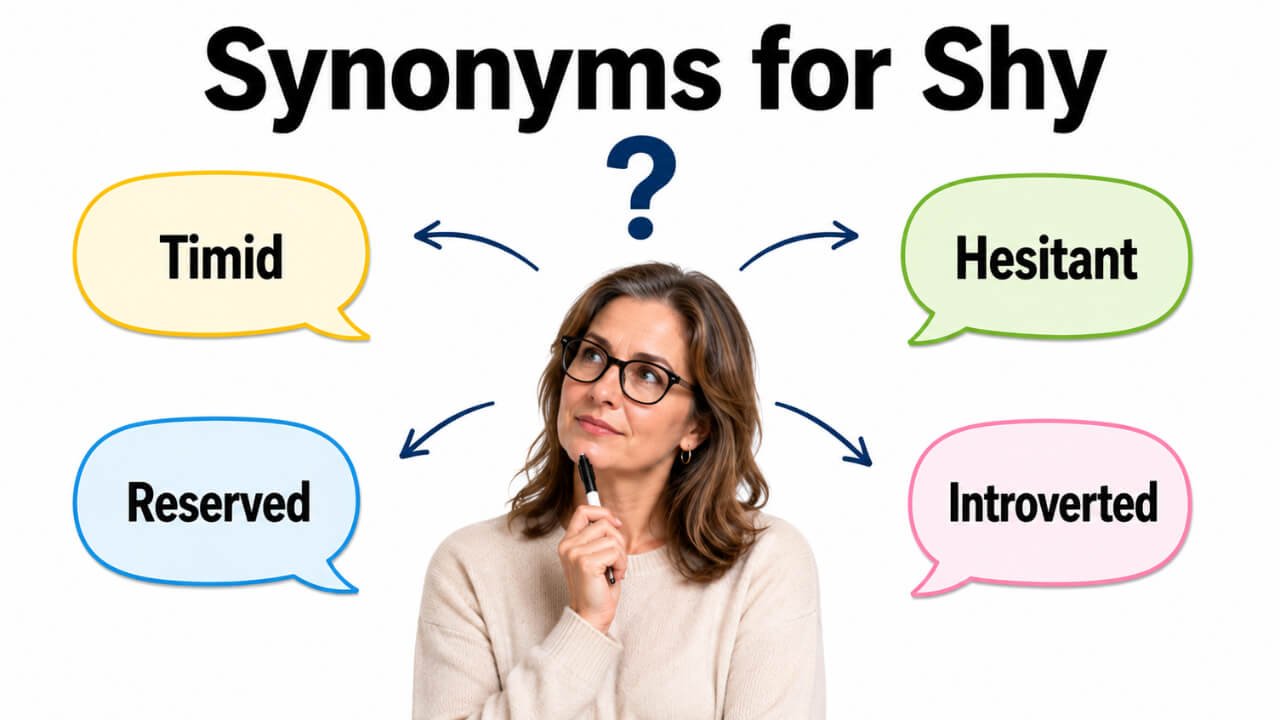
Quick Answer: Common synonyms for shy include timid, bashful, reserved, diffident, self conscious, reticent, withdrawn, quiet, inhibited, and introverted. Timid is best for someone who lacks confidence because of fear. Bashful describes embarrassment or discomfort when receiving attention. Reserved and reticent are suitable for formal writing about someone who speaks or shares little. Self conscious fits social discomfort, while introverted describes someone who prefers limited social activity rather than someone who is necessarily nervous.
Pronunciation and Word Details
Word: Shy.
Pronunciation: /ʃaɪ/.
Part of Speech: Adjective.
Meaning: Nervous, uncomfortable, or unwilling to speak or act confidently around other people.
US Pronunciation:
UK Pronunciation:
What Does “Shy” Mean?
Shy means feeling nervous, uncomfortable, or lacking confidence in social situations. It is mainly used as an adjective to describe a person, expression, reaction, or manner.
A shy person may avoid speaking to strangers, drawing attention, joining conversations, or expressing personal feelings. The word can describe a temporary feeling or a lasting personality trait.
In “The child felt shy on her first day,” shy describes temporary nervousness. In “He has always been shy,” it describes a more consistent personal quality. It can also describe a gentle action, as in “She gave a shy smile.”
Shy has other meanings in certain expressions. To shy away from something means to avoid it because of fear or uncertainty. Just shy of a number means slightly less than that amount.
Meaning, Tone, and Context of “Shy”
Shy is a common, neutral, and conversational word. It can be used in casual speech, personal writing, descriptions, stories, emails, and many formal situations.
The tone often depends on context. Shy can sound gentle and sympathetic when describing someone who needs time to feel comfortable. However, it may sound limiting or judgmental when used without understanding the person’s actual behavior.
In formal writing, reserved, reticent, diffident, or inhibited may provide greater precision. In casual conversation, quiet, nervous, bashful, or shy usually sound more natural.
Shy does not always mean unfriendly, weak, or unwilling to communicate. Someone may be shy but warm, thoughtful, capable, and confident after becoming comfortable.
When and How to Use “Shy”
For Social Nervousness: Use shy when someone feels uncomfortable speaking, meeting people, or joining a group.
Example: Mia felt shy when she entered the crowded classroom.
For a Reserved Personality: Use shy when a person usually avoids attention and speaks less around unfamiliar people.
Example: Omar is shy at first, but he becomes talkative with close friends.
For Romantic Embarrassment: Use shy when someone becomes nervous or embarrassed around a person they admire.
Example: She gave him a shy smile before looking away.
For Hesitant Participation: Use shy when someone wants to participate but lacks the confidence to begin.
Example: The shy student knew the answer but did not raise her hand.
For Avoiding Attention: Use shy when someone dislikes being watched, photographed, or publicly recognized.
Example: He is camera shy and rarely poses for photographs.
For Avoidance: Use shy away from when someone avoids an action, responsibility, or difficult subject.
Example: A strong leader should not shy away from difficult decisions.
For an Amount Slightly Below a Number: Use just shy of when an amount is slightly less than a stated total.
Example: The event attracted just shy of five hundred visitors.
Best Synonyms for Shy
Timid: Easily frightened or lacking confidence in unfamiliar situations.
Example: The timid child stayed close to her mother.
Bashful: Easily embarrassed, especially when receiving praise or attention.
Example: He looked bashful after the teacher complimented his work.
Reserved: Quiet and unwilling to reveal thoughts or emotions quickly.
Example: Lena is reserved during meetings but expresses herself clearly in writing.
Diffident: Lacking confidence in personal abilities or opinions.
Example: His diffident manner made him reluctant to present his idea.
Self Conscious: Uncomfortably aware of how other people may judge one’s appearance or behavior.
Example: She became self conscious when everyone looked at her.
Reticent: Unwilling to speak freely or share personal information.
Example: The witness was reticent about discussing the incident.
Withdrawn: Quiet and socially distant, often because of worry, sadness, or discomfort.
Example: He became withdrawn after moving to a new town.
Quiet: Speaking little or behaving calmly without seeking attention.
Example: The quiet student listened carefully to the discussion.
Inhibited: Unable to act naturally or confidently because of nervousness or social pressure.
Example: She felt inhibited in the unfamiliar environment.
Introverted: More comfortable with private reflection and limited social activity.
Example: He is introverted and prefers small gatherings to large celebrations.
50 Synonyms for Shy with Short Meanings
- Timid: Lacking courage or confidence.
- Bashful: Easily embarrassed by attention.
- Reserved: Quiet and emotionally controlled.
- Diffident: Lacking confidence in oneself.
- Self Conscious: Uncomfortably aware of being observed.
- Reticent: Unwilling to speak or share information.
- Withdrawn: Avoiding social contact or communication.
- Quiet: Speaking little and avoiding attention.
- Inhibited: Unable to behave freely because of nervousness.
- Introverted: Preferring limited social interaction and private reflection.
- Coy: Pretending or appearing shy in a playful manner.
- Sheepish: Embarrassed because of an error or awkward situation.
- Nervous: Worried or uncomfortable in a situation.
- Uneasy: Feeling uncomfortable or uncertain.
- Apprehensive: Anxious about something that may happen.
- Hesitant: Slow to act because of uncertainty.
- Reluctant: Unwilling or uncertain about taking action.
- Unassertive: Unwilling to express needs or opinions confidently.
- Meek: Quiet, gentle, and unwilling to argue.
- Modest: Not seeking praise or excessive attention.
- Demure: Quiet, modest, and controlled in manner.
- Retiring: Quiet and unwilling to attract attention.
- Reclusive: Avoiding other people and social activity.
- Unsociable: Unwilling to spend time with others.
- Socially Anxious: Nervous or distressed during social interaction.
- Guarded: Careful about revealing emotions or information.
- Private: Unwilling to share personal matters openly.
- Uncommunicative: Giving little information or conversation.
- Taciturn: Habitually using very few words.
- Silent: Not speaking in a particular situation.
- Subdued: Quiet and lacking visible confidence or energy.
- Shrinking: Nervous and eager to avoid attention.
- Fearful: Feeling afraid or lacking courage.
- Fainthearted: Lacking bravery in difficult situations.
- Skittish: Easily frightened, nervous, or unsettled.
- Wary: Cautious because of possible danger or difficulty.
- Cautious: Careful about actions and possible consequences.
- Awkward: Uncomfortable or lacking social ease.
- Embarrassed: Uncomfortable because of attention or a mistake.
- Flustered: Confused or nervous because of pressure.
- Blushing: Showing embarrassment through a reddened face.
- Abashed: Embarrassed or ashamed after being noticed or corrected.
- Mortified: Extremely embarrassed or ashamed.
- Tentative: Uncertain and lacking confidence.
- Soft Spoken: Speaking gently and quietly.
- Inconspicuous: Not attracting attention or notice.
- Backward: Unusually hesitant or socially uncomfortable.
- Standoffish: Distant and unwilling to interact warmly.
- Aloof: Emotionally distant or socially separate.
- Unforthcoming: Unwilling to provide information or express thoughts.
Read Also:
Synonyms for Green
Synonyms for Shy by Context
When Shy Means Socially Nervous
Timid, self conscious, inhibited, nervous, uneasy, socially anxious, and awkward describe discomfort during social interaction.
Timid often suggests limited confidence. Self conscious focuses on worrying about how others see you. Inhibited describes difficulty acting naturally.
Example: She felt self conscious while introducing herself to the group.
Example: The timid speaker avoided making eye contact.
When Shy Means Quiet and Reserved
Reserved, quiet, reticent, private, introverted, taciturn, and soft spoken describe someone who speaks little or avoids revealing personal feelings.
Reserved is usually neutral and respectful. Reticent is more formal and suggests unwillingness to discuss something. Introverted describes a preference for less social stimulation rather than fear.
Example: The reserved employee listened carefully before offering an opinion.
Example: He remained reticent about his future plans.
When Shy Means Embarrassed or Bashful
Bashful, sheepish, abashed, embarrassed, blushing, flustered, and coy describe discomfort caused by attention, praise, affection, or a mistake.
Bashful often has a gentle or positive tone. Sheepish usually follows a minor mistake. Abashed is more formal and can suggest embarrassment after criticism.
Example: She looked bashful when the audience praised her performance.
Example: He gave a sheepish smile after forgetting the appointment.
When Shy Means Hesitant or Unwilling
Hesitant, reluctant, tentative, wary, cautious, apprehensive, and unassertive describe someone who is uncertain about speaking or taking action.
Hesitant focuses on delay. Reluctant suggests unwillingness. Wary and cautious suggest concern about possible risks.
Example: The hesitant applicant waited before answering the question.
Example: She was reluctant to share her idea with the entire group.
When Shy Means Socially Distant
Withdrawn, reclusive, unsociable, guarded, aloof, and standoffish describe limited social engagement.
These words can sound stronger or more negative than shy. Withdrawn may suggest an emotional change, while aloof and standoffish can imply deliberate distance.
Example: He became withdrawn after the disagreement.
Example: Her guarded manner made personal conversations difficult.
Another Word for Shy
Timid is a strong general replacement for shy when nervousness or a lack of confidence is the main idea. However, the best alternative depends on the reason for the person’s behavior.
Use reserved for a quiet personality, bashful for embarrassment, reticent for unwillingness to speak, and self conscious for discomfort about being observed.
Original: The shy child stood behind his father.
Better Option: The timid child stood behind his father.
Original: She was shy about discussing her private life.
Better Option: She was reticent about discussing her private life.
Original: Daniel gave a shy smile after receiving the award.
Better Option: Daniel gave a bashful smile after receiving the award.
Original: The new manager seemed shy during the meeting.
Better Option: The new manager seemed reserved during the meeting.
When Not to Use “Shy”
Do not use shy when a more precise word can explain the reason for someone’s silence or hesitation. A person may be quiet because of concentration, privacy, sadness, caution, or personal preference rather than social nervousness.
Avoid calling someone shy simply because they are introverted. Introversion is a preference for limited social stimulation, while shyness involves nervousness or discomfort.
In formal reports, vague uses of shy may sound subjective. Choose an observable description such as reserved, hesitant, or unwilling to respond.
Weak: The witness was shy during the interview.
Better: The witness was reticent and answered only direct questions.
Weak: The employee was too shy to lead.
Better: The employee appeared hesitant when speaking to large groups.
Weak: Sara is shy because she enjoys spending time alone.
Better: Sara is introverted and enjoys spending time alone.
Weak: The customer was shy about the offer.
Better: The customer was cautious about accepting the offer.
Words Commonly Confused With Shy
Shy vs Introverted: Shy describes nervousness or discomfort around people. Introverted describes a preference for quiet settings and limited social activity. An introverted person may still speak confidently.
Shy vs Reserved: Shy suggests nervousness, while reserved suggests emotional control or a preference not to share thoughts immediately.
Shy vs Timid: Shy commonly relates to social discomfort. Timid can describe a broader lack of courage in social, physical, or challenging situations.
Shy vs Bashful: Shy can be a lasting trait. Bashful usually describes temporary embarrassment caused by attention, praise, or affection.
Shy vs Coy: Shy is usually genuine. Coy can suggest playful or deliberate reluctance to reveal feelings.
Shy vs Anxious: Shy is specifically connected to confidence and social interaction. Anxious describes stronger worry that may occur in many situations.
Shy vs Quiet: Shy explains why someone may speak little. Quiet only describes low speech or limited noise and does not necessarily suggest nervousness.
Shy vs Withdrawn: Shy may describe ordinary social discomfort. Withdrawn suggests greater separation from people and may reflect stress, sadness, or emotional difficulty.
Which Synonym Should You Choose?
Choose timid: Use timid when someone lacks confidence or courage in an unfamiliar or demanding situation.
Choose bashful: Use bashful for gentle embarrassment caused by praise, affection, or attention.
Choose reserved: Use reserved in formal writing, reports, essays, and professional descriptions of a quiet personality.
Choose diffident: Use diffident when emphasizing a person’s lack of confidence in personal opinions or abilities.
Choose self conscious: Use self conscious when someone worries about being watched, judged, or noticed.
Choose reticent: Use reticent in formal writing when someone is unwilling to discuss a subject or provide information.
Choose withdrawn: Use withdrawn when someone avoids interaction more strongly than an ordinarily shy person.
Choose introverted: Use introverted when someone prefers solitude or small groups without necessarily feeling afraid.
Choose hesitant: Use hesitant when the focus is delayed action, uncertain speech, or difficulty making a decision.
Choose quiet: Use quiet in casual conversation when you only know that the person speaks little and do not want to assume nervousness.
For professional emails and reports, reserved, reticent, and hesitant are often more precise. For stories and personal descriptions, timid, bashful, self conscious, and shy may sound more natural.
Real Life Examples of “Shy” in Sentences
Original: The shy student avoided speaking during the first lesson.
Better Option: The timid student avoided speaking during the first lesson.
Original: She became shy when everyone praised her singing.
Better Option: She became bashful when everyone praised her singing.
Original: Amir is shy around people he does not know.
Better Option: Amir is self conscious around people he does not know.
Original: The shy employee rarely discussed his personal life.
Better Option: The reserved employee rarely discussed his personal life.
Original: The witness appeared shy when questioned about the event.
Better Option: The witness appeared reticent when questioned about the event.
Original: He was too shy to ask for assistance.
Better Option: He was too hesitant to ask for assistance.
Original: The shy child slowly joined the other players.
Better Option: The apprehensive child slowly joined the other players.
Original: She gave a shy response when asked about her success.
Better Option: She gave a modest response when asked about her success.
Original: The new student seemed shy and uncomfortable.
Better Option: The new student seemed uneasy and inhibited.
Original: He became shy after the conversation turned to his achievements.
Better Option: He became embarrassed after the conversation turned to his achievements.
Synonym Groups and Usage Differences
Nervousness Group
Timid, nervous, uneasy, apprehensive, skittish, and self conscious describe fear or discomfort.
Timid suggests limited courage. Nervous describes general tension. Self conscious focuses on concern about being observed or judged.
Example: She felt self conscious while walking onto the stage.
Reserved Personality Group
Reserved, quiet, private, introverted, soft spoken, and retiring describe people who do not seek attention.
These words can describe natural personality preferences without suggesting fear. Reserved is useful in professional writing because it sounds neutral and respectful.
Example: The reserved professor preferred thoughtful discussion to casual conversation.
Embarrassment Group
Bashful, sheepish, abashed, embarrassed, blushing, and flustered describe discomfort after attention, praise, affection, or a mistake.
Bashful is usually gentle. Sheepish often follows a minor error. Mortified expresses much stronger embarrassment.
Example: He looked sheepish after realizing that he had entered the wrong room.
Hesitation Group
Hesitant, reluctant, tentative, wary, cautious, and apprehensive describe uncertainty before an action.
Hesitant focuses on delay, reluctant on unwillingness, and cautious on concern about consequences.
Example: The hesitant speaker paused before answering the difficult question.
Social Withdrawal Group
Withdrawn, reclusive, unsociable, guarded, aloof, and standoffish describe limited social connection.
These words are stronger than shy and should be chosen carefully. Aloof and standoffish may imply unfriendly behavior, while withdrawn may suggest emotional distress.
Example: His withdrawn behavior worried his close friends.
Antonyms of Shy
The opposite of shy depends on whether the word refers to nervousness, quiet behavior, hesitation, or social withdrawal.
Confident: Certain about one’s abilities and comfortable taking action.
Outgoing: Friendly, energetic, and comfortable meeting people.
Bold: Willing to act or speak without fear.
Sociable: Enjoying conversation and the company of others.
Assertive: Able to express needs and opinions clearly.
Fearless: Showing little or no fear.
Expressive: Openly communicating thoughts and emotions.
Approachable: Friendly and easy to speak with.
Uninhibited: Able to act naturally without social restraint.
Self Assured: Calmly confident in one’s judgment and abilities.
Talkative: Willing to speak frequently and openly.
Extroverted: Energized by social activity and interaction.
Comparison: Shy vs Related Words
Shy vs Timid
Shy mainly describes social nervousness. Timid has a broader meaning and can describe someone who lacks courage in many types of situations.
Example With Shy: The shy guest avoided introducing herself.
Example With Timid: The timid driver refused to travel during the storm.
Shy vs Reserved
Shy suggests discomfort or nervousness. Reserved suggests deliberate emotional control or a natural preference for speaking less.
Example With Shy: He felt shy when the interviewer asked about his achievements.
Example With Reserved: He remained reserved throughout the formal dinner.
Shy vs Introverted
Shy people may want to interact but feel nervous. Introverted people may interact confidently but prefer quiet environments and smaller groups.
Example With Shy: The shy student wanted to join the discussion but feared making a mistake.
Example With Introverted: The introverted student joined the discussion and then spent the evening alone.
Shy vs Bashful
Shy can describe a general personality. Bashful usually describes a temporary reaction to attention, praise, or affection.
Example With Shy: She has been shy since childhood.
Example With Bashful: She looked bashful when her classmates praised her drawing.
Shy vs Self Conscious
Shy describes general social discomfort. Self conscious emphasizes worry about appearance, actions, or the opinions of others.
Example With Shy: He was shy around unfamiliar guests.
Example With Self Conscious: He felt self conscious about speaking with a new accent.
Shy vs Reticent
Shy suggests nervousness. Reticent means unwilling to speak or share information and may result from privacy, caution, or distrust.
Example With Shy: The child was shy when meeting the doctor.
Example With Reticent: The official was reticent about discussing the investigation.
Common Phrases and Expressions With Shy
Shy Person: Someone who feels nervous or uncomfortable around other people.
Shy Child: A child who is hesitant to speak or interact in unfamiliar situations.
Shy Smile: A gentle smile showing nervousness or embarrassment.
Painfully Shy: Extremely shy to the point that social situations become very difficult.
Naturally Shy: Shy as a normal and consistent part of one’s personality.
A Little Shy: Slightly nervous or uncomfortable around others.
Camera Shy: Uncomfortable when being photographed or recorded.
Shy Away From: Avoid something because of fear, discomfort, or uncertainty.
Just Shy Of: Slightly less than a particular number, amount, or goal.
Once Bitten, Twice Shy: More cautious after having a bad experience.
Common Mistakes to Avoid
A common mistake is treating shy, quiet, and introverted as identical. A quiet person may simply prefer listening. An introverted person may enjoy limited social activity without feeling nervous. Use shy only when discomfort or lack of confidence is relevant.
Avoid repeating shy several times in one paragraph. Replace it with precise alternatives such as timid, reserved, bashful, hesitant, or self conscious when the meaning supports the change.
Do not choose a synonym only because it sounds advanced. Reticent describes unwillingness to speak, while diffident emphasizes low confidence. Aloof and standoffish may suggest coldness, so they should not replace shy in every sentence.
Avoid unnatural phrasing such as “She is shy to speak.” Better choices include “She is too shy to speak,” “She is shy about speaking,” or “She feels shy when speaking.”
Do not confuse shy away from with shy from. The standard expression for avoiding something is shy away from.
Use stronger words carefully. Mortified means extremely embarrassed, while withdrawn suggests considerable social separation. Neither word is suitable for mild shyness.
Conclusion
Synonyms for shy help describe different forms of nervousness, quietness, embarrassment, and hesitation more precisely. Timid works well for limited confidence, while bashful describes embarrassment caused by attention. Reserved and reticent suit formal descriptions of quiet or private behavior. Self conscious emphasizes concern about being judged, and introverted describes a preference for limited social activity. Choosing the right alternative depends on why a person speaks less, avoids attention, delays action, or feels uncomfortable around others.
FAQs About Synonyms for Shy
What Is the Best Synonym for Shy?
Timid is the best general synonym when shy means nervous or lacking confidence. Reserved is better when the person is simply quiet.
Is Timid the Same as Shy?
The words are similar, but timid is broader. Shy usually relates to social discomfort, while timid can describe fear in many situations.
What Is a Positive Synonym for Shy?
Reserved, modest, quiet, and soft spoken can describe shy behavior in a respectful or positive way.
What Is a Formal Synonym for Shy?
Diffident, reticent, reserved, and inhibited are suitable formal alternatives. The correct choice depends on the intended meaning.
Can Introverted Replace Shy?
Not in every context. An introverted person prefers limited social activity, but a shy person feels nervous or uncomfortable during interaction.
What Is the Opposite of Shy?
Common opposites include confident, outgoing, bold, sociable, assertive, and self assured.
How Can You Describe a Shy Person Politely?
Use reserved, quiet, private, thoughtful, modest, or soft spoken when these words accurately describe the person’s behavior.
