
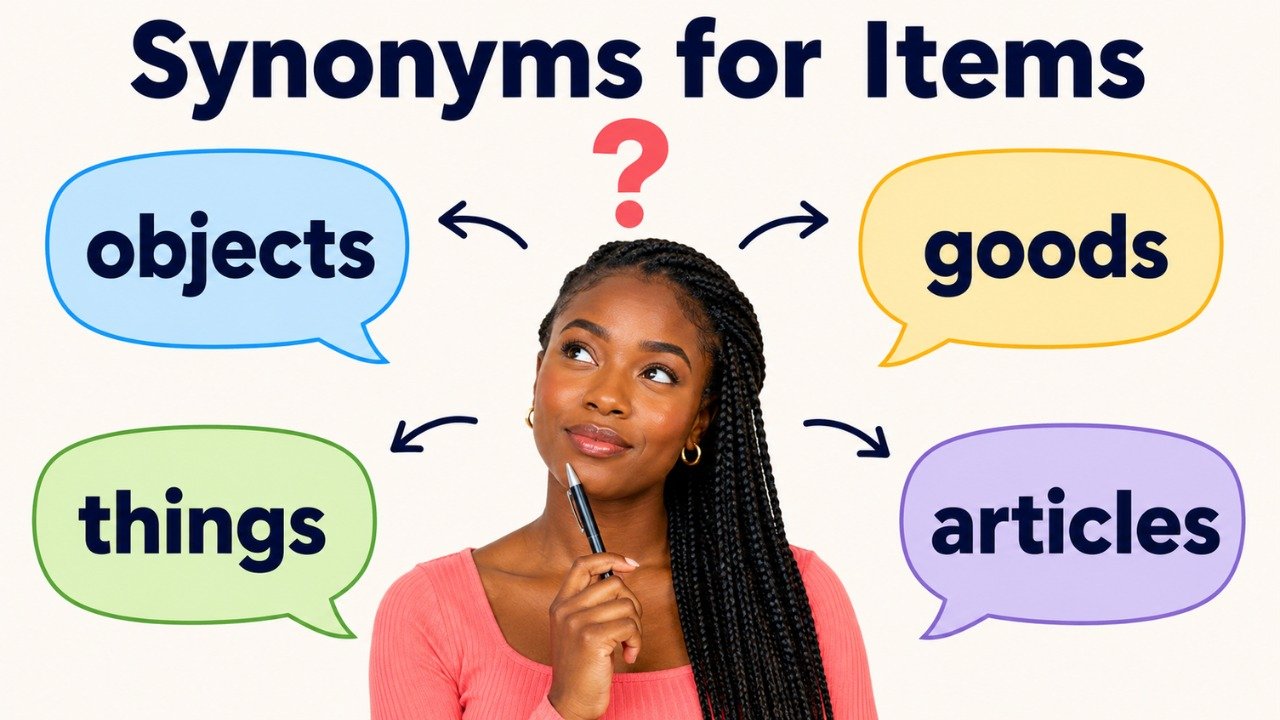
Quick Answer: Useful synonyms for items include things, objects, articles, products, goods, pieces, entries, elements, units, and belongings. The best choice depends on context. Use objects for physical things, products or goods for items being sold, entries for things on a list, elements for parts of a larger whole, units for separately counted things, belongings for personal possessions, and points for topics on an agenda. These synonyms for items help make everyday, academic, professional, retail, and descriptive writing more precise.
Pronunciation and Word Details
Word: Items
Pronunciation: /ˈaɪtəmz/
Part of Speech: Plural noun
Meaning: Individual things, objects, entries, products, or parts considered separately.
US Pronunciation:
UK Pronunciation:
What Does “Items” Mean?
Items means individual things that are considered, counted, listed, discussed, stored, owned, bought, or sold separately.
Items is the plural form of item. It is a neutral and flexible noun that can describe physical objects, products in a store, entries on a list, topics on an agenda, possessions, pieces of information, or individual parts of a larger collection.
In everyday conversation, items often means things or objects.
Example: She placed the fragile items in a separate box.
In retail contexts, items can mean products or goods offered for sale.
Example: Several items were added to the order.
In lists and documents, items may refer to individual entries or points.
Example: Please review all the items on the checklist.
In meetings, items may refer to matters or topics that need discussion.
Example: The final two items on the agenda require approval.
In personal contexts, items can refer to belongings or possessions.
Example: He gathered his personal items before leaving the room.
Meaning, Tone, and Context of “Items”
Items has a neutral tone and works well in both formal and informal language. It is common in conversation, instructions, reports, inventories, lists, shopping contexts, meetings, forms, and professional communication.
The word is useful because it is broad, but that same broadness can make it less precise than a more specific synonym.
Everyday Tone: Items can simply mean things or objects.
Example: Please move these items off the table.
Professional Tone: Items works naturally in reports, inventories, schedules, and workplace communication.
Example: The remaining items will be reviewed tomorrow.
Retail Tone: Items commonly refers to products or goods available for purchase.
Example: Several items are currently unavailable.
Administrative Tone: Items may refer to entries, tasks, questions, or points in a document or list.
Example: Complete all required items before submitting the form.
Personal Tone: Items may describe belongings or possessions without naming them individually.
Example: She packed her personal items into a small bag.
Because items is general, writers should choose a more precise synonym when the type of thing being discussed matters.
When and How to Use “Items”
For Physical Objects: Use items when referring generally to separate physical things.
Example: The shelf contains several decorative items.
For Products: Use items when discussing things that can be purchased or ordered.
Example: The customer selected five items.
For Lists: Use items for individual entries on a list, checklist, form, or document.
Example: Three items remain on the checklist.
For Agendas: Use items for separate matters or topics discussed during a meeting.
Example: The first two agenda items were approved quickly.
For Personal Belongings: Use items when referring generally to possessions.
Example: Please collect all personal items before leaving.
For Collections: Use items for individual pieces within a group.
Example: The collection contains more than twenty historical items.
For Information: Use items when referring to separate pieces of information, questions, or data.
Example: The survey included several items about customer satisfaction.
For Inventory: Use items when separately counting stored goods or objects.
Example: Each item was recorded in the inventory.
Best Synonyms for Items
Things: General objects, matters, or individual entities.
Example: She moved her things into the next room.
Objects: Physical things that can be seen or touched.
Example: Several small objects were found inside the drawer.
Articles: Individual objects or goods, especially in formal or descriptive contexts.
Example: The display contained several household articles.
Products: Things made, supplied, or offered for sale.
Example: The store introduced several new products.
Goods: Physical products or merchandise, especially in commercial contexts.
Example: The warehouse received a shipment of goods.
Pieces: Individual parts, examples, or units of something.
Example: The collection includes several rare pieces.
Entries: Individual records, lines, or things included in a list.
Example: She checked all the entries before submitting the form.
Elements: Individual parts that make up a larger whole.
Example: The design combines several important elements.
Units: Separate individual things that can be counted or measured.
Example: The facility produced one hundred units during the shift.
Belongings: Personal possessions owned or carried by someone.
Example: He collected his belongings before leaving.
50 Synonyms for Items with Short Meanings
- Things: General objects or individual matters.
- Objects: Physical things that can be seen or touched.
- Articles: Separate objects or goods.
- Products: Things produced or offered for sale.
- Goods: Physical merchandise or products.
- Pieces: Individual parts or examples of something.
- Entries: Separate records or things on a list.
- Elements: Parts that make up a larger whole.
- Units: Separately counted individual things.
- Belongings: Personal possessions.
- Possessions: Things owned by a person.
- Effects: Personal belongings, especially collectively.
- Property: Things that belong to someone.
- Merchandise: Goods offered for sale.
- Wares: Goods offered by a seller.
- Stock: Goods kept for sale or supply.
- Inventory: Goods or objects kept and recorded.
- Supplies: Materials or goods kept for use.
- Materials: Physical things used for a purpose.
- Equipment: Items used for a particular activity.
- Tools: Objects used to perform tasks.
- Accessories: Additional items used with something else.
- Components: Parts of a larger system or object.
- Parts: Individual sections of a whole.
- Sections: Separate divisions of something larger.
- Components: Individual pieces within a system.
- Features: Distinct parts or characteristics.
- Details: Individual pieces of information or small parts.
- Points: Separate matters or ideas for consideration.
- Topics: Subjects listed for discussion.
- Matters: Subjects or issues requiring attention.
- Subjects: Topics being discussed or studied.
- Questions: Individual matters requiring an answer.
- Tasks: Individual pieces of work to complete.
- Duties: Specific responsibilities or required tasks.
- Steps: Individual stages in a process.
- Requirements: Individual conditions that must be met.
- Records: Separate stored pieces of information.
- Listings: Individual things presented in a list.
- Selections: Items chosen from a larger group.
- Choices: Options available for selection.
- Options: Possible items or courses of action.
- Examples: Individual cases used to illustrate something.
- Samples: Representative pieces taken from a larger group.
- Specimens: Individual examples collected for study.
- Artifacts: Objects made or used by people, often of historical interest.
- Articles of Use: Individual objects made for practical purposes.
- Contents: Things contained within a place, package, or collection.
- Assets: Valuable items or resources owned by a person or organization.
- Entries of Record: Individual recorded items in a document or system.
Read Also:
Synonyms for Consistently
Synonyms for Items by Context
When Items Means Physical Objects
When items refers to ordinary physical things, objects, things, articles, pieces, and contents are useful alternatives.
Objects: Best when the things are physical and tangible.
Example: Several objects were arranged on the table.
Things: Best for casual and general conversation.
Example: She packed her things before leaving.
Articles: Useful in formal or descriptive writing.
Example: The cabinet contained several decorative articles.
Pieces: Best when the objects are individual examples within a collection.
Example: The exhibit contains several valuable pieces.
When Items Means Products for Sale
In shopping, retail, supply, and commercial contexts, products, goods, merchandise, wares, stock, and inventory may be more precise.
Products: Best for individual things produced or sold.
Example: The company introduced several new products.
Goods: Useful for physical products in commercial writing.
Example: The goods were inspected before delivery.
Merchandise: Best for goods offered for sale.
Example: The merchandise was arranged by category.
Stock: Useful when discussing goods currently available.
Example: The shop received fresh stock this morning.
Inventory: Best when referring collectively to stored or recorded goods.
Example: The manager reviewed the inventory.
When Items Means Things on a List
When items refers to separate things written in a list, use entries, points, listings, questions, requirements, or tasks.
Entries: Best for separately recorded information.
Example: Several entries were missing from the form.
Points: Useful for ideas or matters in a list.
Example: The report covers four main points.
Listings: Best for things formally presented in a list.
Example: The document contains several property listings.
Requirements: Best when each item states a condition that must be met.
Example: Applicants must satisfy all the requirements.
When Items Means Agenda Topics
For meetings or discussions, points, topics, matters, subjects, and questions are more natural than items in some sentences.
Points: Best for separate ideas requiring discussion.
Example: We discussed the final two points.
Topics: Useful for general subjects of discussion.
Example: The meeting covered several important topics.
Matters: More formal and useful for issues requiring attention.
Example: Several financial matters remain unresolved.
Subjects: Useful when referring neutrally to areas being discussed.
Example: The committee considered several subjects.
When Items Means Personal Belongings
When items means things someone owns or carries, belongings, possessions, effects, property, and contents may fit better.
Belongings: The most natural general word for personal things.
Example: She gathered her belongings from the desk.
Possessions: Slightly more formal than belongings.
Example: His possessions were stored safely.
Effects: Often used formally for personal belongings considered collectively.
Example: Her personal effects were packed into two boxes.
Property: Useful when ownership is the main focus.
Example: Please remove your property from the storage area.
When Items Means Parts of a Larger Whole
For parts of a system, design, plan, or object, elements, components, parts, sections, and features are useful choices.
Elements: Best for important parts of an idea, design, or system.
Example: The plan contains several essential elements.
Components: Best for functional parts of a machine, system, or structure.
Example: All major components were inspected.
Parts: A broad everyday alternative.
Example: The device contains several moving parts.
Sections: Best when the whole is divided into clear divisions.
Example: The report contains five sections.
Features: Best for notable characteristics or functions.
Example: The application includes several useful features.
Another Word for Items
Another word for items is things because it works in many general everyday contexts. However, things is more casual and less precise. Objects is better for physical items, products for things being sold, entries for things on a list, and belongings for personal possessions.
Original: Please move these items from the table.
Better Option: Please move these objects from the table.
Original: The customer purchased four items.
Better Option: The customer purchased four products.
Original: Review all items on the list.
Better Option: Review all entries on the list.
Original: He collected his personal items.
Better Option: He collected his belongings.
When Not to Use “Items”
Items can sound vague when a more specific word would tell the reader exactly what is being discussed.
Weak: The factory produces several items.
Better: The factory produces several products.
Products gives the sentence clearer commercial meaning.
Avoid items when talking about a specific category that already has a natural name.
Weak: The carpenter placed his items in the toolbox.
Better: The carpenter placed his tools in the toolbox.
Tools is clearer because it identifies the type of objects.
Items may also sound impersonal when referring to personal possessions.
Weak: She packed her personal items.
Better: She packed her belongings.
In lists or reports, entries or points may be more exact.
Weak: Several items in the record were incorrect.
Better: Several entries in the record were incorrect.
Avoid repeating items too often in professional writing.
Weak: The items on the list included items from storage and items from the office.
Better: The entries on the list included supplies from storage and equipment from the office.
Words Commonly Confused With Items
Items vs Things: Items is more neutral and organized, while things is broader and more conversational.
Items vs Objects: Items can include physical things, list entries, topics, or products. Objects usually refers specifically to physical things.
Items vs Products: Items can mean almost any separate things. Products specifically refers to things produced, supplied, or sold.
Items vs Goods: Items may be individual objects of many kinds. Goods usually refers to physical products in commercial contexts.
Items vs Articles: Articles can mean individual objects or goods, but it often sounds more formal than items.
Items vs Entries: Items is broad, while entries specifically refers to individual records or things included in a list, table, form, or document.
Items vs Elements: Items refers to separate things generally. Elements usually refers to parts that contribute to a larger whole.
Items vs Belongings: Items can refer to any separate things. Belongings specifically means personal possessions.
Which Synonym Should You Choose?
Choose things in casual conversation when the exact category is not important.
Choose objects when describing physical items that can be seen or touched.
Choose articles for formal descriptions of individual objects or goods.
Choose products for commercial writing, shopping, catalogs, orders, and things being sold.
Choose goods when discussing physical merchandise, trade, delivery, or supply.
Choose merchandise when referring collectively to goods offered for sale.
Choose pieces for individual examples in collections, sets, artwork, or furniture.
Choose entries for forms, databases, lists, records, or tables.
Choose points for agenda topics, arguments, or ideas requiring discussion.
Choose elements when discussing parts of a design, concept, plan, or system.
Choose components when describing functional parts of machines, systems, or structures.
Choose units when individual items are being counted, manufactured, measured, or distributed.
Choose belongings for personal possessions in everyday conversation.
Choose possessions when a slightly more formal word for owned things is needed.
Choose effects when referring formally to personal belongings.
Choose supplies for materials kept for future use.
Choose equipment when the items are used collectively for a particular activity.
Real Life Examples of “Items” in Sentences
Original: She placed the fragile items in a box.
Better Option: She placed the fragile objects in a box.
Original: The customer ordered three items.
Better Option: The customer ordered three products.
Original: Several items remain on the checklist.
Better Option: Several tasks remain on the checklist.
Original: We discussed all the agenda items.
Better Option: We discussed all the agenda points.
Original: He collected his personal items before leaving.
Better Option: He collected his belongings before leaving.
Original: The report contains several important items.
Better Option: The report contains several important points.
Original: All items in the inventory were counted.
Better Option: All units in the inventory were counted.
Original: The designer changed several items in the layout.
Better Option: The designer changed several elements in the layout.
Original: These items are required for the project.
Better Option: These materials are required for the project.
Original: The museum displayed several historical items.
Better Option: The museum displayed several historical artifacts.
Synonym Groups and Usage Differences
General Object Group
Things, objects, articles, pieces, and contents can all refer to physical items.
Things is the broadest and most casual. Objects is more specific to physical things. Articles sounds somewhat more formal. Pieces often describes individual examples in a set or collection.
Example: Several objects were placed on the shelf.
Commercial Group
Products, goods, merchandise, wares, stock, and inventory are useful in selling, buying, shipping, and storage contexts.
Products usually refers to individual things produced or sold. Goods emphasizes commercial or physical merchandise. Stock describes goods kept for sale. Inventory describes a recorded collection of available goods.
Example: The warehouse received a new shipment of goods.
List and Record Group
Entries, listings, records, points, questions, and requirements describe items in documents, forms, lists, or databases.
Entries is especially useful for individual recorded pieces of information. Points works for arguments or discussion topics. Requirements identifies conditions that must be met.
Example: Please review all entries before submitting the form.
Personal Possession Group
Belongings, possessions, effects, property, and assets refer to things someone owns.
Belongings is natural in everyday speech. Possessions is slightly more formal. Effects commonly appears in formal descriptions of personal property. Assets usually emphasizes value.
Example: She collected her belongings before leaving.
Parts and Structure Group
Elements, components, parts, sections, features, and units describe things that form or belong to a larger whole.
Elements often refers to conceptual or structural parts. Components usually refers to functional parts. Sections describes clear divisions. Features describes notable characteristics or functions.
Example: The system contains several important components.
Work and Action Group
Tasks, duties, steps, requirements, and questions may replace items when the things being listed involve work or action.
Tasks refers to pieces of work. Duties refers to responsibilities. Steps describes stages in a process. Requirements describes conditions that must be satisfied.
Example: Three tasks remain before the project is complete.
Antonyms of Items
Because items is a broad plural noun, it does not have one exact opposite. The closest contrasting words depend on whether the context involves separate parts, individual objects, or a collection.
Whole: Something complete rather than divided into separate items.
Total: The complete amount rather than separate individual units.
Collection: A group considered together rather than as separate items.
Group: Several things treated as one set.
Whole Set: All members considered together.
Aggregate: A combined total formed from separate parts.
Mass: A quantity viewed as one body rather than separate objects.
Entirety: The complete whole of something.
Combination: Several separate parts joined together.
Unity: A state in which separate elements are treated as one whole.
Comparison: Items vs Related Words
Items vs Things
Items is slightly more organized and neutral. Things is broader and more casual.
Example With Items: Please place the remaining items in the box.
Example With Things: Please put your things in the box.
Items vs Objects
Items may refer to physical things, products, entries, or topics. Objects usually means physical things.
Example With Items: The list contains ten items.
Example With Objects: Ten objects were placed on the table.
Items vs Products
Items is broad, while products specifically describes things created, supplied, or sold.
Example With Items: Several items were added to the order.
Example With Products: Several new products were added to the catalog.
Items vs Goods
Items can refer to almost any individual things. Goods usually refers to physical merchandise in trade or commerce.
Example With Items: The customer returned two items.
Example With Goods: The damaged goods were returned to the supplier.
Items vs Entries
Items can include any separate things. Entries specifically refers to individual records or things placed in a list, table, form, or system.
Example With Items: Check all items on the form.
Example With Entries: Check all entries in the database.
Items vs Elements
Items treats things as separate units. Elements emphasizes their role within a larger whole.
Example With Items: Several items were removed from the plan.
Example With Elements: Several elements of the plan were revised.
Items vs Belongings
Items can mean any things. Belongings specifically refers to things owned or carried by a person.
Example With Items: Please remove these items from the chair.
Example With Belongings: Please collect your belongings before leaving.
Items vs Units
Items is general, while units emphasizes separate countable quantities, especially in manufacturing, inventory, measurement, or distribution.
Example With Items: Twenty items were shipped.
Example With Units: Twenty units were produced during the morning shift.
Common Phrases and Expressions With Items
Personal Items: Things belonging to a particular person.
Example: Keep your personal items with you.
Household Items: Objects commonly used in a home.
Example: The box contains several household items.
Food Items: Individual foods, dishes, or products.
Example: The list includes several food items.
Menu Items: Individual dishes or choices available on a menu.
Example: Several menu items were changed.
Agenda Items: Matters listed for discussion during a meeting.
Example: Three agenda items remain.
Action Items: Tasks that need to be completed after a discussion or meeting.
Example: The team reviewed its action items.
Line Items: Individual entries in a budget, bill, statement, or account.
Example: Each line item was checked carefully.
List Items: Individual entries appearing in a list.
Example: Delete the duplicate list items.
Selected Items: Things chosen from a larger group.
Example: The selected items were moved to a separate folder.
Essential Items: Things considered necessary for a purpose.
Example: Pack only the essential items for the trip.
Common Mistakes to Avoid
One common mistake is using items when a more specific noun would make the sentence clearer.
Mistake: The mechanic organized his items.
Better: The mechanic organized his tools.
Another mistake is using items for abstract concepts without enough context.
Mistake: The essay explains several items about communication.
Better: The essay explains several points about communication.
Avoid treating every synonym as interchangeable.
Mistake: She packed her merchandise before leaving the hotel.
Better: She packed her belongings before leaving the hotel.
Merchandise refers to goods for sale, while belongings refers to personal possessions.
Do not use products when the things are not created or offered for sale.
Mistake: The museum displayed several ancient products.
Better: The museum displayed several ancient artifacts.
Avoid unnecessary repetition of items in lists, reports, and instructions.
Repetitive: Review the items, remove unnecessary items, and organize the remaining items.
Better: Review the entries, remove unnecessary ones, and organize the remaining material.
Be careful with singular and plural agreement.
Incorrect: These items is ready.
Correct: These items are ready.
Remember that item is singular and items is plural.
Singular: This item needs approval.
Plural: These items need approval.
Choose the synonym according to the real meaning. Products fits sales, objects fits physical things, entries fits records, points fits discussions, belongings fits possessions, and elements fits parts of a larger whole.
Conclusion
The best synonyms for items include things, objects, articles, products, goods, pieces, entries, elements, units, and belongings. The right choice depends on what the items actually are. Use objects for physical things, products for things being sold, entries for lists and records, points for agenda topics, elements for parts of a larger whole, and belongings for personal possessions. Choosing more specific synonyms for items can make everyday, academic, retail, and professional writing clearer and more natural.
FAQs About Synonyms for Items
What is the best synonym for items?
Things is the broadest everyday alternative, while objects, products, entries, elements, and belongings are more precise in specific contexts.
What is another word for items on a list?
Entries is usually the best choice. Points, listings, questions, tasks, and requirements may also fit depending on what the list contains.
What is a synonym for items in a store?
Products, goods, merchandise, wares, stock, and inventory can all work in retail or commercial contexts.
What is another word for personal items?
Belongings is the most natural choice. Possessions, personal effects, and property are also useful alternatives.
What is a formal synonym for items?
Articles, elements, entries, components, goods, and units can serve as formal alternatives depending on the context.
What is the difference between items and objects?
Items is broader and can refer to objects, products, entries, or topics. Objects usually refers specifically to physical things.
What is another word for agenda items?
Points, topics, matters, subjects, and questions are useful alternatives for things listed for discussion during a meeting.
