
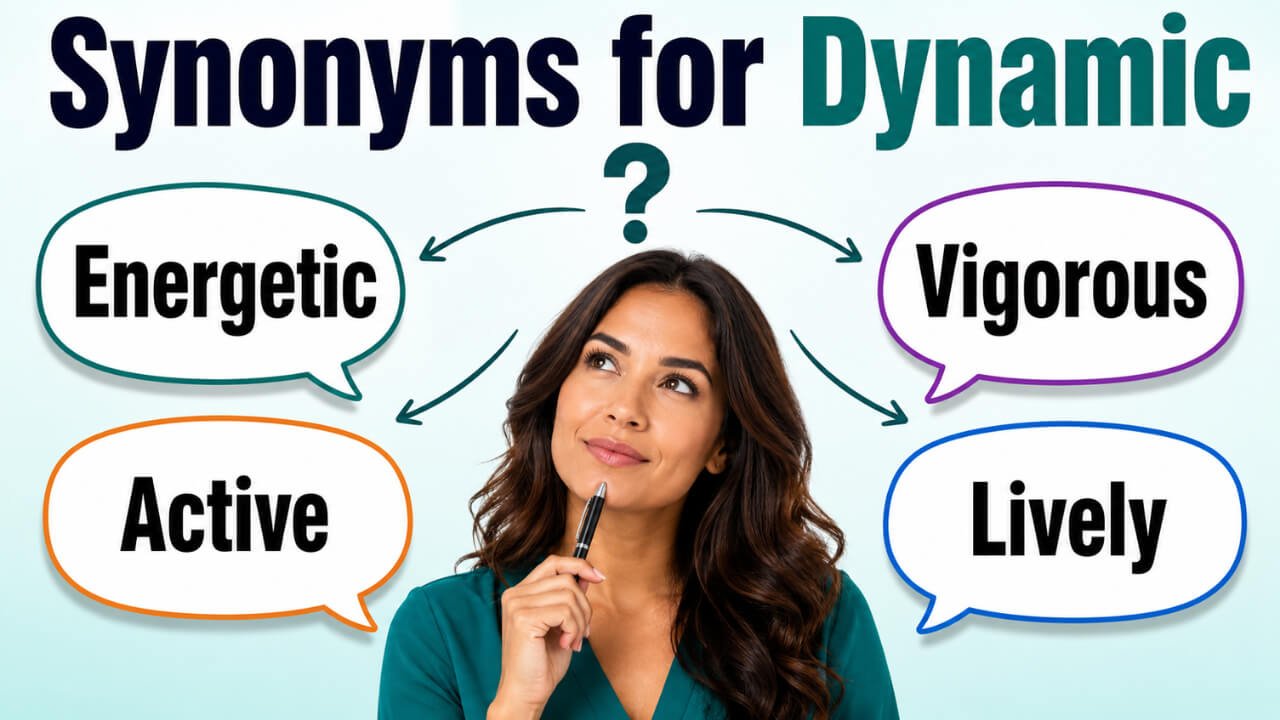
Quick Answer: The best synonyms for dynamic are energetic, active, lively, vibrant, vigorous, evolving, adaptable, forceful, progressive, and versatile. Use energetic for a person with enthusiasm, lively for an exciting atmosphere, evolving for something that keeps changing, adaptable for someone who adjusts easily, and forceful for a strong personality or argument. In formal writing, progressive and evolving often work well. In casual conversation, active, lively, and energetic sound more natural. The right choice depends on whether dynamic describes energy, change, influence, growth, or flexibility.
Pronunciation and Word Details
Word: Dynamic
Pronunciation: /daɪˈnæmɪk/
Part of Speech: Adjective and noun
Meaning: Full of energy, activity, movement, change, influence, or progress.
US Pronunciation:
UK Pronunciation:
What Does “Dynamic” Mean?
Dynamic means active, energetic, powerful, or continually changing. It is mainly used as an adjective, although it can also function as a noun when describing the relationship or interaction between people, forces, or situations.
When dynamic describes a person, it suggests confidence, energy, enthusiasm, and the ability to create change. A dynamic speaker, for example, holds attention and communicates with force.
When it describes a situation, environment, or system, dynamic means that it changes frequently rather than remaining fixed. A dynamic workplace may develop quickly as people, responsibilities, and priorities change.
The word can also describe relationships. In this use, a dynamic is the pattern of behavior, influence, or communication between people.
Meaning, Tone, and Context of “Dynamic”
Dynamic usually has a positive and strong tone. It often suggests energy, progress, movement, confidence, adaptability, and influence.
In everyday conversation, dynamic can describe an enthusiastic person, an exciting event, or an active environment. It sounds slightly more expressive than common words such as active or busy.
In formal, academic, and professional writing, dynamic often describes changing conditions, complex systems, developing relationships, or adaptable processes. It is frequently useful when discussing movement, growth, interaction, or transformation.
In technical contexts, dynamic may refer to forces, motion, changing values, or systems that respond to changing conditions. Its meaning is more precise in these situations.
The word is generally complimentary when used for people. Calling someone dynamic suggests that the person is energetic, confident, engaging, and capable of influencing others.
When and How to Use “Dynamic”
For an Energetic Person: Use dynamic to describe someone who shows confidence, enthusiasm, creativity, and action.
Example: The new instructor is a dynamic speaker who keeps every student involved.
For Continuous Change: Use dynamic when a situation, environment, or process changes regularly.
Example: Language is dynamic because its vocabulary and usage continue to develop.
For Strong Influence: Dynamic can describe a person whose presence, ideas, or actions strongly affect others.
Example: Her dynamic leadership encouraged the group to work toward a shared goal.
For an Exciting Atmosphere: Use dynamic for an environment filled with activity, movement, or stimulating ideas.
Example: The event created a dynamic atmosphere where everyone wanted to participate.
For Adaptability: Dynamic can describe a system, method, or individual that responds effectively to changing needs.
Example: The course uses a dynamic learning process that adjusts to each student’s progress.
For Relationships: As a noun, dynamic describes the pattern of interaction or influence between people.
Example: Open communication improved the dynamic between the two colleagues.
Best Synonyms for Dynamic
Energetic
Synonym: Full of enthusiasm, strength, and active effort.
Example: She gave an energetic presentation that held everyone’s attention.
Active
Synonym: Regularly involved in movement, work, or participation.
Example: He remains active in several educational projects.
Lively
Synonym: Full of life, excitement, conversation, or activity.
Example: The discussion became lively after the main question was introduced.
Vibrant
Synonym: Full of life, color, energy, and enthusiasm.
Example: The neighborhood has a vibrant cultural atmosphere.
Vigorous
Synonym: Showing physical strength, energy, determination, or intensity.
Example: The proposal received vigorous support from the committee.
Evolving
Synonym: Developing or changing gradually over time.
Example: The relationship between language and culture is constantly evolving.
Adaptable
Synonym: Able to adjust successfully to new situations or requirements.
Example: An adaptable employee can manage unexpected responsibilities.
Forceful
Synonym: Strong, confident, convincing, and direct.
Example: She made a forceful argument for improving the process.
Progressive
Synonym: Supporting improvement, development, or modern ideas.
Example: The school adopted a progressive approach to learning.
Versatile
Synonym: Able to perform effectively in many different roles or situations.
Example: He is a versatile writer who works across several subjects.
50 Synonyms for Dynamic with Short Meanings
- Energetic: Full of enthusiasm and physical or mental energy.
- Active: Regularly moving, working, or participating.
- Lively: Full of life, excitement, and activity.
- Vibrant: Bright, energetic, exciting, and full of life.
- Vigorous: Strong, healthy, active, and forceful.
- Animated: Showing noticeable excitement, emotion, or movement.
- Spirited: Full of courage, confidence, and enthusiasm.
- Forceful: Strong, direct, confident, and convincing.
- Powerful: Having considerable strength, influence, or effect.
- Compelling: Strong enough to attract attention or inspire action.
- Charismatic: Naturally able to attract, influence, or inspire people.
- Influential: Able to affect decisions, opinions, or behavior.
- Driving: Providing energy, direction, or motivation.
- Progressive: Supporting development, improvement, and new ideas.
- Innovative: Introducing useful, original, or creative ideas.
- Adaptable: Able to adjust successfully to changing conditions.
- Flexible: Willing or able to change according to circumstances.
- Evolving: Gradually developing into a different or improved form.
- Changing: Becoming different over time.
- Fluid: Able to change smoothly and easily.
- Shifting: Moving or changing from one state to another.
- Variable: Likely to change rather than remain constant.
- Responsive: Reacting quickly and appropriately to change.
- Versatile: Effective in many different roles or situations.
- Enterprising: Energetic and willing to pursue new opportunities.
- Ambitious: Strongly motivated to achieve success or improvement.
- Proactive: Taking action before a problem or need develops.
- Motivated: Having a strong reason or desire to act.
- Industrious: Consistently active, careful, and hardworking.
- Productive: Creating useful results through effective activity.
- Intense: Showing strong energy, emotion, or concentration.
- Robust: Strong, effective, and able to handle pressure.
- Strong: Having considerable power, energy, or influence.
- Bold: Confident, noticeable, and willing to take action.
- Exciting: Producing enthusiasm, interest, or anticipation.
- Engaging: Pleasantly holding attention or interest.
- Stimulating: Encouraging thought, interest, enthusiasm, or activity.
- Electrifying: Creating sudden and powerful excitement.
- Dramatic: Noticeable, impressive, or full of strong effect.
- Expressive: Clearly showing thoughts, feelings, or personality.
- Agile: Able to move, think, or respond quickly.
- Mobile: Able to move or change position easily.
- Kinetic: Related to movement, motion, or active energy.
- Transformative: Producing a major and meaningful change.
- Revolutionary: Creating a complete or highly significant change.
- Forward Looking: Focused on future development and improvement.
- Resourceful: Skilled at finding effective ways to solve problems.
- Determined: Firmly committed to achieving a goal.
- Bustling: Full of busy movement, activity, and energy.
- Thriving: Growing, developing, or succeeding actively.
Read Also:
Synonyms for Challenges

Synonyms for Dynamic by Context
When Dynamic Means Energetic
Energetic, lively, vigorous, animated, spirited, vibrant, and active are useful when dynamic describes enthusiasm or visible activity.
Energetic: Best for someone who shows physical or mental enthusiasm.
Example: The energetic coach encouraged everyone to participate.
Lively: Best for conversations, events, places, or performances.
Example: The meeting included a lively exchange of ideas.
Vigorous: Best for strong activity, effort, debate, or support.
Example: The suggestion produced a vigorous discussion.
Animated: Best when excitement is visible through movement, voice, or expression.
Example: He became animated while explaining his discovery.
When Dynamic Means Changing or Evolving
Evolving, changing, fluid, shifting, variable, transformative, and progressive work well when something does not remain fixed.
Evolving: Best for gradual development over time.
Example: Our understanding of the subject is still evolving.
Fluid: Best for situations, plans, roles, or boundaries that can change easily.
Example: The schedule remains fluid while the final details are reviewed.
Shifting: Best for changing opinions, conditions, priorities, or patterns.
Example: The report reflects shifting attitudes toward education.
Transformative: Best for change that creates a major improvement or new direction.
Example: Reading can be a transformative experience for young learners.
When Dynamic Means Forceful or Influential
Forceful, powerful, compelling, charismatic, influential, bold, and driving are suitable when dynamic refers to impact, leadership, or personal presence.
Forceful: Best for arguments, statements, personalities, or communication.
Example: She offered a forceful explanation of the problem.
Charismatic: Best for a person who naturally attracts and inspires others.
Example: The charismatic speaker connected easily with the audience.
Influential: Best when someone or something affects decisions and opinions.
Example: His research became influential in the field.
Compelling: Best for ideas, stories, arguments, and evidence that strongly attract attention.
Example: The writer presented a compelling case for change.
When Dynamic Means Adaptable or Responsive
Adaptable, flexible, agile, responsive, versatile, proactive, and resourceful describe the ability to react effectively to new conditions.
Adaptable: Best for people who adjust well to unfamiliar situations.
Example: Successful learners are often curious and adaptable.
Flexible: Best for plans, rules, schedules, and attitudes that can be changed.
Example: We need a flexible approach to meet different learning needs.
Responsive: Best for systems, services, designs, and people who react quickly.
Example: The program provides a responsive learning environment.
Versatile: Best for people, methods, or tools that serve several purposes.
Example: She is a versatile performer with a wide range of skills.
Another Word for Dynamic
Energetic is often the best general replacement for dynamic when describing a person, style, speech, or atmosphere. However, the most accurate alternative depends on the intended meaning.
Use evolving when you mean continually changing. Use forceful when describing strong communication or influence. Use adaptable when the main idea is flexibility. Use vibrant when emphasizing life, excitement, or color.
Original: She is a dynamic teacher who keeps the class interested.
Better Option: She is an energetic teacher who keeps the class interested.
Original: The industry operates in a dynamic environment.
Better Option: The industry operates in a rapidly evolving environment.
Original: He has a dynamic personality.
Better Option: He has a charismatic and engaging personality.
Original: We need a dynamic method for solving new problems.
Better Option: We need an adaptable method for solving new problems.
When Not to Use “Dynamic”
Dynamic can become vague when it does not clearly explain what is energetic, changing, powerful, or adaptable. A more specific synonym often gives readers a clearer picture.
Avoid using dynamic repeatedly in the same paragraph. Repetition can make writing sound general and less thoughtful.
Do not use dynamic when the subject is stable, fixed, passive, or unchanging. Choose a word that accurately reflects the actual situation.
In technical writing, dynamic may have a specialized meaning. Replacing it with energetic or lively could change the intended message.
Weak: The organization has a dynamic plan and a dynamic process led by dynamic people.
Better: The organization has an adaptable plan, an evolving process, and an energetic group of leaders.
Weak: The report describes a dynamic number.
Better: The report describes a variable number that changes each month.
Weak: She gave a dynamic answer to the factual question.
Better: She gave a clear and accurate answer to the factual question.
Weak: The quiet and unchanging system is highly dynamic.
Better: The quiet and stable system operates consistently.
Words Commonly Confused With Dynamic
Dynamic vs Energetic: Dynamic can mean energetic, but it can also mean changing, adaptable, influential, or interactive. Energetic mainly refers to enthusiasm, strength, and activity.
Dynamic vs Vibrant: Dynamic emphasizes movement, energy, change, or influence. Vibrant emphasizes life, excitement, brightness, and strong expression.
Dynamic vs Flexible: Dynamic may describe an active or changing situation. Flexible specifically describes the ability or willingness to adjust.
Dynamic vs Evolving: Dynamic can mean changing quickly or actively. Evolving usually describes gradual development over time.
Dynamic vs Powerful: Dynamic may suggest strong influence, but powerful focuses more directly on strength, control, or effect.
Dynamic vs Active: Active means involved in movement or participation. Dynamic adds the idea of energy, influence, development, or noticeable change.
Dynamic vs Dramatic: Dynamic relates to energy and movement. Dramatic describes something striking, emotional, sudden, or visually impressive.
Which Synonym Should You Choose?
Choose energetic when describing a person who shows enthusiasm, strength, and active involvement.
Choose active when you need a simple and neutral word for participation, movement, or regular involvement.
Choose lively when describing an exciting discussion, event, atmosphere, or performance.
Choose vibrant when emphasizing life, color, culture, creativity, or enthusiasm.
Choose evolving when writing about gradual change in formal reports, essays, research, or explanations.
Choose adaptable when describing someone who adjusts successfully to new responsibilities or circumstances.
Choose flexible when referring to plans, schedules, methods, rules, or attitudes that can be changed.
Choose forceful when describing a strong argument, personality, statement, or communication style.
Choose progressive when discussing development, improvement, education, or forward thinking ideas.
Choose versatile when someone or something can perform well in several different roles.
Choose compelling when describing an argument, story, idea, or presentation that strongly holds attention.
Choose responsive when discussing a system, process, or individual that reacts quickly to changing needs.
Real Life Examples of “Dynamic” in Sentences
Original: She is a dynamic leader who encourages creative thinking.
Better Option: She is an influential leader who encourages creative thinking.
Original: The classroom has a dynamic atmosphere.
Better Option: The classroom has a lively and engaging atmosphere.
Original: He delivered a dynamic speech about personal growth.
Better Option: He delivered a powerful speech about personal growth.
Original: The relationship between the characters is dynamic.
Better Option: The relationship between the characters is complex and evolving.
Original: We work in a dynamic environment.
Better Option: We work in a rapidly changing environment.
Original: The instructor uses a dynamic teaching style.
Better Option: The instructor uses an energetic and adaptable teaching style.
Original: Consumer preferences are dynamic.
Better Option: Consumer preferences are constantly shifting.
Original: She brought a dynamic presence to the discussion.
Better Option: She brought a confident and charismatic presence to the discussion.
Original: The program requires a dynamic response to new information.
Better Option: The program requires a flexible response to new information.
Original: Their dynamic approach improved the final result.
Better Option: Their innovative approach improved the final result.
Synonym Groups and Usage Differences
Energy Group
Energetic, active, lively, vigorous, animated, and spirited describe visible enthusiasm, movement, or effort. Energetic is the broadest option, while animated often refers to expressive speech or movement.
Example: Her animated explanation made the difficult concept easier to understand.
Change Group
Evolving, changing, fluid, shifting, variable, transformative, and progressive describe movement from one condition to another. Evolving suggests gradual development, while transformative suggests major change.
Example: The evolving plan reflects the group’s changing needs.
Influence Group
Forceful, powerful, influential, charismatic, compelling, and driving describe impact or control. Charismatic is mainly used for people, while compelling commonly describes arguments, evidence, stories, and ideas.
Example: The speaker presented a compelling argument for improving access to education.
Adaptability Group
Adaptable, flexible, agile, responsive, versatile, proactive, and resourceful describe an ability to respond successfully to new conditions. Flexible is useful for plans, while adaptable often describes people.
Example: Her adaptable approach helped the group manage several unexpected changes.
Growth and Progress Group
Progressive, innovative, ambitious, thriving, forward looking, and enterprising suggest development, improvement, creativity, or future success.
Example: The school introduced an innovative method for developing writing skills.
Excitement Group
Exciting, engaging, stimulating, electrifying, dramatic, vibrant, and bustling describe situations that attract attention or create enthusiasm.
Example: The debate was stimulating because it encouraged everyone to examine new ideas.
Antonyms of Dynamic
The opposite of dynamic depends on whether the word refers to energy, change, influence, movement, or flexibility.
Static: Remaining fixed without movement or change.
Inactive: Not working, moving, or participating.
Passive: Not taking action or creating change.
Dull: Lacking excitement, interest, or energy.
Lifeless: Showing no energy, activity, or enthusiasm.
Weak: Lacking strength, force, or influence.
Rigid: Unable or unwilling to change or adapt.
Fixed: Firmly established and not changing.
Stable: Remaining steady with little or no change.
Stagnant: Showing no development, progress, or movement.
Unchanging: Continuing in the same condition.
Inflexible: Unable or unwilling to adjust.
Unresponsive: Failing to react to new information or conditions.
Uninspiring: Not creating interest, enthusiasm, or motivation.
Comparison: Dynamic vs Related Words
Dynamic vs Energetic
Dynamic has a wider meaning than energetic. It can describe energy, influence, change, adaptability, or interaction. Energetic mainly refers to active enthusiasm and strength.
Example With Dynamic: She is a dynamic leader who guides the group through change.
Example With Energetic: She is an energetic leader who approaches every task enthusiastically.
Dynamic vs Evolving
Dynamic suggests active, noticeable, or continuous change. Evolving usually suggests gradual development over a period of time.
Example With Dynamic: The discussion remained dynamic as new questions appeared.
Example With Evolving: The discussion reflected an evolving understanding of the subject.
Dynamic vs Vibrant
Dynamic focuses on movement, activity, influence, or change. Vibrant focuses on life, enthusiasm, color, and strong expression.
Example With Dynamic: The city has a dynamic economy that changes quickly.
Example With Vibrant: The city has a vibrant arts community filled with creative energy.
Dynamic vs Flexible
Dynamic describes something active, energetic, changing, or influential. Flexible describes something that can be adjusted or changed without difficulty.
Example With Dynamic: The group developed a dynamic strategy for future growth.
Example With Flexible: The group developed a flexible strategy that could be adjusted later.
Dynamic vs Powerful
Dynamic may suggest energy and influence together. Powerful directly emphasizes strength, control, effect, or authority.
Example With Dynamic: Her dynamic presentation encouraged people to participate.
Example With Powerful: Her powerful presentation changed several opinions.
Dynamic vs Active
Active means involved in movement, work, or participation. Dynamic often adds enthusiasm, influence, creativity, or change.
Example With Dynamic: He plays a dynamic role in developing new ideas.
Example With Active: He plays an active role in weekly discussions.
Common Phrases and Expressions With “Dynamic”
Dynamic Personality: An energetic, confident, and influential character.
Dynamic Leader: A leader who inspires action, progress, and change.
Dynamic Environment: A setting that changes frequently and requires adaptability.
Dynamic Process: A process that develops or responds to changing conditions.
Dynamic Relationship: A relationship shaped by changing patterns of interaction.
Dynamic Approach: An active, flexible, or innovative way of handling something.
Dynamic System: A system whose behavior or condition changes over time.
Dynamic Speaker: A confident and energetic person who holds attention.
Dynamic Team: A group that works actively, creatively, and effectively together.
Dynamic Change: Strong, active, or continuing development.
Common Mistakes to Avoid
Unnecessary Repetition: Using dynamic several times in one paragraph can make the writing sound vague. Replace repeated uses with specific words such as energetic, evolving, adaptable, or influential.
Vague Usage: Dynamic does not always explain what makes something active or changing. Add details that show whether you mean energetic, flexible, powerful, or developing.
Wrong Synonym Choice: Not every synonym works in every sentence. Vibrant may describe a culture or atmosphere, but it may sound unnatural for a technical process.
Unnatural Phrasing: Avoid placing dynamic before nouns when the connection is unclear. A dynamic answer is less precise than a detailed, accurate, or confident answer.
Confusing Energy With Change: Energetic is suitable for enthusiastic people and activities. Evolving is better for ideas, systems, relationships, and conditions that develop over time.
Ignoring Technical Meaning: In scientific or technical writing, dynamic may refer specifically to motion, force, interaction, or changing values. A general synonym may alter the meaning.
Overstatement: Do not describe an ordinary or stable situation as dynamic simply to make it sound impressive. Choose language that accurately reflects the subject.
Incorrect Noun Use: When dynamic is a noun, it usually describes an interaction or relationship pattern. For example, the family dynamic means the way family members influence and respond to one another.
Conclusion
The best synonyms for dynamic depend on whether you are describing energy, change, influence, excitement, or adaptability. Energetic and lively work well for enthusiastic people and active environments. Evolving, shifting, and fluid describe changing situations. Forceful, compelling, and charismatic emphasize influence, while adaptable, flexible, and responsive highlight adjustment. Understanding these differences helps you use synonyms for dynamic accurately and naturally. Choose the word that expresses the precise quality you want readers to understand.
FAQs About Synonyms for Dynamic
What Is the Best Synonym for Dynamic?
Energetic is the best general synonym when describing an active person, style, or atmosphere. Evolving is better when dynamic means changing.
Does Dynamic Mean Energetic?
Yes, dynamic can mean energetic, especially when describing a person, speaker, leader, or performance. However, it can also mean changing, adaptable, or influential.
Can Dynamic Describe a Person?
Yes. A dynamic person is usually energetic, confident, engaging, influential, and willing to take action.
Can Dynamic Mean Changing?
Yes. Dynamic often describes a situation, system, relationship, or environment that changes continuously or responds to new conditions.
What Is a Formal Synonym for Dynamic?
Evolving, progressive, adaptable, responsive, influential, and transformative are useful formal alternatives. The best option depends on the sentence.
What Is the Opposite of Dynamic?
Common opposites include static, inactive, passive, rigid, stagnant, fixed, and unchanging.
Is Dynamic a Positive Word?
Dynamic is usually positive. It often praises someone or something for being energetic, adaptable, influential, progressive, or exciting.
