
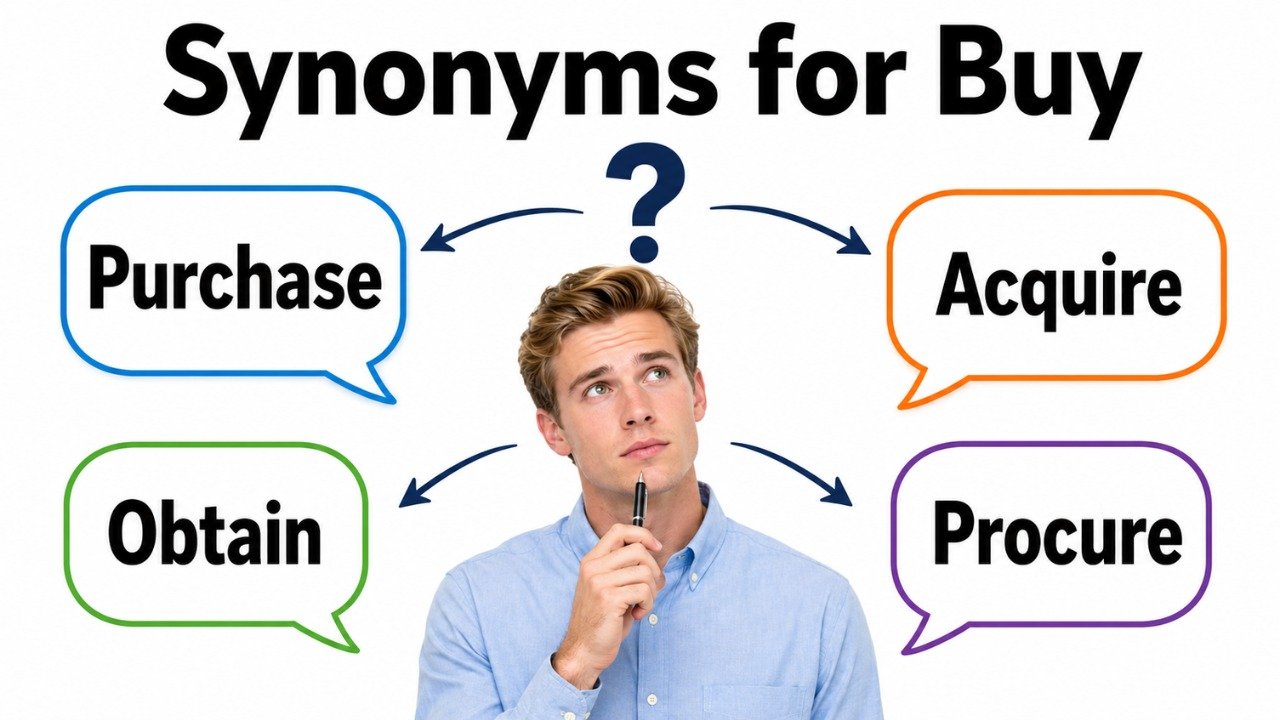
Quick Answer: The best synonyms for buy include purchase, acquire, obtain, procure, pay for, pick up, order, secure, shop for, and invest in. Purchase is the clearest general replacement and works well in formal writing. Acquire emphasizes gaining ownership, while procure suits carefully arranged purchases. Pick up is natural in casual speech, order works when requesting an item, secure emphasizes successfully obtaining something, and invest in is best when the purchase may provide future value.
Pronunciation and Word Details
Word: Buy.
Pronunciation: /baɪ/.
Part of Speech: Verb and noun.
Meaning: To obtain something by paying money for it, or a purchased item considered a good or poor deal.
US Pronunciation:
UK Pronunciation:
What Does “Buy” Mean?
Buy most commonly means to obtain a product, service, property, or right by paying money for it.
As a verb, buy describes the action of purchasing something.
Example: We plan to buy a new dining table.
The person who pays is the buyer, while the item or service is what the person buys. The usual past tense and past participle of buy is bought.
Present: I buy fresh vegetables every week.
Past: I bought fresh vegetables yesterday.
Past Participle: I have bought everything on the list.
Buy can also function as a noun in informal language. In this use, it describes something available at a particular price or something considered a good purchase.
Example: That durable jacket was an excellent buy.
The word also has several figurative meanings. It can mean to believe or accept an explanation.
Example: I do not buy his excuse.
It can mean to gain time, support, loyalty, or an advantage through payment or another sacrifice.
Example: The temporary solution bought the team more time.
Because buy has literal and figurative uses, the most accurate synonym depends on what is being purchased, how formal the sentence is, and whether money is actually involved.
Meaning, Tone, and Context of “Buy”
Buy is a common, neutral, and conversational word. It appears naturally in everyday speech, personal writing, instructions, advertisements, business communication, and financial discussions.
The word is direct and easy to understand.
Example: I need to buy some notebooks.
In formal documents, purchase, acquire, or procure may sound more precise.
Example: The department intends to procure new equipment.
Buy can sound casual when used for expensive property, legal rights, or formal business transactions. Purchase or acquire may better match those contexts.
Casual: They want to buy a building.
Formal: They intend to acquire the building.
When buy means believe, it has an informal and sometimes skeptical tone.
Example: I am not buying that explanation.
When buy means gain something through payment or sacrifice, it can carry a positive, neutral, or negative tone.
Positive: The repairs bought the family several more years of use.
Negative: He tried to buy their silence.
As a noun, buy is informal and often evaluates value.
Example: The used desk was a good buy.
The word is not naturally emotional, academic, or technical by itself. Its tone depends mainly on the object, situation, and surrounding vocabulary.
When and How to Use “Buy”
For Everyday Products
Use buy when talking about ordinary goods such as food, clothing, furniture, books, or household supplies.
Example: She stopped to buy bread on her way home.
For Services
Use buy when someone pays for access, assistance, entertainment, or another service.
Example: We bought a cleaning service for the office.
In more natural formal writing, pay for, book, hire, or commission may be more precise.
For Property
Use buy when purchasing a house, apartment, land, vehicle, or another valuable possession.
Example: They hope to buy a small house next year.
Purchase or acquire may sound more formal in legal and financial writing.
For Casual Conversation
Buy is usually more natural than purchase in relaxed everyday speech.
Example: Where did you buy that lamp?
For Formal Transactions
Use purchase, acquire, or procure when the transaction needs a more professional tone.
Example: The institution will purchase new equipment.
For Advance Requests
Use order when the product will be prepared, delivered, or collected later.
Example: We ordered a new table for the conference room.
For Reservations
Use book or reserve when paying for travel, accommodation, tickets, or scheduled services.
Example: She booked two seats for the evening performance.
For Valuable Assets
Use invest in when buying something expected to provide future financial, practical, or personal value.
Example: They decided to invest in energy efficient equipment.
For Quick or Convenient Purchases
Use pick up when casually buying or collecting an ordinary item.
Example: I will pick up some milk after work.
For Scarce Items
Use secure when the item is difficult to obtain or has limited availability.
Example: She secured the final ticket for the event.
For Believing a Claim
Use buy informally when accepting or rejecting an explanation, story, or idea.
Example: I do not buy the claim that nobody noticed the error.
For Gaining Time
Use buy when an action creates additional time before something must happen.
Example: The short extension bought us another week.
Best Synonyms for Buy
Purchase
Synonym: To obtain something by paying for it.
Example: The school plans to purchase new computers.
Acquire
Synonym: To gain possession or ownership of something.
Example: The collector acquired a rare painting.
Obtain
Synonym: To get something through effort, payment, or a formal process.
Example: You must obtain permission before purchasing the land.
Procure
Synonym: To obtain something through careful arrangement or effort.
Example: The manager procured the necessary materials for the project.
Pay For
Synonym: To provide money in exchange for a product or service.
Example: She paid for the repairs herself.
Pick Up
Synonym: To buy or collect something casually or conveniently.
Example: I will pick up a few supplies this afternoon.
Order
Synonym: To request a product or service that will be provided later.
Example: They ordered new chairs for the waiting room.
Secure
Synonym: To successfully obtain something, especially when availability is limited.
Example: We secured tickets before they became unavailable.
Shop For
Synonym: To look for an item with the intention of purchasing it.
Example: They are shopping for a larger dining table.
Invest In
Synonym: To purchase something expected to produce future value or benefit.
Example: The business invested in modern safety equipment.
50 Synonyms for Buy with Short Meanings
The following words and phrases are direct synonyms or useful contextual alternatives. The correct choice depends on whether buy refers to a product, service, asset, reservation, belief, or figurative advantage.
- Purchase: Obtain something by paying money.
- Acquire: Gain possession or ownership.
- Obtain: Get something through payment, effort, or a process.
- Procure: Obtain something through careful planning or effort.
- Pay For: Give money in exchange for something.
- Pick Up: Buy or collect something casually.
- Get: Obtain something in a general or informal sense.
- Shop For: Search for something with the intention of buying it.
- Order: Request an item or service for later delivery.
- Secure: Successfully obtain something valuable or limited.
- Invest In: Buy something expected to provide future value.
- Make a Purchase: Complete the act of buying something.
- Buy Outright: Purchase something with full payment and ownership.
- Acquire Ownership Of: Become the legal owner of something.
- Take Possession Of: Gain control or physical ownership of something.
- Buy Up: Purchase all or most of an available supply.
- Snap Up: Buy something quickly because it is desirable.
- Stock Up On: Buy a large amount for future use.
- Bargain For: Negotiate the price or conditions of a purchase.
- Bid For: Offer a price in an attempt to purchase something.
- Trade For: Obtain something by giving another item in exchange.
- Exchange For: Receive something in return for another item or value.
- Redeem: Exchange a voucher, credit, or reward for something.
- Reserve: Arrange to hold an item or place for later purchase or use.
- Book: Arrange and often pay for a service, seat, or room.
- Subscribe To: Pay regularly for continued access to something.
- Take Out: Arrange and pay for a policy, loan, or service.
- Commission: Pay someone to create a particular product or work.
- Hire: Pay for temporary use of a person, service, or object.
- Retain: Pay to secure ongoing professional services.
- Source: Find and obtain a product or material.
- Close On: Complete the purchase of property.
- Acquire the Rights To: Purchase legal control over creative or commercial rights.
- License: Pay for legal permission to use something.
- Add to a Collection: Purchase an item for an existing collection.
- Purchase in Bulk: Buy a large quantity at one time.
- Purchase Wholesale: Buy goods in quantity for resale or business use.
- Purchase at Retail: Buy goods directly for personal use.
- Buy Into: Accept, support, or invest in an idea or venture.
- Accept: Regard an idea, claim, or explanation as true.
- Believe: Consider a statement or story to be true.
- Credit: Accept a claim as believable.
- Trust: Believe that a person or statement is reliable.
- Be Convinced By: Accept something after considering it.
- Fall For: Believe a misleading story or trick.
- Swallow: Informally accept an unlikely story as true.
- Embrace: Willingly accept an idea or approach.
- Endorse: Publicly approve or support an idea.
- Bribe: Gain cooperation or influence through improper payment.
- Gain: Obtain time, support, or an advantage through an action or cost.
Read Also:
Synonyms for Exhilarating

Synonyms for Buy by Context
When Buy Means Purchase a Product
Purchase, pick up, get, order, and shop for are useful when referring to ordinary products.
Purchase: Suitable for neutral or formal writing.
Example: She purchased a new desk for her office.
Pick Up: Suitable for small, convenient, or casual purchases.
Example: I need to pick up a few groceries.
Get: Common in informal conversation.
Example: We should get another chair for the guest room.
Order: Best when an item is requested for later delivery.
Example: He ordered a replacement part.
Shop For: Emphasizes searching and comparing before purchasing.
Example: They spent the afternoon shopping for curtains.
When Buy Means Acquire Property or Assets
Acquire, purchase outright, close on, secure, and invest in are appropriate for valuable possessions and assets.
Acquire: Emphasizes gaining ownership.
Example: The business acquired a larger warehouse.
Purchase Outright: Means paying fully instead of using a continuing rental arrangement.
Example: They purchased the equipment outright.
Close On: Describes completing a property transaction.
Example: The couple closed on their first home in June.
Secure: Emphasizes successfully obtaining something valuable.
Example: The investor secured a valuable piece of land.
Invest In: Suggests that the purchase may provide future benefits.
Example: She invested in a small rental property.
When Buy Means Obtain Through Effort
Obtain, procure, source, and secure emphasize the process of finding and gaining something.
Obtain: A broad formal alternative.
Example: The clinic obtained new medical supplies.
Procure: Suggests careful arrangement or difficulty.
Example: The team procured the materials from several suppliers.
Source: Focuses on finding a suitable provider or product.
Example: The designer sourced natural fabric for the project.
Secure: Highlights successful access to a limited item.
Example: We secured enough materials to complete the work.
When Buy Means Arrange a Service
Book, reserve, hire, retain, commission, and subscribe to work for services rather than physical goods.
Book: Used for rooms, seats, appointments, and travel.
Example: We booked a room for two nights.
Reserve: Means arranging for something to be held.
Example: She reserved a table for six people.
Hire: Used when paying for temporary assistance or use.
Example: They hired a photographer for the event.
Retain: Used when paying for continued professional services.
Example: The organization retained a legal adviser.
Commission: Used when paying someone to create a specific work.
Example: The family commissioned a portrait.
Subscribe To: Used for repeated access over a period.
Example: He subscribed to a monthly learning service.
When Buy Means Purchase Quickly
Snap up, pick up, secure, and buy up describe fast or competitive purchasing.
Snap Up: Suggests acting quickly to obtain something desirable.
Example: Shoppers snapped up the discounted chairs.
Pick Up: Describes a convenient and usually ordinary purchase.
Example: She picked up a notebook before class.
Secure: Suggests successfully obtaining limited availability.
Example: He secured the last available seat.
Buy Up: Means purchasing all or most of the available supply.
Example: One collector bought up every remaining copy.
When Buy Means Purchase in Quantity
Stock up on, buy up, purchase in bulk, and purchase wholesale describe larger purchases.
Stock Up On: Means buying enough for future use.
Example: The family stocked up on basic supplies.
Buy Up: Means taking most or all available items.
Example: Investors bought up the available land.
Purchase in Bulk: Means buying a large quantity at one time.
Example: The restaurant purchases rice in bulk.
Purchase Wholesale: Means buying large quantities, often for business use.
Example: The shop purchases its products wholesale.
When Buy Means Believe
Believe, accept, credit, trust, fall for, and swallow can replace buy when no financial transaction is involved.
Believe: The clearest neutral replacement.
Example: I do not believe his explanation.
Accept: Means considering a statement or idea valid.
Example: She refused to accept the official explanation.
Credit: Means regarding a report or claim as believable.
Example: Few readers credited the surprising story.
Trust: Emphasizes confidence in the source.
Example: I trust her account of the event.
Fall For: Suggests being deceived.
Example: He fell for the false advertisement.
Swallow: An informal word suggesting unquestioning belief.
Example: Nobody swallowed the unlikely excuse.
When Buy Means Support an Idea
Buy into, embrace, endorse, accept, and support are useful when buy refers to agreement rather than payment.
Buy Into: Means accepting and supporting an idea or plan.
Example: The staff did not buy into the new approach.
Embrace: Suggests accepting something willingly and enthusiastically.
Example: The community embraced the environmental program.
Endorse: Means publicly or officially supporting something.
Example: The committee endorsed the revised proposal.
Accept: Means agreeing that an idea is valid or suitable.
Example: The members accepted the final plan.
Support: Means approving or helping an idea, person, or effort.
Example: Most residents supported the improvement project.
When Buy Means Gain Time or Advantage
Gain, secure, obtain, and create can replace buy in expressions involving time, support, safety, or opportunity.
Gain: The most direct replacement for obtaining an advantage.
Example: The delay gained the team several extra hours.
Secure: Emphasizes successfully obtaining support or protection.
Example: The agreement secured additional time for negotiations.
Obtain: Suits formal explanations of an acquired advantage.
Example: The company obtained temporary protection from the agreement.
Create: Works when an action produces more time or opportunity.
Example: The temporary repair created enough time to find a permanent solution.
Another Word for Buy
Purchase is the best single replacement for buy in most literal contexts. It has the same basic meaning but sounds slightly more formal and precise.
The best alternative still depends on the situation. Use acquire for ownership, procure for carefully arranged purchases, order for items requested in advance, and invest in for assets expected to provide future value.
Original: We need to buy new office chairs.
Better Option: We need to purchase new office chairs.
Original: The company plans to buy a smaller business.
Better Option: The company plans to acquire a smaller business.
Original: She bought the materials from a specialist supplier.
Better Option: She procured the materials from a specialist supplier.
Original: They bought a small apartment as a long term asset.
Better Option: They invested in a small apartment as a long term asset.
When Not to Use “Buy”
When the Transaction Is Formal or Legal
Buy may sound too casual in contracts, property documents, reports, and official notices.
Weak: The organization will buy the property next month.
Better: The organization will acquire the property next month.
When No Ownership Is Transferred
Do not use buy when the person is only renting, borrowing, or temporarily using something.
Weak: We bought a car for three days.
Better: We rented a car for three days.
When Only a Payment Is Being Described
Pay and buy are related, but they do not always describe the same action. A person pays a bill but buys a product or service.
Weak: I bought the electricity bill yesterday.
Better: I paid the electricity bill yesterday.
When the Item Is Free
Buy requires payment. Use receive, get, collect, or obtain when no money is exchanged.
Weak: She bought a free information guide.
Better: She received a free information guide.
When the Sentence Needs a Specific Service Verb
Book, hire, retain, or commission can communicate the type of transaction more clearly.
Weak: They bought a photographer for the ceremony.
Better: They hired a photographer for the ceremony.
When Referring to Belief in Formal Writing
The figurative meaning of buy may sound too conversational in academic or professional analysis.
Weak: The researchers did not buy the explanation.
Better: The researchers did not accept the explanation.
When Buy Creates Unwanted Repetition
Repeating buy throughout a paragraph can make the writing sound basic.
Weak: We bought a table, bought six chairs, and bought a new lamp.
Better: We purchased a table, selected six chairs, and picked up a new lamp.
When the Purchase Is an Investment
Buy may not communicate the reason or expected future value.
Weak: The company bought new training equipment.
Better: The company invested in new training equipment.
When the Action Is Unethical
Expressions such as buy support, buy loyalty, or buy silence can imply bribery or manipulation. Use precise wording when the ethical meaning matters.
Weak: He tried to buy their cooperation.
Better: He attempted to bribe them for their cooperation.
Words Commonly Confused With Buy
Buy vs Purchase: Both mean obtaining something through payment. Purchase is more formal, while buy is more natural in everyday conversation.
Buy vs Acquire: Buy always suggests payment in its literal sense. Acquire means gaining possession and does not always require money.
Buy vs Obtain: Buy describes a financial transaction. Obtain can involve effort, permission, application, or payment.
Buy vs Pay: Buy focuses on receiving a product or service. Pay focuses on giving money.
Buy vs Order: Buy describes the complete purchase. Order describes requesting an item or service, often before receiving it.
Buy vs Shop: Buy means completing a transaction. Shop means searching, comparing, or looking for something to purchase.
Buy vs Rent: Buying transfers ownership. Renting provides temporary use without full ownership.
Buy vs Invest: Buying is any purchase. Investing means using money with the expectation of future value or benefit.
Buy vs Sell: Buy means obtaining something through payment. Sell means giving something to another person in exchange for payment.
Buy vs By: Buy is a verb related to purchasing. By is a preposition used for position, method, authorship, or time.
Buy vs Bye: Buy means purchase. Bye is an informal expression used when leaving.
Buy vs Bought: Buy is the present form. Bought is the past tense and past participle.
Which Synonym Should You Choose?
Choose purchase as the strongest general alternative in neutral and formal writing.
Choose acquire when emphasizing ownership of property, assets, rights, or another business.
Choose obtain when the item is gained through payment, permission, effort, or an official process.
Choose procure when something requires careful arrangement, specialist knowledge, or considerable effort to obtain.
Choose pay for when the sentence should focus on the money provided.
Choose pick up in casual speech for groceries, supplies, tickets, and other ordinary items.
Choose order when requesting an item that will be prepared, delivered, or collected later.
Choose secure when availability is limited or obtaining the item is an achievement.
Choose shop for when describing the process of looking and comparing.
Choose invest in when the purchase is expected to offer future financial or practical value.
Choose reserve when arranging for an item, place, or service to be held.
Choose book for travel, accommodation, appointments, tickets, and scheduled services.
Choose hire when paying for temporary services, labor, equipment, or transport.
Choose commission when paying someone to create a custom work.
Choose retain when securing continuing professional services.
Choose source when describing the process of finding products, materials, or suppliers.
Choose snap up when someone purchases a desirable item quickly.
Choose stock up on when purchasing a large quantity for future use.
Choose believe or accept when buy refers to regarding a statement as true.
Choose buy into, embrace, or support when discussing agreement with an idea or plan.
Choose gain when buy refers to creating additional time or an advantage.
Real Life Examples of “Buy” in Sentences
Original: We need to buy more paper for the printer.
Better Option: We need to purchase more paper for the printer.
Original: The company bought a new warehouse.
Better Option: The company acquired a new warehouse.
Original: She bought a ticket before the event.
Better Option: She secured a ticket before the event.
Original: I will buy some fruit on my way home.
Better Option: I will pick up some fruit on my way home.
Original: They bought a table that will arrive next week.
Better Option: They ordered a table that will arrive next week.
Original: The restaurant buys vegetables from nearby farms.
Better Option: The restaurant sources vegetables from nearby farms.
Original: We bought a room for two nights.
Better Option: We booked a room for two nights.
Original: The family bought solar equipment to reduce future costs.
Better Option: The family invested in solar equipment to reduce future costs.
Original: I do not buy his explanation.
Better Option: I do not believe his explanation.
Original: The temporary agreement bought the team more time.
Better Option: The temporary agreement gave the team more time.
Synonym Groups and Usage Differences
Direct Purchase Group
This group includes purchase, pay for, make a purchase, and buy outright.
Use these alternatives when money is exchanged directly for ownership.
Example: She purchased the equipment outright.
Ownership Group
This group includes acquire, acquire ownership of, take possession of, and close on.
These expressions emphasize gaining legal or physical control of an asset.
Example: The couple closed on the property last week.
Casual Shopping Group
This group includes get, pick up, shop for, and snap up.
These alternatives sound natural in everyday conversations about ordinary products.
Example: I will pick up some fresh bread this evening.
Careful Acquisition Group
This group includes procure, obtain, source, and secure.
Use these words when obtaining something requires planning, effort, access, or specialist knowledge.
Example: The engineer procured the required parts.
Advance Arrangement Group
This group includes order, reserve, book, commission, and subscribe to.
These words describe purchases arranged before the product or service is received.
Example: They commissioned a custom dining table.
Quantity Purchase Group
This group includes stock up on, buy up, purchase in bulk, and purchase wholesale.
Use these expressions when discussing larger quantities.
Example: The store purchased its packaging materials in bulk.
Service Payment Group
This group includes hire, retain, take out, and pay for.
These alternatives describe paying for temporary work, professional advice, insurance, or another service.
Example: The business retained an accountant.
Investment Group
This group includes invest in, secure, acquire, and buy into.
These words suit assets, business interests, or opportunities expected to provide future benefits.
Example: The owners invested in more efficient machinery.
Belief Group
This group includes believe, accept, credit, trust, fall for, and swallow.
Use these words when buy means treating an explanation or claim as true.
Example: Few people believed the unlikely excuse.
Support Group
This group includes buy into, embrace, endorse, accept, and support.
These alternatives describe agreement with an idea, proposal, or approach.
Example: The employees embraced the revised working method.
Antonyms of Buy
The main opposite of buy is sell. Other antonyms depend on whether buy refers to purchasing, accepting an idea, or gaining something.
Sell: Give something to another person in exchange for money.
Return: Take a purchased item back to the seller.
Refund: Repay money for a returned or cancelled purchase.
Give Away: Transfer something without receiving payment.
Donate: Give money or property without expecting payment.
Discard: Get rid of something rather than acquire it.
Refuse: Decline an offer, product, or proposal.
Reject: Decide not to accept something.
Decline: Politely refuse an offer or opportunity.
Disbelieve: Consider a claim or explanation untrue.
Doubt: Feel uncertain about the truth of something.
Question: Express uncertainty about a claim or idea.
Oppose: Act against an idea, plan, or proposal.
Resist: Refuse to accept or support something.
Divest: Sell or remove ownership of an asset.
Comparison Between Buy and Related Words
Buy vs Purchase
Buy and purchase share the same basic meaning. Buy is more conversational, while purchase sounds more formal or commercial.
Example With Buy: I need to buy a new coat.
Example With Purchase: The department will purchase new uniforms.
Buy vs Acquire
Buy always suggests a payment in its literal meaning. Acquire simply means gaining possession and may involve purchase, gift, inheritance, or another method.
Example With Buy: She bought the painting at an auction.
Example With Acquire: She acquired the painting from a relative.
Buy vs Obtain
Buy refers specifically to getting something through payment. Obtain is broader and can involve effort, permission, or a formal process.
Example With Buy: He bought a ticket at the entrance.
Example With Obtain: He obtained permission to enter the private area.
Buy vs Procure
Buy is general and direct. Procure suggests that obtaining the item required planning, effort, or special arrangements.
Example With Buy: They bought additional materials.
Example With Procure: They procured rare materials from a specialist.
Buy vs Pay For
Buy focuses on the product or service received. Pay for focuses on the money or responsibility for the cost.
Example With Buy: She bought lunch.
Example With Pay For: She paid for everyone’s lunch.
Buy vs Order
Buy describes the purchase itself. Order means requesting something that may be delivered or prepared later.
Example With Buy: He bought a new bookshelf.
Example With Order: He ordered a bookshelf that will arrive next week.
Buy vs Shop For
Buy means completing a transaction. Shop for describes searching and comparing before making a decision.
Example With Buy: They bought a new sofa.
Example With Shop For: They spent Saturday shopping for a new sofa.
Buy vs Invest In
Buy can describe any purchase. Invest in suggests that the buyer expects future value, income, efficiency, or another benefit.
Example With Buy: The company bought new equipment.
Example With Invest In: The company invested in equipment that will reduce production costs.
Buy vs Rent
Buying gives the purchaser ownership. Renting provides temporary use for an agreed payment.
Example With Buy: They bought a house near the school.
Example With Rent: They rented a house for one year.
Buy vs Book
Buy can apply to products and services. Book is more precise for reservations, accommodation, seats, travel, and appointments.
Example With Buy: We bought two tickets.
Example With Book: We booked two seats for the evening performance.
Common Phrases and Expressions With Buy
Buy Into an Idea: Accept or support a belief, proposal, or plan.
Buy Time: Gain additional time before something must happen.
Buy in Bulk: Purchase a large quantity at one time.
Buy on Credit: Purchase something with payment due later.
Buy Outright: Pay the full price and gain complete ownership.
Buy Back: Purchase something that was previously sold.
Buy Up: Purchase all or most of an available supply.
Buy Out: Purchase another person’s share or full control of a business.
Buy Off: Improperly pay someone to influence an action or decision.
Buy For a Song: Purchase something for a very low price.
Money Cannot Buy: Used to describe something valuable that cannot be obtained through payment.
A Good Buy: An item considered valuable for its price.
Common Mistakes to Avoid
Confusing Buy With By
Buy refers to purchasing, while by is a preposition.
Incorrect: I want to by a new chair.
Correct: I want to buy a new chair.
Confusing Buy With Bye
Bye is used when leaving or ending a conversation.
Incorrect: She said buy and left.
Correct: She said bye and left.
Using Buyed as the Past Tense
The correct past tense of buy is bought.
Incorrect: We buyed new curtains yesterday.
Correct: We bought new curtains yesterday.
Using Bought After Did
Use the base form buy after did.
Incorrect: Did you bought the tickets?
Correct: Did you buy the tickets?
Confusing Buy With Pay
A person buys an item but pays a price, fee, bill, or person.
Incorrect: I bought the electricity bill.
Correct: I paid the electricity bill.
Using Buy When No Ownership Is Gained
Do not use buy for a temporary rental.
Incorrect: We bought a room for one night.
Correct: We booked a room for one night.
Using Purchase Too Often in Casual Speech
Purchase is correct, but it can sound unnecessarily formal in everyday conversation.
Unnatural: I am going to purchase some bread.
Natural: I am going to buy some bread.
Using Buy for a Free Item
Buy requires payment.
Incorrect: I bought a free sample.
Correct: I received a free sample.
Choosing an Inaccurate Figurative Synonym
Fall for suggests deception, while accept and believe are more neutral.
Too Strong: She fell for the accurate explanation.
Better: She accepted the accurate explanation.
Repeating Buy in Every Sentence
Use relevant alternatives to improve clarity and variety.
Repetitive: We bought paint, bought brushes, and bought new tools.
Improved: We purchased paint, picked up brushes, and ordered new tools.
Leaving the Purchase Unclear
Name the product, service, or asset when the context does not make it obvious.
Vague: The company plans to buy soon.
Clear: The company plans to acquire a new warehouse soon.
Conclusion
The most useful synonyms for buy include purchase, acquire, obtain, procure, pay for, order, secure, pick up, and invest in. Purchase is the strongest general alternative, while acquire suits ownership and procure describes carefully arranged buying. Choose pick up for casual speech, order for advance requests, and invest in for purchases expected to provide future value. When buy means believe or support, alternatives such as accept, believe, embrace, and endorse create clearer and more precise sentences.
FAQs About Synonyms for Buy
What Is the Best Synonym for Buy?
Purchase is the best general synonym for buy because it has the same core meaning and works in most formal and neutral contexts.
What Is a Formal Synonym for Buy?
Purchase, acquire, procure, and obtain are useful formal alternatives. The best choice depends on the type of transaction.
What Is a Casual Synonym for Buy?
Get and pick up are natural casual alternatives for ordinary purchases.
Can Acquire Replace Buy?
Acquire can replace buy when emphasizing ownership. However, acquire does not always involve payment, so it is broader than buy.
What Is Another Word for Buying Property?
Purchase, acquire, invest in, and close on are suitable expressions for buying property.
What Does Buy Mean in “I Do Not Buy It”?
In this expression, buy means believe or accept. “I do not buy it” means “I do not believe it.”
What Is the Opposite of Buy?
Sell is the clearest opposite of buy. In figurative contexts, reject, refuse, doubt, and disbelieve may act as opposites.
