
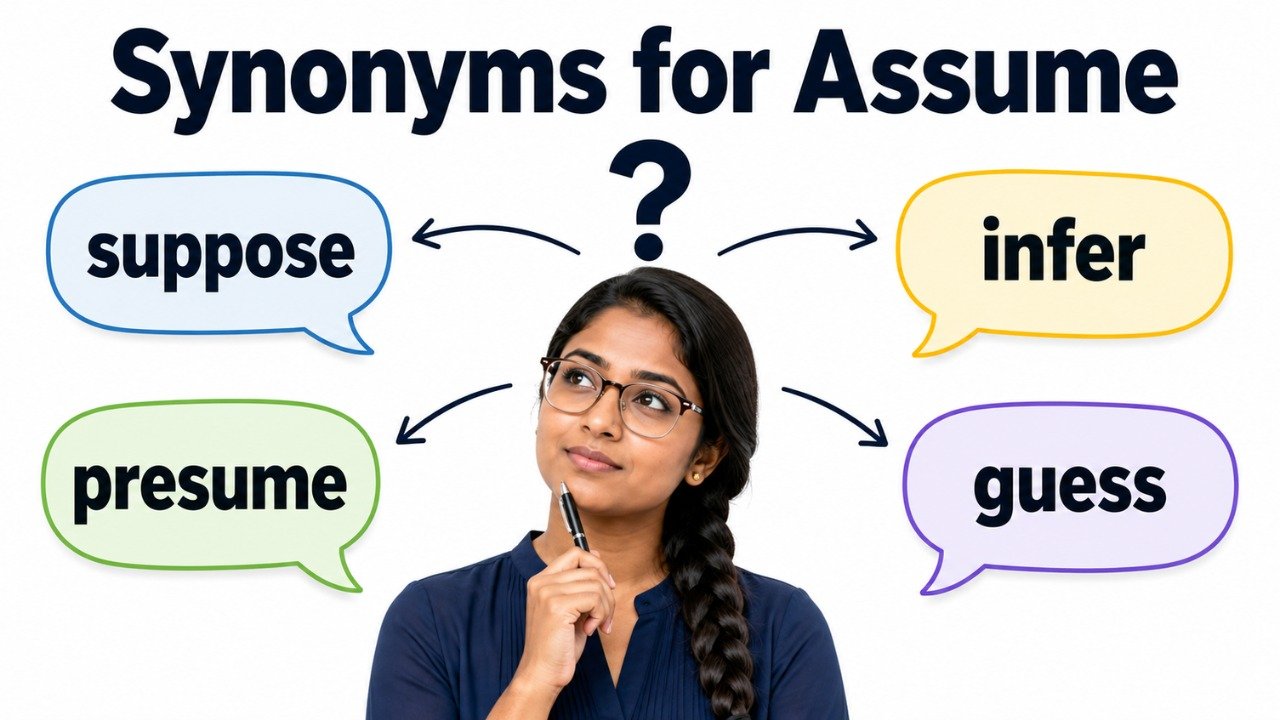
Quick Answer: Common synonyms for assume include suppose, presume, believe, think, expect, infer, imagine, guess, conclude, and accept. The best choice depends on context. Use suppose for a tentative belief, presume when a belief is based on probability, infer when reaching a conclusion from evidence, expect when predicting something likely to happen, and conclude when evidence leads to a judgment. When assume means taking responsibility or control, words such as undertake, accept, adopt, and take on may be more accurate.
Pronunciation and Word Details
Word: Assume
Pronunciation: /əˈsuːm/
Part of Speech: Verb
Meaning: To accept something as true without complete proof, or to take on a role, duty, responsibility, position, or quality.
US Pronunciation:
UK Pronunciation:
What Does “Assume” Mean?
Assume means to believe that something is true without having complete proof or certainty. It is a verb commonly used when people form expectations, make judgments, or proceed based on information that has not been fully confirmed.
For example, if you assume a meeting starts at nine, you believe that time is correct even though you may not have verified it.
The word also has another important meaning. Assume can mean to take on a responsibility, role, position, duty, appearance, or condition. A person can assume leadership, assume responsibility, or assume control.
Because assume has several meanings, the best synonym depends strongly on the sentence. Suppose, presume, infer, believe, expect, accept, undertake, and adopt can all replace assume in certain contexts, but they are not interchangeable in every situation.
Meaning, Tone, and Context of “Assume”
Assume is generally neutral and works in both everyday and formal English. It appears frequently in conversation, essays, academic discussions, workplace communication, instructions, arguments, and analytical writing.
For Unconfirmed Beliefs: Assume often describes accepting an idea as true before it has been proved.
Example: I assumed the store would be open.
For Reasoning: Assume can introduce a condition that people temporarily accept so they can analyze a situation.
Example: Assume the figures remain unchanged for the next month.
For Expectations: Assume can express what someone believes will probably happen.
Example: We assumed everyone would arrive before noon.
For Responsibility: Assume can mean accepting a duty or obligation.
Example: She assumed responsibility for organizing the event.
For Leadership or Control: Assume can describe taking possession of authority or a position.
Example: He assumed control of the project.
For Appearance or Character: Assume may describe taking on a particular quality, form, expression, or manner.
Example: Her expression assumed a serious look.
In casual conversation, suppose and think often sound more natural than assume. In analytical writing, presume, infer, posit, and hypothesize may express a more precise type of reasoning.
When and How to Use “Assume”
Use assume when you want to communicate that an idea is being accepted without complete confirmation or that someone is taking on a role, responsibility, or position.
For an Unverified Belief: Use assume when something appears likely but has not been confirmed.
Example: I assumed he had already received the message.
For an Expected Outcome: Use assume when making a reasonable expectation about what may happen.
Example: We assumed demand would remain steady.
For Temporary Reasoning: Use assume when asking readers to accept a condition for the purpose of discussion or analysis.
Example: Assume the total cost is divided equally.
For Responsibility: Use assume when someone accepts responsibility for an action, duty, or result.
Example: The manager assumed responsibility for the mistake.
For a New Role: Use assume when someone begins performing an official or important position.
Example: She assumed the role of team leader.
For Control or Authority: Use assume when someone takes control of something.
Example: The new director assumed control of daily operations.
For a Quality or Form: Use assume when something begins showing a particular appearance, shape, character, or manner.
Example: The discussion gradually assumed a more serious tone.
Best Synonyms for Assume
Suppose: To believe something is probably true without being completely certain.
Example: I suppose they have already left.
Presume: To believe something is likely to be true based on available information or probability.
Example: We presume the documents are accurate unless evidence shows otherwise.
Believe: To accept something as true.
Example: She believed the train would arrive on time.
Think: To hold an opinion, idea, or belief.
Example: I think the package will arrive tomorrow.
Expect: To believe that something will probably happen.
Example: They expect the work to finish soon.
Infer: To reach a conclusion based on evidence or clues.
Example: From his response, we inferred that he disagreed.
Guess: To form an opinion without enough information to know for certain.
Example: I guessed that she was busy.
Conclude: To decide something after considering evidence or information.
Example: The researchers concluded that further examination was needed.
Accept: To regard something as true, valid, or satisfactory.
Example: We accepted the explanation as accurate.
Undertake: To accept responsibility for a task, duty, or project.
Example: She undertook responsibility for preparing the final report.
50 Synonyms for Assume with Short Meanings
- Suppose: Believe something is probably true.
- Presume: Accept something as likely without complete proof.
- Believe: Regard something as true.
- Think: Hold an opinion or belief.
- Expect: Believe something will probably happen.
- Infer: Reach a conclusion from evidence.
- Guess: Form an opinion without enough information.
- Imagine: Form an idea about something not confirmed.
- Conclude: Reach a judgment after considering information.
- Accept: Regard something as true or valid.
- Consider: Think of something in a particular way.
- Suspect: Believe something may be true.
- Surmise: Form a conclusion from limited evidence.
- Deduce: Reach a conclusion through reasoning.
- Gather: Understand something from available clues.
- Reckon: Think or suppose, especially informally.
- Figure: Think or calculate that something is likely.
- Estimate: Form an approximate judgment.
- Anticipate: Expect something before it happens.
- Predict: State or believe what is likely to happen.
- Forecast: Predict a future situation or result.
- Project: Estimate a future result from current information.
- Postulate: Suggest something as a basis for reasoning.
- Posit: Put forward an idea as an assumption.
- Hypothesize: Propose an explanation for examination.
- Theorize: Develop an explanation based on ideas or evidence.
- Speculate: Consider possibilities without firm evidence.
- Conjecture: Form an opinion from incomplete information.
- Take: Understand or interpret something in a certain way.
- Deem: Consider something to have a particular quality.
- Regard: Consider something in a certain way.
- Judge: Form an opinion after consideration.
- Interpret: Understand something in a particular way.
- Take for granted: Accept something without questioning it.
- Take as given: Treat something as already established.
- Proceed on: Act according to an accepted assumption.
- Take on: Accept a responsibility, role, or task.
- Undertake: Accept responsibility for doing something.
- Accept responsibility: Agree to be accountable for something.
- Adopt: Take up a position, approach, role, or attitude.
- Accept: Take or receive a duty, position, or belief.
- Enter upon: Begin performing a position or responsibility.
- Occupy: Take or hold a position or role.
- Take control: Begin directing or managing something.
- Take charge: Accept authority or responsibility.
- Inherit: Receive a role, duty, situation, or responsibility from another.
- Shoulder: Accept a burden or responsibility.
- Embrace: Willingly accept a role, duty, or idea.
- Acquire: Come to possess a quality, form, or characteristic.
- Adopt a role: Begin behaving or functioning in a particular capacity.
Read Also:
Synonyms for Looking Forward
Synonyms for Assume by Context
When Assume Means Believe Without Proof
Suppose, presume, believe, think, guess, imagine, suspect, surmise, and conjecture can describe forming a belief without complete certainty.
Suppose: Best for a tentative or casual belief.
Example: I suppose she will arrive soon.
Presume: Best when the belief seems reasonable from known circumstances.
Example: We presume the payment has already been processed.
Guess: Best when little information is available.
Example: I guessed that the office was closed.
Suspect: Best when someone believes something may be true, often because of clues.
Example: They suspected that the delay was caused by heavy traffic.
When Assume Means Reach a Conclusion
Infer, deduce, conclude, gather, interpret, and judge work when assume involves reasoning from available information.
Infer: Used when evidence indirectly suggests a conclusion.
Example: We inferred from his silence that he preferred not to participate.
Deduce: Used when logical reasoning produces the conclusion.
Example: She deduced from the records that the payment had been made.
Conclude: Used when information leads to a final judgment.
Example: They concluded that the original estimate was inaccurate.
When Assume Means Expect
Expect, anticipate, predict, forecast, project, and estimate are useful when assume concerns a future event or outcome.
Expect: The most natural general alternative.
Example: We expect the delivery to arrive tomorrow.
Anticipate: Suggests thinking about an event before it occurs.
Example: They anticipate strong demand during the holiday period.
Project: Best when future results are calculated from current information.
Example: Analysts projected higher costs for the next quarter.
When Assume Means Accept a Responsibility
Take on, undertake, shoulder, accept, embrace, and accept responsibility are appropriate when assume refers to a duty.
Take on: Natural in everyday and professional communication.
Example: Maria took on additional responsibilities.
Undertake: More formal and often used for significant duties.
Example: The committee undertook a detailed review.
Shoulder: Emphasizes carrying a burden or responsibility.
Example: He shouldered responsibility for solving the problem.
When Assume Means Take Control or a Position
Take control, take charge, occupy, enter upon, and take on are useful alternatives when someone assumes authority or a formal role.
Take Control: Clearly expresses gaining authority over something.
Example: She took control of the department.
Take Charge: Often used when someone begins directing a situation.
Example: He took charge of the negotiations.
Occupy: Appropriate for holding an office, position, or formal role.
Example: She occupied the position for several years.
When Assume Means Adopt a Quality or Appearance
Adopt, acquire, take on, and develop can replace assume when something changes in character, appearance, or form.
Adopt: Often describes taking on an attitude, expression, method, or style.
Example: He adopted a more serious tone.
Acquire: Useful when a person or thing gradually gains a quality.
Example: The surface acquired a darker appearance.
Take On: Natural when something develops a particular character.
Example: The conversation took on a more urgent tone.
Another Word for Assume
The best general alternative to assume is suppose when you mean believing something without certainty. However, the strongest replacement changes according to context.
Use presume when there is some reasonable basis for the belief. Use infer when evidence leads you to a conclusion. Use expect when talking about the future. Use take on or undertake when referring to responsibility.
Original: I assume they are coming tonight.
Better Option: I suppose they are coming tonight.
Original: We assume the figures are correct based on the available records.
Better Option: We presume the figures are correct based on the available records.
Original: From her reaction, I assume she already knew.
Better Option: From her reaction, I infer that she already knew.
Original: She assumed responsibility for the new project.
Better Option: She took on responsibility for the new project.
When Not to Use “Assume”
Assume is useful, but it can sound vague when a more exact verb explains how a conclusion was reached.
Avoid assume when you actually have evidence. Infer, conclude, determine, or establish may describe the reasoning more accurately.
Weak: We assumed from the test results that the method was ineffective.
Better: We concluded from the test results that the method was ineffective.
Avoid assume when you are making a casual personal prediction and a simpler verb sounds more natural.
Weak: I assume he will call later.
Better: I think he will call later.
Avoid assume when you specifically mean expecting a future event.
Weak: We assume demand will increase next month.
Better: We expect demand to increase next month.
Avoid assume when describing responsibility if the sentence could be clearer with take on, undertake, or accept responsibility.
Weak: She assumed several new duties.
Better: She took on several new duties.
Avoid repeatedly using assume in analytical writing when different relationships exist between ideas.
Weak: We assume the figures are accurate, assume costs remain stable, and assume customers respond positively.
Better: We presume the figures are accurate, expect costs to remain stable, and predict a positive customer response.
Words Commonly Confused With Assume
Assume vs Presume: Assume means accepting something as true without complete proof. Presume usually suggests that the belief has at least some reasonable basis.
Assume vs Suppose: Suppose is often more tentative and conversational. Assume can sound more definite or can establish a condition for reasoning.
Assume vs Infer: Assume can happen without evidence. Infer specifically means reaching a conclusion from evidence or clues.
Assume vs Guess: Guess usually suggests greater uncertainty and less evidence than assume.
Assume vs Expect: Assume concerns what someone accepts as true. Expect usually concerns what someone believes is likely to happen.
Assume vs Conclude: Assume often comes before full verification. Conclude usually follows consideration of evidence.
Assume vs Predict: Assume accepts an idea as true for the present discussion. Predict describes what someone believes will occur in the future.
Assume vs Undertake: Assume can mean taking on a role or responsibility. Undertake specifically means accepting and beginning a task or responsibility.
Which Synonym Should You Choose?
Choose suppose when expressing a tentative belief in ordinary conversation.
Choose presume when the belief is based on reasonable circumstances but has not been confirmed.
Choose believe when you simply regard something as true.
Choose think for neutral, everyday opinions and judgments.
Choose guess when you have little information and are uncertain.
Choose infer when clues or evidence support your conclusion.
Choose conclude when evidence leads to a more definite judgment.
Choose expect when discussing something likely to happen in the future.
Choose predict when describing a specific future outcome.
Choose posit when introducing an idea as a basis for formal reasoning.
Choose hypothesize when proposing an explanation that can be examined or tested.
Choose take on when someone accepts a responsibility, task, or role.
Choose undertake in formal writing when someone commits to an important task or responsibility.
Choose shoulder when emphasizing the burden involved in accepting responsibility.
Choose take control when assume refers to gaining authority over a situation.
Choose adopt when assume describes taking on an attitude, approach, manner, or role.
Real Life Examples of “Assume” in Sentences
Original: I assume you already know the answer.
Better Option: I suppose you already know the answer.
Original: We assume the appointment is still scheduled for Friday.
Better Option: We presume the appointment is still scheduled for Friday.
Original: From his expression, I assume he was disappointed.
Better Option: From his expression, I inferred that he was disappointed.
Original: They assume prices will rise next month.
Better Option: They expect prices to rise next month.
Original: I assumed the package had already arrived.
Better Option: I thought the package had already arrived.
Original: She assumed responsibility for the final decision.
Better Option: She accepted responsibility for the final decision.
Original: He assumed control of the department in March.
Better Option: He took control of the department in March.
Original: The discussion assumed a more serious tone.
Better Option: The discussion took on a more serious tone.
Original: For this calculation, assume every participant contributes equally.
Better Option: For this calculation, suppose every participant contributes equally.
Original: Researchers assumed that the two factors were connected.
Better Option: Researchers hypothesized that the two factors were connected.
Synonym Groups and Usage Differences
Belief Group
Suppose, presume, believe, think, suspect, and imagine belong to the belief group. These words describe accepting an idea as true or likely.
Suppose is tentative. Presume suggests reasonable grounds. Believe is broader. Think is conversational. Suspect often arises from clues.
Example: I presume they have already received the invitation.
Uncertainty Group
Guess, speculate, conjecture, and surmise emphasize incomplete knowledge.
Guess suggests minimal certainty. Speculate involves considering possible explanations. Conjecture is more formal. Surmise means reaching a possible conclusion from limited information.
Example: We can only speculate about what caused the change.
Reasoning Group
Infer, deduce, conclude, gather, judge, and interpret describe conclusions formed through thought or evidence.
Infer uses indirect evidence. Deduce stresses logical reasoning. Conclude often describes a final judgment.
Example: From the available evidence, investigators inferred that the event occurred earlier.
Expectation Group
Expect, anticipate, predict, forecast, estimate, and project relate to future possibilities.
Expect is broad and natural. Anticipate implies advance awareness. Predict states what may happen. Project often relies on numerical or current information.
Example: We expect demand to increase during the summer.
Academic Reasoning Group
Postulate, posit, hypothesize, and theorize are useful when an assumption forms part of formal reasoning.
Posit and postulate introduce an idea for discussion. Hypothesize proposes a possible explanation. Theorize develops a broader explanation.
Example: The argument posits that access to information influences decision making.
Responsibility Group
Take on, undertake, shoulder, accept responsibility, and embrace describe accepting duties.
Take on is neutral. Undertake sounds more formal. Shoulder emphasizes burden.
Example: She undertook responsibility for coordinating the entire project.
Authority Group
Take control, take charge, occupy, and take on describe gaining a position or authority.
Example: A new supervisor took charge of the team.
Quality and Appearance Group
Adopt, acquire, develop, and take on describe gaining a quality, appearance, attitude, or character.
Example: His voice took on a calmer tone.
Antonyms of Assume
The opposite of assume changes according to its meaning. When assume means believing without proof, antonyms involve verifying, questioning, or knowing. When it means taking responsibility, antonyms involve refusing or avoiding responsibility.
Verify: Confirm that something is true or accurate.
Confirm: Establish that information is correct.
Know: Have clear or certain understanding.
Prove: Demonstrate that something is true through evidence.
Establish: Show something to be true through reliable information.
Question: Express doubt rather than accepting an idea immediately.
Doubt: Feel uncertain about whether something is true.
Reject: Refuse to accept an idea, claim, or responsibility.
Decline: Refuse to accept an offer, position, or duty.
Avoid: Keep away from a responsibility or obligation.
Relinquish: Give up a position, responsibility, or control.
Surrender: Give up authority, control, or possession.
Comparison: Assume vs Related Words
Assume vs Presume
Assume means accepting something as true without full proof. Presume often indicates that circumstances provide a reasonable basis for the belief.
Example With Assume: I assume the office is closed today.
Example With Presume: Since the lights are off and the doors are locked, I presume the office is closed.
Assume vs Suppose
Assume may establish something as true for practical purposes. Suppose often sounds more tentative and conversational.
Example With Assume: Assume the total cost remains unchanged.
Example With Suppose: I suppose we could leave earlier.
Assume vs Infer
Assume does not necessarily require evidence. Infer means forming a conclusion because evidence or clues point toward it.
Example With Assume: I assumed she was unavailable.
Example With Infer: From her unanswered messages, I inferred that she was unavailable.
Assume vs Guess
Assume can involve some expectation or belief. Guess normally communicates greater uncertainty.
Example With Assume: I assumed the journey would take two hours.
Example With Guess: I guessed that the journey would take about two hours.
Assume vs Believe
Believe simply means accepting something as true. Assume often carries the additional idea that the belief has not been confirmed.
Example With Assume: I assumed the report was complete.
Example With Believe: I believe the report is accurate.
Assume vs Expect
Assume can refer to a belief about either the present or future. Expect focuses mainly on something believed likely to happen.
Example With Assume: I assume they know about the change.
Example With Expect: I expect them to arrive before noon.
Assume vs Conclude
Assume often happens before full investigation. Conclude usually comes after evidence or reasoning has been considered.
Example With Assume: We assumed the first explanation was correct.
Example With Conclude: After reviewing the evidence, we concluded that the first explanation was correct.
Assume vs Hypothesize
Assume accepts a proposition temporarily or without proof. Hypothesize proposes a possible explanation for investigation or analysis.
Example With Assume: Assume the temperature remains constant.
Example With Hypothesize: Researchers hypothesized that temperature affected the reaction.
Common Phrases and Expressions With “Assume”
Assume Responsibility: Accept accountability for a task, action, or outcome.
Assume Control: Begin directing or managing something.
Assume a Role: Begin performing a particular function or position.
Assume Office: Begin officially serving in a position of authority.
Assume Leadership: Begin leading a group, organization, or activity.
Assume That: Accept a statement or condition as true.
Reasonable to Assume: Sensible to believe based on the available circumstances.
Safe to Assume: Reasonable to accept as likely true with relatively little risk of error.
Wrongly Assume: Believe something that later proves incorrect.
Do Not Assume: A warning not to accept something as true without checking.
Common Mistakes to Avoid
One common mistake is treating assume and infer as identical. They describe different reasoning processes. You assume when you accept something without complete proof. You infer when evidence leads you toward a conclusion.
Incorrect Idea: Assume and infer always mean the same thing.
Better Approach: Use infer when clues or evidence produce the conclusion.
Another mistake is using presume simply because it sounds more formal. Presume usually suggests that the belief has some reasonable basis.
Weak: I presume the answer is seven, but I have no idea.
Better: I guess the answer is seven, but I have no idea.
Avoid using guess when the sentence describes a carefully reasoned judgment.
Weak: After examining all the evidence, the committee guessed that the system had failed.
Better: After examining all the evidence, the committee concluded that the system had failed.
Do not automatically replace assume with believe when assume means taking responsibility.
Incorrect: She believed responsibility for the project.
Correct: She assumed responsibility for the project.
Better Alternative: She accepted responsibility for the project.
Avoid vague repetition in essays and reports.
Weak: We assume sales will rise. We assume costs will remain stable. We assume demand will continue.
Better: We expect sales to rise, project stable costs, and anticipate continued demand.
Be careful with take for granted. It can replace assume in some situations, but it often suggests accepting something without sufficient appreciation or questioning.
Example: He took her support for granted.
This meaning is stronger and more emotional than simply saying he assumed she would help.
Another frequent mistake is choosing a synonym without checking the grammatical structure.
Incorrect: We inferred the figures to remain stable.
Better: We expected the figures to remain stable.
Also Correct: We inferred from the data that the figures would remain stable.
Always choose a replacement according to meaning, tone, evidence, certainty, and sentence structure rather than treating every synonym as interchangeable.
Conclusion
Knowing the best synonyms for assume helps you express belief, uncertainty, reasoning, expectation, and responsibility more precisely. Use suppose or think for tentative everyday beliefs, presume when circumstances support an expectation, infer or conclude when evidence matters, and expect or predict for future outcomes. When assume refers to duties or authority, take on, undertake, accept responsibility, or take control may be clearer. Choosing the right alternative makes both casual and formal writing more accurate, natural, and specific.
FAQs About Synonyms for Assume
What Is the Best Synonym for Assume?
The best general synonym is suppose when assume means accepting something as probably true without complete certainty. Presume, think, believe, and expect may be better in other contexts.
What Is a Formal Synonym for Assume?
Formal Alternatives: Presume, infer, posit, postulate, hypothesize, conclude, and undertake can work in formal contexts. The correct choice depends on the intended meaning.
Are Assume and Presume the Same?
No. Assume can mean accepting something without proof, while presume usually suggests that the belief is supported by probability or reasonable circumstances.
Can Infer Be Used Instead of Assume?
Yes, but only when evidence or clues lead to the conclusion. If no evidence is involved, assume, suppose, or guess is usually more accurate.
What Is Another Word for Assume Responsibility?
Best Alternatives: Take on responsibility, accept responsibility, undertake a duty, shoulder responsibility, and take charge are useful choices.
What Is Another Word for Assume in an Essay?
In essays, alternatives include suppose, presume, infer, posit, hypothesize, conclude, expect, and consider. Select the word according to how strongly the claim is supported by evidence.
What Is the Difference Between Assume and Guess?
Assume often suggests accepting an idea as likely or useful without full confirmation. Guess usually indicates greater uncertainty and less supporting information.
