
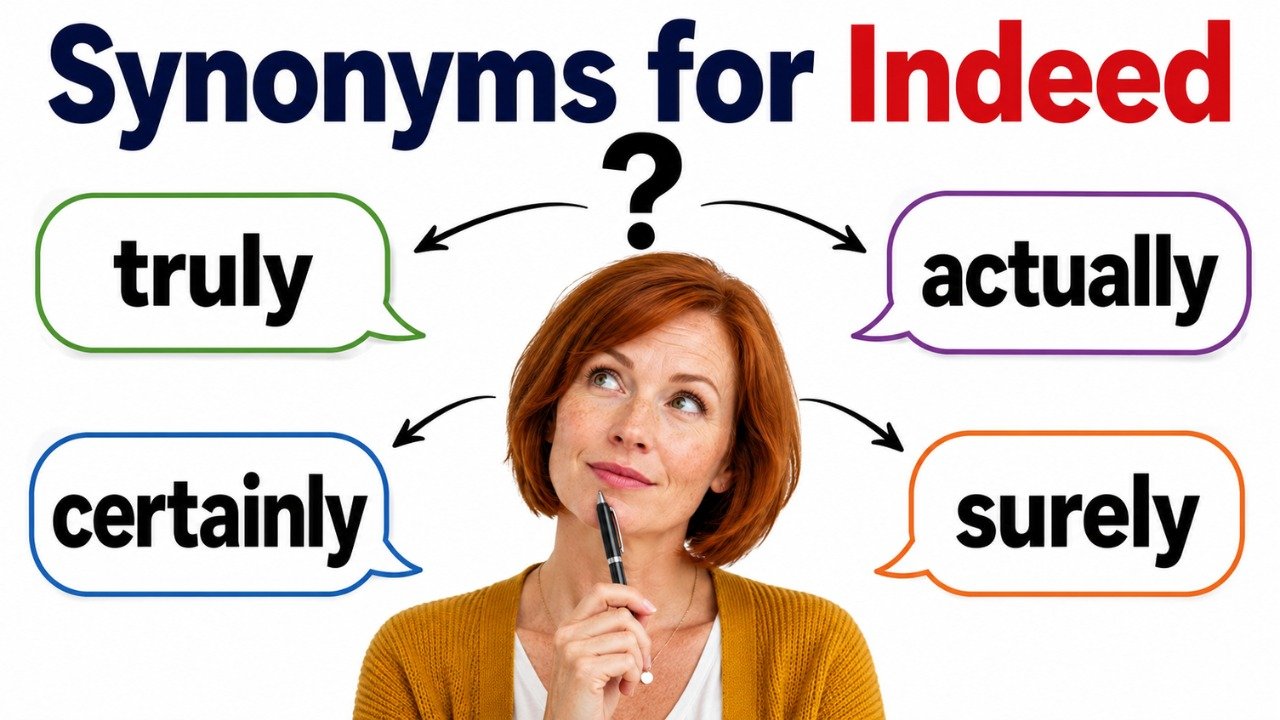
Quick Answer: The best synonyms for indeed include certainly, truly, really, actually, definitely, surely, undoubtedly, unquestionably, absolutely, and in fact. Use certainly for confident confirmation, truly when emphasizing truth or sincerity, actually when correcting or clarifying information, definitely for strong certainty, and in fact when adding evidence or a stronger supporting statement. In formal writing, undoubtedly and unquestionably can add strong emphasis, while really and definitely sound more natural in everyday conversation.
Pronunciation and Word Details
Word: Indeed.
Pronunciation: /ɪnˈdiːd/
Part of Speech: Adverb.
Meaning: Used to emphasize that something is true, confirm a statement, or introduce information that strengthens what was already said.
US Pronunciation:
UK Pronunciation:
What Does “Indeed” Mean?
Indeed means certainly, truly, or in fact, and it is mainly used to emphasize the truth of a statement or strengthen information that has already been given.
Indeed is an adverb. It can confirm something, emphasize a description, express agreement, or introduce an additional fact that makes an earlier statement stronger.
For Confirmation: Indeed can show that a statement is definitely true.
Example: The task was difficult indeed.
For Agreement: It can confirm another person’s statement.
Example: “The view is impressive.” “Indeed, it is.”
For Emphasis: Indeed strengthens an adjective, statement, or conclusion.
Example: She was very fortunate indeed.
For Additional Evidence: Indeed can introduce a fact that supports or strengthens an earlier point.
Example: The problem is serious. Indeed, several departments have already reported difficulties.
Its exact meaning depends on sentence position and context, but the central idea is usually truth, confirmation, or emphasis.
Meaning, Tone, and Context of “Indeed”
Tone: Indeed is generally neutral to formal, although it also appears naturally in conversation.
Formal Use: Indeed works especially well in essays, reports, arguments, speeches, analysis, and other writing where the writer wants to emphasize or confirm a point.
Conversational Use: In speech, indeed can sound thoughtful, confident, slightly formal, or emphatic depending on the situation.
Academic Use: Writers often use indeed to introduce evidence that strengthens a previous claim.
Polite Use: Indeed can confirm another person’s observation without sounding aggressive.
Emotional Use: It can strengthen feelings such as surprise, admiration, concern, or satisfaction.
Strong Use: Indeed often adds more emphasis than simply saying yes or true.
Example: It was a remarkable achievement indeed.
The word is versatile because it can mean certainly, truly, actually, or in fact depending on how the sentence is constructed.
When and How to Use “Indeed”
For Confirmation: Use indeed when confirming that something is true.
Example: The results were indeed better than expected.
For Strong Agreement: Use indeed when strongly agreeing with a statement.
Example: “That was an excellent explanation.” “Indeed, it was.”
For Emphasis: Use indeed to strengthen an adjective or description.
Example: The journey was long indeed.
For Supporting Evidence: Use indeed to introduce additional information that proves or reinforces a point.
Example: The town has changed greatly. Indeed, several entire neighborhoods have been rebuilt.
For Clarification: Indeed can strengthen a fact that helps clarify an earlier statement.
Example: The assignment was challenging. Indeed, only a few students completed every section.
For Formal Argument: Use indeed when moving from a general claim to stronger supporting information.
Example: The policy requires careful review. Indeed, several sections appear to create unnecessary confusion.
For Surprise: Indeed can emphasize something unexpected.
Example: It was indeed surprising to see how quickly the situation changed.
Best Synonyms for Indeed
Certainly: Used to express confidence that something is true.
Example: She certainly understood the importance of the decision.
Truly: Used to emphasize that something is genuinely or completely true.
Example: The performance was truly impressive.
Really: A common conversational word used for emphasis or confirmation.
Example: The result was really surprising.
Actually: Used to emphasize a fact or correct an assumption.
Example: The solution was actually simpler than we expected.
Definitely: Used to express strong certainty.
Example: This approach is definitely more practical.
Surely: Used to express confidence or strong expectation.
Example: Surely there must be another explanation.
Undoubtedly: Used when there is very little or no doubt.
Example: She is undoubtedly one of the strongest candidates.
Unquestionably: Used when something is clearly true and difficult to dispute.
Example: The discovery was unquestionably important.
Absolutely: Used for very strong agreement or emphasis.
Example: The answer is absolutely correct.
In Fact: Used to introduce information that confirms or strengthens an earlier statement.
Example: The process is efficient. In fact, it takes only a few minutes.
50 Synonyms for Indeed with Short Meanings
- Certainly: Without doubt or uncertainty.
- Truly: In a truthful or genuine way.
- Really: Used to emphasize truth or intensity.
- Actually: In reality or as a matter of fact.
- Definitely: With complete certainty.
- Surely: With confidence that something is true.
- Undoubtedly: Without reasonable doubt.
- Unquestionably: In a way that cannot reasonably be disputed.
- Absolutely: Completely and without qualification.
- In Fact: Used to introduce a stronger supporting fact.
- Assuredly: With confidence and certainty.
- Clearly: In an obvious or unmistakable way.
- Evidently: In a way that appears clearly true.
- Obviously: In a way that is easy to recognize as true.
- Plainly: Clearly and unmistakably.
- Positively: With strong certainty or emphasis.
- Undeniably: In a way that cannot reasonably be denied.
- Indisputably: In a way that cannot be seriously disputed.
- Decidedly: Clearly and definitely.
- Genuinely: In a sincere or real way.
- In Truth: Used to emphasize what is genuinely true.
- In Reality: Used to emphasize the actual situation.
- In Actuality: Referring to what is really the case.
- As a Matter of Fact: Used to introduce or emphasize a factual point.
- To Be Sure: Used to acknowledge or confirm something as true.
- Without Doubt: With complete certainty.
- Beyond Doubt: Certain enough that reasonable doubt is absent.
- Without Question: Certainly and without dispute.
- For Certain: Definitely true or sure.
- For Sure: Certainly, especially in casual conversation.
- Most Certainly: Used for particularly strong confirmation.
- Very Much So: Used to strongly confirm a previous statement.
- Of Course: Used when something is accepted as obvious or expected.
- Sure Enough: Used when something turns out as expected or predicted.
- Admittedly: Used to acknowledge that something is true.
- Demonstrably: In a way that can be shown by evidence.
- Verifiably: In a way that can be confirmed as true.
- Provably: In a way that can be proved.
- Factually: According to facts.
- Authentically: In a genuine or real manner.
- Emphatically: In a forceful and definite manner.
- Exactly: Used for strong agreement in some contexts.
- Precisely: Used to confirm that something is exactly correct.
- Quite So: Used to express formal agreement.
- True Enough: Used to acknowledge that a statement is substantially true.
- That Is True: A direct expression of confirmation.
- Yes: A direct word of agreement or confirmation.
- By All Means: Used to express willing or emphatic agreement in suitable contexts.
- Beyond Question: In a way that leaves no reasonable uncertainty.
- Without Reservation: With complete confidence or agreement.
Read Also:
Synonyms for Vocabulary

Synonyms for Indeed by Context
When Indeed Means Certainly
When indeed confirms that something is true, certainty words are usually the strongest replacements.
Certainly: Natural in both formal and everyday English.
Example: She certainly deserves recognition for her work.
Definitely: Strong and common in conversation.
Example: The second option is definitely more practical.
Undoubtedly: More formal and appropriate for essays or reports.
Example: The change will undoubtedly affect future planning.
Unquestionably: Strongly emphasizes that something is beyond reasonable dispute.
Example: Her contribution was unquestionably valuable.
When Indeed Means Truly
Indeed sometimes emphasizes the genuine quality or intensity of something.
Truly: Best when emphasizing sincerity, truth, or strong quality.
Example: It was a truly memorable experience.
Really: More conversational and natural in casual speech.
Example: The final result was really impressive.
Genuinely: Useful when emphasizing authenticity or sincerity.
Example: She was genuinely pleased by the news.
Absolutely: Adds particularly strong emphasis.
Example: The performance was absolutely outstanding.
When Indeed Means In Fact
Indeed can introduce evidence or information that strengthens a statement.
In Fact: The most direct alternative in this context.
Example: The change was successful. In fact, results improved almost immediately.
Actually: Useful when presenting the real situation or correcting an assumption.
Example: The problem looked complicated, but it was actually quite simple.
As a Matter of Fact: Useful when adding a factual point, especially in conversation.
Example: The building is quite old. As a matter of fact, it has stood there for generations.
In Reality: Useful when contrasting appearances with the actual situation.
Example: The task appeared simple, but in reality it required considerable preparation.
When Indeed Expresses Agreement
Indeed can work as a strong confirmation of another statement.
Certainly: A polite and confident expression of agreement.
Example: “The changes helped.” “Certainly, they did.”
Absolutely: Expresses stronger and more enthusiastic agreement.
Example: “Was the decision necessary?” “Absolutely.”
Exactly: Best when agreeing that someone has expressed a point accurately.
Example: “We need clearer instructions.” “Exactly.”
Quite So: A more formal way to confirm someone’s statement.
Example: “The evidence remains incomplete.” “Quite so.”
When Indeed Adds Emphasis
Indeed can intensify an adjective, description, or statement.
Very Much So: Strongly confirms a description.
Example: The situation was difficult, very much so.
Truly: Adds natural emphasis without sounding overly forceful.
Example: The landscape was truly beautiful.
Decidedly: Adds formal emphasis to a quality.
Example: The atmosphere became decidedly tense.
Emphatically: Useful when expressing something with unusual force.
Example: She emphatically rejected the suggestion.
Another Word for Indeed
The best general replacement for indeed is often certainly when confirming something, while in fact is usually better when introducing supporting information. The best alternative depends on whether indeed expresses certainty, truth, agreement, emphasis, or additional evidence.
Original: She was indeed qualified for the position.
Better Option: She was certainly qualified for the position.
Original: The problem is indeed serious.
Better Option: The problem is undoubtedly serious.
Original: The plan worked well. Indeed, the results exceeded expectations.
Better Option: The plan worked well. In fact, the results exceeded expectations.
Original: It was a beautiful evening indeed.
Better Option: It was a truly beautiful evening.
When Not to Use “Indeed”
Indeed is useful, but it can sound overly formal, repetitive, or unnecessary when a simpler word expresses the meaning more naturally.
In casual conversation, really, definitely, or absolutely may sound more natural.
Weak: I indeed liked the meal very much.
Better: I really liked the meal.
Avoid using indeed repeatedly within a short paragraph because its emphatic effect becomes weaker.
Weak: The report is indeed useful. It is indeed detailed and indeed accurate.
Better: The report is certainly useful. It is detailed and highly accurate.
Do not use indeed when actually is needed to correct an incorrect assumption.
Weak: I thought he had left, but he was indeed still inside.
Better: I thought he had left, but he was actually still inside.
Use in fact when introducing a supporting fact if greater clarity is needed.
Weak: The project improved efficiency. Indeed, processing time fell substantially.
Better: The project improved efficiency. In fact, processing time fell substantially.
Words Commonly Confused With Indeed
Indeed vs Certainly: Indeed often emphasizes or confirms a statement, while certainly focuses more directly on confidence and certainty.
Indeed vs Really: Both can add emphasis, but really is more conversational. Indeed often sounds more formal or deliberate.
Indeed vs Actually: Indeed confirms or strengthens information. Actually often corrects an assumption or introduces the real situation.
Indeed vs In Fact: Both can strengthen a previous statement, but in fact more clearly introduces supporting or corrective factual information.
Indeed vs Definitely: Definitely strongly expresses certainty, especially in speech. Indeed can express certainty but may also introduce evidence or emphasize a description.
Indeed vs Truly: Truly emphasizes genuineness, sincerity, or degree. Indeed often emphasizes the truth of a broader statement.
Indeed vs Surely: Surely often expresses expectation or confidence, sometimes inviting agreement. Indeed usually confirms something more directly.
Indeed vs Absolutely: Absolutely is generally stronger and more enthusiastic, particularly in direct agreement.
Which Synonym Should You Choose?
Choose certainly when confirming information confidently in formal writing, correspondence, essays, or conversation.
Choose truly when emphasizing sincerity, authenticity, beauty, importance, or emotional strength.
Choose really when you need natural emphasis in casual speech or conversational writing.
Choose actually when correcting an assumption, revealing the real situation, or presenting an unexpected fact.
Choose definitely when expressing strong certainty in everyday conversation.
Choose undoubtedly when making a confident point in formal essays, analysis, or reports.
Choose unquestionably when emphasizing that a statement is extremely difficult to dispute.
Choose absolutely for strong agreement, certainty, or emphasis.
Choose in fact when adding evidence or a stronger detail to support the previous sentence.
Choose evidently or clearly when the truth of something can be recognized from available information.
Choose precisely or exactly when indeed is being used as a response showing agreement with an accurate statement.
Real Life Examples of “Indeed” in Sentences
Original: The new method is indeed more efficient.
Better Option: The new method is certainly more efficient.
Original: She was indeed surprised by the result.
Better Option: She was genuinely surprised by the result.
Original: The task was difficult indeed.
Better Option: The task was truly difficult.
Original: He is indeed capable of handling the responsibility.
Better Option: He is undoubtedly capable of handling the responsibility.
Original: The problem is serious indeed.
Better Option: The problem is unquestionably serious.
Original: The plan succeeded. Indeed, it produced better results than expected.
Better Option: The plan succeeded. In fact, it produced better results than expected.
Original: She did indeed complete the assignment early.
Better Option: She certainly completed the assignment early.
Original: It was indeed a remarkable discovery.
Better Option: It was truly a remarkable discovery.
Original: The answer is indeed correct.
Better Option: The answer is absolutely correct.
Original: His concerns were indeed justified.
Better Option: His concerns were clearly justified.
Synonym Groups and Usage Differences
Certainty Group
Words: Certainly, definitely, surely, undoubtedly, unquestionably, assuredly.
These words express confidence that something is true. Certainly is flexible, while undoubtedly and unquestionably sound stronger and more formal.
Example: The evidence undoubtedly supports the conclusion.
Truth Group
Words: Truly, really, genuinely, in truth, in reality.
These alternatives emphasize truth, authenticity, or what is actually the case.
Example: The experience was truly unforgettable.
Supporting Fact Group
Words: In fact, actually, as a matter of fact, in actuality, in reality.
These expressions work when indeed introduces information that strengthens, clarifies, or corrects an earlier statement.
Example: The project was completed early. In fact, it finished several days ahead of schedule.
Agreement Group
Words: Certainly, absolutely, exactly, precisely, quite so, yes.
These alternatives can express agreement, but their tone differs. Absolutely is enthusiastic, exactly confirms accuracy, and quite so sounds more formal.
Example: “The instructions need to be clearer.” “Exactly.”
Strong Emphasis Group
Words: Absolutely, positively, decidedly, emphatically, most certainly.
These words strengthen certainty or intensity. They are useful when ordinary confirmation is not strong enough.
Example: The change was absolutely necessary.
Antonyms of Indeed
Indeed does not have one exact antonym because it can express certainty, truth, agreement, or emphasis. Its opposites therefore depend on context.
Perhaps: Expresses possibility rather than certainty.
Maybe: Indicates uncertainty.
Possibly: Suggests that something may be true without confirming it.
Doubtfully: In a manner showing uncertainty or lack of confidence.
Uncertainly: Without definite confidence.
Apparently: Indicates that something seems true without complete confirmation.
Supposedly: Describes something claimed to be true but not necessarily confirmed.
Questionably: In a way that creates doubt.
Probably: Expresses likelihood rather than complete certainty.
Allegedly: Indicates that something has been claimed but not established as fact.
Comparison: Indeed vs Related Words
Indeed vs Certainly
Indeed can confirm or emphasize a statement and can also introduce supporting information. Certainly focuses more directly on certainty.
Example With Indeed: She did indeed understand the instructions.
Example With Certainly: She certainly understood the instructions.
Indeed vs Really
Indeed often sounds more deliberate or formal. Really is more common in casual conversation and often emphasizes degree.
Example With Indeed: The result was impressive indeed.
Example With Really: The result was really impressive.
Indeed vs Actually
Indeed confirms something as true, whereas actually often corrects an assumption or reveals a fact that may be unexpected.
Example With Indeed: He did indeed complete the work.
Example With Actually: He actually completed the work a day early.
Indeed vs In Fact
Both can reinforce a statement. In fact more directly introduces supporting evidence or additional factual information.
Example With Indeed: The situation is serious indeed.
Example With In Fact: The situation is serious. In fact, several problems have already appeared.
Indeed vs Truly
Indeed emphasizes confirmation or truth. Truly often emphasizes genuineness, sincerity, or intensity.
Example With Indeed: She was indeed qualified.
Example With Truly: She was truly grateful.
Indeed vs Definitely
Indeed can sound somewhat formal, while definitely is common and direct in everyday communication.
Example With Indeed: The change is indeed necessary.
Example With Definitely: The change is definitely necessary.
Indeed vs Undoubtedly
Both express strong confidence, but undoubtedly places more direct emphasis on the absence of doubt.
Example With Indeed: The result was indeed significant.
Example With Undoubtedly: The result was undoubtedly significant.
Common Phrases and Expressions With Indeed
Yes, Indeed: Used to express strong agreement or confirmation.
Very Good Indeed: Used to strongly emphasize that something is good.
Very Much Indeed: Used to intensify a feeling, quality, or response.
Indeed It Is: Used to confirm a previous statement.
Indeed It Was: Used to strongly agree with a statement about something in the past.
Indeed So: Used as a formal or emphatic confirmation.
If Indeed: Used when acknowledging that something may be true while leaving some uncertainty.
Indeed True: Used to emphasize the truth of a statement.
Indeed Possible: Used to emphasize that something genuinely can happen.
Indeed Necessary: Used to emphasize that something is genuinely required.
Common Mistakes to Avoid
Overusing Indeed: Repeating indeed too frequently makes writing sound unnatural and reduces its emphatic effect.
Weak: The idea is indeed useful, indeed practical, and indeed affordable.
Better: The idea is certainly useful, practical, and affordable.
Using Indeed Instead of Actually: Use actually when you are correcting an assumption or presenting unexpected reality.
Weak: We expected ten participants, but indeed fifteen arrived.
Better: We expected ten participants, but actually fifteen arrived.
Choosing a Formal Word in Casual Speech: Indeed can sometimes sound more formal than necessary.
Weak: I indeed enjoyed the movie.
Better: I really enjoyed the movie.
Confusing Indeed With Definitely: Definitely focuses specifically on certainty, while indeed can serve several functions, including emphasis and supporting evidence.
Using Indeed Without a Clear Purpose: The word should strengthen, confirm, or develop the surrounding statement. Remove it if the sentence means exactly the same thing without any loss of emphasis.
Forgetting Sentence Position: Indeed can appear at the beginning, middle, or end of a sentence, but placement changes emphasis.
Example: Indeed, the decision was difficult.
Example: The decision was indeed difficult.
Example: The decision was difficult indeed.
Using Weak Synonyms in Formal Writing: Really may be natural in conversation, but certainly, undoubtedly, or in fact may provide greater precision in formal contexts.
Conclusion
Understanding synonyms for indeed helps you choose the right level of certainty, agreement, truth, or emphasis. Use certainly for confident confirmation, truly for genuine emphasis, actually for correction or clarification, definitely for strong everyday certainty, and in fact when adding supporting evidence. More formal choices include undoubtedly and unquestionably, while absolutely works well for strong agreement. Choosing the synonym that matches the sentence purpose makes your writing clearer, more precise, and more natural.
FAQs About Synonyms for Indeed
What is the best synonym for indeed?
Answer: Certainly is one of the best general synonyms for indeed. Truly, actually, definitely, undoubtedly, and in fact are better in specific contexts.
What is another word for indeed in formal writing?
Answer: Certainly, undoubtedly, unquestionably, assuredly, and in fact are useful formal alternatives.
Can really replace indeed?
Answer: Yes, when indeed adds emphasis, especially in casual conversation. Really is generally less formal.
What is the difference between indeed and actually?
Answer: Indeed usually confirms or strengthens a statement, while actually often corrects an assumption or introduces unexpected information.
Is certainly a synonym for indeed?
Answer: Yes. Certainly is one of the closest alternatives when indeed expresses confidence or confirmation.
What can I use instead of indeed in an essay?
Answer: Depending on context, you can use certainly, undoubtedly, unquestionably, in fact, clearly, or demonstrably.
Can in fact replace indeed?
Answer: Yes, especially when indeed introduces evidence or additional information that strengthens a previous statement.
