
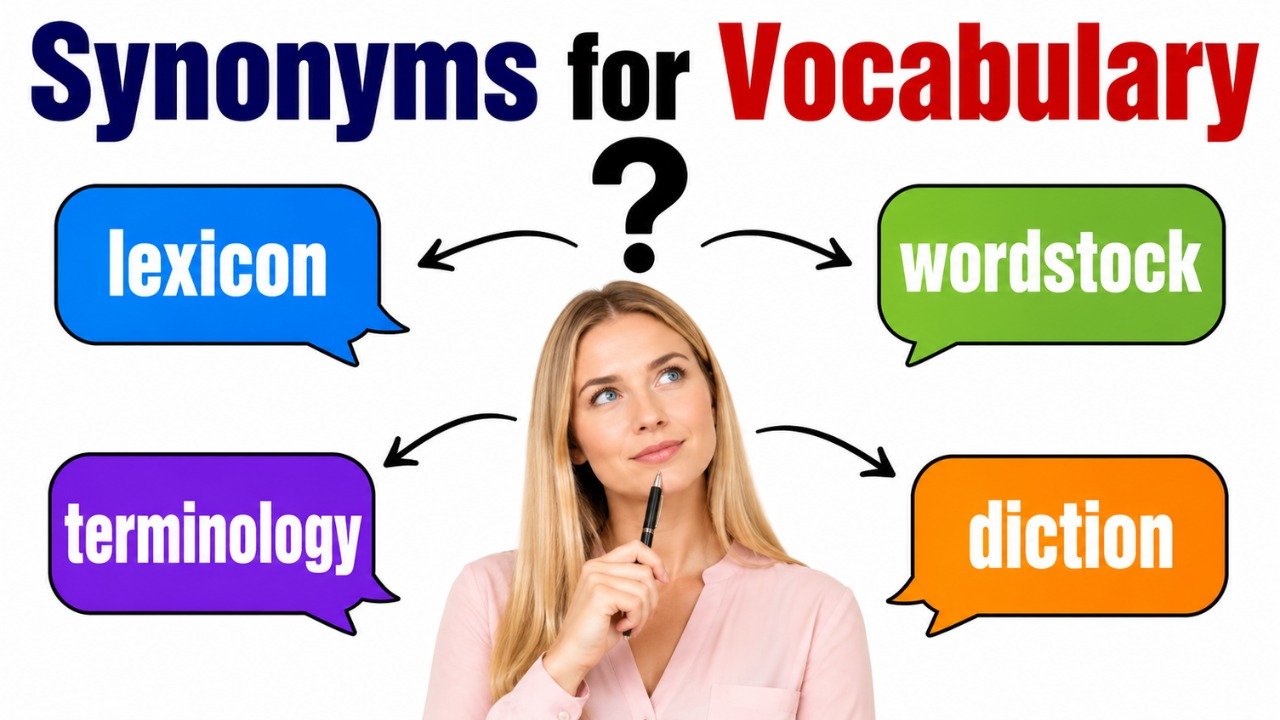
Quick Answer: The best synonyms for vocabulary include lexicon, terminology, diction, word stock, language, word bank, word list, glossary, nomenclature, and terms. Use lexicon for the complete set of words used by a person, field, or language, terminology for specialized professional words, diction for a writer or speaker’s word choice, glossary for an explained list of terms, and word bank or word list in learning and teaching contexts.
Pronunciation and Word Details
Word: Vocabulary.
Pronunciation: /vəˈkæbjəˌleri/
Part of Speech: Noun.
Meaning: The collection of words known, understood, or used by a person, group, profession, subject, or language.
US Pronunciation:
UK Pronunciation:
What Does “Vocabulary” Mean?
Vocabulary means the collection of words that a person knows, understands, uses, or encounters within a language, subject, profession, or particular context.
Vocabulary is a noun. It can describe all the words someone understands, the words used in a specific field, or a selected set of words studied for learning purposes.
Example: Reading regularly can increase a student’s vocabulary.
In this sentence, vocabulary means the collection of words the student knows and understands.
The word can also describe specialized language.
Example: Medical vocabulary contains many technical terms.
In academic contexts, vocabulary often refers to words learners need to recognize and use accurately. In writing, it can also refer to the range and quality of words selected by an author.
Meaning, Tone, and Context of “Vocabulary”
Vocabulary is a neutral and widely used word. It is common in education, language learning, grammar, writing, reading, linguistics, professional communication, and academic discussion.
The word sounds natural in both formal and everyday contexts.
In education, vocabulary commonly refers to words students are learning.
Example: The teacher introduced ten new vocabulary words.
In linguistics, lexicon may be more precise when discussing the complete set of words in a language or the mental store of words known by a speaker.
In professional contexts, terminology is often better when referring to specialized words used within a field such as science, law, medicine, computing, or engineering.
In writing analysis, diction refers specifically to the words a writer or speaker chooses rather than the entire collection of words they know.
Vocabulary itself is generally factual rather than emotional. Its tone becomes positive or negative only through surrounding descriptions such as rich vocabulary, limited vocabulary, technical vocabulary, or advanced vocabulary.
When and How to Use “Vocabulary”
For Language Learning: Use vocabulary when discussing words someone is learning in another language.
Example: She studies new vocabulary every evening.
For Reading Skills: Vocabulary can describe the words a reader recognizes and understands.
Example: A strong vocabulary can improve reading comprehension.
For Writing: Use vocabulary when referring to the range of words available to a writer.
Example: His vocabulary became more varied as his writing improved.
For Speaking: Vocabulary can refer to the words a person uses while communicating.
Example: Regular conversation helped her expand her spoken vocabulary.
For Specialized Subjects: Use vocabulary for words associated with a specific field or topic.
Example: Students must learn scientific vocabulary before studying the chapter.
For Word Study: Vocabulary is useful when referring to a selected group of words being taught or reviewed.
Example: Today’s vocabulary includes words related to weather.
For Personal Word Knowledge: Use vocabulary when describing the set of words a person knows.
Example: Reading different genres can broaden your vocabulary.
Best Synonyms for Vocabulary
Lexicon
Synonym: The complete collection of words used in a language, subject, community, or by an individual.
Example: Several technical expressions have entered the modern scientific lexicon.
Terminology
Synonym: Specialized words and expressions used within a profession, subject, or field.
Example: Students must understand the terminology used in biology.
Diction
Synonym: The particular choice and use of words in speech or writing.
Example: The author’s formal diction creates a serious tone.
Word Stock
Synonym: The collection of words available within a language or known by a person.
Example: Reading widely can increase a learner’s word stock.
Language
Synonym: Words and expressions used for communication within a particular context.
Example: The language of the report is clear and professional.
Word Bank
Synonym: A prepared collection of useful words, usually for learning or writing activities.
Example: Students used the word bank to complete the exercise.
Word List
Synonym: An organized collection of words selected for study, reference, or practice.
Example: Review the word list before taking the quiz.
Glossary
Synonym: A list of specialized or unfamiliar words accompanied by explanations or definitions.
Example: The glossary explains important terms from the chapter.
Nomenclature
Synonym: A formal system of names and terms used within a particular subject.
Example: Scientific nomenclature helps classify organisms consistently.
Terms
Synonym: Words or expressions used with specific meanings, especially within a subject.
Example: The lesson introduces several important grammar terms.
50 Synonyms for Vocabulary with Short Meanings
- Lexicon: The complete set of words used in a language, field, or by a person.
- Terminology: Specialized words used within a particular subject or profession.
- Diction: The choice and style of words used in speech or writing.
- Word Stock: The collection of words available to a speaker or language.
- Language: Words and expressions used for communication.
- Word Bank: A prepared collection of words for learning or writing.
- Word List: A selected list of words for study or reference.
- Glossary: A list of terms with their meanings or explanations.
- Nomenclature: A structured system of names and technical terms.
- Terms: Words or expressions with particular meanings.
- Word Set: A defined collection of related words.
- Collection of Words: A group of words gathered for a particular purpose.
- Range of Words: The variety of words known or used.
- Stock of Words: The total supply of words available to someone.
- Body of Words: A group of words belonging to a language or subject.
- Word Repertoire: The range of words a person can understand or use.
- Repertoire: The available range of expressions or words someone can use.
- Expression Bank: A collection of useful expressions for communication.
- Phrase Bank: A prepared set of phrases for speaking or writing.
- Term Bank: A collection of specialized terms used for reference.
- Technical Language: Specialized words used in a particular profession or subject.
- Specialized Language: Vocabulary associated with a specific field or activity.
- Subject Language: Words typically used within one academic subject.
- Field Terminology: Specialized terms belonging to a professional or academic field.
- Professional Terminology: Words and expressions used in a profession.
- Academic Vocabulary: Words commonly used in educational and scholarly contexts.
- Technical Vocabulary: Specialized words related to a technical subject.
- Specialized Vocabulary: Words associated with one specific area of knowledge.
- Everyday Language: Common words used in ordinary communication.
- Common Language: Familiar words understood by many people.
- Word Choice: The selection of particular words for communication.
- Choice of Words: The specific words selected in speech or writing.
- Verbal Repertoire: The collection of words and expressions a speaker can use.
- Linguistic Repertoire: The range of language resources available to a person.
- Language Repertoire: The range of words and expressions available for communication.
- Terminological Set: A collection of terms belonging to one subject.
- Set of Terms: A defined collection of specialized expressions.
- List of Terms: An organized group of subject specific words.
- Register: A style and range of language associated with a situation or group.
- Phraseology: The characteristic words and phrases used in a subject or style.
- Wording: The specific words used to express an idea.
- Verbal Expression: The words used to communicate thoughts or ideas.
- Language Resources: The words and expressions available for communication.
- Word Resources: A collection of words available for study or use.
- Working Vocabulary: Words a person can actively use in communication.
- Active Vocabulary: Words a person regularly uses when speaking or writing.
- Passive Vocabulary: Words a person understands but may not regularly use.
- Recognition Vocabulary: Words a person can recognize and understand.
- Expressive Vocabulary: Words a person can actively produce in speech or writing.
- Personal Lexicon: The collection of words known or used by an individual.
Synonyms for Taken
Synonyms for Vocabulary by Context
When Vocabulary Means a Collection of Known Words
When vocabulary refers to all the words someone knows, strong alternatives include lexicon, word stock, word repertoire, verbal repertoire, personal lexicon, and range of words.
Example: Reading fiction can expand a student’s lexicon.
Example: Daily conversation can strengthen a learner’s word repertoire.
When Vocabulary Means Specialized Terms
Use terminology, technical language, specialized language, field terminology, professional terminology, and nomenclature when discussing words used within a particular profession or subject.
Example: Medical terminology can be difficult for beginners.
Example: Students first learned the technical language of chemistry.
When Vocabulary Means Word Choice
Use diction, word choice, choice of words, wording, or phraseology when focusing on how someone selects and uses language.
Example: Her careful diction gives the essay a formal tone.
Example: The wording of the instruction should be clearer.
When Vocabulary Means a Study List
Use word bank, word list, term bank, glossary, or list of terms when referring to a group of words prepared for learning or reference.
Example: Students reviewed the word bank before writing their paragraphs.
Example: The glossary explains unfamiliar technical words.
When Vocabulary Means Words Used in Education
Use academic vocabulary, subject language, specialized vocabulary, or technical vocabulary when discussing words needed for study.
Example: Academic vocabulary is important for understanding formal texts.
Example: The lesson introduces technical vocabulary related to electricity.
Another Word for Vocabulary
The best single replacement for vocabulary is often lexicon, especially when referring to the collection of words used by a person, language, community, or subject. However, terminology is better for specialized professional words, while diction is more accurate when discussing word choice.
Original: Her vocabulary has improved through regular reading.
Better Option: Her lexicon has expanded through regular reading.
Original: Students need to learn the vocabulary of medicine.
Better Option: Students need to learn medical terminology.
Original: The writer’s vocabulary creates a formal tone.
Better Option: The writer’s diction creates a formal tone.
Original: Review the vocabulary at the end of the chapter.
Better Option: Review the glossary at the end of the chapter.
When Not to Use “Vocabulary”
Vocabulary is sometimes too broad when a more specific word would communicate the meaning more accurately.
When discussing professional or scientific expressions, terminology is usually clearer.
Weak: Doctors must learn a large amount of medical vocabulary.
Better: Doctors must learn extensive medical terminology.
When analyzing an author’s particular choice of words, use diction instead.
Weak: The poet’s vocabulary creates a serious mood.
Better: The poet’s diction creates a serious mood.
Vocabulary can also sound repetitive if it appears many times in one paragraph.
Weak: Students study vocabulary because vocabulary helps them understand texts and use vocabulary correctly.
Better: Students study new words because a broader lexicon helps them understand texts and communicate more precisely.
Avoid using glossary as a direct replacement when you mean all the words someone knows. A glossary is specifically an organized list of terms with explanations.
Words Commonly Confused With Vocabulary
Vocabulary vs Lexicon: Vocabulary commonly refers to the words known or used by a person or within a subject. Lexicon is often more formal and can refer to the complete collection of words in a language, field, or individual’s mental word store.
Vocabulary vs Terminology: Vocabulary is broad, while terminology specifically refers to specialized terms used within a particular field.
Vocabulary vs Diction: Vocabulary refers to the range or collection of words available to someone. Diction refers to the specific words chosen in speech or writing.
Vocabulary vs Glossary: Vocabulary is a collection of words known or used. A glossary is a written list of terms accompanied by definitions or explanations.
Vocabulary vs Language: Language is broader and includes vocabulary, grammar, structure, pronunciation, and patterns of communication.
Vocabulary vs Nomenclature: Vocabulary can include any words, while nomenclature refers specifically to an organized system of names and terms.
Vocabulary vs Register: Vocabulary refers to words themselves, while register describes the style of language appropriate for a particular situation, audience, or social context.
Which Synonym Should You Choose?
Choose lexicon when discussing the complete range of words used by a person, community, subject, or language.
Choose terminology for professional, scientific, medical, legal, technical, or academic terms.
Choose diction when analyzing a speaker’s or writer’s word choice.
Choose word bank for classroom activities, language exercises, writing support, or vocabulary practice.
Choose word list when referring to a simple organized list of words for study or reference.
Choose glossary when the words are accompanied by definitions or explanations.
Choose nomenclature when referring to an established system of formal names or classifications.
Choose word stock when discussing the total collection of words available within a language or known by a speaker.
Choose academic vocabulary for words frequently used in essays, textbooks, lectures, and formal education.
Choose technical vocabulary when referring to specialized words used in a technical or scientific field.
Choose working vocabulary when discussing words a person can actively use in speaking and writing.
Real Life Examples of “Vocabulary” in Sentences
Original: Reading regularly helped her expand her vocabulary.
Better Option: Reading regularly helped her expand her lexicon.
Original: Students must learn the vocabulary used in biology.
Better Option: Students must learn the terminology used in biology.
Original: The author’s vocabulary is simple and direct.
Better Option: The author’s diction is simple and direct.
Original: Review the vocabulary before the test.
Better Option: Review the word list before the test.
Original: The chapter introduces new scientific vocabulary.
Better Option: The chapter introduces new scientific terminology.
Original: The teacher prepared vocabulary for the writing exercise.
Better Option: The teacher prepared a word bank for the writing exercise.
Original: His professional vocabulary is very strong.
Better Option: His knowledge of professional terminology is very strong.
Original: Children develop vocabulary through reading and conversation.
Better Option: Children develop their word repertoire through reading and conversation.
Original: The book explains difficult vocabulary at the back.
Better Option: The book explains difficult terms in a glossary at the back.
Original: Her vocabulary changes depending on the audience.
Better Option: Her word choice changes depending on the audience.
Synonym Groups and Usage Differences
General Word Collection Group
This group includes lexicon, word stock, word repertoire, personal lexicon, and range of words. These expressions describe the words known, understood, or available to a speaker.
Example: His personal lexicon grew as he read more challenging books.
Specialized Language Group
This group includes terminology, technical language, specialized language, nomenclature, and field terminology. These words are best when discussing a particular profession or subject.
Example: Legal terminology can be difficult for readers without specialist knowledge.
Word Choice Group
This group includes diction, wording, word choice, choice of words, and phraseology. These alternatives focus on how language is selected rather than how many words someone knows.
Example: The speaker’s careful word choice made the explanation easy to understand.
Learning Resources Group
This group includes word bank, word list, glossary, term bank, and list of terms. These are useful for educational materials and reference tools.
Example: The teacher provided a word bank for the writing activity.
Language Ability Group
This group includes active vocabulary, passive vocabulary, working vocabulary, recognition vocabulary, and expressive vocabulary. These phrases describe different ways words are known or used.
Example: A learner may understand a word as part of passive vocabulary before using it actively.
Antonyms of Vocabulary
Vocabulary does not have one exact opposite because it refers to a collection or range of words. However, several terms and expressions can describe the opposite idea of having a broad or developed vocabulary.
Antonym: Wordlessness. The absence of words or verbal expression.
Antonym: Silence. The absence of spoken words.
Antonym: Limited Vocabulary. A small range of known or usable words.
Antonym: Restricted Vocabulary. A narrow collection of words available for communication.
Antonym: Poor Word Choice. Inaccurate or ineffective selection of words.
Antonym: Verbal Limitation. Reduced ability to express ideas through words.
Antonym: Linguistic Limitation. A limited range of available language resources.
Antonym: Inarticulateness. Difficulty expressing ideas clearly through words.
Antonym: Lack of Terminology. Absence of the specialized terms needed for a subject.
Antonym: Narrow Lexicon. A relatively small range of known or available words.
Comparison: Vocabulary vs Related Words
Vocabulary vs Lexicon
Vocabulary is the everyday term for words known or used by a person or within a field. Lexicon is somewhat more formal and can refer to an entire system or collection of words.
Example With Vocabulary: Reading helps students develop a larger vocabulary.
Example With Lexicon: Several new expressions have entered the modern lexicon.
Vocabulary vs Terminology
Vocabulary can describe any collection of words. Terminology specifically describes specialized terms associated with a profession, field, or subject.
Example With Vocabulary: Students learned new vocabulary during the lesson.
Example With Terminology: Students learned the terminology used in genetics.
Vocabulary vs Diction
Vocabulary refers to the range of words available to a person. Diction describes which words someone actually chooses in a particular piece of speech or writing.
Example With Vocabulary: Her vocabulary has grown significantly.
Example With Diction: Her formal diction suits the academic essay.
Vocabulary vs Glossary
Vocabulary refers to words known, learned, or used. A glossary is an organized reference list that explains difficult or specialized terms.
Example With Vocabulary: The unit contains new vocabulary.
Example With Glossary: The glossary defines the unfamiliar terms.
Vocabulary vs Language
Vocabulary is one part of language. Language is much broader and also involves grammar, pronunciation, syntax, meaning, and communication patterns.
Example With Vocabulary: His vocabulary improved after months of reading.
Example With Language: His language became clearer and more accurate.
Vocabulary vs Word Bank
Vocabulary refers broadly to words someone knows or uses. A word bank is a prepared collection of words designed to support a particular learning or writing task.
Example With Vocabulary: The student has an extensive vocabulary.
Example With Word Bank: The student selected descriptive adjectives from the word bank.
Vocabulary vs Nomenclature
Vocabulary may include ordinary and specialized words. Nomenclature refers to an organized system used for naming or classifying things.
Example With Vocabulary: Students learned new scientific vocabulary.
Example With Nomenclature: The course introduces the nomenclature used to classify chemical compounds.
Common Phrases and Expressions With “Vocabulary”
Build Vocabulary: Increase the number of words someone knows or understands.
Expand Vocabulary: Add new words to an existing range of language.
Improve Vocabulary: Develop stronger knowledge and use of words.
Rich Vocabulary: A broad and varied range of words.
Limited Vocabulary: A relatively small range of known or usable words.
Active Vocabulary: Words a person regularly uses in speaking or writing.
Passive Vocabulary: Words a person understands but does not commonly use.
Academic Vocabulary: Words frequently used in educational and formal contexts.
Technical Vocabulary: Specialized words used in technical or professional subjects.
Vocabulary Development: The process of learning, understanding, and using more words.
Common Mistakes to Avoid
A common mistake is treating every synonym for vocabulary as completely interchangeable. Each alternative has a slightly different meaning.
Do not use diction when you mean the entire collection of words someone knows. Diction refers to actual word choice in a particular context.
Do not use glossary as a synonym for a person’s vocabulary. A glossary is a reference list containing words and explanations.
Avoid using terminology for ordinary everyday words unless those words belong to a particular profession, academic field, or specialized subject.
Another mistake is confusing vocabulary with language. Vocabulary is only one part of language. Grammar, pronunciation, syntax, and other features also contribute to language.
Be careful with repetitive writing.
Weak: The student’s vocabulary improved because she studied vocabulary every day and completed vocabulary exercises.
Better: The student’s vocabulary improved because she studied new words daily and completed regular word exercises.
Choose a synonym according to the exact meaning you want to communicate rather than replacing vocabulary mechanically.
Conclusion
The most useful synonyms for vocabulary include lexicon, terminology, diction, word stock, word bank, word list, glossary, nomenclature, language, and terms. Choose lexicon for a broad collection of words, terminology for specialized fields, diction for word choice, glossary for defined terms, and word bank for learning activities. Understanding these differences helps you choose language that accurately reflects whether you mean general word knowledge, professional terms, writing style, or a prepared collection of words.
FAQs About Synonyms for Vocabulary
What Is the Best Synonym for Vocabulary?
Lexicon is one of the closest general synonyms. However, terminology, diction, glossary, or word bank may be more accurate in specific contexts.
What Is Another Word for Vocabulary in Formal Writing?
Lexicon is a strong formal alternative. Use terminology when referring to specialized professional or academic words.
Is Lexicon the Same as Vocabulary?
They are closely related, but lexicon is often more formal and can describe the complete collection of words in a language, subject, community, or person’s mental word store.
What Is a Synonym for Vocabulary in Education?
Useful alternatives include word bank, word list, academic vocabulary, glossary, and word set, depending on how the words are being taught or organized.
Is Terminology a Synonym for Vocabulary?
Yes, but only in certain contexts. Terminology specifically refers to specialized words and expressions used within a particular subject or profession.
What Is the Difference Between Vocabulary and Diction?
Vocabulary is the range of words someone knows or can use. Diction is the specific choice of words used in a particular piece of speech or writing.
What Is the Opposite of Vocabulary?
Vocabulary has no exact single opposite. Expressions such as limited vocabulary, narrow lexicon, wordlessness, and verbal limitation can express contrasting ideas depending on context.
