
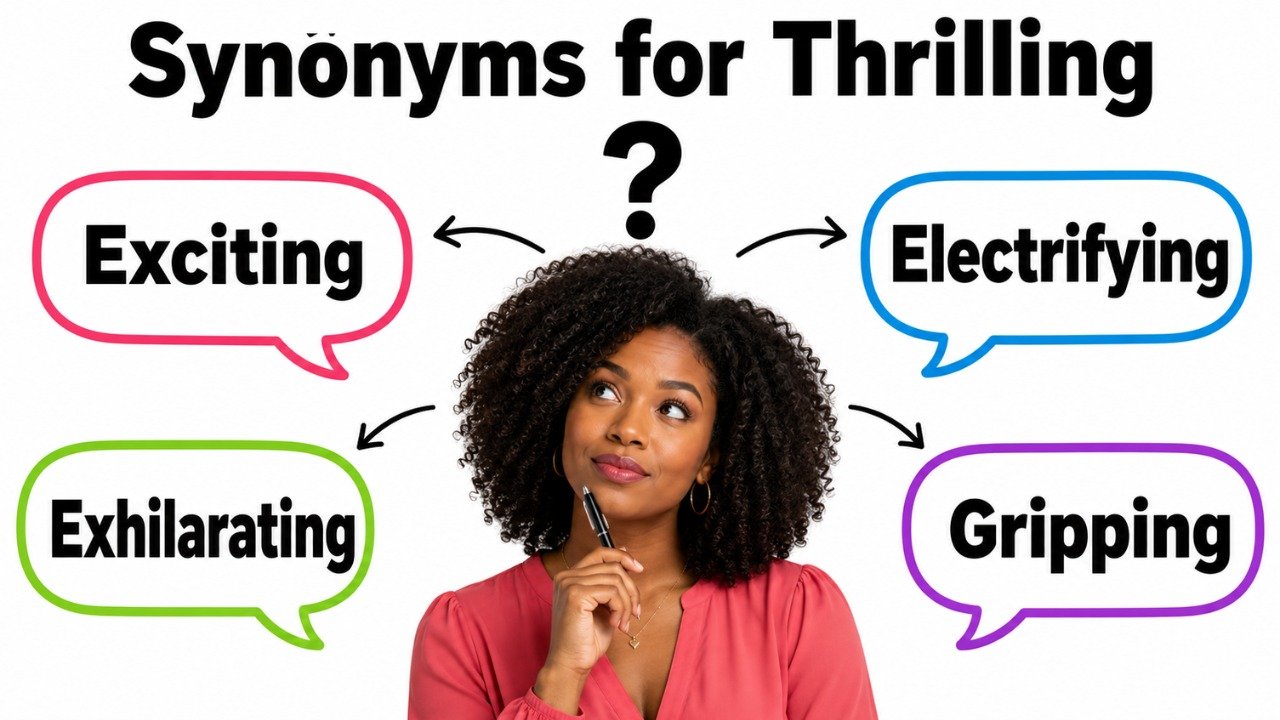
Quick Answer: The best synonyms for thrilling include exciting, exhilarating, electrifying, gripping, riveting, suspenseful, breathtaking, captivating, dramatic, and stimulating. Use exciting as the most flexible everyday alternative. Choose exhilarating for an experience that creates intense joy and energy, electrifying for powerful excitement, and gripping or riveting for a story that holds attention. Suspenseful works best when uncertainty creates tension, while breathtaking describes something so impressive or exciting that it leaves a person amazed.
Pronunciation and Word Details
Word: Thrilling.
Pronunciation: /ˈθrɪlɪŋ/.
Part of Speech: Adjective.
Meaning: Causing strong excitement, pleasure, suspense, or emotional energy.
US Pronunciation:
UK Pronunciation:
What Does “Thrilling” Mean?
Thrilling means extremely exciting, enjoyable, or emotionally powerful. It is mainly used as an adjective to describe an experience, event, story, activity, performance, or discovery that creates a strong feeling of excitement.
The word often suggests more than ordinary enjoyment. Something thrilling may make a person feel energetic, amazed, nervous, curious, or eager to know what happens next.
A thrilling experience may involve physical adventure, such as climbing a mountain or riding through fast moving water. It can also involve mental or emotional excitement, such as reading a mystery or watching a close competition.
Thrilling is also the present participle form of the verb thrill. In this use, it describes the act of creating excitement or pleasure.
Adjective Example: The final chapter was thrilling.
Verb Form Example: The performance was thrilling the audience.
Meaning, Tone, and Context of “Thrilling”
Thrilling has a strong, positive, and emotional tone. It communicates a higher level of excitement than words such as interesting, enjoyable, or entertaining.
The word is common in both conversational and descriptive writing. It may appear in reviews, stories, travel writing, personal conversations, promotional descriptions, and discussions about entertainment or adventure.
In formal reports or academic writing, thrilling may sound too emotional or subjective. Words such as significant, compelling, remarkable, or stimulating may be more suitable when an objective tone is required.
Thrilling can describe positive excitement, but it may also contain an element of fear, suspense, risk, or uncertainty. A thrilling escape, for example, can be exciting because danger is involved.
Positive Context: The team achieved a thrilling victory.
Suspenseful Context: The novel reaches a thrilling conclusion.
Adventure Context: They enjoyed a thrilling journey through the mountains.
Emotional Context: Receiving the award was a thrilling moment.
When and How to Use “Thrilling”
For Adventures
Use thrilling for activities that produce excitement through movement, speed, height, danger, or discovery.
Example: The river journey was a thrilling adventure.
For Stories
Use thrilling when a book, film, play, or narrative keeps the audience excited and eager to discover what happens next.
Example: The mystery has a thrilling final chapter.
For Competitions
Use thrilling for close games, races, contests, or performances that create intense excitement.
Example: The teams delivered a thrilling match.
For Important Discoveries
Use thrilling when a discovery, opportunity, or achievement creates strong happiness and enthusiasm.
Example: Finding the missing evidence was a thrilling breakthrough.
For Unexpected Success
Use thrilling to describe a result that feels exciting because it was difficult, surprising, or especially meaningful.
Example: Winning the competition was a thrilling achievement.
For Suspense
Use thrilling when uncertainty, danger, or anticipation creates emotional tension.
Example: The characters made a thrilling escape from the storm.
For Personal Experiences
Use thrilling when discussing a memorable moment that produced intense pleasure or excitement.
Example: Speaking before the large audience was a thrilling experience.
Best Synonyms for Thrilling
Exciting: Creating strong interest, enthusiasm, or eagerness.
Example: The new project offers exciting opportunities.
Exhilarating: Producing intense happiness, energy, and excitement.
Example: Reaching the mountain peak was exhilarating.
Electrifying: Creating sudden, powerful, and energetic excitement.
Example: The singer gave an electrifying performance.
Gripping: Holding attention so strongly that it is difficult to look away.
Example: The novel tells a gripping story of survival.
Riveting: Completely absorbing a person’s attention.
Example: Her speech was informative and riveting.
Suspenseful: Creating tension and uncertainty about what will happen.
Example: The final scene was extremely suspenseful.
Breathtaking: So beautiful, impressive, or exciting that it causes amazement.
Example: The view from the summit was breathtaking.
Captivating: Attracting and holding attention through charm or interest.
Example: The speaker gave a captivating presentation.
Dramatic: Full of powerful action, emotion, or unexpected change.
Example: The race ended with a dramatic victory.
Stimulating: Encouraging interest, thought, energy, or enthusiasm.
Example: The students had a stimulating discussion.
50 Synonyms for Thrilling with Short Meanings
- Exciting: Producing strong interest, enthusiasm, or eagerness.
- Exhilarating: Creating intense joy, energy, and excitement.
- Electrifying: Producing sudden and powerful excitement.
- Gripping: Holding attention through strong interest or suspense.
- Riveting: So interesting that attention remains completely focused.
- Suspenseful: Creating uncertainty and nervous anticipation.
- Breathtaking: Causing amazement through beauty, excitement, or intensity.
- Dramatic: Filled with powerful action, emotion, or change.
- Captivating: Holding attention through charm or fascination.
- Enthralling: Keeping someone completely interested and delighted.
- Engrossing: Taking up a person’s full attention.
- Absorbing: Deeply interesting and mentally engaging.
- Compelling: Powerful enough to attract and maintain attention.
- Stimulating: Encouraging thought, energy, or enthusiasm.
- Invigorating: Making someone feel refreshed, energetic, and excited.
- Stirring: Producing strong feelings or enthusiasm.
- Rousing: Creating excitement, energy, or emotional involvement.
- Sensational: Extremely impressive, exciting, or remarkable.
- Spectacular: Visually impressive, dramatic, or exciting.
- Fascinating: Extremely interesting and worthy of close attention.
- Mesmerizing: Holding attention as if through a powerful spell.
- Spellbinding: So interesting that it seems impossible to look away.
- Intense: Extremely strong in feeling, action, or effect.
- Tense: Filled with nervous excitement or uncertainty.
- Nail biting: Producing nervous excitement and suspense.
- Pulse pounding: Creating intense physical and emotional excitement.
- Heart racing: Causing a rapid feeling of excitement or fear.
- Heart stopping: Extremely shocking, frightening, or exciting.
- Spine tingling: Producing a strong physical feeling of excitement or fear.
- Hair raising: Extremely frightening, dangerous, or exciting.
- White knuckle: Involving intense fear, tension, or excitement.
- Edge of your seat: Keeping someone intensely interested and anxious.
- Adrenaline charged: Filled with energy, speed, risk, or excitement.
- Thrill packed: Containing many exciting moments or activities.
- Action packed: Filled with movement, conflict, and energetic events.
- Fast paced: Moving quickly and maintaining constant interest.
- High stakes: Involving serious risks, rewards, or consequences.
- Eventful: Containing many interesting or important events.
- Dynamic: Full of energy, activity, and noticeable change.
- Energetic: Showing or creating active enthusiasm.
- Lively: Full of movement, activity, and cheerful energy.
- Animated: Full of enthusiasm, movement, or expression.
- Adventurous: Involving exploration, risk, or unusual experiences.
- Daring: Showing courage through risk or bold action.
- Astonishing: Causing great surprise or amazement.
- Amazing: Producing wonder, admiration, or excitement.
- Remarkable: Unusual enough to deserve attention or admiration.
- Unforgettable: So impressive or exciting that it remains in memory.
- Charged: Filled with strong emotion, energy, or tension.
- Mind blowing: Extremely impressive, surprising, or exciting.
Read Also:
Synonyms for Buy

Synonyms for Thrilling by Context
When Thrilling Means Exciting
Exciting is the most direct and flexible replacement for thrilling. It works for events, activities, plans, opportunities, news, and personal experiences.
Other useful alternatives include exhilarating, stimulating, invigorating, and lively.
Example With Thrilling: We received some thrilling news about the competition.
Example With Exciting: We received some exciting news about the competition.
Example With Exhilarating: The successful climb was an exhilarating experience.
When Thrilling Means Suspenseful
Thrilling can describe a situation that creates nervous excitement because the result is uncertain.
Useful synonyms include suspenseful, tense, gripping, nail biting, and edge of your seat.
Example With Thrilling: The final minutes of the game were thrilling.
Example With Suspenseful: The final minutes of the game were suspenseful.
Example With Nail Biting: The competition reached a nail biting conclusion.
When Thrilling Means Attention Holding
A thrilling story, speech, or performance may hold someone’s attention completely.
Useful alternatives include riveting, captivating, enthralling, engrossing, absorbing, compelling, and spellbinding.
Example With Thrilling: The author created a thrilling story.
Example With Riveting: The author created a riveting story.
Example With Enthralling: The audience listened to the enthralling tale.
When Thrilling Means Energetic
Thrilling can describe an event or performance that creates powerful energy and enthusiasm.
Useful alternatives include electrifying, dynamic, energetic, animated, stirring, and rousing.
Example With Thrilling: The band delivered a thrilling performance.
Example With Electrifying: The band delivered an electrifying performance.
Example With Dynamic: The dancers gave a dynamic performance.
When Thrilling Means Impressive
Thrilling may describe something that creates wonder because it is unusually beautiful, dramatic, or remarkable.
Useful synonyms include breathtaking, spectacular, sensational, astonishing, and amazing.
Example With Thrilling: We saw a thrilling view from the peak.
Example With Breathtaking: We saw a breathtaking view from the peak.
Example With Spectacular: The valley offered spectacular scenery.
When Thrilling Means Risky
Some thrilling activities are exciting because they involve danger, courage, speed, or uncertainty.
Useful alternatives include adventurous, daring, white knuckle, adrenaline charged, and high stakes.
Example With Thrilling: They took part in a thrilling mountain expedition.
Example With Adventurous: They took part in an adventurous mountain expedition.
Example With Daring: The rescue required a daring plan.
Another Word for Thrilling
Exciting is usually the best single replacement for thrilling because it is natural, widely understood, and suitable for many situations. However, the strongest alternative depends on the source of the excitement.
Use exhilarating for joyful physical excitement, gripping for stories, suspenseful for uncertainty, and electrifying for energetic performances.
Original: It was a thrilling journey through the forest.
Better Option: It was an exhilarating journey through the forest.
Original: The book has a thrilling plot.
Better Option: The book has a gripping plot.
Original: The final round was thrilling.
Better Option: The final round was suspenseful.
Original: The speaker delivered a thrilling presentation.
Better Option: The speaker delivered an electrifying presentation.
When Not to Use “Thrilling”
Avoid thrilling when the intended meaning is only pleasant, interesting, or useful. The word suggests strong excitement, so it may exaggerate an ordinary experience.
Weak: The instructions provided a thrilling explanation of the process.
Better: The instructions provided a clear explanation of the process.
Do not use thrilling repeatedly in the same paragraph. Choose more precise alternatives to show whether the excitement came from danger, suspense, beauty, or energy.
Weak: The thrilling race had a thrilling ending and a thrilling celebration.
Better: The exciting race had a nail biting ending and an energetic celebration.
Avoid thrilling in highly objective reports unless emotional evaluation is appropriate.
Weak: The study produced thrilling statistical findings.
Better: The study produced significant statistical findings.
Do not use thrilling for experiences that are mainly peaceful or relaxing.
Weak: We enjoyed a thrilling afternoon of quiet meditation.
Better: We enjoyed a peaceful afternoon of quiet meditation.
Avoid thrilling when something is frightening but not enjoyable. Frightening, alarming, or terrifying may communicate the meaning more accurately.
Weak: The dangerous accident was thrilling for the witnesses.
Better: The dangerous accident was alarming for the witnesses.
Words Commonly Confused With Thrilling
Thrilling vs Exciting: Thrilling suggests a particularly strong level of excitement. Exciting is broader and can describe anything that creates interest or enthusiasm.
Thrilling vs Exhilarating: Thrilling may include excitement, fear, or suspense. Exhilarating usually emphasizes joy, energy, and a refreshing sense of freedom.
Thrilling vs Suspenseful: Thrilling describes the overall feeling of intense excitement. Suspenseful specifically describes uncertainty about what will happen next.
Thrilling vs Gripping: Thrilling focuses on the excitement produced by something. Gripping focuses on how strongly it holds attention.
Thrilling vs Riveting: Thrilling suggests emotional excitement, while riveting emphasizes complete mental attention.
Thrilling vs Breathtaking: Thrilling often relates to action or suspense. Breathtaking commonly describes something overwhelmingly beautiful, impressive, or dramatic.
Thrilling vs Frightening: Thrilling usually includes enjoyment or positive excitement. Frightening primarily creates fear and may not be enjoyable.
Thrilling vs Stimulating: Thrilling creates emotional excitement. Stimulating often creates intellectual interest, fresh ideas, or mental energy.
Which Synonym Should You Choose?
Choose exciting for a natural and flexible alternative in everyday speech, emails, and general writing.
Choose exhilarating for adventures, physical activities, travel experiences, and moments that create intense joy or energy.
Choose electrifying for performances, speeches, crowds, and events that create sudden emotional energy.
Choose gripping for books, stories, reports, documentaries, and accounts that strongly hold attention.
Choose riveting when something keeps a reader, listener, or viewer completely focused.
Choose suspenseful when uncertainty about the result creates tension or nervous excitement.
Choose breathtaking for impressive views, remarkable beauty, dramatic achievements, or extraordinary moments.
Choose captivating for people, presentations, descriptions, stories, and performances that attract attention through charm.
Choose dramatic for sudden changes, emotional events, close competitions, and powerful scenes.
Choose stimulating for discussions, lessons, ideas, and experiences that encourage thought or mental activity.
Choose compelling for essays, arguments, evidence, and presentations that strongly influence attention or belief.
Choose remarkable for formal reports when thrilling sounds too emotional.
Choose lively for conversations, gatherings, descriptions, and environments filled with cheerful activity.
Choose nail biting for informal descriptions of close competitions or uncertain endings.
Choose high stakes for situations involving major risks, consequences, or rewards.
Real Life Examples of “Thrilling” in Sentences
Original: The championship ended with a thrilling final round.
Better Option: The championship ended with a nail biting final round.
Original: We had a thrilling ride through the mountains.
Better Option: We had an exhilarating ride through the mountains.
Original: The novel tells a thrilling story about survival.
Better Option: The novel tells a gripping story about survival.
Original: The orchestra gave a thrilling performance.
Better Option: The orchestra gave an electrifying performance.
Original: The explorers made a thrilling discovery.
Better Option: The explorers made an astonishing discovery.
Original: The rescue reached a thrilling conclusion.
Better Option: The rescue reached a dramatic conclusion.
Original: The speaker shared a thrilling account of the journey.
Better Option: The speaker shared a captivating account of the journey.
Original: The view from the mountain was thrilling.
Better Option: The view from the mountain was breathtaking.
Original: The final chapter was thrilling from beginning to end.
Better Option: The final chapter was riveting from beginning to end.
Original: Starting the new position was a thrilling experience.
Better Option: Starting the new position was an exciting experience.
Synonym Groups and Usage Differences
General Excitement Group
Exciting, exhilarating, stimulating, invigorating, and sensational describe experiences that create enthusiasm or pleasure.
Exciting is the broadest option. Exhilarating suggests intense energy, while invigorating suggests renewed strength or freshness.
Example: Swimming in the open water was an invigorating experience.
Suspense Group
Suspenseful, tense, nail biting, heart racing, and edge of your seat describe excitement caused by uncertainty.
Suspenseful is suitable for neutral descriptions. Nail biting and edge of your seat are more conversational and expressive.
Example: The close race had a nail biting finish.
Attention Group
Gripping, riveting, engrossing, absorbing, compelling, and fascinating describe something that strongly holds mental attention.
Gripping often suits serious or suspenseful subjects. Riveting and engrossing emphasize complete concentration.
Example: The witness gave a gripping account of the event.
Performance Group
Electrifying, dynamic, energetic, lively, animated, stirring, and rousing describe performances or events that create strong energy.
Electrifying is the strongest choice for a performance that produces an immediate and powerful audience reaction.
Example: The actor gave an electrifying performance.
Wonder Group
Breathtaking, spectacular, astonishing, amazing, remarkable, and mind blowing describe something unusually impressive.
Breathtaking is often used for scenery and major achievements. Remarkable is more suitable for formal or measured writing.
Example: The scientists reported a remarkable result.
Adventure Group
Adventurous, daring, white knuckle, adrenaline charged, action packed, and thrill packed describe experiences involving speed, movement, courage, or risk.
Adventurous has a positive and exploratory tone. White knuckle emphasizes fear and extreme tension.
Example: The travelers followed an adventurous route across the valley.
Emotional Impact Group
Stirring, rousing, intense, dramatic, charged, and unforgettable describe experiences that create powerful emotions.
Stirring often describes speeches, music, or stories that inspire emotion. Charged suggests an atmosphere filled with tension or energy.
Example: The ceremony included a stirring speech.
Antonyms of Thrilling
The opposite of thrilling depends on whether the word refers to excitement, suspense, energy, or interest.
Boring: Failing to create interest or excitement.
Dull: Lacking energy, variety, or appeal.
Tedious: Feeling long, tiring, and repetitive.
Uneventful: Containing no important, unusual, or exciting events.
Predictable: Easy to anticipate and lacking surprise.
Calm: Free from intense excitement or emotional tension.
Peaceful: Quiet, relaxed, and free from disturbance.
Ordinary: Normal and not especially interesting or impressive.
Monotonous: Repetitive and lacking variety.
Unstimulating: Failing to encourage interest or thought.
Unexciting: Not producing enthusiasm or emotional energy.
Routine: Regular, expected, and lacking novelty.
Forgettable: Not interesting or impressive enough to remain in memory.
Lifeless: Lacking energy, spirit, or enthusiasm.
Unremarkable: Not unusual or worthy of special attention.
Comparison: Thrilling vs Related Words
Thrilling vs Exciting
Thrilling describes an especially strong form of excitement. Exciting is more general and works in a wider range of situations.
Example With Thrilling: The climbers completed a thrilling journey.
Example With Exciting: The students heard exciting news about the trip.
Thrilling vs Exhilarating
Thrilling may combine excitement with danger, fear, or suspense. Exhilarating emphasizes pleasure, freedom, and physical or emotional energy.
Example With Thrilling: The escape scene was thrilling.
Example With Exhilarating: Running along the beach was exhilarating.
Thrilling vs Gripping
Thrilling focuses on the emotion created by an experience. Gripping focuses on the ability of something to hold attention.
Example With Thrilling: The race produced a thrilling finish.
Example With Gripping: The report gave a gripping account of the rescue.
Thrilling vs Riveting
Thrilling suggests intense emotional excitement. Riveting suggests complete concentration and deep interest.
Example With Thrilling: The team achieved a thrilling victory.
Example With Riveting: The speaker delivered a riveting explanation.
Thrilling vs Suspenseful
Thrilling can describe any intense excitement. Suspenseful is limited to situations where uncertainty creates tension.
Example With Thrilling: The journey was thrilling from start to finish.
Example With Suspenseful: The final chapter was suspenseful because the result remained uncertain.
Thrilling vs Breathtaking
Thrilling usually describes action, emotion, or suspense. Breathtaking often describes impressive beauty, scale, skill, or achievement.
Example With Thrilling: The chase through the city was thrilling.
Example With Breathtaking: The mountain scenery was breathtaking.
Thrilling vs Electrifying
Thrilling describes strong excitement in general. Electrifying emphasizes sudden energy and a powerful emotional reaction.
Example With Thrilling: The competition was thrilling.
Example With Electrifying: The winner received an electrifying welcome.
Thrilling vs Dramatic
Thrilling describes the emotional excitement caused by something. Dramatic describes powerful action, emotion, contrast, or change.
Example With Thrilling: The audience enjoyed a thrilling performance.
Example With Dramatic: The story ended with a dramatic revelation.
Common Phrases and Expressions With Thrilling
Thrilling Experience: An event that creates intense excitement or pleasure.
Thrilling Adventure: A journey or activity filled with excitement, discovery, or risk.
Thrilling Story: A narrative that strongly holds attention and creates excitement.
Thrilling Conclusion: An exciting or suspenseful ending.
Thrilling Victory: An exciting success, often achieved after a close competition.
Thrilling Performance: A presentation, act, or display that creates powerful excitement.
Thrilling Discovery: A finding that produces strong enthusiasm or amazement.
Thrilling Moment: A brief experience filled with excitement or emotional intensity.
Thrilling Journey: A trip involving adventure, surprise, or memorable experiences.
Thrilling Opportunity: A chance to do something new, valuable, or exciting.
Common Mistakes to Avoid
Repeating Thrilling Too Often
Using thrilling several times in one paragraph makes the writing sound repetitive. Replace it with more precise words based on the intended meaning.
Repetitive: The thrilling event had a thrilling performance and a thrilling ending.
Improved: The exciting event had an electrifying performance and a dramatic ending.
Choosing an Overly Strong Word
Thrilling suggests intense excitement. Do not use it for an experience that was only mildly interesting or pleasant.
Unnatural: The routine meeting was thrilling.
Improved: The routine meeting was informative.
Confusing Thrilling With Frightening
An experience can be both thrilling and frightening, but the words do not mean the same thing. Thrilling normally includes excitement or enjoyment.
Incorrect Meaning: The destructive storm was thrilling for the frightened residents.
Improved: The destructive storm was terrifying for the frightened residents.
Using the Wrong Contextual Synonym
Not every synonym fits every noun. A breathtaking view sounds natural, but a breathtaking discussion may sound exaggerated.
Weak: We had a breathtaking classroom discussion.
Better: We had a stimulating classroom discussion.
Using Informal Expressions in Formal Writing
Expressions such as mind blowing, nail biting, and edge of your seat may be too conversational for reports or academic essays.
Informal: The research produced mind blowing findings.
Formal: The research produced remarkable findings.
Ignoring the Source of Excitement
Choose a word that shows why something was thrilling. Use suspenseful for uncertainty, exhilarating for joyful energy, and gripping for strong attention.
Vague: The final chapter was thrilling.
Precise: The final chapter was suspenseful.
Creating Unnatural Phrasing
Some combinations sound awkward because thrilling already expresses a high level of excitement.
Awkward: The experience was very extremely thrilling.
Natural: The experience was absolutely thrilling.
Conclusion
The best synonyms for thrilling depend on the type of excitement being described. Exciting is the most flexible everyday alternative, while exhilarating suits joyful adventures and electrifying suits energetic performances. Gripping, riveting, and suspenseful work well for stories, competitions, and uncertain outcomes. Breathtaking describes impressive beauty or achievement, while captivating emphasizes strong attraction. By choosing among these synonyms for thrilling carefully, you can communicate whether an experience was energetic, suspenseful, memorable, dramatic, or emotionally powerful.
FAQs About Synonyms for Thrilling
What Is the Best Synonym for Thrilling?
Exciting is the best general synonym because it works naturally for events, experiences, opportunities, stories, and news.
What Is a Stronger Word Than Thrilling?
Electrifying, exhilarating, breathtaking, and pulse pounding can sound stronger, depending on the context.
Is Exhilarating the Same as Thrilling?
The meanings are similar, but exhilarating emphasizes joy and energy. Thrilling may also include suspense, fear, or danger.
Can Gripping Replace Thrilling?
Gripping can replace thrilling when describing a story, speech, report, or account that strongly holds attention.
What Is a Formal Synonym for Thrilling?
Compelling, stimulating, remarkable, riveting, and significant may be suitable formal alternatives, depending on the sentence.
What Is a Casual Synonym for Thrilling?
Exciting is the most natural casual choice. Nail biting, mind blowing, and edge of your seat are more expressive informal options.
What Is the Opposite of Thrilling?
Common opposites include boring, dull, uneventful, predictable, monotonous, and unexciting.
