
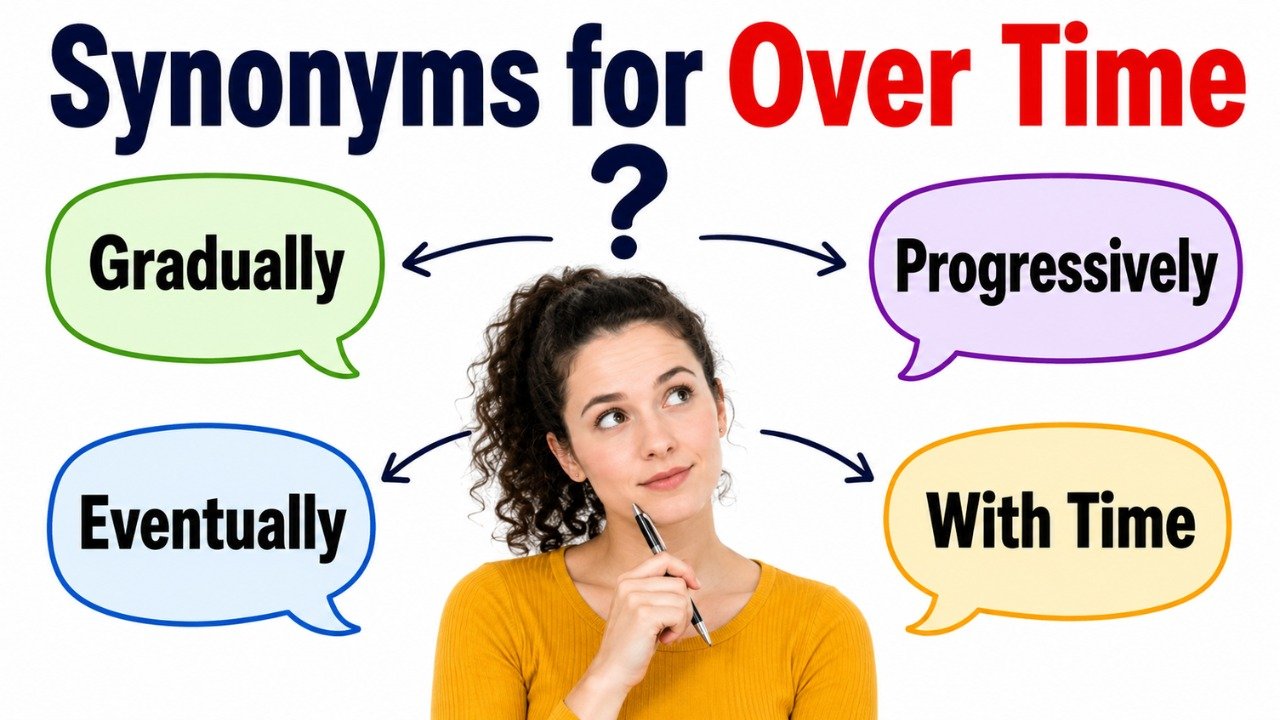
Quick Answer: The best synonyms for over time include gradually, eventually, with time, in time, over the years, as time passes, progressively, little by little, in the long run, and in due course. Use gradually when a change happens slowly in stages. Choose eventually for a final result reached after a delay. Over the years works well for long periods, while with time is natural in casual speech. Progressively suits formal and academic writing, and in the long run emphasizes a future result rather than the process of change.
Pronunciation and Word Details
Word: Over time.
Pronunciation: /ˌoʊvər ˈtaɪm/.
Part of Speech: Adverbial prepositional phrase.
Meaning: During a period of time, especially when something changes, develops, or becomes noticeable gradually.
US Pronunciation:
UK Pronunciation:
What Does “Over Time” Mean?
Over time means during a period rather than at one immediate moment. It commonly describes a change, development, effect, habit, result, or process that happens gradually.
Over time is an adverbial prepositional phrase. It modifies a verb by explaining when or how a process occurs.
Gradual Change: The neighborhood became quieter over time.
Development: Her confidence increased over time.
Accumulation: Small expenses can become significant over time.
Long Term Effect: Regular practice improves performance over time.
Changing Condition: The color may fade over time.
The phrase does not state an exact duration. It may refer to days, months, years, or decades. The surrounding sentence usually helps the reader understand the length of the period.
Over time can also describe repeated experiences that produce a later result.
Example: Over time, he learned how to manage difficult conversations.
In this sentence, the learning did not happen at once. It developed through experience.
The phrase may appear at the beginning, middle, or end of a sentence.
Beginning Position: Over time, the small business developed a loyal customer base.
Middle Position: The relationship, over time, became more trusting.
End Position: Her writing became clearer over time.
The end position is usually the most natural in everyday writing. The beginning position gives greater emphasis to the passage of time.
Meaning, Tone, and Context of “Over Time”
Over time has a neutral and flexible tone. It is common in casual conversation, academic writing, reports, essays, instructions, research, health discussions, education, history, and business communication.
Conversational Tone: Over time sounds natural when discussing personal growth, relationships, habits, and everyday changes.
Example: You will become more comfortable with the process over time.
Formal Tone: The phrase can appear in professional reports when describing trends, performance, costs, or results.
Example: Operating costs increased over time.
Academic Tone: Researchers and students use over time to discuss development, historical change, repeated observation, and long term patterns.
Example: The study examined how attitudes changed over time.
Technical Tone: Over time can describe physical wear, chemical change, system performance, or data trends.
Example: The material may weaken over time.
Emotional Tone: The phrase itself is neutral, but it can introduce emotional development.
Example: Her disappointment became easier to manage over time.
Historical Context: It can describe gradual social, political, linguistic, or cultural change.
Example: The meaning of the word changed over time.
Educational Context: It often explains how knowledge and ability develop through continued learning.
Example: Vocabulary grows over time through reading and practice.
Over time usually emphasizes a process rather than one specific moment. It suggests that the result develops through accumulated effects, repeated actions, or changing conditions.
When and How to Use “Over Time”
For Gradual Change
Use over time when something changes slowly rather than suddenly.
Example: The wooden surface darkened over time.
For Personal Development
Use the phrase when a skill, habit, attitude, or emotional response develops through experience.
Example: She became more confident over time.
For Long Term Results
Use over time when repeated actions produce a result after a significant period.
Example: Regular saving can create financial security over time.
For Physical Wear
Use over time when an object becomes weaker, older, damaged, faded, or less effective.
Example: The fabric may lose its softness over time.
For Learning and Practice
Use the phrase when knowledge or performance improves through repetition.
Example: His pronunciation improved over time.
For Historical Change
Use over time when describing how communities, customs, language, or institutions develop.
Example: Local traditions changed over time.
For Relationships
Use the phrase when trust, affection, understanding, or conflict develops gradually.
Example: The two coworkers became close friends over time.
For Trends and Data
Use over time when discussing changes measured across several periods.
Example: The chart shows how demand increased over time.
For Accumulated Effects
Use the phrase when small actions or events combine to create a larger outcome.
Example: Minor delays can become costly over time.
For Recovery and Adjustment
Use over time when improvement happens through patience, treatment, rest, or continued effort.
Example: The discomfort became less noticeable over time.
Best Synonyms for Over Time
Gradually
Synonym: Slowly and through a series of small changes.
Example: The weather gradually became warmer.
Eventually
Synonym: At a later time after a delay or process.
Example: The team eventually found a practical solution.
With Time
Synonym: As time passes and conditions develop.
Example: The task will become easier with time.
In Time
Synonym: After enough time has passed.
Example: In time, she learned to trust her judgment.
Over the Years
Synonym: During a period covering several years.
Example: The town has expanded considerably over the years.
As Time Passes
Synonym: While time continues to move forward.
Example: Memories may become less detailed as time passes.
Progressively
Synonym: By continuing stages or increasing degrees.
Example: The symptoms became progressively less severe.
Little by Little
Synonym: Through many small amounts or stages.
Example: Little by little, the students gained confidence.
In the Long Run
Synonym: After a long period, especially when considering the final result.
Example: Careful planning saves money in the long run.
In Due Course
Synonym: At an appropriate future time after the expected process.
Example: The results will become available in due course.
50 Synonyms for Over Time with Short Meanings
- Gradually: Through small and slow changes.
- Eventually: At a later point after some delay.
- With Time: As time passes.
- In Time: After enough time has passed.
- As Time Passes: While a period continues.
- As Time Goes By: While time continues to move forward.
- Over the Years: During several years.
- Through the Years: Across a long period of years.
- Across Time: Throughout different periods.
- In the Long Run: After considering the final long term result.
- Over the Long Term: During an extended future period.
- In the Course of Time: During the natural passage of time.
- Over the Course of Time: Throughout a developing period.
- With the Passage of Time: As time gradually moves forward.
- In Due Course: At the expected future time.
- Sooner or Later: At some future point.
- Ultimately: In the final result.
- Finally: At the end of a process or delay.
- After a While: Following a period of time.
- Little by Little: In many small stages.
- Bit by Bit: Through small gradual amounts.
- Step by Step: Through a sequence of stages.
- By Degrees: Gradually through increasing stages.
- Progressively: In continuing or developing stages.
- Incrementally: Through small increases or additions.
- Steadily: At a regular and continuing rate.
- Slowly: At a low speed or gradual pace.
- Continuously: Without stopping during a period.
- Continually: Repeatedly throughout a period.
- Successively: In a continuing sequence.
- Cumulatively: Through the combined effect of repeated additions.
- In Stages: Through separate parts of a process.
- Over Successive Stages: Across several developing phases.
- Over a Period: During an unspecified amount of time.
- Over an Extended Period: During a long span.
- Over Many Years: Across a large number of years.
- Over Several Months: During a period of several months.
- As Days Pass: While one day follows another.
- As Months Pass: While one month follows another.
- As the Years Pass: While years continue to pass.
- As the Years Go By: During the passage of several years.
- Day by Day: Gradually with each passing day.
- Month by Month: Gradually with each passing month.
- Year by Year: Gradually with each passing year.
- From Year to Year: Across one year and the next.
- Throughout the Period: During the entire span being discussed.
- As Events Unfold: While events gradually develop.
- As the Situation Develops: While circumstances continue to change.
- Through Continued Practice: As a result of repeated practice.
- Through Repeated Experience: As a result of experiencing something many times.
Read Also:
Synonyms for Element

Synonyms for Over Time by Context
When Over Time Means Gradually
Gradually, progressively, little by little, bit by bit, incrementally, and by degrees describe slow change through small stages.
Gradually is the clearest general replacement. Progressively sounds more formal and often suggests a continuing direction. Little by little and bit by bit are more conversational. Incrementally is common when changes can be divided into measurable steps. By degrees has a slightly more literary tone.
Example With Gradually: The pain gradually became less intense.
Example With Progressively: The system became progressively more efficient.
Example With Little by Little: Little by little, she rebuilt her confidence.
Example With Incrementally: The organization increased its capacity incrementally.
When Over Time Means Eventually
Eventually, ultimately, finally, sooner or later, in time, and in due course focus on a later outcome.
Eventually means that something happens after waiting, effort, or delay. Ultimately emphasizes the final outcome. Finally may express relief or completion. Sooner or later suggests that the result is expected but its timing is uncertain. In due course has a formal and patient tone.
Example With Eventually: The missing document was eventually found.
Example With Ultimately: The decision ultimately benefited the entire group.
Example With Finally: The team finally completed the project.
Example With In Due Course: All approved applicants will receive a response in due course.
When Over Time Means During Many Years
Over the years, through the years, over many years, year by year, and as the years pass describe development across a long period.
Over the years is natural in both speech and writing. Through the years often carries a reflective tone. Over many years emphasizes duration. Year by year highlights separate stages of annual change.
Example With Over the Years: The building has been repaired several times over the years.
Example With Through the Years: Their friendship remained strong through the years.
Example With Year by Year: The garden became more colorful year by year.
Example With As the Years Pass: Priorities often change as the years pass.
When Over Time Means During a General Period
Over a period, throughout the period, over an extended period, and over the course of time fit situations where the exact duration is not central.
Over a period is simple and flexible. Throughout the period suggests that something continued during the entire span. Over an extended period emphasizes a long duration. Over the course of time is more formal.
Example With Over a Period: The researchers collected information over a period of six months.
Example With Throughout the Period: Performance remained stable throughout the period.
Example With Over an Extended Period: Repeated pressure can damage the surface over an extended period.
When Over Time Means Through Repetition
Through continued practice, through repeated experience, steadily, continually, and cumulatively describe results created by repeated actions.
Through continued practice works well for skills. Through repeated experience suits learning and emotional adjustment. Steadily emphasizes consistent progress. Continually describes repeated events. Cumulatively emphasizes the combined effect of many small changes.
Example With Continued Practice: Her accuracy improved through continued practice.
Example With Repeated Experience: He became more patient through repeated experience.
Example With Steadily: The team steadily improved its performance.
Example With Cumulatively: Small improvements cumulatively produced a major result.
When Over Time Means As Events Develop
As events unfold, as the situation develops, as time passes, and as time goes by describe change that becomes visible while a situation continues.
As events unfold is useful for stories, investigations, and developing situations. As the situation develops is common in reports and updates. As time passes is neutral. As time goes by sounds slightly more reflective.
Example With As Events Unfold: More information may become available as events unfold.
Example With As the Situation Develops: The plan may need adjustment as the situation develops.
Example With As Time Passes: The difference becomes clearer as time passes.
Another Word for Over Time
Gradually is often the best single replacement for over time when a sentence describes slow change. However, it does not fit every context.
Use eventually when the sentence emphasizes a final result. Choose over the years when the period covers many years. Use in the long run when discussing the eventual benefit or consequence of an action.
Original: Her confidence improved over time.
Better Option: Her confidence improved gradually.
Original: Over time, the team found a solution.
Better Option: The team eventually found a solution.
Original: The neighborhood has changed over time.
Better Option: The neighborhood has changed considerably over the years.
Original: Regular maintenance saves money over time.
Better Option: Regular maintenance saves money in the long run.
When Not to Use “Over Time”
Over time can become vague, repetitive, or inaccurate when the exact duration, type of change, or final result matters.
When the Exact Period Is Known
Use the actual time span when it gives the reader useful information.
Weak: Sales increased over time.
Better: Sales increased steadily over six months.
When the Change Was Sudden
Do not use over time for something that happened immediately.
Weak: The window broke over time when the ball struck it.
Better: The window broke immediately when the ball struck it.
When You Mean Eventually
Over time emphasizes a process, while eventually emphasizes the final outcome.
Weak: The lost keys were found over time.
Better: The lost keys were eventually found.
When You Mean Throughout a Period
If something remained true during an entire period, throughout may be clearer.
Weak: Attendance remained stable over time.
Better: Attendance remained stable throughout the semester.
When You Mean Regularly
Over time does not mean repeatedly at fixed intervals.
Weak: The report is published over time.
Better: The report is published monthly.
When Repetition Weakens the Paragraph
Using over time in several nearby sentences makes the writing sound limited.
Weak: Skills improve over time. Confidence grows over time. Speed increases over time.
Better: Skills improve gradually. Confidence develops with practice, and speed increases steadily.
When a More Precise Trend Word Is Available
Choose increased, declined, fluctuated, accumulated, evolved, or deteriorated when these verbs explain the change more clearly.
Weak: The temperature changed over time.
Better: The temperature declined steadily throughout the evening.
When You Mean Extra Working Hours
Do not confuse over time with overtime. Overtime is one word when it refers to work performed beyond normal hours.
Weak: The employee received over time pay.
Better: The employee received overtime pay.
Words Commonly Confused With Over Time
Over Time vs Overtime: Over time means gradually or during a period. Overtime means extra working hours or an additional period in a game.
Over Time vs In Time: Over time describes gradual development. In time means before it is too late or after enough time has passed.
Over Time vs On Time: Over time refers to a continuing period. On time means at the planned or expected moment.
Over Time vs With Time: Both can describe gradual change. With time often sounds more personal or conversational.
Over Time vs Eventually: Over time emphasizes the process of change. Eventually emphasizes the final result.
Over Time vs Throughout: Over time often suggests development. Throughout means during every part of a period.
Over Time vs Gradually: Over time describes the period in which change happens. Gradually describes the slow manner of the change.
Over Time vs Long Term: Over time is an adverbial phrase. Long term usually describes a plan, effect, goal, or period.
Over Time vs From Time to Time: Over time means gradually. From time to time means occasionally.
Over Time vs At the Same Time: Over time describes an extended period. At the same time means simultaneously.
Which Synonym Should You Choose?
Choose Gradually: Use gradually when something changes slowly through small stages.
Choose Eventually: Use eventually when the final outcome matters more than the process.
Choose With Time: Use with time in natural conversation about healing, learning, confidence, or adjustment.
Choose In Time: Use in time when something becomes possible after enough time has passed.
Choose Over the Years: Use over the years for personal, historical, social, or physical changes across several years.
Choose Progressively: Use progressively in formal writing when a condition moves consistently in one direction.
Choose Incrementally: Use incrementally for measurable changes made in small amounts.
Choose Steadily: Use steadily when progress continues at a regular pace.
Choose Little by Little: Use little by little for friendly and conversational descriptions of gradual progress.
Choose In the Long Run: Use in the long run when discussing an eventual benefit, cost, or consequence.
Choose In Due Course: Use in due course for formal communication about something expected to happen later.
Choose Cumulatively: Use cumulatively when many small effects combine into a larger result.
Choose Throughout the Period: Use throughout the period when something remains true during the entire span.
Choose As Events Unfold: Use as events unfold when information or circumstances continue to develop.
For Formal Writing: Progressively, incrementally, cumulatively, over the course of time, and in due course are strong choices.
For Casual Speech: With time, little by little, after a while, and sooner or later sound natural.
For Academic Writing: Over the years, progressively, throughout the period, and over an extended period provide useful precision.
For Reports: Use steadily for consistent movement, cumulatively for combined effects, and throughout the period for continuing conditions.
For Essays: Choose over the years for historical development and gradually for slow change.
For Emails: Use in due course for formal future expectations and eventually for a completed result after delay.
For Conversation: With time, in time, little by little, and over the years are clear and familiar.
Real Life Examples of “Over Time” in Sentences
Original: Her communication skills improved over time.
Better Option: Her communication skills improved gradually.
Original: The old photograph faded over time.
Better Option: The old photograph slowly faded with the passage of time.
Original: Over time, the team learned how to work together.
Better Option: The team eventually learned how to work together.
Original: The city became more crowded over time.
Better Option: The city became more crowded over the years.
Original: Regular exercise can improve strength over time.
Better Option: Regular exercise can improve strength in the long run.
Original: The cost increased over time.
Better Option: The cost increased steadily throughout the year.
Original: Over time, the small changes created a major difference.
Better Option: Cumulatively, the small changes created a major difference.
Original: The child became more independent over time.
Better Option: The child became more independent little by little.
Original: The system became less reliable over time.
Better Option: The system became progressively less reliable.
Original: Trust developed over time.
Better Option: Trust developed through repeated experience.
Synonym Groups and Usage Differences
Gradual Change Group
Gradually, slowly, progressively, incrementally, steadily, little by little, and by degrees describe slow development.
Gradually is broad and neutral. Slowly emphasizes speed. Progressively suggests movement in one direction. Incrementally focuses on small measurable stages. Steadily describes consistent movement without major interruption.
Example: The damaged area gradually returned to its original condition.
Eventual Result Group
Eventually, ultimately, finally, sooner or later, in time, and in due course focus on what happens after a delay or process.
Eventually is the most flexible. Ultimately emphasizes the final conclusion. Finally often expresses completion or relief. In due course is formal and patient.
Example: The discussion eventually produced a workable agreement.
Long Period Group
Over the years, through the years, over many years, as the years pass, and year by year describe extended periods.
Over the years is neutral. Through the years often sounds reflective. Year by year highlights visible stages or annual comparisons.
Example: The community has grown considerably over the years.
Repetition Group
Through continued practice, through repeated experience, continually, continuously, and successively focus on repeated actions or events.
Continually means something happens repeatedly. Continuously means it happens without stopping. Successively means one stage or event follows another.
Example: Her technique improved through continued practice.
Accumulation Group
Cumulatively, incrementally, bit by bit, and little by little describe effects that build through repeated additions.
Cumulatively is formal and focuses on the total combined result. Bit by bit and little by little are informal and easy to understand.
Example: The small expenses cumulatively created a serious budget problem.
Passage of Time Group
As time passes, as time goes by, with time, and with the passage of time emphasize the movement of time itself.
With time is conversational. With the passage of time is more formal or reflective. As time goes by may carry an emotional or thoughtful tone.
Example: The importance of the experience became clearer as time passed.
Developing Situation Group
As events unfold, as the situation develops, in stages, and over successive stages describe a process that has not yet finished.
As events unfold suits news, stories, and investigations. In stages fits planned processes. Over successive stages emphasizes an ordered sequence.
Example: The strategy will be adjusted as the situation develops.
Antonyms of Over Time
The opposite of over time depends on whether the phrase describes gradual change, delayed results, or an extended process.
Immediately: Without any delay.
Instantly: At once or in a moment.
Suddenly: Quickly and unexpectedly.
At Once: Without waiting.
All at Once: Happening completely in one moment.
Straightaway: Immediately and without delay.
Promptly: Quickly and at the expected time.
Abruptly: In a sudden and unexpected manner.
Rapidly: At a very fast rate.
Quickly: Within a short period.
Simultaneously: At the same time rather than across a period.
In a Moment: Within a very brief time.
From the Start: Beginning immediately rather than developing later.
At a Single Point: Occurring at one particular moment.
Without Delay: Happening as soon as possible.
Comparison: Over Time vs Related Words
Over Time vs Gradually
Over time identifies the period during which a change happens. Gradually explains that the change happens slowly and in stages.
Example With Over Time: The surface became smoother over time.
Example With Gradually: The surface gradually became smoother.
Over Time vs Eventually
Over time emphasizes an ongoing process. Eventually emphasizes the final outcome after waiting or effort.
Example With Over Time: Her understanding improved over time.
Example With Eventually: She eventually understood the complete process.
Over Time vs With Time
Both phrases describe change as time passes. Over time is slightly more neutral and analytical. With time often sounds more personal or reassuring.
Example With Over Time: The system became easier to manage over time.
Example With With Time: With time, the experience became easier to discuss.
Over Time vs In Time
Over time means during an extended period. In time can mean early enough or after enough time has passed.
Example With Over Time: The building developed cracks over time.
Example With In Time: The workers arrived in time to prevent further damage.
Over Time vs Over the Years
Over time can refer to any duration. Over the years specifically suggests several years.
Example With Over Time: The pain decreased over time.
Example With Over the Years: The town expanded greatly over the years.
Over Time vs Throughout
Over time often suggests change or development. Throughout means during every part of a stated period.
Example With Over Time: Demand increased over time.
Example With Throughout: Demand remained high throughout the summer.
Over Time vs In the Long Run
Over time emphasizes gradual development. In the long run emphasizes the eventual benefit or consequence.
Example With Over Time: The process became more efficient over time.
Example With In the Long Run: The new process will reduce costs in the long run.
Over Time vs Progressively
Over time is broad and neutral. Progressively describes a continuing change that moves in a particular direction.
Example With Over Time: The condition changed over time.
Example With Progressively: The condition became progressively more severe.
Over Time vs From Time to Time
Over time means during a period or gradually. From time to time means occasionally.
Example With Over Time: His skills improved over time.
Example With From Time to Time: He attends additional classes from time to time.
Over Time vs Overtime
Over time is a two word phrase meaning gradually or during a period. Overtime is one word when it means work beyond normal hours or an additional period in a competition.
Example With Over Time: The equipment became less reliable over time.
Example With Overtime: The employee worked overtime to complete the order.
Common Phrases and Expressions With Over Time
Change Over Time: To become different during a period.
Develop Over Time: To grow or become more advanced gradually.
Improve Over Time: To become better as time passes.
Grow Over Time: To increase in size, strength, knowledge, or value.
Build Over Time: To develop through repeated additions or effort.
Evolve Over Time: To change gradually into a different or more developed form.
Accumulate Over Time: To increase through repeated small additions.
Learn Over Time: To gain knowledge through experience and practice.
Decline Over Time: To become weaker, smaller, or less effective gradually.
Fade Over Time: To lose color, strength, or clarity slowly.
Increase Over Time: To become greater during a period.
Decrease Over Time: To become smaller or less significant during a period.
Vary Over Time: To change in amount, condition, or form across different periods.
Recover Over Time: To return gradually to a healthier or stronger condition.
Become Clearer Over Time: To become easier to understand as more information or experience is gained.
Common Mistakes to Avoid
Writing Overtime Instead of Over Time
Over time and overtime have different meanings.
Incorrect: The paint will fade overtime.
Correct: The paint will fade over time.
Use overtime when referring to additional working hours.
Example: She worked overtime on Friday.
Using Over Time for an Immediate Event
Over time should not describe something that happens in one moment.
Incorrect: The glass broke over time when it hit the floor.
Correct: The glass broke instantly when it hit the floor.
Confusing Over Time With On Time
On time means at the planned moment.
Incorrect: The train arrived over time.
Correct: The train arrived on time.
Confusing Over Time With In Time
In time often means before it is too late.
Incorrect: We reached the station over time to catch the train.
Correct: We reached the station in time to catch the train.
Using Over Time Without a Clear Change
The phrase works best when a sentence describes development, accumulation, or a continuing condition.
Vague: The report existed over time.
Better: The report was revised several times over the course of the year.
Repeating the Phrase Too Often
Repeated use makes a paragraph sound mechanical.
Repetitive: The plant grew over time, became stronger over time, and produced flowers over time.
Improved: The plant grew gradually, became stronger with regular care, and eventually produced flowers.
Choosing Eventually When the Process Matters
Eventually only identifies the later result. It does not clearly describe gradual development.
Less Accurate: The metal eventually weakened during years of exposure.
Better: The metal gradually weakened over years of exposure.
Choosing Gradually When the Result Was Delayed but Not Slow
Gradually suggests a slow process.
Less Accurate: The missing package was gradually delivered.
Better: The missing package was eventually delivered.
Leaving the Duration Unnecessarily Vague
Add a specific period when it helps the reader interpret the result.
Vague: Attendance improved over time.
Clear: Attendance improved steadily over the following three months.
Using Throughout for a Changing Trend
Throughout often suggests continuity during the whole period, not gradual change.
Unclear: Prices increased throughout.
Better: Prices increased steadily over time.
Using Long Term as an Adverb
Long term usually works as an adjective or noun phrase. In the long run is often the natural adverbial alternative.
Unnatural: The policy will save money long term.
Better: The policy will save money in the long run.
Conclusion
Synonyms for over time help express gradual change, extended duration, repeated development, and eventual results more precisely. Gradually is best for slow change, while eventually focuses on a final outcome. Over the years suits long periods, and progressively works well in formal analysis. With time sounds natural in personal or conversational writing, while in the long run highlights future benefits or consequences. Selecting the right alternative makes the sentence clearer and shows whether the focus is on the process, duration, repetition, or result.
FAQs About Synonyms for Over Time
What Is the Best Synonym for Over Time?
Gradually is the best general synonym when something changes slowly. Eventually is better when the final result matters most.
What Is a Formal Synonym for Over Time?
Progressively, incrementally, cumulatively, over the course of time, and in due course are useful formal alternatives.
Can Eventually Replace Over Time?
Eventually can replace over time when the sentence focuses on a final outcome. It does not always express gradual development.
Is Over Time One Word or Two Words?
Over time is written as two words when it means gradually or during a period. Overtime is one word when it refers to extra working hours.
What Is Another Way to Say Over the Years?
Through the years, over many years, as the years pass, year by year, and with the passage of time are suitable alternatives.
What Is the Difference Between Over Time and With Time?
Both describe change as time passes. Over time is neutral and analytical, while with time often sounds more personal or reassuring.
What Is an Opposite of Over Time?
Immediately, instantly, suddenly, and all at once are common opposites when over time describes gradual change.
