
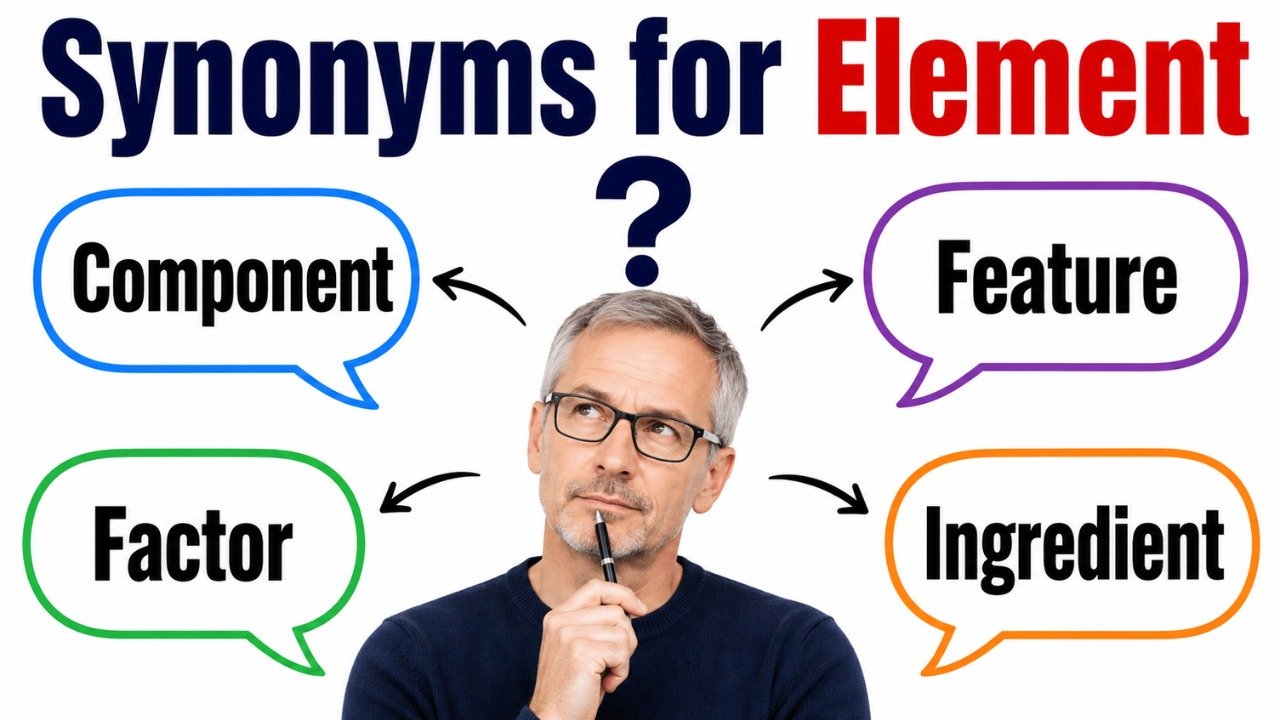
Quick Answer: The best synonyms for element include component, part, factor, feature, aspect, ingredient, constituent, unit, member, and substance. Use component for something that forms part of a larger system. Part is the clearest choice in casual speech, while factor suits causes and influences. Feature describes a noticeable quality, and aspect refers to one side of a subject. Ingredient is best for mixtures and recipes. Constituent works well in formal writing, member suits groups and mathematical sets, and substance is appropriate in scientific contexts.
Pronunciation and Word Details
Word: Element.
Pronunciation: /ˈelɪmənt/.
Part of Speech: Noun.
Meaning: A basic part, feature, substance, or condition that helps form a larger whole.
US Pronunciation:
UK Pronunciation:
What Does “Element” Mean?
Element means a basic part, feature, substance, or influence within something larger.
Element is mainly used as a noun. Its exact meaning changes according to the subject being discussed. It may describe a component of a system, a factor in a situation, a chemical substance, a member of a mathematical set, or the natural conditions of weather and the environment.
When discussing plans, systems, stories, or designs, element usually means a part that contributes to the whole.
Example: Trust is an important element of a successful partnership.
In science, an element is a pure substance made from one type of atom.
Example: Oxygen is an element that supports many natural processes.
In mathematics, an element is an individual member of a set.
Example: The number five is an element of the set.
The plural form, elements, can also mean natural weather conditions such as wind, rain, heat, and cold.
Example: The shelter protected the travelers from the elements.
Element can also describe the surroundings or conditions in which someone feels comfortable.
Example: She is in her element when she is teaching young students.
The word may therefore refer to something physical, abstract, scientific, mathematical, environmental, or personal.
Meaning, Tone, and Context of “Element”
Element has a neutral to formal tone. It appears frequently in academic writing, scientific explanations, professional reports, technical descriptions, essays, and serious discussions.
In everyday conversation, part is often simpler and more natural. However, element is useful when the writer wants to emphasize that something has a meaningful role within a larger structure.
Neutral Context: Element can describe any part or feature of a larger whole.
Formal Context: It is common in reports, essays, research, analysis, planning, and professional communication.
Academic Context: Writers use element when discussing literature, society, language, mathematics, history, and scientific concepts.
Scientific Context: Element has a precise meaning as a pure chemical substance containing one type of atom.
Technical Context: It may describe a basic component of a system, machine, process, structure, or design.
Conversational Context: Element appears in expressions such as in your element, out of your element, and the element of surprise.
Environmental Context: The elements refers to natural weather conditions and forces.
Emotional Context: Element itself is not strongly emotional, but it can describe emotional features such as fear, hope, trust, or tension within a situation.
The word is broad, so readers must use the surrounding sentence to determine its meaning. A design element is a visual component, a chemical element is a substance, and a human element is the personal or emotional part of a situation.
When and How to Use “Element”
For a Part of a Larger Whole
Use element when describing one meaningful part of a system, plan, object, story, design, or process.
Explanation: The word suggests that the part contributes to the structure or success of the whole.
Example: Clear communication is a central element of the project plan.
For a Cause or Influence
Use element when describing something that affects a result, decision, condition, or outcome.
Explanation: In this context, factor is often a close replacement.
Example: Cost was an important element in their final decision.
For a Noticeable Feature
Use element when discussing a quality, detail, or characteristic that can be recognized within something.
Explanation: Feature or aspect may be more precise when the focus is on appearance or one side of a subject.
Example: Humor is a memorable element of the story.
For an Ingredient or Material
Use element when discussing one substance or material that forms part of a mixture or product.
Explanation: Ingredient is usually clearer for food, while material is better for physical construction.
Example: Natural stone is a major element of the building’s design.
For a Chemical Substance
Use element in science when referring to a pure substance made of one type of atom.
Explanation: This is a precise technical meaning and should not be replaced casually with ingredient or material.
Example: Carbon is an element found in all known living organisms.
For a Member of a Set
Use element when identifying one individual item within a mathematical set.
Explanation: Member is the closest general synonym in this context.
Example: Every element of the set must satisfy the stated condition.
For Natural Conditions
Use the plural form, elements, when referring to wind, rain, snow, heat, cold, or other natural forces.
Explanation: Weather or natural forces can sometimes replace this meaning.
Example: The equipment was designed to survive the elements.
For Comfort and Ability
Use the expression in your element when someone feels confident, comfortable, or skilled in a situation.
Explanation: This phrase is common in both conversation and descriptive writing.
Example: He was in his element while explaining the complex process.
For Discomfort or Unfamiliarity
Use out of your element when someone feels uncomfortable, unprepared, or unfamiliar with a situation.
Explanation: The expression suggests that a person is outside their usual area of confidence.
Example: She felt out of her element at the technical meeting.
For Surprise
Use element in the phrase element of surprise when unexpected action provides an advantage or creates a stronger effect.
Explanation: This expression is common in planning, storytelling, competition, and strategy.
Example: The team relied on the element of surprise.
Best Synonyms for Element
Component
Synonym: A part that combines with other parts to form a system, machine, structure, or process.
Example: The battery is an essential component of the device.
Part
Synonym: A general piece or portion of a larger whole.
Example: Regular practice is an important part of learning a new skill.
Factor
Synonym: A circumstance, cause, or influence that helps produce a result.
Example: Experience was a major factor in the hiring decision.
Feature
Synonym: A noticeable or important quality, detail, or function.
Example: The large windows are the most attractive feature of the room.
Aspect
Synonym: One particular side, quality, or part of a subject or situation.
Example: Cost is only one aspect of the decision.
Ingredient
Synonym: One of the substances or qualities used to create a mixture, product, or successful result.
Example: Patience is a necessary ingredient for effective teaching.
Constituent
Synonym: A formal term for a part that helps form a larger whole.
Example: Water is a major constituent of many living cells.
Unit
Synonym: One individual part of a larger group, structure, or system.
Example: Each unit of the course covers a different topic.
Member
Synonym: An individual person, object, or value belonging to a group or set.
Example: Seven is a member of the set of odd numbers.
Substance
Synonym: A particular type of physical material, especially in scientific contexts.
Example: The laboratory identified the substance as a pure element.
50 Synonyms for Element with Short Meanings
- Component: A part that helps form a larger system.
- Part: A general piece of a complete whole.
- Factor: A cause or influence affecting a result.
- Feature: A noticeable quality, function, or detail.
- Aspect: One particular side of a subject.
- Ingredient: A substance or quality used to create something.
- Constituent: A formal term for a forming part.
- Unit: One separate part of a larger system.
- Member: An individual belonging to a group or set.
- Piece: A separate portion of something larger.
- Section: A distinct part of an object, text, or structure.
- Portion: An amount or part taken from a whole.
- Segment: A clearly divided part of something.
- Division: A separated part of a larger structure.
- Detail: A small but meaningful part.
- Characteristic: A quality that helps identify something.
- Trait: A particular quality or distinguishing feature.
- Quality: A feature or property of a person or thing.
- Property: A quality belonging to a substance or object.
- Attribute: A characteristic associated with someone or something.
- Consideration: A fact or issue that must be examined.
- Influence: Something that affects a person, action, or result.
- Cause: Something that produces an event or condition.
- Condition: A circumstance affecting a situation or outcome.
- Circumstance: A fact or situation connected with an event.
- Principle: A basic rule, belief, or idea.
- Basis: The main support or reason for something.
- Foundation: A basic part on which something is built.
- Building Block: A basic unit used to create something larger.
- Requirement: Something necessary for success or completion.
- Substance: A particular kind of physical matter.
- Material: A substance used to make or form something.
- Chemical: A substance with a particular composition.
- Atom: The smallest basic unit of a chemical element.
- Matter: Physical material that occupies space.
- Medium: A substance or environment through which something operates.
- Environment: The conditions or surroundings in which something exists.
- Setting: The place or conditions surrounding an event.
- Surroundings: The objects and conditions around someone or something.
- Atmosphere: The general mood or surrounding conditions.
- Habitat: The natural environment of a living thing.
- Domain: An area of knowledge, activity, or influence.
- Realm: A particular area of experience or activity.
- Sphere: A field of action, knowledge, or interest.
- Weather: Atmospheric conditions such as wind, rain, and heat.
- Natural Forces: Conditions or powers produced by nature.
- Faction: A distinct group within a larger organization.
- Contingent: A group forming part of a larger body.
- Category: A class containing related items or ideas.
- Item: One individual thing within a group, list, or set.
Read Also:
Synonyms for Material
Synonyms for Element by Context
When Element Means a Component or Part
Component, part, piece, section, portion, segment, unit, and constituent are useful when element refers to one part of a larger whole.
Component often appears in technical and professional writing. Part is the most natural general choice. Piece is common for physical objects. Section describes a clearly divided area. Constituent has a more formal tone.
Example With Element: Safety is an essential element of the plan.
Example With Component: Safety is an essential component of the plan.
Example With Part: Safety is an essential part of the plan.
Example With Constituent: Safety is a fundamental constituent of the plan.
When Element Means a Factor
Factor, consideration, influence, cause, condition, and circumstance work when element affects a decision, event, or result.
Factor is usually the strongest replacement. Consideration refers to something that must be thought about. Influence emphasizes an effect on behavior or outcomes. Cause suggests direct responsibility for a result.
Example With Element: Distance was an important element in their choice.
Example With Factor: Distance was an important factor in their choice.
Example With Consideration: Distance was an important consideration in their choice.
Example With Influence: Distance had a strong influence on their choice.
When Element Means a Feature or Quality
Feature, aspect, characteristic, trait, quality, property, attribute, and detail are appropriate when element refers to something noticeable or descriptive.
Feature is useful for visible or functional qualities. Aspect describes one side of a broader subject. Characteristic and trait describe identifying qualities. Property is often used for materials and scientific subjects.
Example With Element: Simplicity is the strongest element of the design.
Example With Feature: Simplicity is the strongest feature of the design.
Example With Aspect: Simplicity is the most appealing aspect of the design.
Example With Quality: Simplicity is the design’s strongest quality.
When Element Means an Ingredient
Ingredient, constituent, material, substance, component, and building block work when element helps create a mixture, product, process, or successful result.
Ingredient is natural for food and figurative descriptions of success. Material refers to physical substances. Building block emphasizes something basic and necessary.
Example With Element: Trust is a vital element of friendship.
Example With Ingredient: Trust is a vital ingredient in friendship.
Example With Building Block: Trust is a basic building block of friendship.
Example With Foundation: Trust is the foundation of friendship.
When Element Means a Chemical Substance
Substance, chemical, material, matter, and atom are related alternatives, but they are not always exact replacements.
An element is a specific type of pure substance. Chemical is broader because chemicals may be elements or compounds. Atom refers to the smallest unit that retains the properties of an element.
Example With Element: Gold is a valuable chemical element.
Example With Substance: Gold is a valuable pure substance.
Example With Material: Gold is a valuable material.
Example With Chemical: Gold is a naturally occurring chemical.
When Element Means a Member of a Set
Member, item, unit, entry, and value may replace element when discussing sets, lists, collections, or groups.
Member is the clearest general alternative. Item suits lists and collections. Value is useful when the element is a number or variable.
Example With Element: Each element of the set is a positive number.
Example With Member: Each member of the set is a positive number.
Example With Item: Each item in the collection has a label.
Example With Value: Each value in the set is greater than zero.
When Elements Means Natural Conditions
Weather, natural forces, conditions, surroundings, and environment can replace elements when referring to wind, rain, cold, heat, or exposure to nature.
Weather is the simplest alternative. Natural forces is broader and more dramatic. Conditions is useful when discussing practical exposure.
Example With Elements: The cabin protected them from the elements.
Example With Weather: The cabin protected them from severe weather.
Example With Natural Forces: The cabin protected them from powerful natural forces.
Example With Conditions: The cabin protected them from harsh outdoor conditions.
When Element Means an Environment
Environment, setting, surroundings, atmosphere, habitat, domain, realm, and sphere are useful when element describes a place or situation where someone naturally belongs.
Environment emphasizes surrounding conditions. Setting focuses on location or circumstances. Domain and sphere refer to areas of skill, knowledge, or activity.
Example With Element: She is in her element in the classroom.
Example With Environment: The classroom is her ideal environment.
Example With Domain: Teaching is her natural domain.
Example With Sphere: Education is the sphere in which she feels most confident.
Another Word for Element
Component is often the best single replacement for element when referring to a meaningful part of a larger system. However, the strongest alternative depends on the intended meaning.
Use part in casual writing, factor for influences, feature for noticeable qualities, ingredient for mixtures, substance for science, and member for sets or groups.
Original: Communication is a key element of teamwork.
Better Option: Communication is a key component of teamwork.
Original: Price was an important element in the decision.
Better Option: Price was an important factor in the decision.
Original: Color is the most striking element of the room.
Better Option: Color is the most striking feature of the room.
Original: Patience is an essential element of good leadership.
Better Option: Patience is an essential ingredient in good leadership.
When Not to Use “Element”
Element is broad and useful, but it may sound vague, overly formal, repetitive, or technically inaccurate in some sentences.
When a Simpler Word Is Clearer
In casual conversation, part may sound more natural than element.
Weak: My favorite element of the film was the ending.
Better: My favorite part of the film was the ending.
When Describing a Direct Cause
Use factor, cause, or influence when discussing something that affects an outcome.
Weak: Lack of preparation was an element in the failure.
Better: Lack of preparation was a major factor in the failure.
When Referring to a Visible Quality
Use feature, detail, or aspect when the sentence focuses on appearance or design.
Weak: The curved entrance is an attractive element of the building.
Better: The curved entrance is an attractive feature of the building.
When Discussing Food
Ingredient is usually clearer and more natural than element.
Weak: Flour is the main element in the mixture.
Better: Flour is the main ingredient in the mixture.
When Scientific Accuracy Matters
Do not use element as a general replacement for every chemical, compound, or material.
Weak: Water is a chemical element.
Better: Water is a chemical compound made from hydrogen and oxygen.
When Describing a Mathematical Set
Use member if the audience may not understand the technical mathematical meaning of element.
Weak: The first element belongs to the set.
Better: The first member belongs to the set.
When Element Is Repeated Too Often
Repeating element can make an explanation sound mechanical.
Weak: The design has a color element, a texture element, and a lighting element.
Better: The design combines color, texture, and lighting.
When the Meaning Is Unclear
Element should identify a specific role, quality, part, or influence.
Weak: There was an unusual element in the situation.
Better: There was an unusual atmosphere surrounding the situation.
Words Commonly Confused With Element
Element vs Component: Element is broad and can mean a part, feature, factor, substance, or condition. Component usually means a functional part of a system, machine, or structure.
Element vs Part: Part is the most general word for a piece of something larger. Element often suggests that the part has a meaningful role or contributes to the nature of the whole.
Element vs Factor: Element may refer to any part of a situation. Factor specifically describes something that influences a result, decision, or condition.
Element vs Feature: Element describes a forming part. Feature describes a noticeable, important, or distinctive quality.
Element vs Aspect: Element can be a separate part of a whole. Aspect refers to one side, viewpoint, or dimension of a subject.
Element vs Ingredient: Element is broad. Ingredient describes a substance used in a mixture or a quality necessary for a result.
Element vs Constituent: Both words can mean a forming part. Constituent is more formal and often appears in scientific, political, and academic writing.
Element vs Substance: Element has a precise scientific meaning, but it can also have many general meanings. Substance refers broadly to a type of physical matter.
Element vs Atom: A chemical element is a pure substance. An atom is the smallest unit of that element that retains its chemical identity.
Element vs Compound: An element contains one type of atom. A compound contains atoms from two or more different elements chemically joined together.
Element vs Member: Element is the standard technical term in mathematics for an object belonging to a set. Member is the clearer everyday alternative.
Element vs Environment: Element may refer to surroundings in certain expressions. Environment refers more broadly to the conditions and surroundings in which something exists.
Which Synonym Should You Choose?
Choose component when describing a functional part of a machine, system, strategy, process, or structure.
Choose part for clear and natural everyday communication.
Choose factor when writing about causes, influences, decisions, risks, or results.
Choose feature when describing a noticeable quality, function, or design detail.
Choose aspect when discussing one particular side of a broad subject.
Choose ingredient for food, mixtures, formulas, or figurative descriptions of success.
Choose constituent in formal, academic, scientific, or political writing.
Choose unit when referring to one separate part of a course, system, organization, or structure.
Choose member when referring to a person in a group or an object in a mathematical set.
Choose piece when describing a physical portion or an individual object.
Choose section when something is clearly divided into organized parts.
Choose detail when referring to a small but meaningful feature.
Choose characteristic when describing an identifying quality.
Choose attribute when discussing a quality assigned to a person, object, system, or category.
Choose consideration when discussing something that must be examined before a decision.
Choose influence when emphasizing an effect on behavior or outcomes.
Choose foundation when referring to the basic support on which something depends.
Choose building block when discussing a basic unit from which something larger develops.
Choose substance in scientific writing about physical matter.
Choose material when discussing what an object is made from.
Choose weather when elements refers to rain, wind, cold, heat, or outdoor conditions.
Choose environment when describing the surroundings in which someone or something operates.
Choose domain, realm, or sphere when discussing an area of knowledge, ability, or activity.
Choose item when referring to one thing in a list, collection, or group.
Real Life Examples of “Element” in Sentences
Original: Trust is an important element of a healthy relationship.
Better Option: Trust is an important foundation of a healthy relationship.
Original: Cost was a major element in their decision.
Better Option: Cost was a major factor in their decision.
Original: The entrance is the most impressive element of the building.
Better Option: The entrance is the most impressive feature of the building.
Original: Practice is an essential element of improvement.
Better Option: Practice is an essential ingredient in improvement.
Original: The heating element stopped working.
Better Option: The heating component stopped working.
Original: Each element of the set has a different value.
Better Option: Each member of the set has a different value.
Original: The protective coating can resist the elements.
Better Option: The protective coating can resist harsh weather.
Original: Mystery is a central element of the novel.
Better Option: Mystery is a central aspect of the novel.
Original: The human element affected the final result.
Better Option: Human influence affected the final result.
Original: She was in her element during the presentation.
Better Option: She was completely confident during the presentation.
Synonym Groups and Usage Differences
Parts and Components Group
Component, part, piece, section, portion, segment, unit, and constituent describe something that forms part of a larger whole.
Component suggests a practical or functional role. Part is broad and conversational. Piece often refers to something physical. Section and segment describe clear divisions. Constituent is more formal.
Example: Reliable communication is a central component of the system.
Causes and Influences Group
Factor, influence, cause, condition, circumstance, and consideration describe something that affects a situation or outcome.
Factor is neutral and common in reports. Cause suggests direct responsibility. Influence emphasizes an effect. Consideration refers to something examined before a decision.
Example: Availability was the deciding factor in their choice.
Features and Qualities Group
Feature, aspect, characteristic, trait, quality, property, attribute, and detail describe what something is like.
Feature is noticeable. Aspect is one side of a subject. Trait often describes people or living things. Property is common in science. Detail refers to something small and specific.
Example: Flexibility is a valuable characteristic of the material.
Ingredients and Foundations Group
Ingredient, foundation, basis, principle, building block, and requirement describe something necessary for creating or supporting a result.
Ingredient works for mixtures and figurative success. Foundation suggests basic support. Principle refers to a guiding idea. Requirement describes something necessary.
Example: Honesty is a basic requirement for lasting trust.
Scientific Group
Substance, material, chemical, atom, and matter relate to the scientific meaning of element.
Substance is a type of matter. Material describes what something is made from. Chemical is broader than element. Atom is the smallest basic unit of an element.
Example: Every atom of a particular element contains the same number of protons.
Mathematical Group
Member, item, unit, entry, and value can describe an individual object within a set, sequence, list, or collection.
Member is the clearest alternative to element in set theory. Value is appropriate when the members are numbers or variables.
Example: Each member of the set satisfies the equation.
Environment Group
Environment, setting, surroundings, atmosphere, habitat, domain, realm, and sphere describe conditions or areas in which something exists or operates.
Environment and surroundings refer to external conditions. Atmosphere may also describe mood. Domain, realm, and sphere describe areas of knowledge or activity.
Example: Creative work is the realm in which she feels most confident.
Natural Conditions Group
Weather, natural forces, conditions, and environment can replace the plural word elements when it refers to nature.
Weather is direct and familiar. Natural forces sounds broader and stronger. Conditions is useful in practical descriptions.
Example: The equipment remained undamaged despite the severe weather.
Antonyms of Element
Element does not have one exact opposite because it has several meanings. The best antonym depends on whether element means a part, cause, feature, substance, or natural condition.
Whole: The complete thing rather than one individual part.
Entirety: Everything considered as one complete unit.
Totality: The full amount or complete collection.
Combination: A complete mixture formed from several parts.
Composite: Something created from multiple components.
System: An organized whole containing related parts.
Absence: The state of a necessary part not being present.
Exclusion: The removal or omission of a part or member.
Irrelevance: Something that has no meaningful connection to the subject.
Nonfactor: Something that does not influence a result.
Unimportance: The condition of having little or no significance.
Foreignness: The quality of not naturally belonging in a setting.
Discomfort: The feeling of being out of one’s natural environment.
Artificial Condition: A created condition rather than a natural force.
Compound: A substance formed from two or more chemical elements.
Comparison: Element vs Related Words
Element vs Component
Element is broader and may describe a part, quality, factor, substance, or condition. Component usually describes a working or structural part of a larger system.
Example With Element: Trust is a key element of the agreement.
Example With Component: The battery is a key component of the device.
Element vs Part
Part is a general everyday word. Element often sounds more formal and suggests that the part contributes to the nature or success of the whole.
Example With Element: Humor is an important element of the speech.
Example With Part: The final paragraph is my favorite part of the speech.
Element vs Factor
Element may mean any part of a situation. Factor specifically means something that influences a result or decision.
Example With Element: Timing was an important element of the plan.
Example With Factor: Timing was an important factor in the plan’s success.
Element vs Feature
Element is something included within a larger whole. Feature is a noticeable quality, function, or detail.
Example With Element: Lighting is an important element of the design.
Example With Feature: The adjustable lighting is a useful feature.
Element vs Aspect
Element often refers to a forming part. Aspect describes one side or dimension of a subject.
Example With Element: Security is a necessary element of the system.
Example With Aspect: Security is one aspect of the system that requires review.
Element vs Ingredient
Element is broad and may describe any important part. Ingredient usually describes something combined with other things to create a mixture or result.
Example With Element: Patience is an important element of teaching.
Example With Ingredient: Patience is an important ingredient in successful teaching.
Element vs Constituent
Both can mean a part of a whole. Constituent is more formal and strongly emphasizes that the part helps form the complete object, substance, or organization.
Example With Element: Carbon is an element in many natural substances.
Example With Constituent: Carbon is a major constituent of many natural substances.
Element vs Substance
Element has a specific scientific definition as a pure substance containing one type of atom. Substance is a broader term for any particular kind of physical matter.
Example With Element: Iron is a chemical element.
Example With Substance: Iron is a solid substance at ordinary temperatures.
Element vs Atom
An element is a category of pure substance. An atom is one individual unit of that element.
Example With Element: Helium is a light chemical element.
Example With Atom: A helium atom contains two protons.
Element vs Compound
An element contains one type of atom. A compound contains two or more different elements chemically bonded together.
Example With Element: Oxygen is an element.
Example With Compound: Water is a compound containing hydrogen and oxygen.
Element vs Member
Element is the standard mathematical term for an object belonging to a set. Member expresses the same idea in more familiar language.
Example With Element: Four is an element of the set.
Example With Member: Four is a member of the set.
Common Phrases and Expressions With Element
Key Element: A part that is especially important to success or understanding.
Essential Element: A part that is completely necessary.
Basic Element: A simple or fundamental part.
Central Element: A part that holds a main position or role.
Chemical Element: A pure substance made from one type of atom.
Design Element: A visual or functional part of a design.
Human Element: The personal, emotional, or unpredictable part of a situation.
Element of Surprise: An unexpected quality or action that creates an advantage or strong effect.
In Your Element: Feeling comfortable, confident, and skilled in a situation.
Out of Your Element: Feeling uncomfortable, unfamiliar, or unprepared.
Expose to the Elements: To leave someone or something unprotected from outdoor weather.
Protection From the Elements: Shelter or defense from rain, wind, cold, heat, and other natural conditions.
Common Mistakes to Avoid
Using Element as a Universal Replacement
Element cannot naturally replace part, factor, ingredient, or feature in every sentence.
Unnatural: I ate an element of the cake.
Natural: I ate a piece of the cake.
Choose the synonym that matches the exact relationship being described.
Confusing Elements and Compounds
A chemical element contains one type of atom. A compound contains atoms from different elements.
Incorrect: Water is an element.
Correct: Water is a compound formed from hydrogen and oxygen.
Confusing an Element With an Atom
An element is a pure substance or category of atoms. An atom is one individual unit.
Incorrect: One element moved through the detector.
Correct: One atom moved through the detector.
Using Element When Factor Is More Precise
When something influences an outcome, factor is usually clearer.
Vague: Weather was an element in the cancellation.
Clear: Weather was a major factor in the cancellation.
Using Element When Feature Is More Natural
Feature is often better for visible qualities, functions, and design details.
Vague: The balcony is a popular element of the apartment.
Clear: The balcony is a popular feature of the apartment.
Repeating Element Too Often
Repeated use can make the writing sound formal and monotonous.
Repetitive: Color is one element, texture is another element, and shape is a third element.
Improved: The design combines color, texture, and shape.
Writing Vague Sentences
Do not use element without explaining its role.
Vague: There is an important element involved.
Clear: Public safety is an important consideration in the decision.
Choosing an Overly Formal Word
Element may sound unnecessary in simple conversation.
Formal: Which element of the book did you enjoy most?
Natural: Which part of the book did you enjoy most?
Using the Wrong Singular Verb
The subject in the phrase one of the elements is singular because one is the main subject.
Incorrect: One of the most important elements are trust.
Correct: One of the most important elements is trust.
Forgetting the Plural Meaning
The elements can refer to outdoor weather, but a single element does not usually carry that meaning.
Unnatural: The jacket protected him from the element.
Natural: The jacket protected him from the elements.
Conclusion
The best synonyms for element depend on its meaning in the sentence. Component and part describe sections of a larger whole, while factor suits causes and influences. Feature and aspect work for qualities, and ingredient fits mixtures or necessary conditions. Use constituent in formal writing, substance in scientific discussion, and member for sets or groups. Understanding these synonyms for element makes it easier to choose precise language for everyday, academic, mathematical, technical, and scientific contexts.
FAQs About Synonyms for Element
What Is the Best Synonym for Element?
Component is the best general synonym when element means a meaningful part of a larger system. Part is usually better in casual speech.
What Is a Simple Word for Element?
Part is the simplest alternative. It works naturally when referring to a piece or section of a larger whole.
What Is a Formal Synonym for Element?
Constituent is a strong formal synonym. Component, factor, aspect, and attribute are also suitable in professional and academic writing.
Is Factor a Synonym for Element?
Yes, when element means something that influences a decision, event, condition, or result. Factor is not suitable for every meaning of element.
What Is Another Word for a Key Element?
Key component, essential part, central factor, vital ingredient, and basic requirement are useful alternatives.
What Is a Synonym for Element in Science?
Substance, material, and chemical are related alternatives. However, element has a precise scientific meaning and cannot always be replaced without changing the meaning.
What Is the Opposite of Element?
Whole, entirety, and totality are useful opposites when element means one part of something larger. The exact antonym depends on the context.
