
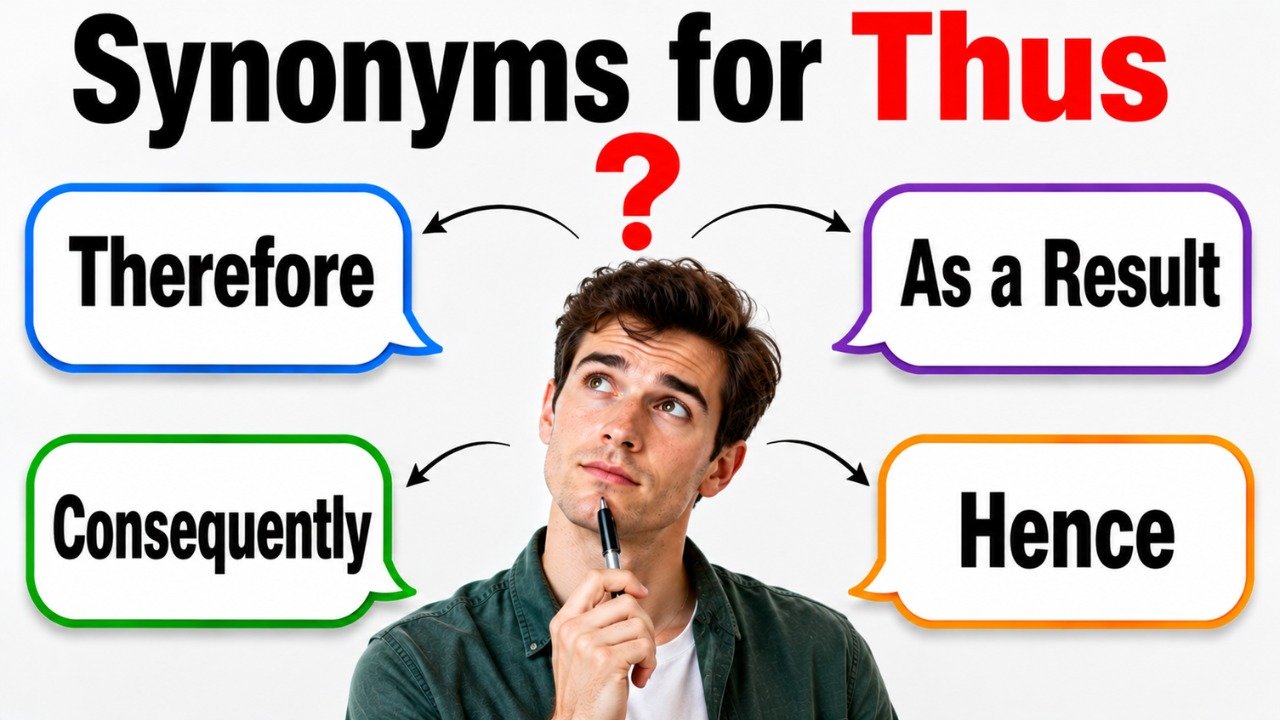
Quick Answer: The best synonyms for thus include therefore, consequently, hence, accordingly, so, as a result, for that reason, thereby, in this way, and in this manner. Use therefore or consequently in formal writing to introduce a logical result. Use so in casual speech, accordingly when an action follows from known facts, thereby when one action produces a particular result, and in this way when explaining a method. The most accurate choice among synonyms for thus depends on whether the sentence expresses a consequence, conclusion, method, manner, or degree.
Pronunciation and Word Details
Word: Thus.
Pronunciation: /ðʌs/.
Part of Speech: Adverb.
Meaning: In this way, for this reason, or as a result of what has just been stated.
US Pronunciation:
UK Pronunciation:
What Does “Thus” Mean?
Thus means therefore, in this way, or to this degree. It is an adverb used to connect an action, fact, or idea with its result, method, or logical conclusion.
The most common use of thus introduces a consequence.
Example: The road was closed. Thus, we had to choose another route.
In this sentence, thus means therefore or as a result.
Thus can also explain how something happens.
Example: Fold the paper inward, thus creating a smaller square.
Here, thus means in this way or by doing so.
A less common use of thus refers to a particular degree or extent.
Example: The project has progressed thus far without difficulty.
In this phrase, thus far means up to this point or until now.
Thus often connects ideas in essays, reports, explanations, instructions, and formal arguments. It helps readers understand the relationship between a cause and its result.
Meaning, Tone, and Context of “Thus”
Thus has a formal, neutral, and logical tone. It is especially common in academic writing, professional reports, technical explanations, formal essays, historical writing, and carefully structured arguments.
The word often signals that a conclusion follows naturally from the information that came before it.
Example: Demand continued to rise. Thus, additional staff were required.
In everyday conversation, thus may sound overly formal. Speakers usually prefer so, that is why, or because of this.
Formal: The materials were unavailable. Thus, production was delayed.
Conversational: The materials were unavailable, so production was delayed.
Thus is not usually emotional. Its purpose is to organize reasoning and clarify relationships between ideas. It sounds more objective than expressive.
When used to describe a method, thus can sound precise and instructional.
Example: Rotate the handle clockwise, thus releasing the lock.
When used in phrases such as thus far, it refers to progress up to the present point.
Example: The results thus far have been encouraging.
Writers should choose thus when they want a concise and formal connection. They should choose a simpler synonym when the audience expects natural conversation or informal language.
When and How to Use “Thus”
For Showing a Result
Use thus when one event or fact produces another event or condition.
Example: The store had reached capacity. Thus, no additional visitors were admitted.
In this use, therefore, consequently, and as a result are strong alternatives.
For Drawing a Logical Conclusion
Thus can introduce a conclusion based on previously stated evidence or reasoning.
Example: Every available seat was occupied. Thus, the event had reached full attendance.
This use is common in essays, reports, research discussions, and formal arguments.
For Explaining a Method
Use thus to mean in this way when explaining how an action produces a result.
Example: Press the two sides together, thus sealing the container.
In this context, in this way, by doing so, or thereby may sound more natural.
For Connecting Cause and Effect
Thus can make the relationship between a cause and its effect clear.
Example: The temperature dropped below freezing, thus causing the water to turn into ice.
The phrase following thus often contains an ing verb when it describes the direct effect of an action.
For Recommending a Response
Use thus when an action should follow from known conditions.
Example: The deadline has changed. Thus, the schedule must be revised.
Accordingly is another suitable choice in this context.
For Summarizing an Argument
Thus can introduce the final point that follows from several earlier statements.
Example: The plan is affordable, practical, and easy to implement. Thus, it is the strongest available option.
This use helps make conclusions easy to identify.
For Describing Progress to a Point
The phrase thus far means until now or up to this point.
Example: The training has been successful thus far.
This phrase is useful in progress reports, updates, and evaluations.
For Expressing a Degree
In less common formal usage, thus may mean to this extent or to such a degree.
Example: The fabric was only thus wide.
This use is uncommon in modern everyday writing and usually requires context or a physical gesture.
Best Synonyms for Thus
Therefore: For that reason or as a logical result.
Example: The application was incomplete. Therefore, it could not be approved.
Consequently: As a result of something that happened earlier.
Example: Heavy rain continued overnight. Consequently, several roads became difficult to use.
Hence: For this reason or from this fact.
Example: The equipment was outdated, hence the need for replacement.
Accordingly: In a way that is suitable or logical because of known information.
Example: The meeting time changed, and the calendar was updated accordingly.
So: For that reason or as a result.
Example: The room was full, so we waited outside.
As a Result: Because of the situation just mentioned.
Example: The delivery arrived late. As a result, the work began the following morning.
For That Reason: Because of the fact already stated.
Example: The instructions were unclear. For that reason, several people asked for assistance.
Thereby: By that action or by that means.
Example: She reorganized the files, thereby making them easier to locate.
In This Way: By using the method just described.
Example: Add the ingredients gradually. In this way, the mixture will remain smooth.
In This Manner: In the particular way that has been explained.
Example: Arrange the records in this manner to simplify future searches.
50 Synonyms for Thus with Short Meanings
- Therefore: For that reason.
- Consequently: As a result of an earlier event.
- Hence: From this fact or for this reason.
- Accordingly: In a way that logically follows.
- So: For that reason in everyday language.
- As a Result: Because of what happened before.
- For That Reason: Because of the stated fact.
- For This Reason: Because of the current fact or situation.
- Because of This: Due to the matter just mentioned.
- Due to This: As a result of this situation.
- Owing to This: Because of this fact or condition.
- As a Consequence: As the result of an action or event.
- In Consequence: As an effect of something previously stated.
- On That Account: Because of that particular reason.
- In Light of This: Considering the information just given.
- In View of This: Taking the stated facts into consideration.
- Given This: Considering that this fact is true.
- Considering This: After taking this information into account.
- That Being So: Since the stated situation is true.
- This Being the Case: Because the described condition exists.
- It Follows That: The next conclusion logically results.
- Which Means That: Introducing the meaning or result of a fact.
- That Is Why: Explaining the reason for a result.
- Which Is Why: Connecting a situation with its consequence.
- On This Basis: Using the stated fact as support.
- On These Grounds: Because of the reasons already presented.
- By This Reasoning: According to the logic just explained.
- From This: As a conclusion drawn from this fact.
- Thereby: By that action or means.
- Thereupon: Immediately after or as a result of that event.
- In Turn: As a later result in a connected sequence.
- Then: As a result or next logical step.
- Ergo: Therefore, especially in formal reasoning.
- This Leads To: Introducing the result of an action or condition.
- As Such: Because something has the stated quality or role.
- With This Result: Producing the result that follows.
- With the Result That: Causing the stated outcome.
- In This Way: By the method just described.
- In This Manner: In the stated way.
- Like This: In this particular way.
- By This Means: Through the method already mentioned.
- By Doing So: Through performing the stated action.
- Through This Method: By using the explained process.
- In Such a Way: By acting in a particular manner.
- In the Following Manner: According to the explanation that follows.
- As Follows: In the way described next.
- To This Extent: Up to this particular degree.
- To That Extent: Up to the degree already mentioned.
- To Such a Degree: To an especially strong level.
- So Much: To this amount or degree.
Read Also:
Synonyms for Further

Synonyms for Thus by Context
When Thus Means Therefore
When thus introduces a logical result or conclusion, the best alternatives include therefore, consequently, hence, accordingly, so, and as a result.
Example With Thus: The documents were submitted after the deadline. Thus, they could not be reviewed immediately.
Example With Therefore: The documents were submitted after the deadline. Therefore, they could not be reviewed immediately.
Therefore is a close formal replacement. Consequently emphasizes the result, while so sounds more conversational.
When Thus Means As a Result
Use as a result, as a consequence, in consequence, or because of this when the sentence focuses on the effect of an earlier event.
Example With Thus: The system was not maintained. Thus, its performance gradually declined.
Example With As a Result: The system was not maintained. As a result, its performance gradually declined.
As a result is clear in both formal and general writing. Consequently is slightly more formal.
When Thus Means Accordingly
Accordingly works well when a person changes an action or decision in response to new information.
Example With Thus: The room was smaller than expected. Thus, the seating arrangement was changed.
Example With Accordingly: The room was smaller than expected. Accordingly, the seating arrangement was changed.
Accordingly suggests a suitable or logical response rather than merely an automatic result.
When Thus Means In This Way
When thus explains a method, use in this way, in this manner, like this, by this means, or through this method.
Example With Thus: Separate the files by date, thus making older records easier to find.
Example With In This Way: Separate the files by date. In this way, older records will be easier to find.
In this way is often clearer in instructions intended for general readers.
When Thus Means By Doing So
Use by doing so or thereby when an action creates a specific result.
Example With Thus: She reduced unnecessary expenses, thus saving more money each month.
Example With By Doing So: She reduced unnecessary expenses. By doing so, she saved more money each month.
Thereby is more concise and formal. By doing so sounds more natural and explanatory.
When Thus Introduces a Conclusion
Use it follows that, on this basis, by this reasoning, or on these grounds when the conclusion comes from evidence or analysis.
Example With Thus: Every test produced the same outcome. Thus, the procedure appears reliable.
Example With It Follows That: Every test produced the same outcome. It follows that the procedure appears reliable.
It follows that clearly emphasizes logical reasoning.
When Thus Means To This Extent
In less common usage, thus can describe an amount, size, or degree. Suitable alternatives include to this extent, to that degree, and so much.
Example With Thus: The opening was only thus wide.
Example With To This Extent: The opening extended only to this width.
A clearer modern phrase is usually better unless the meaning is supported by a gesture or visual explanation.
When Thus Appears in Thus Far
Thus far means until now, so far, or up to this point.
Example With Thus Far: Thus far, the repairs have remained within the planned budget.
Example With So Far: So far, the repairs have remained within the planned budget.
So far is more conversational, while thus far has a more formal tone.
Another Word for Thus
Therefore is usually the best single replacement for thus when the word introduces a conclusion or result. However, the strongest alternative depends on context. Use consequently for a clear consequence, so for casual speech, thereby for a result produced by an action, and in this way when explaining a method.
Original: The evidence was incomplete. Thus, no final decision was made.
Better Option: The evidence was incomplete. Therefore, no final decision was made.
Original: The temperature continued to fall, thus increasing the risk of ice.
Better Option: The temperature continued to fall, thereby increasing the risk of ice.
Original: Mix the solution slowly, thus preventing air from entering.
Better Option: Mix the solution slowly. In this way, you can prevent air from entering.
Original: The instructions were confusing. Thus, several participants made errors.
Better Option: The instructions were confusing, so several participants made errors.
When Not to Use “Thus”
Thus is useful in formal writing, but it may sound stiff, repetitive, vague, or unnatural in some situations.
In Very Casual Conversation
Thus may sound too formal in an ordinary spoken sentence.
Weak: I was tired. Thus, I went home.
Better: I was tired, so I went home.
When the Result Is Not Logically Connected
Do not use thus unless the second idea genuinely follows from the first.
Weak: The office opened at nine. Thus, the walls were painted blue.
Better: The office opened at nine, and the walls were painted blue.
The second fact is not a consequence of the first.
When a More Precise Relationship Is Needed
Thus may hide whether the sentence expresses a cause, response, method, or conclusion.
Weak: The price increased. Thus, the company changed its plan.
Better: Because the price increased, the company revised its purchasing plan.
The improved sentence makes the connection more specific.
When It Is Repeated Too Often
Using thus in several nearby sentences can make writing sound mechanical.
Weak: The schedule changed. Thus, the meeting moved. Thus, the invitations were revised.
Better: The schedule changed. Therefore, the meeting moved, and the invitations were revised accordingly.
When Thus and Therefore Appear Together
Thus and therefore normally perform the same function. Using both is unnecessary.
Weak: Thus, therefore, the proposal was rejected.
Better: Therefore, the proposal was rejected.
When the Intended Meaning Is Method
Readers may misunderstand thus as therefore when the intended meaning is in this way.
Weak: Hold the tool thus.
Better: Hold the tool in this manner.
The better option is clearer when no visual example or gesture is available.
When the Audience Needs Simple Language
In instructions for beginners, therefore, so, or in this way may be easier to understand.
Weak: Adjust the setting, thus ensuring suitable performance.
Better: Adjust the setting. This will help ensure suitable performance.
Words Commonly Confused With Thus
Thus vs Therefore: Both introduce a result or conclusion. Thus is slightly more formal and can also mean in this way. Therefore almost always expresses a logical consequence.
Thus vs Hence: Both can mean for this reason. Hence is concise and often appears before a noun phrase, while thus more commonly connects complete ideas.
Thus vs Consequently: Thus may introduce a logical conclusion or explain a method. Consequently strongly emphasizes that one event is the consequence of another.
Thus vs Accordingly: Thus presents a result or conclusion. Accordingly often suggests that a person acted in a suitable way because of the circumstances.
Thus vs So: Both can express a result. Thus is formal, while so is common in conversation and general writing.
Thus vs Thereby: Thus may mean therefore or in this way. Thereby specifically means by that action or by that means.
Thus vs Henceforth: Thus means therefore or in this way. Henceforth means from this time onward. The two words are not interchangeable.
Thus vs So Far: Thus far means until now. So far has the same basic meaning but sounds more conversational.
Thus vs Then: Thus shows a logical result. Then usually shows time, order, or the next step, although it can sometimes introduce a consequence.
Which Synonym Should You Choose?
Choose therefore when presenting a formal conclusion in an essay, report, or professional document.
Choose consequently when one event directly causes an important result.
Choose hence when you need a concise and formal connection between a fact and its conclusion.
Choose accordingly when an action or decision changes in response to known circumstances.
Choose so in casual speech, informal messages, and simple everyday explanations.
Choose as a result when you want the cause and effect relationship to be immediately clear.
Choose for that reason when explaining a decision in a polite and natural way.
Choose thereby when the action in the first part of a sentence produces the result in the second part.
Choose in this way when explaining a method, process, or instruction.
Choose by doing so when you want to emphasize the action that creates a particular benefit or result.
Choose it follows that when presenting a logical conclusion based on evidence or reasoning.
Choose thus far when discussing progress or conditions up to the present point.
Real Life Examples of “Thus” in Sentences
Original: The payment was received late. Thus, the order was processed the next morning.
Better Option: The payment was received late. Therefore, the order was processed the next morning.
Original: The weather became worse, thus forcing the event indoors.
Better Option: The weather became worse, consequently forcing the event indoors.
Original: The room was unavailable. Thus, we selected another location.
Better Option: The room was unavailable, so we selected another location.
Original: She reviewed every figure, thus reducing the risk of errors.
Better Option: She reviewed every figure, thereby reducing the risk of errors.
Original: Store the files by category, thus making them easier to retrieve.
Better Option: Store the files by category. In this way, they will be easier to retrieve.
Original: The deadline was extended. Thus, the team revised its schedule.
Better Option: The deadline was extended. Accordingly, the team revised its schedule.
Original: Demand was lower than expected. Thus, production was reduced.
Better Option: Demand was lower than expected. As a result, production was reduced.
Original: The route was blocked. Thus, we could not reach the building directly.
Better Option: The route was blocked. For that reason, we could not reach the building directly.
Original: The evidence supports both claims. Thus, further investigation is necessary.
Better Option: The evidence supports both claims. It follows that further investigation is necessary.
Original: Thus far, the new process has produced consistent results.
Better Option: So far, the new process has produced consistent results.
Synonym Groups and Usage Differences
Result Group
This group includes therefore, consequently, as a result, as a consequence, and in consequence. These expressions connect an earlier event with its outcome.
Therefore emphasizes logical reasoning. Consequently gives greater attention to the effect. As a result is direct and easy to understand.
Example: The instructions arrived late. Consequently, the work could not begin on time.
Reason Group
This group includes for that reason, for this reason, because of this, owing to this, and on that account. These expressions explain why something happened or why a decision was made.
They are often clearer than thus when the writer wants to emphasize a specific reason.
Example: The document contained private information. For that reason, access was restricted.
Response Group
This group includes accordingly, in light of this, in view of this, given this, and considering this. These expressions show that a decision or action responds to particular facts.
Example: The venue has limited seating. Accordingly, advance booking is recommended.
Logical Conclusion Group
This group includes hence, it follows that, on this basis, on these grounds, and by this reasoning. These choices are useful in arguments, analysis, reports, and essays.
Example: Every trial produced the same result. It follows that the method is reasonably consistent.
Method Group
This group includes in this way, in this manner, like this, through this method, and by this means. These phrases describe how something is done.
Example: Place the records in separate folders. In this way, each category remains organized.
Action and Result Group
This group includes thereby, by doing so, with this result, and with the result that. These alternatives show that one action creates a particular outcome.
Example: She simplified the form, thereby making it faster to complete.
Degree Group
This group includes to this extent, to that extent, to such a degree, and so much. These expressions relate to an amount, level, or intensity.
Example: The problem had grown to such a degree that immediate action was required.
Conversational Group
This group includes so, that is why, which is why, and then. These choices sound natural in speech and informal writing.
Example: The bus was delayed, so we arrived a few minutes late.
Antonyms of Thus
Thus has no single exact antonym because it can express a result, method, or degree. However, several words and phrases communicate an opposing relationship.
However: Introduces a contrast rather than a result.
Nevertheless: Shows that something remains true despite an earlier fact.
Nonetheless: Introduces an unexpected contrast.
Even So: Shows that the following statement is true despite what came before.
Despite This: Indicates that an action happens in opposition to a stated condition.
In Spite of This: Expresses contrast with the previous information.
Conversely: Introduces an opposite relationship or situation.
On the Contrary: States that the opposite is true.
Otherwise: Describes a different result or alternative condition.
Instead: Introduces a replacement action or choice.
Unrelatedly: Signals that the next idea does not result from the previous one.
Differently: In another way rather than in this way.
Comparison: Thus vs Related Words
Thus vs Therefore
Thus and therefore can both introduce a logical result. Thus is slightly more formal and can also describe a method. Therefore focuses specifically on a conclusion or consequence.
Example With Thus: The evidence was incomplete. Thus, the claim remained unproven.
Example With Therefore: The evidence was incomplete. Therefore, the claim remained unproven.
Thus vs Consequently
Thus can introduce either a conclusion or a result. Consequently places stronger emphasis on the consequence of an earlier event.
Example With Thus: The road was damaged. Thus, traffic was redirected.
Example With Consequently: The road was damaged. Consequently, traffic was redirected.
Consequently is especially suitable when the second event directly results from the first.
Thus vs Hence
Thus and hence both have a formal tone. Hence often introduces a short conclusion or noun phrase. Thus works naturally before a complete clause.
Example With Thus: The material was weak. Thus, a stronger alternative was selected.
Example With Hence: The material was weak, hence the need for a stronger alternative.
Thus vs Accordingly
Thus introduces a result or conclusion. Accordingly usually shows that someone responded appropriately to information or circumstances.
Example With Thus: The schedule changed. Thus, the meeting was moved.
Example With Accordingly: The schedule changed. Accordingly, the meeting was moved.
Accordingly gives greater attention to the deliberate response.
Thus vs So
Thus is formal and common in structured writing. So is simple, conversational, and natural in speech.
Example With Thus: The door was locked. Thus, we entered through another door.
Example With So: The door was locked, so we entered through another door.
Thus vs Thereby
Thus can mean therefore or in this way. Thereby means by that action and usually appears within the same sentence as the action producing the result.
Example With Thus: She updated the records, thus improving their accuracy.
Example With Thereby: She updated the records, thereby improving their accuracy.
Thereby is often more precise in sentences that describe a direct result.
Thus vs In This Way
Thus is concise but may sound formal or ambiguous. In this way clearly indicates a method.
Example With Thus: Organize the notes thus to improve readability.
Example With In This Way: Organize the notes in this way to improve readability.
Thus vs As a Result
Thus is compact and formal. As a result is slightly longer but often clearer for general readers.
Example With Thus: Costs increased. Thus, the budget had to be revised.
Example With As a Result: Costs increased. As a result, the budget had to be revised.
Common Phrases and Expressions With “Thus”
Thus Far: Until now or up to this point.
Example: Thus far, the project has remained within budget.
Thus Showing: Demonstrating something through the action just described.
Example: She corrected the figures, thus showing careful attention to detail.
Thus Making: Causing something to become a particular way.
Example: The files were reorganized, thus making them easier to search.
Thus Allowing: Creating an opportunity or ability.
Example: The entrance was widened, thus allowing larger equipment to pass through.
Thus Creating: Producing a new condition, object, or result.
Example: The walls were removed, thus creating a larger room.
Thus Ensuring: Helping make a result certain or likely.
Example: Each figure was checked twice, thus ensuring greater accuracy.
Thus Preventing: Stopping an unwanted result through an action.
Example: The lid was secured, thus preventing the liquid from spilling.
Thus Leading To: Producing a later event or consequence.
Example: Demand increased rapidly, thus leading to longer waiting times.
Thus Resulting In: Causing a particular outcome.
Example: Several steps were removed, thus resulting in a simpler process.
And Thus: Used before a final consequence or conclusion.
Example: The conditions improved, and thus the work continued as planned.
Common Mistakes to Avoid
Using Thus Without a Clear Result
The idea after thus should logically follow from the earlier statement.
Incorrect: The report was printed. Thus, the manager wore a blue shirt.
Correct: The report was printed. Thus, it was ready for distribution.
Confusing Result With Contrast
Thus introduces a consequence, while however introduces an opposing or unexpected idea.
Incorrect: The task was difficult. Thus, the team completed it successfully.
Better: The task was difficult. However, the team completed it successfully.
Success is presented as a contrast to the difficulty, not its natural result.
Using Thus and So Together
Do not place two result connectors together.
Incorrect: Thus, so the meeting was cancelled.
Correct: Thus, the meeting was cancelled.
Correct: So, the meeting was cancelled.
Repeating Thus in Every Paragraph
Frequent repetition makes formal writing sound mechanical. Rotate accurate alternatives such as therefore, consequently, accordingly, and as a result.
Repetitive: The price rose. Thus, demand fell. Thus, production decreased.
Improved: The price rose. Consequently, demand fell, and production decreased accordingly.
Choosing Thereby Incorrectly
Thereby normally refers to the result produced by a specific action. It does not always replace therefore at the beginning of a separate sentence.
Unnatural: The office was closed. Thereby, we returned home.
Better: The office was closed. Therefore, we returned home.
Using Thus in an Unclear Method Statement
When thus means in this way, readers need enough information to understand the method.
Unclear: Arrange the objects thus.
Better: Arrange the objects in two equal rows.
Adding Unnecessary Punctuation
When thus begins an independent sentence, it is usually followed by a comma.
Correct: The evidence was insufficient. Thus, the investigation continued.
When it appears before an ing phrase inside a sentence, a comma often separates the phrase from the main clause.
Correct: She labeled each folder, thus making the records easier to identify.
Using Thus Far to Mean a Future Time
Thus far refers only to the period up to the present or another stated point.
Incorrect: Thus far, the team will complete the next stage tomorrow.
Correct: Thus far, the team has completed three stages.
Assuming Every Synonym Is Interchangeable
Therefore, thereby, accordingly, and in this way express different relationships. Select the word according to the sentence rather than replacing thus automatically.
Example: Use therefore for a conclusion, thereby for a direct result of an action, and in this way for a method.
Conclusion
The most useful synonyms for thus include therefore, consequently, hence, accordingly, so, as a result, thereby, and in this way. Therefore is best for formal conclusions, while consequently emphasizes a direct outcome. So works naturally in conversation, and thereby connects an action with its result. When thus describes a method, in this way is usually clearer. Understanding these contextual differences helps you choose synonyms for thus that improve sentence flow, logical clarity, precision, and readability.
FAQs About Synonyms for Thus
What Is the Best Synonym for Thus?
Therefore is usually the closest synonym when thus introduces a logical result. In this way is better when thus explains a method.
Is Thus the Same as Therefore?
They are similar when introducing a conclusion. However, thus can also mean in this way, while therefore only expresses a result or logical consequence.
Can So Replace Thus?
Yes, so can replace thus in many result sentences. So sounds more natural in casual speech, while thus has a more formal tone.
What Is a Formal Synonym for Thus?
Therefore, consequently, hence, accordingly, and thereby are useful formal alternatives. The best option depends on the relationship between the ideas.
What Does Thus Far Mean?
Thus far means until now, so far, or up to this point.
What Is the Difference Between Thus and Thereby?
Thus may mean therefore or in this way. Thereby specifically means by that action or by that means.
Should a Comma Follow Thus?
A comma usually follows thus when it begins a sentence or independent clause. However, punctuation may differ when thus introduces a shorter phrase within a sentence.
