
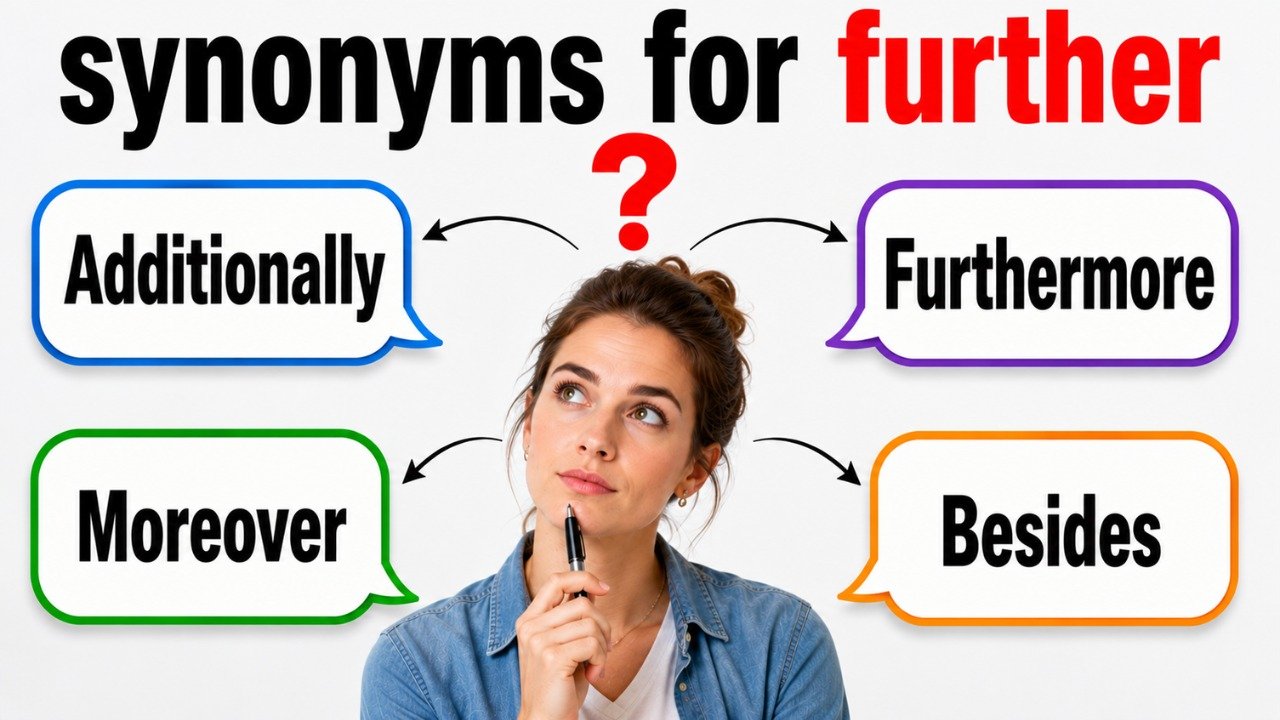
Quick Answer: The best synonyms for further include additional, more, extra, farther, beyond, onward, additionally, moreover, advance, and promote. Use additional for information, details, or requirements. Choose more when you need a simple and flexible replacement. Farther is usually better for measurable physical distance, while beyond suggests passing a point or limit. Use additionally or moreover to introduce another idea in formal writing. When further is a verb, advance, promote, develop, and support are often the strongest choices.
Pronunciation and Word Details
Word: Further.
Pronunciation: /ˈfɜːrðər/.
Part of Speech: Adverb, adjective, and verb.
Meaning: Further means more, additional, more distant, more advanced, or to help something develop.
US Pronunciation:
UK Pronunciation:
What Does “Further” Mean?
Further means more, additional, or to a greater degree. It can also describe progress beyond a current point or the act of helping something develop.
As an adjective, further describes something additional.
Example: We need further information before making a decision.
As an adverb, it describes movement, progress, distance, or degree.
Example: The research explores the subject further.
As a verb, further means to promote, advance, or support a purpose.
Example: The program was created to further public education.
The word works in formal writing, everyday conversation, academic discussion, business communication, instructions, and reports. Its exact meaning depends on the words and ideas around it.
Meaning, Tone, and Context of “Further”
Further usually has a neutral or slightly formal tone. It is common in professional, academic, legal, educational, and informational writing.
In everyday conversation, people often replace further with simpler words such as more, extra, or additional.
Formal Context: Further investigation is required.
Casual Context: We need more time to discuss it.
Further can express several ideas.
Additional Amount: It can mean more than what is already available.
Example: Please provide further details.
Greater Degree: It can show that an action continues more deeply or completely.
Example: We should examine the problem further.
Progress: It can describe movement toward a more advanced stage.
Example: The new training further improved her skills.
Distance: It can describe a greater distance, although farther is often preferred for measurable physical distance.
Example: They traveled further into the forest.
Development: As a verb, it can mean supporting or advancing a goal.
Example: The agreement will further cooperation between the groups.
When and How to Use “Further”
For Additional Information
Use further when asking for more information, explanation, evidence, or detail.
Example: Contact the office for further information.
For Continued Discussion
Use further when a subject needs more conversation, thought, or examination.
Example: The proposal requires further discussion.
For Greater Depth
Use further when something must be explored, studied, or developed more deeply.
Example: The scientist investigated the results further.
For Progress
Use further when an action moves a plan, project, or idea forward.
Example: The meeting helped further the negotiations.
For Distance
Use further when referring generally to a greater distance or progress beyond a point.
Example: We walked further along the path.
For Adding Another Point
Further can introduce another supporting point, especially in formal writing.
Example: Further, the evidence supports the original conclusion.
In this use, furthermore, additionally, or moreover may sound more natural.
For Supporting a Purpose
As a verb, further means to help a cause, goal, career, plan, or interest develop.
Example: She completed the course to further her career.
Best Synonyms for Further
Additional
Synonym: More than what is already present, known, or required.
Example: We need additional evidence before reaching a conclusion.
More
Synonym: A greater amount, degree, number, or extent.
Example: The manager requested more information.
Extra
Synonym: Added beyond the usual or expected amount.
Example: The task required extra time.
Farther
Synonym: At or toward a greater measurable physical distance.
Example: The station is farther down the road.
Beyond
Synonym: Past a particular point, limit, stage, or area.
Example: The discussion moved beyond the original question.
Onward
Synonym: Forward from a particular point in time, space, or progress.
Example: The team continued onward despite the difficulties.
Additionally
Synonym: Used to introduce another fact, point, or idea.
Example: Additionally, all applicants must provide identification.
Moreover
Synonym: Used to add an important supporting point.
Example: The plan is affordable. Moreover, it can be completed quickly.
Advance
Synonym: To move something forward or help it make progress.
Example: The new research may advance medical knowledge.
Promote
Synonym: To encourage, support, or help something develop.
Example: The campaign aims to promote healthy habits.
50 Synonyms for Further with Short Meanings
- Additional: More than what already exists.
- More: A greater amount, degree, or number.
- Extra: Added beyond the normal amount.
- Supplementary: Provided to complete or strengthen something.
- Supplemental: Added to improve or complete existing material.
- Added: Included in addition to what was already present.
- Other: Different or additional.
- Else: In addition to what has been mentioned.
- New: Recently added or introduced.
- Fresh: Newly provided or added.
- Greater: Larger in amount, degree, or importance.
- Extended: Made longer, larger, or broader.
- Continued: Carried on without stopping.
- Prolonged: Made to last for a longer period.
- Subsequent: Happening or coming later.
- Next: Coming immediately after something.
- Later: Happening after the present time or event.
- Ensuing: Occurring as a result or afterward.
- Following: Coming after something else.
- Beyond: Past a point, stage, or limit.
- Farther: At a greater physical distance.
- More Distant: Located at a greater distance.
- Remoter: Farther away in place, time, or connection.
- Onward: Moving forward from a particular point.
- Ahead: Farther forward in position or progress.
- Deeper: Farther into a subject, place, or condition.
- More Deeply: With greater thought, detail, or intensity.
- More Fully: In a more complete way.
- More Closely: With greater attention or detail.
- More Extensively: Over a wider area or range.
- More Thoroughly: In a more complete and careful manner.
- More Widely: Across a greater area or audience.
- More Strongly: With greater force, certainty, or intensity.
- More Significantly: To a more important or noticeable degree.
- Additionally: As another point or item.
- Moreover: Used to add a supporting statement.
- Furthermore: Used to introduce another related point.
- Also: In addition to something already mentioned.
- Besides: In addition to another fact or reason.
- Likewise: In a similar way or as an additional point.
- In Addition: As an extra fact, action, or item.
- Advance: To move something toward progress.
- Promote: To encourage or support development.
- Develop: To make something grow or improve.
- Foster: To encourage the growth of something.
- Encourage: To give support or confidence.
- Support: To help a person, purpose, or activity succeed.
- Improve: To make something better.
- Strengthen: To make something more effective or powerful.
- Extend: To increase the length, range, or influence of something.
Read Also:
Synonyms for Most
Synonyms for Further by Context
When Further Means Additional
When further describes something added to what already exists, good synonyms include additional, more, extra, supplementary, supplemental, and added.
Further: We require further documentation.
Additional: We require additional documentation.
More: We require more documentation.
Extra: We require extra documentation.
Additional is usually the strongest formal replacement. More sounds natural in both formal and casual communication. Extra is more conversational and often suggests something beyond the normal amount.
When Further Means to a Greater Degree
When further describes increased depth, detail, effort, or understanding, use more deeply, more fully, more closely, more thoroughly, or to a greater extent.
Further: The issue should be studied further.
More Deeply: The issue should be studied more deeply.
More Thoroughly: The issue should be studied more thoroughly.
More Closely: The issue should be studied more closely.
Choose the synonym that identifies the exact kind of increased effort. More deeply suggests depth of thought. More thoroughly suggests completeness. More closely suggests careful attention.
When Further Means Farther in Distance
When further refers to physical distance, useful alternatives include farther, beyond, more distant, onward, and ahead.
Further: The village is further along the road.
Farther: The village is farther along the road.
Beyond: The village lies beyond the bridge.
Ahead: The village is several miles ahead.
Farther is often preferred when the distance can be measured. Further remains common when the distance is general, figurative, or connected to progress.
When Further Introduces Another Point
When further adds another fact or argument, choose additionally, moreover, furthermore, also, besides, or in addition.
Further: Further, the results were independently verified.
Additionally: Additionally, the results were independently verified.
Moreover: Moreover, the results were independently verified.
In Addition: In addition, the results were independently verified.
Additionally is clear and neutral. Moreover gives the new point extra importance. Furthermore is highly formal. Also is usually best in casual or simple writing.
When Further Means Promote or Advance
When further is used as a verb, strong alternatives include advance, promote, develop, foster, encourage, support, and strengthen.
Further: The policy will further economic development.
Promote: The policy will promote economic development.
Support: The policy will support economic development.
Advance: The policy will advance economic development.
Promote emphasizes encouragement. Support emphasizes assistance. Advance emphasizes forward progress. Develop emphasizes growth over time.
Another Word for Further
The best single replacement for further is often additional when the word describes information, details, action, or requirements. However, the best alternative always depends on the intended meaning.
Use more for a simple and flexible replacement. Use farther for measurable distance. Use additionally when introducing another point. Use advance or promote when further functions as a verb.
Original: Further information will be provided tomorrow.
Better Option: Additional information will be provided tomorrow.
Original: We need to discuss the matter further.
Better Option: We need to discuss the matter more thoroughly.
Original: The hikers traveled further up the mountain.
Better Option: The hikers traveled farther up the mountain.
Original: The project will further scientific understanding.
Better Option: The project will advance scientific understanding.
When Not to Use “Further”
Further is useful, but it can sound vague when a more precise word would explain the intended meaning.
When Referring to Exact Physical Distance
Use farther when discussing a measurable distance.
Weak: The second store is five miles further away.
Better: The second store is five miles farther away.
When You Mean Additional
Further can sound unnecessarily formal in simple conversation.
Weak: Do you have any further questions?
Better: Do you have any more questions?
Both sentences are correct, but more sounds warmer and more conversational.
When Greater Precision Is Needed
Further does not explain whether something needs more depth, detail, time, or attention.
Weak: We need to examine the report further.
Better: We need to examine the report more thoroughly.
When Introducing Another Point
Starting several sentences with further can make formal writing repetitive.
Weak: Further, the plan requires more funding.
Better: Moreover, the plan requires more funding.
When Describing a Specific Action
As a verb, further may sound vague unless the reader understands what kind of support is being provided.
Weak: The program will further the community.
Better: The program will support education within the community.
Words Commonly Confused With Further
Further vs Farther: Further usually refers to additional amount, degree, progress, or figurative distance. Farther usually refers to measurable physical distance.
Further vs Furthermore: Further has several grammatical uses. Furthermore is an adverb used specifically to introduce another supporting point.
Further vs Future: Further means more, additional, or more advanced. Future refers to a time that has not yet arrived.
Further vs Additional: Further can describe amount, progress, distance, or development. Additional mainly means extra or added.
Further vs Moreover: Further can modify actions, nouns, and goals. Moreover connects one statement to another and adds emphasis.
Further vs Advance: Further can function as an adjective, adverb, or verb. Advance usually describes forward movement, improvement, or progress.
Which Synonym Should You Choose?
Choose additional when writing about information, details, documents, evidence, requirements, or actions.
Choose more when you need a natural and flexible word for everyday writing or conversation.
Choose extra when something is beyond the usual, planned, or required amount.
Choose farther when referring to a measurable physical distance.
Choose beyond when something passes a point, boundary, stage, or limit.
Choose additionally when adding another neutral fact or requirement.
Choose moreover when adding a strong supporting argument in formal writing.
Choose more thoroughly when an action needs greater completeness or care.
Choose more deeply when discussing thought, understanding, emotion, research, or analysis.
Choose advance when describing progress in research, knowledge, negotiations, technology, or a career.
Choose promote when describing support for a cause, idea, behavior, product, or activity.
Choose foster when describing the gradual development of trust, creativity, cooperation, or growth.
Choose support when you want a broad, direct verb that means providing help.
Real Life Examples of “Further” in Sentences
Original: Please contact us if you need further assistance.
Better Option: Please contact us if you need additional assistance.
Original: The teacher explained the concept further.
Better Option: The teacher explained the concept more fully.
Original: We should investigate the complaint further.
Better Option: We should investigate the complaint more thoroughly.
Original: The bus stop is further down the street.
Better Option: The bus stop is farther down the street.
Original: The new evidence further supports her claim.
Better Option: The new evidence strengthens her claim.
Original: She returned to school to further her education.
Better Option: She returned to school to advance her education.
Original: Further, the proposal could reduce costs.
Better Option: Moreover, the proposal could reduce costs.
Original: The group hopes to further cooperation among its members.
Better Option: The group hopes to foster cooperation among its members.
Original: No further action is necessary.
Better Option: No additional action is necessary.
Original: The discussion moved further into the causes of the problem.
Better Option: The discussion explored the causes of the problem more deeply.
Synonym Groups and Usage Differences
Additional Amount Group
This group includes additional, more, extra, supplementary, supplemental, and added. These words describe something included beyond what is already present.
Additional is formal and precise. More is flexible. Extra is conversational. Supplementary and supplemental describe material provided to complete or improve something.
Example: The course includes supplementary reading materials.
Distance and Movement Group
This group includes farther, beyond, onward, ahead, more distant, and remoter. These words describe movement or position past a particular point.
Farther works best for measurable physical distance. Beyond suggests crossing a limit. Onward emphasizes continued movement. Ahead describes a forward position.
Example: The travelers continued onward after resting.
Degree and Depth Group
This group includes deeper, more deeply, more fully, more closely, more extensively, and more thoroughly.
These alternatives are more specific than further because they explain how an action increases.
Example: The editor reviewed the final chapter more closely.
Addition and Connection Group
This group includes additionally, moreover, furthermore, also, besides, likewise, and in addition.
These words connect ideas. Additionally is neutral. Moreover adds emphasis. Furthermore is highly formal. Also is simple and conversational.
Example: Moreover, the proposed changes would improve efficiency.
Progress and Development Group
This group includes advance, promote, develop, foster, encourage, support, improve, strengthen, and extend.
These verbs describe different types of progress. Advance focuses on forward movement. Promote focuses on active encouragement. Foster describes gradual growth. Strengthen means making something more effective.
Example: The training program will strengthen leadership skills.
Time and Sequence Group
This group includes subsequent, next, later, ensuing, following, continued, and prolonged.
These alternatives relate to events that happen afterward or continue for a longer period.
Example: The following meeting was more productive.
Antonyms of Further
The opposite of further changes according to its meaning. It can mean less instead of more, nearer instead of more distant, or hinder instead of promote.
Less: A smaller amount or degree.
Fewer: A smaller number of countable things.
Reduced: Made smaller in amount, size, or degree.
Limited: Restricted in range, amount, or opportunity.
Nearer: At a shorter distance.
Closer: Positioned at a smaller distance or stronger relationship.
Earlier: Happening before another time or event.
Previous: Existing or happening before the current one.
Halt: To stop progress or movement.
Hinder: To make progress more difficult.
Prevent: To stop something from happening.
Discourage: To reduce confidence, interest, or support.
Obstruct: To block movement, progress, or action.
Weaken: To make something less powerful or effective.
Regress: To return to a less developed condition.
Comparison of Further and Related Words
Further vs Farther
Further commonly refers to additional degree, figurative distance, progress, or development. Farther usually refers to measurable physical distance.
Example With Further: We need to explore the question further.
Example With Farther: The hotel is two miles farther along the coast.
Further vs Additional
Further has several meanings, including more, more distant, and to promote. Additional specifically means added or extra.
Example With Further: Further research may change the conclusion.
Example With Additional: Additional research may change the conclusion.
Both sentences are correct, but additional focuses clearly on extra research.
Further vs More
More is simpler and more conversational. Further is often more formal and may suggest continued progress or depth.
Example With Further: The matter requires further consideration.
Example With More: The matter requires more consideration.
Further vs Moreover
Further can describe nouns, actions, distance, degree, or progress. Moreover is used to add a supporting statement.
Example With Further: We need further evidence.
Example With Moreover: Moreover, the evidence must come from reliable records.
Further vs Furthermore
Further has several parts of speech and meanings. Furthermore only connects an additional point to a previous statement.
Example With Further: The committee requested further details.
Example With Furthermore: Furthermore, the committee requested updated records.
Further vs Advance
Further and advance can both function as verbs meaning to promote progress. Advance usually sounds more direct when describing movement toward a goal.
Example With Further: The course may further your career.
Example With Advance: The course may advance your career.
Further vs Promote
Further can mean helping any goal, interest, or process develop. Promote often suggests active encouragement, public support, or increased awareness.
Example With Further: The policy will further cooperation.
Example With Promote: The policy will promote cooperation.
Common Phrases and Expressions With Further
Further Information: More facts, guidance, or explanation.
Further Details: Additional specific information.
Further Action: Another step taken after an earlier action.
Further Discussion: More conversation or consideration about a subject.
Further Investigation: Additional examination or research.
Further Education: Education continued after a previous stage of study.
Further Development: Continued growth, improvement, or progress.
Further Assistance: More help or support.
Until Further Notice: Until another announcement or instruction is given.
Without Further Delay: Immediately, without waiting any longer.
Common Mistakes to Avoid
Confusing Further and Farther
Use farther for measurable physical distance. Use further for additional amount, figurative distance, degree, progress, or development.
Incorrect: The school is three miles further away.
Better: The school is three miles farther away.
Using Further When a More Precise Word Is Available
Further can be vague when the exact type of improvement or continuation matters.
Vague: The team studied the data further.
Precise: The team studied the data more thoroughly.
Repeating Further Too Often
Repeated use can make writing sound formal and mechanical.
Repetitive: Further research is needed. Further discussion is also required. Further evidence must be collected.
Better: Additional research is needed. The issue also requires more discussion and stronger evidence.
Choosing a Synonym With the Wrong Meaning
Do not use additionally when discussing distance. Do not use farther when discussing extra information.
Incorrect: Please send farther information.
Correct: Please send further information.
Better: Please send additional information.
Using Further as a Connector Unnaturally
Further can introduce another point, but additionally, moreover, or furthermore often sounds clearer.
Awkward: Further, every employee must complete the form.
Better: Additionally, every employee must complete the form.
Confusing Further With Future
Future relates to time that has not happened yet. Further means more, additional, or more advanced.
Incorrect: We will discuss this at a further date.
Better: We will discuss this at a future date.
A further date may suggest another date, while a future date clearly means a later time.
Using Further Without a Clear Object
When further is a verb, make sure the sentence identifies the goal, cause, interest, or process being advanced.
Unclear: The organization hopes to further.
Clear: The organization hopes to further educational opportunities.
Conclusion
The best synonyms for further depend on whether the word means additional, more distant, more detailed, or to promote progress. Use additional for information and requirements, more for everyday communication, farther for measurable distance, and additionally or moreover when connecting ideas. More deeply and more thoroughly provide greater precision when describing degree. When further functions as a verb, advance, promote, foster, develop, and support are strong alternatives. Choosing a context specific replacement makes every sentence clearer, more natural, and more informative.
FAQs About Synonyms for Further
What Is the Best Synonym for Further?
Additional is often the best synonym when further describes information, details, action, or requirements. More is the most flexible choice for everyday use.
Can More Replace Further?
Yes. More can replace further when the meaning is an additional amount or degree. However, it may not work when further means to promote or advance something.
What Is the Difference Between Further and Farther?
Farther usually refers to measurable physical distance. Further commonly refers to additional amount, degree, progress, figurative distance, or development.
Is Additionally a Synonym for Further?
Additionally is a synonym when further introduces another fact, point, or requirement. It does not replace further in sentences about distance or development.
What Is a Formal Synonym for Further?
Additional, supplementary, moreover, furthermore, and subsequent are useful formal alternatives. The right choice depends on the sentence meaning.
What Is a Casual Synonym for Further?
More and extra are natural casual alternatives. More is flexible, while extra usually means beyond the normal or expected amount.
What Is a Synonym for Further as a Verb?
Advance, promote, develop, foster, encourage, and support can replace further when it means helping a goal, career, cause, or process make progress.
