
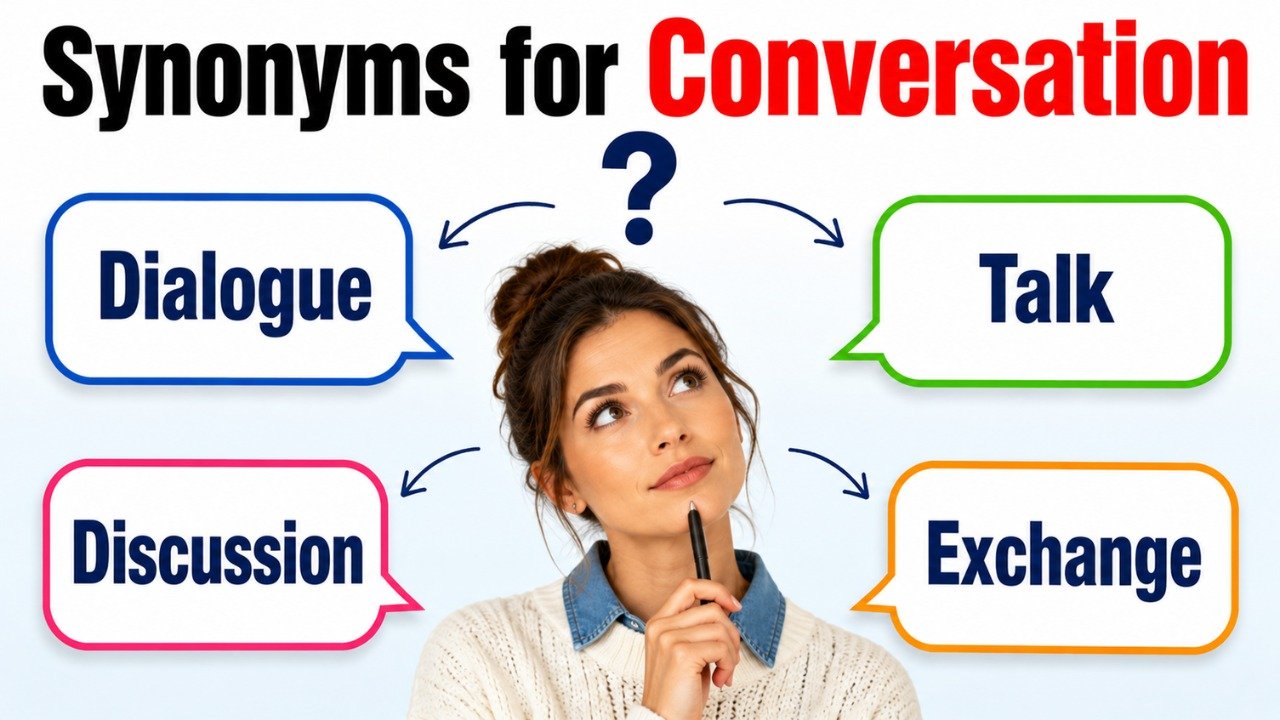
Quick Answer: The best synonyms for conversation include dialogue, discussion, talk, chat, exchange, discourse, consultation, interview, debate, and banter. Dialogue works well for a meaningful exchange of ideas, while discussion suits formal or focused communication. Talk is a broad everyday alternative, and chat is best for relaxed casual speech. Use consultation for professional advice, interview for structured questions, debate for opposing views, discourse for academic writing, exchange for brief communication, and banter for playful conversation.
Pronunciation and Word Details
Word: Conversation.
Pronunciation: /ˌkɒn.vəˈseɪ.ʃən/.
Part of Speech: Noun.
Meaning: A spoken exchange of thoughts, ideas, feelings, or information between two or more people.
US Pronunciation:
UK Pronunciation:
What Does “Conversation” Mean?
Conversation means a spoken exchange in which people share information, opinions, questions, thoughts, or feelings.
Conversation is mainly used as a noun. It can describe a brief casual chat, a serious private discussion, a professional consultation, or a longer exchange of ideas.
Example: We had a pleasant conversation while waiting for the meeting to begin.
The word usually suggests that more than one person takes part. Each participant has an opportunity to speak, respond, ask questions, or react.
Example: Their conversation moved from travel plans to family memories.
Conversation may be formal or informal. A conversation between friends can be relaxed and playful, while a conversation between a manager and an employee may be serious and professional.
Example: The manager requested a private conversation about the project.
The word can also refer to communication through writing when messages are exchanged in a natural and responsive way.
Example: The written conversation continued throughout the afternoon.
In broader contexts, conversation can mean public discussion about an important issue.
Example: The article encouraged a wider conversation about education.
The exact meaning depends on the people involved, the subject being discussed, the purpose of the interaction, and the level of formality.
Meaning, Tone, and Context of “Conversation”
Conversation is a neutral and flexible word. It can describe communication in casual, professional, emotional, social, academic, and public settings.
Neutral Tone: Conversation does not automatically suggest agreement, disagreement, seriousness, or humor. The surrounding words establish the tone.
Casual Context: Friends, relatives, neighbors, and coworkers often have conversations about ordinary experiences, plans, interests, or recent events.
Example: Their casual conversation lasted throughout lunch.
Formal Context: Conversation can describe a planned exchange between professionals, leaders, teachers, clients, or colleagues.
Example: The director began a formal conversation about workplace expectations.
Emotional Context: A conversation may involve personal feelings, difficult experiences, apologies, or important decisions.
Example: They had an honest conversation about their concerns.
Academic Context: Scholars may use conversation to describe an ongoing exchange of ideas within a field of study.
Example: Her research contributes to the broader conversation about language development.
Professional Context: The word is common in meetings, interviews, consultations, performance reviews, and workplace communication.
Example: The conversation helped both teams understand the new responsibilities.
Public Context: Conversation can describe widespread discussion about a social, cultural, educational, or economic subject.
Example: The report started a national conversation about public safety.
Technical Context: Conversation may refer to a sequence of connected messages or responses between users and a communication system.
Conversation is polite and natural in most settings. However, a more specific synonym often communicates the exact purpose or tone more clearly.
When and How to Use “Conversation”
For Casual Communication
Use conversation when people speak informally about everyday topics, personal experiences, interests, or plans.
Example: We enjoyed a relaxed conversation over dinner.
For Sharing Ideas
Use conversation when people exchange thoughts, opinions, or perspectives without necessarily trying to reach a final decision.
Example: The workshop encouraged conversation among participants.
For Serious Matters
Use conversation for a thoughtful or important exchange about a problem, decision, relationship, or responsibility.
Example: The family had a serious conversation about moving to another city.
For Professional Communication
Use conversation when coworkers, managers, clients, or specialists exchange information in a polite and organized way.
Example: The conversation clarified the client’s expectations.
For Private Matters
Use conversation when people discuss personal, sensitive, or confidential information.
Example: The doctor requested a private conversation with the patient.
For Building Relationships
Use conversation when communication helps people become familiar, develop trust, or understand one another.
Example: A friendly conversation helped the new employees feel welcome.
For Resolving Conflict
Use conversation when people discuss disagreement in order to understand different views or find a solution.
Example: An open conversation helped them resolve the misunderstanding.
For Public Discussion
Use conversation to describe a wider exchange of opinions about an issue within a community or society.
Example: The documentary created a broader conversation about food waste.
For Written Exchanges
Use conversation when written messages form a connected and responsive exchange.
Example: Their written conversation included several questions and detailed replies.
Best Synonyms for Conversation
Dialogue
Synonym: Dialogue is an exchange of ideas, opinions, or information between two or more people.
Example: The community meeting created a useful dialogue between residents and planners.
Discussion
Synonym: Discussion is a focused exchange about a particular topic, question, or problem.
Example: The team held a discussion about the upcoming project.
Talk
Synonym: Talk is a broad and natural word for spoken communication.
Example: We had a long talk about our future plans.
Chat
Synonym: Chat is a friendly and informal conversation.
Example: They stopped for a quick chat after work.
Exchange
Synonym: Exchange is a brief or purposeful sharing of words, ideas, or information.
Example: Their exchange revealed several important concerns.
Discourse
Synonym: Discourse is a formal, serious, or academic discussion of ideas.
Example: The essay examines public discourse about education.
Consultation
Synonym: Consultation is a professional conversation in which advice or expert guidance is given.
Example: The patient scheduled a consultation with a specialist.
Interview
Synonym: Interview is a structured conversation in which one person asks questions to collect information.
Example: The reporter conducted an interview with the author.
Debate
Synonym: Debate is a structured exchange involving different or opposing opinions.
Example: The students participated in a debate about school policies.
Banter
Synonym: Banter is a playful exchange of humorous or teasing remarks.
Example: Their friendly banter made everyone laugh.
50 Synonyms for Conversation with Short Meanings
- Dialogue: An exchange of ideas between people.
- Discussion: A focused talk about a particular subject.
- Talk: A general spoken exchange.
- Chat: A relaxed and informal conversation.
- Exchange: A sharing of words, thoughts, or information.
- Communication: The process of sharing information or feelings.
- Discourse: Formal or serious discussion of a subject.
- Consultation: A professional talk for advice or guidance.
- Conference: A formal meeting for discussion.
- Interview: A structured conversation based on questions.
- Debate: A discussion involving opposing opinions.
- Deliberation: Careful discussion before making a decision.
- Negotiation: Discussion intended to reach an agreement.
- Colloquy: A formal or literary conversation.
- Interaction: Communication or activity between people.
- Meeting: A planned gathering for discussion.
- Forum: An organized setting for exchanging views.
- Symposium: A formal meeting focused on a particular subject.
- Roundtable: A group discussion in which participants share ideas.
- Panel Discussion: A structured conversation among selected speakers.
- Question and Answer Session: A discussion based on questions and responses.
- Verbal Exchange: A spoken sharing of words or ideas.
- Spoken Exchange: Communication carried out through speech.
- Oral Communication: The spoken transfer of information.
- Chitchat: Light and informal conversation.
- Small Talk: Polite conversation about ordinary subjects.
- Banter: Playful and humorous verbal exchange.
- Chatter: Continuous casual or lively talk.
- Gossip: Informal talk about other people or events.
- Gab: Casual and often lengthy talk.
- Confab: An informal conversation or discussion.
- Heart to Heart: A sincere conversation about personal feelings.
- One to One: A private conversation between two people.
- Catch Up: A conversation about recent experiences or events.
- Friendly Talk: A warm and informal spoken exchange.
- Informal Talk: A relaxed conversation without strict structure.
- Private Discussion: A conversation not intended for others to hear.
- Serious Discussion: A focused talk about an important matter.
- Open Discussion: A conversation in which views are shared freely.
- Group Discussion: A conversation involving several participants.
- Business Discussion: A professional conversation about work matters.
- Professional Discussion: A formal exchange related to work or expertise.
- Social Interaction: Communication that helps people connect.
- Dialogue Session: A planned period for exchanging views.
- Consultation Session: A meeting arranged to receive advice.
- Negotiation Session: A discussion intended to settle terms.
- Repartee: A quick and clever exchange of remarks.
- Badinage: Light and playful teasing in conversation.
- Palaver: A long or sometimes unnecessary discussion.
- Communion: A deep sharing of thoughts or feelings.
Read Also:
Synonyms for Investigate

Synonyms for Conversation by Context
When Conversation Means Casual Talk
Chat, chitchat, small talk, chatter, gab, and catch up describe relaxed everyday communication.
Chat is the most common informal alternative. Chitchat and small talk usually involve light subjects. Catch up is useful when people discuss what has happened since they last met.
Example: We had a quick chat before the class began.
Example: The neighbors made small talk while waiting outside.
Example: I met an old friend for a catch up over lunch.
When Conversation Means a Focused Discussion
Discussion, dialogue, exchange, deliberation, and conference work well when people address a particular topic or problem.
Discussion is the broadest choice. Dialogue emphasizes participation and mutual understanding. Deliberation suggests careful thought before a decision.
Example: The committee held a discussion about the new schedule.
Example: The meeting created a productive dialogue among staff members.
Example: After careful deliberation, the group approved the proposal.
When Conversation Means Professional Advice
Consultation, interview, conference, meeting, and professional discussion suit workplace or expert settings.
Consultation is best when someone seeks advice. Interview describes a structured series of questions. Conference often involves a formal meeting between several participants.
Example: She arranged a consultation with a financial adviser.
Example: The interview focused on the applicant’s experience.
Example: The teachers attended a conference about student progress.
When Conversation Means Disagreement
Debate, argument, dispute, negotiation, and deliberation involve different views or competing interests.
Debate is usually structured and focused on ideas. Negotiation aims to produce agreement. Argument can sound emotional or confrontational, so it is not always a neutral replacement.
Example: The candidates took part in a public debate.
Example: The negotiation continued until both groups accepted the terms.
When Conversation Means Playful Talk
Banter, repartee, badinage, chatter, and friendly talk describe lively or humorous communication.
Banter is common for friendly teasing. Repartee suggests clever and quick responses. Badinage is more literary and less common in everyday speech.
Example: Their playful banter entertained the entire group.
Example: The performers were known for their witty repartee.
When Conversation Means Deep Personal Communication
Heart to heart, private discussion, communion, honest talk, and serious discussion describe meaningful or emotional communication.
Heart to heart is best for a sincere discussion about feelings. Communion suggests a deep emotional or intellectual connection.
Example: The sisters had a heart to heart about their relationship.
Example: Their private discussion helped rebuild trust.
When Conversation Means Public Exchange
Forum, symposium, roundtable, panel discussion, discourse, and open discussion describe organized exchanges of ideas.
Forum is useful when members of the public can participate. Symposium is formal and often academic. Roundtable suggests balanced participation among a small group.
Example: The community forum allowed residents to share concerns.
Example: Experts joined a symposium on language education.
Example: The roundtable explored several possible solutions.
When Conversation Means Written Communication
Exchange, communication, written dialogue, message thread, and discussion can describe connected written responses.
Exchange is useful for a brief series of messages. Written dialogue emphasizes responsiveness between participants.
Example: Their written exchange clarified the misunderstanding.
Example: The discussion continued through several detailed messages.
Another Word for Conversation
Dialogue is often the best single alternative to conversation because it suggests a meaningful exchange in which people listen and respond to one another.
However, the most accurate replacement depends on context. Chat is better for casual speech, discussion for a focused topic, consultation for professional advice, and debate for opposing opinions.
Original: The two leaders began a conversation about cooperation.
Better Option: The two leaders began a dialogue about cooperation.
Original: We had a conversation during our lunch break.
Better Option: We had a chat during our lunch break.
Original: The team had a conversation about the delayed project.
Better Option: The team had a discussion about the delayed project.
Original: She had a conversation with an expert about the problem.
Better Option: She had a consultation with an expert about the problem.
When Not to Use “Conversation”
Conversation is a broad word. Avoid it when a more specific term would communicate the purpose, tone, or structure more clearly.
When the Exchange Is Highly Formal
Conversation may sound too casual when referring to a structured legal, academic, or professional event.
Weak: The specialists attended a conversation about medical research.
Better: The specialists attended a symposium about medical research.
When Questions Follow a Planned Structure
Use interview when one person asks prepared questions to collect information.
Weak: The reporter had a conversation with the witness for the article.
Better: The reporter conducted an interview with the witness for the article.
When Opposing Views Are Presented
Use debate when participants defend different positions.
Weak: The candidates had a conversation about tax policy.
Better: The candidates held a debate about tax policy.
When People Are Trying to Reach an Agreement
Use negotiation when the purpose is to settle conditions or resolve competing demands.
Weak: The companies entered a conversation about contract terms.
Better: The companies entered a negotiation about contract terms.
When Expert Advice Is the Main Purpose
Use consultation when a person meets a specialist for professional guidance.
Weak: She booked a conversation with the adviser.
Better: She booked a consultation with the adviser.
When the Talk Is Brief and Casual
Chat may sound more natural than conversation in relaxed everyday situations.
Weak: We had a short conversation beside the entrance.
Better: We had a quick chat beside the entrance.
When the Word Becomes Repetitive
Using conversation several times in one paragraph can make writing sound vague.
Weak: Our conversation began after another conversation ended, and the conversation lasted an hour.
Better: Our discussion began after the earlier meeting ended, and the exchange lasted an hour.
Words Commonly Confused With Conversation
Conversation vs Dialogue: Conversation is a broad term for spoken interaction. Dialogue often emphasizes a balanced exchange of ideas or an attempt to build understanding.
Conversation vs Discussion: Conversation can move naturally between several subjects. Discussion usually focuses on a particular topic, question, or problem.
Conversation vs Talk: Talk is a broad everyday word. It can refer to a conversation, a speech, or the act of speaking generally.
Conversation vs Chat: Chat is usually informal, friendly, and light. Conversation can be casual, serious, emotional, or professional.
Conversation vs Debate: Conversation does not require disagreement. Debate involves opposing opinions, arguments, or positions.
Conversation vs Interview: Conversation is usually flexible and shared. Interview follows a question based structure and has a clear information gathering purpose.
Conversation vs Consultation: Conversation may happen for any reason. Consultation occurs when someone seeks professional advice or expert guidance.
Conversation vs Discourse: Conversation is common in everyday language. Discourse is more formal and is often used in academic, political, or intellectual contexts.
Conversation vs Communication: Conversation is one form of communication. Communication also includes writing, gestures, signs, images, and other methods of sharing information.
Conversation vs Monologue: Conversation involves responses from more than one participant. Monologue is an extended speech delivered by one person.
Which Synonym Should You Choose?
Choose dialogue when emphasizing mutual understanding, cooperation, or an exchange of viewpoints.
Choose discussion when people focus on a particular topic, problem, decision, or plan.
Choose talk in everyday speech when you need a broad and natural alternative.
Choose chat for a short, relaxed, and friendly conversation.
Choose exchange when describing a brief sharing of words, opinions, or information.
Choose discourse in academic essays, formal analysis, or discussions about public language and ideas.
Choose consultation when a person seeks professional or expert advice.
Choose interview when one person asks organized questions to gather information.
Choose debate when participants present opposing opinions or arguments.
Choose deliberation when a group considers an issue carefully before deciding.
Choose negotiation when people discuss terms and try to reach an agreement.
Choose conference when referring to a planned and formal meeting.
Choose banter when the conversation includes friendly teasing or humor.
Choose repartee when the speakers exchange quick, clever, and witty remarks.
Choose small talk when people politely discuss light and ordinary subjects.
Choose heart to heart when the conversation is sincere, private, and emotional.
Choose forum when many people are invited to share ideas publicly.
Choose roundtable when several participants contribute equally to an organized discussion.
Choose meeting for a planned professional or organizational conversation.
Choose communication when the method of sharing information is more important than the spoken exchange itself.
Real Life Examples of “Conversation” in Sentences
Original: We had a friendly conversation after the meeting.
Better Option: We had a friendly chat after the meeting.
Original: The manager started a conversation about the new policy.
Better Option: The manager started a discussion about the new policy.
Original: The two communities began a conversation about cooperation.
Better Option: The two communities began a dialogue about cooperation.
Original: She had a conversation with a specialist about her options.
Better Option: She had a consultation with a specialist about her options.
Original: The reporter recorded a conversation with the scientist.
Better Option: The reporter recorded an interview with the scientist.
Original: The candidates had a conversation about public spending.
Better Option: The candidates held a debate about public spending.
Original: Their conversation included several clever jokes.
Better Option: Their banter included several clever jokes.
Original: The committee continued its conversation before voting.
Better Option: The committee continued its deliberation before voting.
Original: The businesses began a conversation about the contract.
Better Option: The businesses began a negotiation about the contract.
Original: We had an emotional conversation about our friendship.
Better Option: We had a heart to heart about our friendship.
Synonym Groups and Usage Differences
Casual Conversation Group
Chat, chitchat, small talk, chatter, gab, and catch up describe informal communication.
Chat is the most flexible word in this group. Small talk usually involves polite but unimportant subjects. Chitchat suggests relaxed conversation, while catch up focuses on sharing recent news.
Example: We met for a chat and caught up on recent events.
Focused Discussion Group
Discussion, dialogue, deliberation, conference, and roundtable describe purposeful exchanges.
Discussion focuses on a topic. Dialogue emphasizes mutual participation. Deliberation suggests careful thinking. Roundtable often describes an organized group exchange.
Example: The roundtable produced a thoughtful discussion about local services.
Professional Communication Group
Consultation, interview, meeting, conference, and business discussion describe structured workplace or expert communication.
Consultation focuses on advice. Interview focuses on questions. Meeting is the broadest professional term.
Example: The consultation gave the client a clearer understanding of the process.
Disagreement Group
Debate, argument, dispute, negotiation, and controversy involve differences of opinion or interest.
Debate is organized and idea focused. Argument may be emotional. Negotiation aims to produce an agreement.
Example: The negotiation resolved a dispute that had continued for several weeks.
Playful Speech Group
Banter, repartee, badinage, chatter, and joking exchange describe lively or humorous talk.
Banter is common and informal. Repartee emphasizes quick wit. Badinage is more formal or literary.
Example: The friends exchanged playful banter throughout the evening.
Personal Communication Group
Heart to heart, private discussion, honest talk, communion, and serious discussion describe sincere or emotional exchanges.
Heart to heart is natural in everyday language. Communion is more formal and suggests a deep connection.
Example: Their honest talk helped them understand each other’s concerns.
Public Discussion Group
Forum, symposium, panel discussion, discourse, and open discussion involve ideas shared before a group or public audience.
Forum allows broad participation. Symposium is formal and specialized. Panel discussion involves a selected group of speakers.
Example: The panel discussion introduced several perspectives on the issue.
Information Exchange Group
Communication, exchange, verbal exchange, oral communication, and interaction focus on the sharing process.
Communication is the broadest term. Exchange emphasizes movement between participants. Interaction includes words, reactions, and behavior.
Example: Clear communication prevented further confusion.
Antonyms of Conversation
Conversation does not have one exact opposite because its meaning changes by context. Its opposites may describe silence, isolation, one sided speech, or a refusal to communicate.
Silence: The absence of speech or sound.
Quiet: A state with little or no talking.
Monologue: A long speech delivered by one person without equal response.
Soliloquy: A speech in which a person expresses thoughts aloud while alone.
Isolation: Separation from communication or social contact.
Withdrawal: The act of avoiding participation or interaction.
Noncommunication: A lack of meaningful information exchange.
Muteness: The condition of not speaking.
Avoidance: An effort to escape a discussion or interaction.
Disconnection: A lack of contact, understanding, or communication.
Interruption: An action that prevents a conversation from continuing smoothly.
Secrecy: The deliberate withholding of information from others.
Refusal: An unwillingness to speak, respond, or participate.
Inattention: A failure to listen or engage with another speaker.
Miscommunication: An unsuccessful exchange that produces misunderstanding.
Comparison: Conversation vs Related Words
Conversation vs Dialogue
Conversation is a general exchange of speech. Dialogue often suggests a purposeful and balanced exchange intended to improve understanding.
Example With Conversation: We had a pleasant conversation during lunch.
Example With Dialogue: The two groups opened a dialogue about future cooperation.
Conversation vs Discussion
Conversation can move freely between topics. Discussion usually concentrates on a specific subject, problem, or decision.
Example With Conversation: Their conversation covered music, travel, and family.
Example With Discussion: Their discussion focused on the project deadline.
Conversation vs Talk
Conversation normally describes an exchange between people. Talk can describe an exchange, a speech, or spoken communication in general.
Example With Conversation: I enjoyed our conversation about books.
Example With Talk: The teacher gave a talk about reading habits.
Conversation vs Chat
Conversation is neutral and can be formal or informal. Chat is friendly, relaxed, and usually informal.
Example With Conversation: The manager requested a private conversation.
Example With Chat: We had a quick chat before leaving.
Conversation vs Exchange
Conversation often suggests a longer interaction. Exchange can describe a brief series of comments, messages, or opinions.
Example With Conversation: The conversation continued for more than an hour.
Example With Exchange: Their brief exchange clarified the meeting time.
Conversation vs Debate
Conversation may involve agreement, curiosity, or ordinary social contact. Debate requires competing views or arguments.
Example With Conversation: The students had a conversation about the book.
Example With Debate: The students held a debate about the author’s main argument.
Conversation vs Interview
Conversation develops naturally between participants. Interview follows a planned structure in which one person mainly asks questions.
Example With Conversation: We had an informal conversation after the event.
Example With Interview: The researcher conducted an interview with each participant.
Conversation vs Consultation
Conversation can serve any social or practical purpose. Consultation is arranged to receive professional advice, information, or guidance.
Example With Conversation: She had a conversation with her neighbor.
Example With Consultation: She scheduled a consultation with a legal adviser.
Conversation vs Discourse
Conversation is common in daily speech. Discourse refers to formal communication or a broader system of ideas and language.
Example With Conversation: Their conversation became more serious.
Example With Discourse: The study examines political discourse during periods of change.
Conversation vs Communication
Conversation is usually a two way spoken exchange. Communication includes speech, writing, gestures, signs, and other methods of sharing meaning.
Example With Conversation: A short conversation solved the misunderstanding.
Example With Communication: Clear communication is essential during an emergency.
Common Phrases and Expressions With Conversation
Start a Conversation: Begin speaking or exchanging ideas with someone.
Have a Conversation: Speak with another person about one or more subjects.
Join the Conversation: Begin participating in an existing discussion.
Continue the Conversation: Keep an exchange going after it has started.
End the Conversation: Bring a spoken exchange to a close.
Casual Conversation: Relaxed talk about ordinary or personal topics.
Private Conversation: A discussion intended to remain between selected people.
Meaningful Conversation: An exchange involving important ideas or genuine feelings.
Difficult Conversation: A serious discussion about an uncomfortable or sensitive issue.
Open Conversation: An honest exchange in which participants can speak freely.
Conversation Starter: A question, comment, or subject used to begin talking.
Conversation Topic: The subject people are discussing.
Conversation Partner: A person who takes part in the exchange.
Polite Conversation: Respectful and socially appropriate communication.
Lively Conversation: An energetic and interesting exchange.
Common Mistakes to Avoid
Forgetting the Article Before a Singular Noun
Conversation is a countable noun when it refers to one specific exchange. Use a or the before the singular form when required.
Incorrect: We had conversation after the meeting.
Correct: We had a conversation after the meeting.
Using the Singular Form After Many
Use conversations after words that require a plural noun.
Incorrect: We had many interesting conversation during the trip.
Correct: We had many interesting conversations during the trip.
Confusing Conversation With Converse
Conversation is a noun. Converse is usually a verb meaning to talk with someone.
Incorrect: We had a pleasant converse about art.
Correct: We had a pleasant conversation about art.
Correct: We conversed about art for an hour.
Using Chat in a Highly Formal Context
Chat may sound too casual in professional, academic, legal, or official writing.
Weak: The committee held a chat about the safety policy.
Better: The committee held a discussion about the safety policy.
Using Debate When There Is No Disagreement
Debate requires opposing ideas or positions. Do not use it for an ordinary friendly exchange.
Weak: We had a debate about our weekend plans.
Better: We had a conversation about our weekend plans.
Using Interview for an Equal Exchange
Interview usually places one person in the role of asking questions. Dialogue or conversation is better when both people participate equally.
Weak: The two friends had an interview about their childhood memories.
Better: The two friends had a conversation about their childhood memories.
Overusing Conversation
Repeating conversation too often can make a paragraph sound dull or vague. Replace it with a more precise word when the context changes.
Repetitive: The conversation began casually, but the conversation became serious when the conversation turned to work.
Improved: The chat began casually, but the discussion became serious when the topic turned to work.
Choosing a Synonym Without Considering Tone
Banter, debate, consultation, and heart to heart describe very different types of communication. Choose a word that matches the purpose and emotional tone.
Unnatural: The doctor had playful banter with the patient about the test results.
Better: The doctor had a careful discussion with the patient about the test results.
Using Conversation for One Sided Speech
A speech or monologue is not normally a conversation because listeners may not respond.
Incorrect: The speaker delivered a conversation to the audience.
Correct: The speaker delivered a talk to the audience.
Using Vague Phrasing
Conversation can be too general when readers need to understand what actually happened.
Vague: The officials had a conversation.
Clearer: The officials negotiated new terms for the agreement.
Conclusion
The most useful synonyms for conversation include dialogue, discussion, talk, chat, exchange, discourse, consultation, interview, debate, and banter. Choose dialogue for mutual understanding, discussion for a focused topic, chat for casual speech, consultation for expert advice, and debate for opposing views. Interview fits structured questioning, while heart to heart suits personal communication. Selecting the right alternative helps readers understand the purpose, tone, formality, and emotional quality of each exchange.
FAQs About Synonyms for Conversation
What Is the Best Synonym for Conversation?
Dialogue is a strong general synonym, especially when people exchange ideas and listen to one another. Talk or discussion may be better in everyday contexts.
What Is a Casual Synonym for Conversation?
Chat is the most natural casual alternative. Chitchat, small talk, chatter, and catch up are also useful in informal situations.
What Is a Formal Synonym for Conversation?
Discussion, dialogue, discourse, consultation, conference, and colloquy are formal alternatives. The best choice depends on the purpose of the exchange.
What Is Another Word for a Serious Conversation?
Discussion, heart to heart, deliberation, and private talk can describe a serious conversation. Heart to heart is best for emotional subjects.
What Is the Difference Between Conversation and Dialogue?
Conversation is a broad word for spoken communication. Dialogue often emphasizes balanced participation, careful listening, and mutual understanding.
Can Discussion Replace Conversation?
Discussion can replace conversation when people focus on a specific subject, decision, or problem. It may sound too formal for relaxed social talk.
What Is the Opposite of Conversation?
Silence is the clearest general opposite. Monologue, isolation, withdrawal, and noncommunication may also work depending on the context.
