
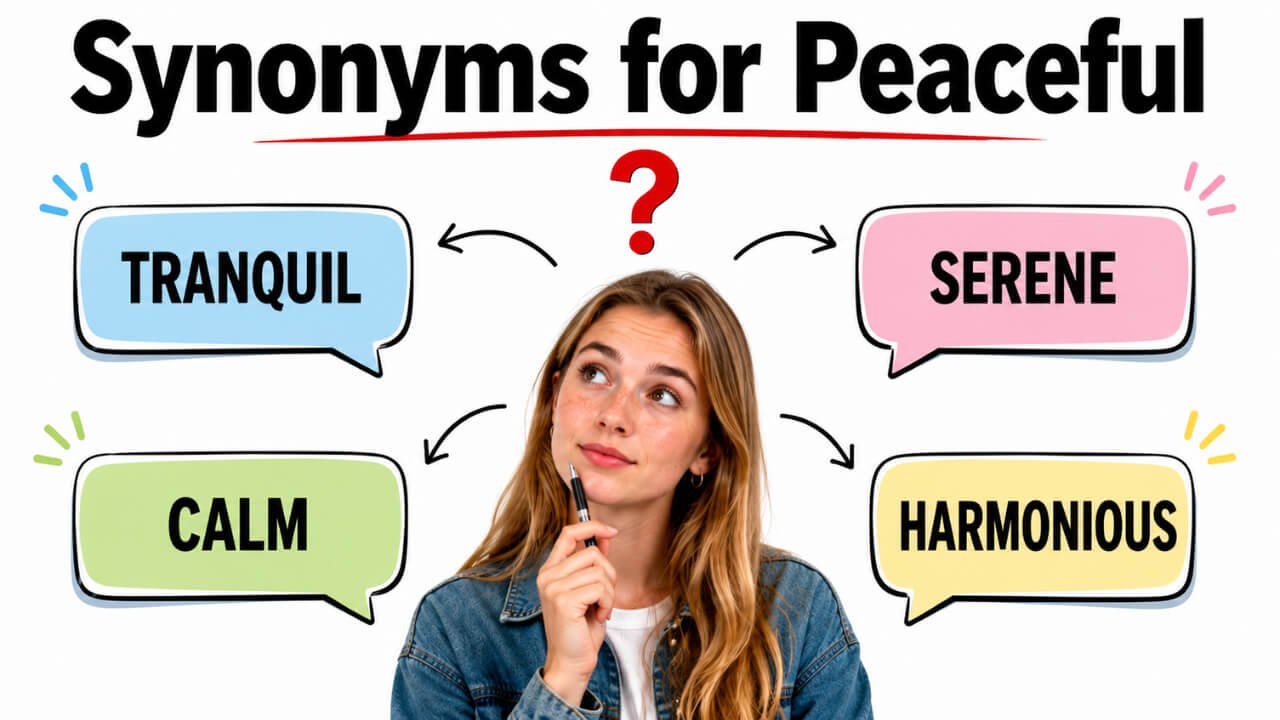
Quick Answer: The best synonyms for peaceful include calm, tranquil, serene, quiet, restful, harmonious, placid, peaceable, soothing, and nonviolent. Use calm for people, situations, or emotions without stress. Tranquil and serene work well for beautiful places and relaxed states of mind. Quiet is best when there is little noise, while restful describes something that helps a person relax. Harmonious suits relationships and communities, peaceable describes cooperative behavior, and nonviolent is the clearest choice when referring to actions that avoid physical force or conflict.
Pronunciation and Word Details
Word: Peaceful.
Pronunciation: /ˈpiːsfəl/.
Part of Speech: Adjective.
Meaning: Free from conflict, noise, stress, disturbance, or violence.
US Pronunciation:
UK Pronunciation:
What Does “Peaceful” Mean?
Peaceful means calm, quiet, and free from conflict, stress, violence, or disturbance.
The word is mainly used as an adjective. It can describe a person, place, situation, relationship, period, action, or emotional condition.
A peaceful place has little noise or activity. A peaceful person remains calm and avoids arguments. A peaceful society experiences cooperation instead of violence. A peaceful feeling is one of emotional comfort and inner calm.
For Places: The garden was peaceful in the early morning.
For People: She remained peaceful despite the disagreement.
For Situations: The meeting ended in a peaceful manner.
For Relationships: The two families maintained a peaceful relationship.
For Emotions: He felt peaceful after spending time outdoors.
For Political or Social Actions: The group organized a peaceful demonstration.
The meaning changes slightly according to the noun it describes. Peaceful surroundings are quiet and relaxing, while peaceful behavior is calm and nonviolent.
Meaning, Tone, and Context of “Peaceful”
Peaceful usually has a positive, gentle, and reassuring tone. It suggests safety, comfort, cooperation, emotional balance, or freedom from disturbance.
In casual speech, people often use peaceful to describe a quiet home, a calm evening, a relaxing vacation, or a comfortable state of mind.
In descriptive writing, peaceful can create an image of natural beauty, silence, still water, soft light, or an undisturbed landscape. Serene, tranquil, idyllic, and pastoral are often stronger choices in this context.
In formal writing, peaceful may describe negotiations, political transitions, public gatherings, international relations, or methods of resolving disagreement. Peaceable, nonviolent, diplomatic, and conciliatory may provide greater precision.
The word is also common in emotional and personal contexts. A peaceful person may be composed, centered, contented, or untroubled.
Although peaceful is positive, it does not always mean silent. A place can contain soft sounds and still feel peaceful because it lacks stress or disturbance.
When and How to Use “Peaceful”
For Quiet Places: Use peaceful to describe locations with little noise, stress, or activity.
Example: We found a peaceful spot beside the lake.
For Calm Emotions: Use peaceful when someone feels relaxed and emotionally settled.
Example: She felt peaceful after resolving the disagreement.
For Restful Experiences: Use peaceful for activities or environments that encourage relaxation.
Example: The slow walk through the countryside was peaceful.
For Cooperative Relationships: Use peaceful when people live or work together without serious conflict.
Example: The neighboring communities maintained peaceful relations.
For Nonviolent Actions: Use peaceful when an action avoids force, aggression, or physical conflict.
Example: The participants made their concerns known through peaceful action.
For Gentle Personalities: Use peaceful for someone who prefers calm discussion and avoids unnecessary arguments.
Example: He was a peaceful person who listened before responding.
For Stable Periods: Use peaceful to describe a time without major conflict, disorder, or danger.
Example: The region experienced several peaceful years.
For Death: Peaceful may gently describe a death that occurred without visible pain or distress.
Example: The family said that she had a peaceful passing.
For Solutions: Use peaceful when a disagreement is resolved through communication and cooperation.
Example: Both sides searched for a peaceful solution.
Best Synonyms for Peaceful
Calm: Free from worry, excitement, stress, or disturbance.
Example: The sea remained calm throughout the afternoon.
Tranquil: Quiet, relaxing, and free from interruption.
Example: They spent the weekend in a tranquil village.
Serene: Beautifully calm, clear, and emotionally undisturbed.
Example: Her serene expression reassured everyone in the room.
Quiet: Making little noise or containing little activity.
Example: The library provided a quiet place to study.
Restful: Helping the body or mind relax and recover.
Example: The soft lighting created a restful atmosphere.
Harmonious: Friendly, balanced, and free from serious disagreement.
Example: The team developed a harmonious working relationship.
Placid: Calm and not easily excited or disturbed.
Example: The placid lake reflected the surrounding hills.
Peaceable: Inclined to avoid conflict and behave cooperatively.
Example: The residents were known as a peaceable community.
Soothing: Producing a feeling of calm, comfort, or relief.
Example: The soothing sound of rain helped her relax.
Nonviolent: Avoiding physical force, aggression, or violent action.
Example: The leaders encouraged a nonviolent response.
50 Synonyms for Peaceful with Short Meanings
- Calm: Free from stress, excitement, or disturbance.
- Tranquil: Quiet and pleasantly undisturbed.
- Serene: Deeply calm and emotionally clear.
- Quiet: Making little noise or activity.
- Restful: Helping someone relax or recover.
- Placid: Calm and not easily disturbed.
- Still: Free from movement, noise, or activity.
- Harmonious: Friendly, balanced, and free from conflict.
- Gentle: Mild, kind, and not forceful.
- Relaxed: Free from tension, anxiety, or pressure.
- Composed: Calm and in control of emotions.
- Untroubled: Free from worry, difficulty, or distress.
- Undisturbed: Not interrupted, changed, or bothered.
- Soothing: Creating comfort and emotional calm.
- Mellow: Pleasantly gentle, relaxed, and soft.
- Pacific: Inclined toward peace rather than conflict.
- Peaceable: Willing to avoid arguments or violence.
- Nonviolent: Avoiding physical force or aggression.
- Amicable: Friendly and free from serious disagreement.
- Friendly: Kind, cooperative, and not hostile.
- Cooperative: Willing to work with others calmly.
- Conciliatory: Intended to reduce anger or disagreement.
- Diplomatic: Skilled at managing disagreement tactfully.
- Tolerant: Accepting differences without hostility.
- Patient: Able to remain calm during difficulty or delay.
- Balanced: Emotionally steady and reasonably controlled.
- Stable: Firm, secure, and unlikely to become disorderly.
- Orderly: Calm, organized, and under control.
- Secure: Safe from danger, fear, or disturbance.
- Safe: Protected from harm, violence, or risk.
- Idyllic: Extremely pleasant, beautiful, and peaceful.
- Pastoral: Peacefully connected with country life.
- Secluded: Quietly separated from busy places or people.
- Hushed: Very quiet because sound has been reduced.
- Silent: Completely or almost completely without sound.
- Soundless: Producing no sound.
- Noiseless: Making little or no noise.
- Meditative: Encouraging deep thought and inner calm.
- Reflective: Quietly thoughtful and emotionally settled.
- Centered: Emotionally balanced and mentally calm.
- Contented: Peacefully satisfied with one’s situation.
- Comfortable: Relaxed, safe, and free from unease.
- Easygoing: Relaxed and not easily worried or annoyed.
- Mild: Gentle and not severe or aggressive.
- Collected: Calm and able to think clearly.
- Poised: Calm, confident, and self controlled.
- Equable: Calm and not easily affected by changing emotions.
- Halcyon: Calm, happy, and free from trouble.
- Reposeful: Quiet and suitable for rest.
- At Peace: Calm, satisfied, and free from emotional conflict.
Read Also:
Synonyms for Dedicated

Synonyms for Peaceful by Context
When Peaceful Means Calm and Relaxed
Calm, relaxed, serene, composed, centered, and untroubled describe a person or emotional state without stress or agitation.
Calm is the most flexible option. Serene suggests a deeper and more graceful form of calm. Composed emphasizes emotional control, especially during a difficult situation.
Example: She remained composed while answering the unexpected questions.
Example: He felt serene after completing the difficult task.
Centered is useful when someone feels mentally balanced and aware. Untroubled suggests freedom from worry.
When Peaceful Means Quiet
Quiet, still, silent, hushed, soundless, and noiseless refer to a low level or complete absence of sound.
Quiet is the most natural general synonym. Still suggests an absence of movement as well as noise. Hushed describes an intentionally lowered level of sound.
Example: The house became quiet after everyone went to sleep.
Example: A hushed atmosphere filled the hall before the speech began.
Silent and soundless are stronger than peaceful because they may suggest complete absence of sound.
When Peaceful Describes a Place
Tranquil, serene, idyllic, pastoral, secluded, placid, restful, and reposeful work well for locations and natural surroundings.
Tranquil describes a place that is free from interruption. Idyllic adds the idea of beauty and perfection. Pastoral is suitable for attractive countryside settings.
Example: The travelers discovered a tranquil beach beyond the cliffs.
Example: The small farmhouse stood in an idyllic valley.
Secluded emphasizes privacy and distance from crowded areas. Placid is especially natural for lakes, rivers, and calm water.
When Peaceful Means Free From Conflict
Harmonious, peaceable, amicable, friendly, cooperative, conciliatory, and diplomatic describe people, relationships, or discussions without hostility.
Harmonious is best for relationships that are balanced and cooperative. Amicable often describes a friendly agreement or separation.
Example: The discussion remained amicable despite their different opinions.
Example: Both departments developed a harmonious partnership.
Conciliatory describes words or actions intended to reduce anger. Diplomatic emphasizes tact and careful communication.
When Peaceful Means Nonviolent
Nonviolent, peaceable, pacific, gentle, and mild describe actions, beliefs, or people that avoid aggression or physical force.
Nonviolent is the clearest choice for organized action or resistance without violence. Peaceable often describes a person or community that naturally avoids conflict.
Example: The organizers requested a nonviolent response.
Example: The village had a long tradition of peaceable cooperation.
Pacific is formal and less common in everyday speech. It means favoring peace and opposing conflict.
When Peaceful Means Safe and Stable
Stable, orderly, secure, safe, balanced, and controlled describe conditions without chaos, danger, or sudden disruption.
Stable is suitable for governments, communities, relationships, and situations. Orderly emphasizes organization and control.
Example: Residents hoped for a stable and secure future.
Example: The event remained orderly from beginning to end.
Safe focuses on protection from harm rather than quietness or emotional calm.
Another Word for Peaceful
Calm is usually the best single replacement for peaceful because it can describe people, places, emotions, weather, and situations. However, the best alternative depends on the intended meaning.
Use tranquil for a relaxing place, harmonious for a friendly relationship, nonviolent for actions without aggression, and serene for graceful inner calm.
Original: We spent the afternoon in a peaceful garden.
Better Option: We spent the afternoon in a tranquil garden.
Original: She appeared peaceful before the interview.
Better Option: She appeared calm before the interview.
Original: The two groups reached a peaceful agreement.
Better Option: The two groups reached an amicable agreement.
Original: The organizers planned a peaceful protest.
Better Option: The organizers planned a nonviolent protest.
When Not to Use “Peaceful”
Avoid peaceful when a more specific word would explain the intended meaning more clearly.
Do not use peaceful when you only mean that a place has no sound. Quiet or silent may be more accurate.
Weak: The recording room must be peaceful.
Better: The recording room must be quiet.
Avoid peaceful when describing a formal agreement that ended an argument. Amicable, diplomatic, or negotiated may offer greater precision.
Weak: The business partners reached a peaceful separation.
Better: The business partners reached an amicable separation.
Do not use peaceful when the main idea is physical safety.
Weak: The equipment creates a peaceful working environment.
Better: The equipment creates a safe working environment.
Avoid peaceful for people who are simply shy or reserved. Quiet, reserved, or introverted may be more accurate.
Weak: He is peaceful and rarely speaks during meetings.
Better: He is reserved and rarely speaks during meetings.
Do not repeat peaceful several times in the same paragraph.
Weak: The peaceful lake made the peaceful village feel even more peaceful.
Better: The placid lake gave the tranquil village a deeply restful atmosphere.
Avoid peaceful when discussing nonviolent political or social action if precision is important.
Weak: They used peaceful methods to oppose the decision.
Better: They used nonviolent methods to oppose the decision.
Words Commonly Confused With Peaceful
Peaceful vs Calm: Peaceful describes freedom from conflict, stress, noise, or violence. Calm mainly describes a lack of strong emotion, movement, or disturbance.
Peaceful vs Quiet: Peaceful suggests emotional comfort or freedom from disruption. Quiet mainly refers to little noise or activity.
Peaceful vs Serene: Peaceful is broad and practical. Serene suggests a deeper, more graceful, and often beautiful form of calm.
Peaceful vs Tranquil: Peaceful can describe people, actions, and relationships. Tranquil is most commonly used for places, surroundings, and states of mind.
Peaceful vs Silent: Peaceful does not require complete silence. Silent means that no one is speaking or that there is little or no sound.
Peaceful vs Restful: Peaceful describes an absence of conflict or disturbance. Restful describes something that helps a person relax or regain energy.
Peaceful vs Peaceable: Peaceful describes a condition or atmosphere. Peaceable commonly describes people or groups that prefer to avoid conflict.
Peaceful vs Nonviolent: Peaceful has a broad meaning. Nonviolent specifically means that no physical force or violence is used.
Peaceful vs Harmonious: Peaceful means free from conflict. Harmonious suggests that different people or parts work together pleasantly and effectively.
Peaceful vs Placid: Peaceful is suitable for many contexts. Placid often describes calm water, an undisturbed expression, or a person who is not easily excited.
Which Synonym Should You Choose?
Choose calm when describing emotions, weather, situations, or people without stress.
Choose tranquil when writing about a quiet location, landscape, garden, beach, or retreat.
Choose serene when you want a graceful or literary description of deep calm.
Choose quiet when the main idea is a low level of noise or activity.
Choose restful when describing a room, vacation, experience, or environment that encourages relaxation.
Choose placid when describing calm water, a gentle expression, or a person who is not easily disturbed.
Choose harmonious when discussing cooperative relationships, teams, families, communities, or designs.
Choose amicable for friendly agreements, discussions, settlements, or separations.
Choose peaceable when describing a person or group that naturally avoids conflict.
Choose nonviolent for formal writing about actions, campaigns, protests, resistance, or methods that avoid physical force.
Choose conciliatory when someone is trying to reduce anger or repair a disagreement.
Choose diplomatic when careful communication is needed to prevent conflict.
Choose composed in reports, essays, and professional writing about someone who controls their emotions.
Choose easygoing in casual speech when describing a relaxed and undemanding personality.
Choose idyllic or pastoral in descriptive writing about beautiful and relaxing countryside settings.
Real Life Examples of “Peaceful” in Sentences
Original: The lake looked peaceful at sunrise.
Better Option: The lake looked placid at sunrise.
Original: She remained peaceful during the stressful conversation.
Better Option: She remained composed during the stressful conversation.
Original: We chose a peaceful hotel outside the city.
Better Option: We chose a tranquil hotel outside the city.
Original: The two neighbors developed a peaceful relationship.
Better Option: The two neighbors developed an amicable relationship.
Original: His peaceful voice helped the child relax.
Better Option: His soothing voice helped the child relax.
Original: The organization supported peaceful action.
Better Option: The organization supported nonviolent action.
Original: The countryside was peaceful and beautiful.
Better Option: The countryside was idyllic and beautiful.
Original: She felt peaceful after finishing her work.
Better Option: She felt contented after finishing her work.
Original: The office was peaceful before the employees arrived.
Better Option: The office was quiet before the employees arrived.
Original: Both sides wanted a peaceful solution.
Better Option: Both sides wanted a diplomatic solution.
Synonym Groups and Usage Differences
Calmness Group
Calm, serene, composed, centered, collected, poised, and equable describe emotional balance and self control.
Calm is general and natural. Composed and collected suggest control during pressure. Poised adds confidence and grace.
Example: She remained poised while presenting her proposal.
Quietness Group
Quiet, silent, still, hushed, soundless, and noiseless describe reduced sound or activity.
Quiet is flexible, while silent and soundless are stronger. Hushed suggests that sound has been intentionally lowered.
Example: The audience became hushed as the speaker approached.
Relaxation Group
Restful, soothing, mellow, comfortable, relaxed, and reposeful describe an atmosphere or experience that reduces tension.
Restful is best for sleep, rooms, holidays, and environments. Soothing describes something that actively creates calm.
Example: The gentle music created a soothing atmosphere.
Natural Beauty Group
Tranquil, idyllic, pastoral, secluded, serene, and placid are useful for landscapes and outdoor settings.
Idyllic suggests an almost perfect scene. Pastoral connects peacefulness with rural life. Secluded emphasizes privacy.
Example: They rented a secluded cottage in the hills.
Cooperation Group
Harmonious, amicable, friendly, cooperative, diplomatic, and conciliatory describe relationships and communication without hostility.
Harmonious suggests lasting balance. Amicable commonly describes agreements. Conciliatory refers to an effort to reduce conflict.
Example: Her conciliatory response prevented the argument from growing.
Nonviolence Group
Nonviolent, peaceable, pacific, gentle, and mild describe behavior that avoids aggression.
Nonviolent is direct and formal. Peaceable emphasizes a natural preference for cooperation. Gentle suggests kindness and lack of force.
Example: The group remained peaceable throughout the gathering.
Security Group
Safe, secure, stable, orderly, and untroubled describe conditions without danger, disorder, or uncertainty.
Safe focuses on freedom from harm. Stable means that serious change or conflict is unlikely.
Example: The residents wanted a stable and secure community.
Antonyms of Peaceful
The opposite of peaceful depends on whether the word describes noise, emotions, relationships, places, or behavior.
Violent: Involving physical force intended to cause harm.
Hostile: Unfriendly, aggressive, or opposed to cooperation.
Aggressive: Ready to attack, argue, or behave forcefully.
War Like: Inclined toward fighting or military conflict.
Turbulent: Filled with disorder, conflict, or sudden change.
Chaotic: Completely disorganized and difficult to control.
Noisy: Producing a large amount of sound.
Loud: Making strong or easily heard sounds.
Disturbed: Interrupted, unsettled, or emotionally troubled.
Restless: Unable to remain calm, still, or relaxed.
Anxious: Worried, nervous, or uneasy.
Agitated: Emotionally upset, excited, or disturbed.
Tense: Nervous, uncomfortable, or likely to produce conflict.
Stressful: Causing mental or emotional pressure.
Disorderly: Lacking control, organization, or calm behavior.
Unstable: Likely to change, fail, or become dangerous.
Unsafe: Not protected from harm or danger.
Contentious: Likely to cause disagreement or argument.
Conflict Ridden: Frequently affected by serious disagreements.
Troubled: Experiencing problems, worry, or conflict.
Comparison: Peaceful vs Related Words
Peaceful vs Calm
Peaceful describes an absence of conflict, disturbance, noise, or violence. Calm mainly describes emotional control or a lack of movement and excitement.
Example With Peaceful: The residents enjoyed a peaceful evening together.
Example With Calm: She stayed calm while solving the problem.
Peaceful vs Tranquil
Peaceful has a broad range of uses. Tranquil usually describes a place or state of mind that is pleasantly quiet and undisturbed.
Example With Peaceful: The community remained peaceful throughout the event.
Example With Tranquil: The forest felt tranquil after the rain.
Peaceful vs Serene
Peaceful is common in everyday language. Serene is more descriptive and often suggests graceful, beautiful, or deep calm.
Example With Peaceful: He felt peaceful after the conversation.
Example With Serene: Her face appeared serene in the soft morning light.
Peaceful vs Quiet
Peaceful suggests comfort and freedom from stress or conflict. Quiet mainly refers to low noise or activity.
Example With Peaceful: They hoped to build a peaceful life in the countryside.
Example With Quiet: They needed a quiet room for the interview.
Peaceful vs Restful
Peaceful describes calm conditions. Restful emphasizes that something allows a person to relax or regain energy.
Example With Peaceful: The garden was peaceful after sunset.
Example With Restful: The comfortable chair provided a restful place to read.
Peaceful vs Harmonious
Peaceful means that there is little or no conflict. Harmonious suggests that people or parts cooperate effectively and pleasantly.
Example With Peaceful: The two communities maintained peaceful relations.
Example With Harmonious: The different departments formed a harmonious team.
Peaceful vs Nonviolent
Peaceful is broad and can describe emotions, locations, or relationships. Nonviolent specifically refers to behavior that does not use physical force.
Example With Peaceful: The gathering remained peaceful.
Example With Nonviolent: The participants used nonviolent methods to express their concerns.
Peaceful vs Peaceable
Peaceful describes a state, environment, or condition. Peaceable more often describes people who prefer to avoid conflict.
Example With Peaceful: The town had a peaceful atmosphere.
Example With Peaceable: The town was known for its peaceable residents.
Common Phrases and Expressions With Peaceful
Peaceful Place: A location without noise, stress, or disturbance.
Peaceful Life: A way of living with little conflict or anxiety.
Peaceful Environment: Surroundings that feel safe, calm, and relaxing.
Peaceful Atmosphere: A mood or setting without tension or disruption.
Peaceful Night: A quiet night without interruption or trouble.
Peaceful Sleep: Rest that is calm and undisturbed.
Peaceful Solution: An answer to conflict that avoids force or aggression.
Peaceful Agreement: A settlement reached without violence or serious hostility.
Peaceful Protest: An organized expression of opinion without violence.
Peaceful Transition: A major change completed without conflict or disorder.
Peaceful Relationship: A connection between people or groups with little hostility.
Peaceful Community: A group of people living together without serious conflict.
Peaceful Coexistence: The ability of different groups to live together without fighting.
Peaceful Resolution: The ending of a disagreement through communication or cooperation.
Peaceful State of Mind: A feeling of inner calm and emotional balance.
Common Mistakes to Avoid
A common mistake is using peaceful when quiet is more accurate. Quiet refers mainly to sound, while peaceful includes comfort, safety, and freedom from stress or conflict.
Writers also confuse peaceful with silent. A peaceful park may contain birds, wind, and conversation. A silent park would contain almost no sound.
Another mistake is using calm, tranquil, and serene as perfect replacements in every sentence. Calm is broad, tranquil is especially suitable for places, and serene often has a graceful or literary tone.
Avoid describing someone as peaceful when you mean shy, reserved, or quiet. Peaceful describes calm or nonviolent behavior, not a reluctance to speak.
Do not use nonviolent when describing a relaxing location. Nonviolent refers specifically to actions that avoid physical force.
Avoid excessive repetition in descriptive paragraphs. Replace peaceful with tranquil, serene, restful, placid, or idyllic when those words match the exact meaning.
Writers should also avoid unnatural combinations. A person can have a peaceful expression, but serene expression may sound more vivid. A peaceful negotiation is understandable, but diplomatic negotiation may be more precise.
Always consider whether the sentence describes emotional calm, low noise, cooperation, safety, beauty, or freedom from violence before choosing a synonym.
Conclusion
Understanding synonyms for peaceful helps you describe calm emotions, quiet places, cooperative relationships, and nonviolent actions more accurately. Calm is the most flexible replacement, while tranquil and serene suit relaxing surroundings and inner stillness. Quiet focuses on sound, restful emphasizes relaxation, and harmonious describes friendly cooperation. Choose peaceable for people who avoid conflict and nonviolent for actions that reject physical force. Selecting the right synonym creates clearer descriptions, stronger emotional meaning, and more natural sentences in conversation, essays, reports, and creative writing.
FAQs About Synonyms for Peaceful
What Is the Best Synonym for Peaceful?
Calm is the best general synonym because it can describe people, places, emotions, weather, and situations. Tranquil is often better for relaxing locations.
What Is a Stronger Word for Peaceful?
Serene can sound stronger because it suggests deep and graceful calm. Idyllic is stronger when describing an extremely beautiful and peaceful place.
What Is a Formal Synonym for Peaceful?
Peaceable, harmonious, conciliatory, diplomatic, and nonviolent are useful formal alternatives. The correct choice depends on whether you are describing people, relationships, communication, or actions.
Are Peaceful and Quiet the Same?
Not exactly. Quiet mainly means that there is little noise. Peaceful also suggests comfort, safety, emotional calm, or freedom from conflict.
What Is Another Word for a Peaceful Place?
Tranquil, serene, secluded, idyllic, restful, and pastoral can describe a peaceful place. Tranquil is the most flexible choice.
What Word Describes a Peaceful Person?
Calm, composed, gentle, peaceable, easygoing, and patient can describe a peaceful person. Peaceable is especially suitable for someone who avoids arguments or violence.
What Is the Opposite of Peaceful?
Common opposites include violent, hostile, noisy, turbulent, chaotic, tense, restless, and disturbed. The best antonym depends on the context.
