
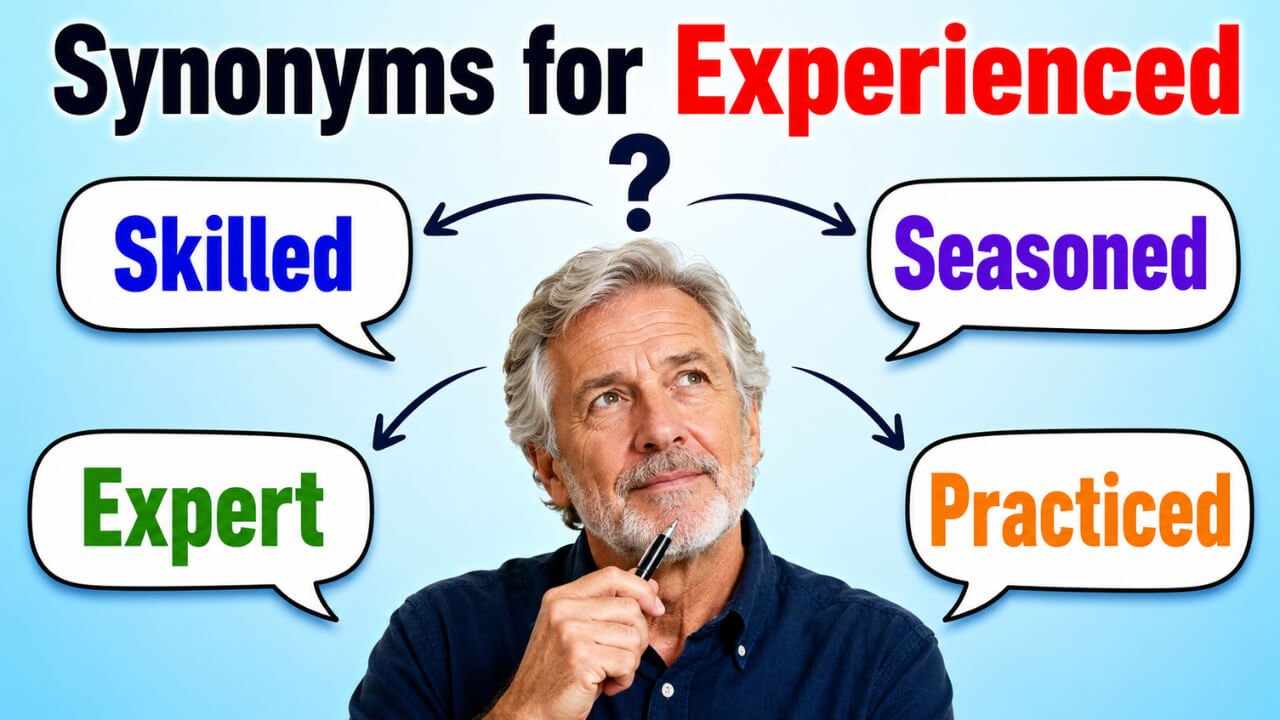
Quick Answer: The best synonyms for experienced are seasoned, skilled, knowledgeable, proficient, expert, practiced, accomplished, competent, qualified, and veteran. Use seasoned for someone with years of practical experience, skilled for proven ability, knowledgeable for strong subject understanding, and proficient for a high level of competence. Expert is best when someone has advanced knowledge, while veteran emphasizes long service. In formal writing, seasoned, proficient, accomplished, and qualified work well. In casual conversation, skilled, familiar, and experienced often sound more natural. The best choice among synonyms for experienced depends on whether you mean ability, knowledge, professional history, repeated practice, or personal exposure.
Pronunciation and Word Details
Word: Experienced
Pronunciation: /ɪkˈspɪriənst/
Part of Speech: Adjective
Meaning: Having gained knowledge, skill, or understanding through practice, work, or personal involvement.
US Pronunciation:
UK Pronunciation:
What Does “Experienced” Mean?
Experienced means having knowledge, skill, confidence, or understanding that comes from doing something over time. It is most commonly used as an adjective to describe a person who has dealt with a particular task, subject, role, or situation before.
An experienced teacher has developed teaching ability through years of classroom practice. An experienced traveler understands how to handle different places, schedules, and travel problems. An experienced worker knows how to complete responsibilities efficiently because of previous practice.
The word can also be the past tense or past participle of the verb experience. In that use, it means that someone went through, felt, or encountered something.
Example: She experienced several challenges during the project.
As an adjective, experienced is usually followed by a noun or used after a linking verb.
Before a Noun: They hired an experienced editor.
After a Linking Verb: The editor is experienced in academic writing.
Experienced can describe professional ability, practical knowledge, personal familiarity, repeated exposure, or confidence developed over time.
Meaning, Tone, and Context of “Experienced”
Experienced has a positive, neutral, and professional tone. It suggests that someone has learned through practice rather than only through theory.
The word is common in professional writing, job descriptions, personal profiles, formal reports, academic discussions, recommendations, and everyday conversations. It can describe people in nearly any role, including teachers, writers, technicians, managers, travelers, speakers, researchers, and caregivers.
In formal writing, experienced often communicates reliability and proven ability. However, it does not automatically mean that someone is an expert. A person can be experienced without having the highest possible level of skill.
In casual conversation, experienced may simply mean familiar with something.
Example: She is experienced with this type of software.
In personal contexts, the word may describe someone who has faced or handled a particular situation before.
Example: He is experienced in managing difficult conversations.
The tone becomes stronger when experienced is modified by words such as highly, deeply, widely, or extensively.
Example: She is highly experienced in teaching adult learners.
When and How to Use “Experienced”
For Professional Ability: Use experienced when someone has developed practical skill through work.
Example: The experienced technician identified the problem quickly.
For Subject Knowledge: Use experienced when a person understands a field through study and repeated involvement.
Example: We asked an experienced researcher to review the results.
For Repeated Practice: Use experienced when skill has improved through performing the same task many times.
Example: An experienced driver knows how to remain calm in heavy traffic.
For Long Service: Use experienced when someone has worked in a role or field for a considerable period.
Example: The experienced administrator understood how to organize the records efficiently.
For Personal Exposure: Use experienced when someone has already encountered a type of event or situation.
Example: She is experienced in handling unexpected changes.
For Familiarity With Tools: Use experienced with when someone knows how to use a particular tool, system, method, or process.
Example: He is experienced with several editing programs.
For Knowledge of a Field: Use experienced in when referring to an area of work, study, or responsibility.
Example: She is experienced in financial planning.
For Performing an Activity: Use experienced at when emphasizing ability in a particular action, although experienced in is often more natural.
Example: He is experienced at resolving disagreements.
Best Synonyms for Experienced
Seasoned
Synonym: Having extensive practical experience gained over a long period.
Example: A seasoned instructor can adapt lessons to different learning styles.
Skilled
Synonym: Having the ability and training needed to perform something well.
Example: The skilled carpenter completed the detailed work carefully.
Knowledgeable
Synonym: Having a strong understanding of a subject.
Example: She is knowledgeable about grammar and sentence structure.
Proficient
Synonym: Able to perform a task competently and effectively.
Example: He is proficient in preparing detailed reports.
Expert
Synonym: Having advanced knowledge or exceptional skill in a particular area.
Example: The expert reviewer noticed several important errors.
Practiced
Synonym: Skilled because of repeated performance or training.
Example: Her practiced delivery made the speech sound natural.
Accomplished
Synonym: Highly skilled and successful in a particular activity.
Example: He is an accomplished writer with a clear and engaging style.
Competent
Synonym: Having enough ability, knowledge, and judgment to perform successfully.
Example: The competent assistant handled the responsibility without difficulty.
Qualified
Synonym: Having the required knowledge, training, education, or experience.
Example: The position requires a qualified and experienced applicant.
Veteran
Synonym: A person with long and substantial experience in a field or activity.
Example: The veteran journalist knew how to ask focused questions.
50 Synonyms for Experienced with Short Meanings
- Seasoned: Having extensive practical experience.
- Skilled: Able to perform a task well.
- Knowledgeable: Having strong understanding of a subject.
- Proficient: Competent and effective in a particular skill.
- Expert: Having advanced knowledge or ability.
- Practiced: Skilled through repeated performance.
- Accomplished: Highly skilled and successful.
- Competent: Able to perform a responsibility properly.
- Capable: Having the ability to complete something successfully.
- Qualified: Meeting the required standards of skill or knowledge.
- Trained: Taught and prepared to perform a task.
- Veteran: Having long experience in a field.
- Adept: Highly skilled at performing something.
- Masterful: Showing exceptional skill, control, or ability.
- Professional: Showing the skill expected from a trained worker.
- Well Versed: Having detailed knowledge of a subject.
- Familiar: Knowing something through previous contact or use.
- Informed: Having useful knowledge and understanding.
- Tested: Proven through difficult or repeated situations.
- Proven: Shown by experience to be effective or reliable.
- Mature: Showing developed judgment and understanding.
- Savvy: Having practical knowledge and good judgment.
- Sophisticated: Showing advanced knowledge, experience, or understanding.
- Polished: Refined and confident through repeated practice.
- Efficient: Able to produce good results without wasted effort.
- Prepared: Ready because of training, knowledge, or previous experience.
- Specialized: Having focused skill in a particular area.
- Established: Recognized and experienced in a field.
- Authoritative: Showing confident and reliable knowledge.
- Reliable: Consistently able to perform well.
- Resourceful: Skilled at finding practical solutions.
- Insightful: Able to understand situations deeply.
- Perceptive: Quick to notice and understand important details.
- Wise: Showing sound judgment gained through experience.
- Practical: Focused on useful knowledge and real situations.
- Long Serving: Having worked in a role for many years.
- Time Tested: Proven effective through long use or experience.
- Tried: Shown to be dependable through previous use.
- Initiated: Familiar with the knowledge or practices of a field.
- Conversant: Familiar and comfortable with a subject.
- Accustomed: Familiar with something through regular experience.
- Habituated: Used to a condition through repeated exposure.
- Exposed: Having encountered a situation or subject before.
- Learned: Having extensive knowledge gained through study.
- Erudite: Having deep academic or scholarly knowledge.
- Journeyman: A competent worker with practical training and experience.
- Master: A person with exceptional command of a skill.
- Practitioner: A person actively experienced in a profession or activity.
- Specialist: A person with focused knowledge and experience.
- Old Hand: A person with considerable practical experience.
Read Also:
Synonyms for Dynamic
Synonyms for Experienced by Context
When Experienced Means Skilled
Skilled, proficient, adept, practiced, accomplished, competent, and masterful work well when experienced refers to ability developed through practice.
Skilled: Use this for someone who performs a task well.
Example: She is a skilled editor who notices small errors.
Proficient: Use this for a strong and dependable level of ability.
Example: He is proficient in preparing clear financial summaries.
Adept: Use this when someone performs a difficult task with ease.
Example: The facilitator is adept at keeping discussions productive.
Practiced: Use this when repeated performance has created confidence.
Example: Her practiced movements showed years of training.
Accomplished: Use this for someone whose skill has produced notable success.
Example: He is an accomplished musician and composer.
When Experienced Means Knowledgeable
Knowledgeable, informed, well versed, learned, erudite, insightful, and authoritative are suitable when experienced emphasizes understanding.
Knowledgeable: Best for broad or useful understanding of a subject.
Example: The guide was knowledgeable about local history.
Well Versed: Best for detailed familiarity with a subject or process.
Example: She is well versed in formal grammar rules.
Informed: Best when someone has accurate and current knowledge.
Example: An informed decision requires careful consideration.
Learned: Best for knowledge gained through serious study.
Example: The learned professor explained the historical context.
Authoritative: Best for knowledge that sounds reliable and confident.
Example: The book provides an authoritative explanation of the subject.
When Experienced Means Seasoned
Seasoned, veteran, established, long serving, proven, tested, and old hand emphasize long practical involvement.
Seasoned: Best for someone with years of real practice.
Example: A seasoned manager can recognize problems before they grow.
Veteran: Best for a person with long service in a profession or activity.
Example: The veteran reporter remained calm during the interview.
Established: Best for someone who has built a recognized position or reputation.
Example: She is an established researcher in language education.
Long Serving: Best for someone who has remained in a role for many years.
Example: The long serving teacher was respected by generations of students.
Proven: Best when past performance has demonstrated ability.
Example: They selected a proven leader to direct the project.
When Experienced Means Familiar
Familiar, conversant, accustomed, habituated, initiated, and exposed describe knowledge developed through contact or repeated experience.
Familiar: Best when someone recognizes or understands something from previous use.
Example: I am familiar with the basic editing process.
Conversant: Best in formal writing when someone understands a subject well enough to discuss it.
Example: She is conversant with several approaches to language teaching.
Accustomed: Best when someone has become comfortable with a condition.
Example: He is accustomed to working under strict deadlines.
Initiated: Best when someone has been introduced to specialized knowledge or practice.
Example: Only initiated members understood the traditional procedure.
Exposed: Best when someone has encountered an idea, environment, or situation before.
Example: Students exposed to different writing styles often develop greater flexibility.
When Experienced Means Professionally Prepared
Qualified, trained, professional, prepared, specialized, capable, and reliable describe readiness for a role.
Qualified: Best when someone meets formal or practical requirements.
Example: A qualified instructor should understand both theory and practice.
Trained: Best when someone has received instruction for a specific task.
Example: A trained technician completed the inspection.
Professional: Best when someone behaves or performs according to recognized standards.
Example: Her professional approach created confidence.
Specialized: Best when someone has focused experience in one area.
Example: The clinic requires a specialized therapist.
Reliable: Best when experience has made someone dependable.
Example: We need a reliable assistant who can manage sensitive information.
Another Word for Experienced
Seasoned is often the best single replacement for experienced when describing someone with years of practical knowledge. It suggests that the person has handled many situations and developed sound judgment.
However, seasoned is not suitable in every sentence. Use skilled when ability is most important, knowledgeable when subject understanding matters, and familiar when someone has previous contact with something.
Original: She is an experienced teacher who understands different learning needs.
Better Option: She is a seasoned teacher who understands different learning needs.
Original: He is an experienced designer with excellent technical ability.
Better Option: He is a skilled designer with excellent technical ability.
Original: We need an experienced person to explain the regulations.
Better Option: We need a knowledgeable person to explain the regulations.
Original: She is experienced with the new filing system.
Better Option: She is familiar with the new filing system.
When Not to Use “Experienced”
Experienced can sound vague when the sentence does not explain the relevant skill, field, or situation. Readers may understand that a person has experience but not what that experience involves.
Add a specific area whenever possible.
Weak: We are looking for an experienced person.
Better: We are looking for a skilled editor with experience in academic writing.
Do not use experienced as a substitute for expert when you mean the highest level of knowledge. Someone may have years of experience without being an expert.
Weak: He has worked in the field for two years, so he is an experienced expert.
Better: He has practical experience in the field and continues to develop his expertise.
Avoid using seasoned when experienced refers to going through an event. Seasoned describes developed skill, not simply personal exposure.
Weak: She was seasoned a difficult childhood.
Better: She experienced a difficult childhood.
Do not repeat experienced several times in one paragraph. Replace repeated uses with more exact alternatives.
Weak: The experienced manager hired an experienced assistant to support the experienced team.
Better: The seasoned manager hired a skilled assistant to support the established team.
Avoid using experienced when trained or qualified is more accurate. Training and qualifications describe preparation or formal requirements, while experience describes previous involvement.
Weak: Every experienced applicant must hold the required certificate.
Better: Every qualified applicant must hold the required certificate.
Words Commonly Confused With Experienced
Experienced vs Expert: Experienced means having gained knowledge or ability through practice. Expert means having an exceptionally high level of knowledge or skill. An experienced person is not always an expert.
Experienced vs Skilled: Experienced focuses on previous involvement and practice. Skilled focuses on the ability to perform well. Someone may be experienced but only moderately skilled.
Experienced vs Qualified: Experienced refers to practical background. Qualified means meeting the required standards, education, training, or credentials for a role.
Experienced vs Seasoned: Both words suggest practical knowledge. Seasoned usually implies longer and broader experience, especially in a profession.
Experienced vs Knowledgeable: Experienced describes learning through involvement. Knowledgeable describes strong understanding, which may come from study, observation, or practice.
Experienced vs Familiar: Experienced suggests deeper involvement and developed ability. Familiar means knowing or recognizing something through previous contact.
Experienced vs Trained: Experienced means someone has performed or encountered something before. Trained means someone has received instruction or preparation.
Experienced vs Accomplished: Experienced emphasizes time and practice. Accomplished emphasizes impressive ability and successful results.
Which Synonym Should You Choose?
Choose seasoned when describing someone with many years of practical professional experience.
Choose skilled when ability and performance are more important than length of service.
Choose knowledgeable when discussing strong understanding of a topic, rule, subject, or field.
Choose proficient when you need a formal word for a dependable level of competence.
Choose expert when the person has advanced knowledge and recognized mastery.
Choose practiced when repeated performance has made an action smooth and confident.
Choose accomplished when someone has achieved success through developed skill.
Choose competent when a person can perform a responsibility correctly and reliably.
Choose qualified when education, training, experience, or formal requirements matter.
Choose veteran when emphasizing long service in a field, profession, or activity.
Choose familiar in casual speech when someone has used, seen, or encountered something before.
Choose well versed in formal reports, essays, or professional communication when someone understands a subject thoroughly.
Choose savvy in conversational writing when practical judgment is important.
Choose proven when past results have demonstrated reliability or success.
Choose specialized when someone has focused experience in a narrow area.
Real Life Examples of “Experienced” in Sentences
Original: The experienced nurse reassured the nervous patient.
Better Option: The seasoned nurse reassured the nervous patient.
Original: We need an experienced writer for this detailed project.
Better Option: We need a skilled writer for this detailed project.
Original: She is experienced in language instruction.
Better Option: She is proficient in language instruction.
Original: He is an experienced researcher with deep subject knowledge.
Better Option: He is a knowledgeable researcher with deep subject understanding.
Original: The experienced speaker answered every question confidently.
Better Option: The accomplished speaker answered every question confidently.
Original: An experienced mechanic inspected the engine.
Better Option: A trained mechanic inspected the engine.
Original: She is experienced with this type of equipment.
Better Option: She is familiar with this type of equipment.
Original: The experienced manager handled the disagreement calmly.
Better Option: The veteran manager handled the disagreement calmly.
Original: They selected an experienced applicant for the role.
Better Option: They selected a qualified applicant for the role.
Original: His experienced eye noticed the difference immediately.
Better Option: His practiced eye noticed the difference immediately.
Synonym Groups and Usage Differences
Professional Experience Group
Seasoned, veteran, established, long serving, professional, and old hand describe people who have worked in a field for a considerable time.
Seasoned is broadly positive and professional. Veteran emphasizes length of service. Established may also suggest a strong reputation. Old hand is more conversational.
Example: The seasoned administrator understood how to handle the complex situation.
Skill Group
Skilled, proficient, adept, accomplished, masterful, competent, and capable emphasize ability rather than time.
Skilled is broad and natural. Proficient is more formal. Adept suggests ease and confidence, while masterful indicates exceptional ability.
Example: The adept negotiator helped both sides reach an agreement.
Knowledge Group
Knowledgeable, well versed, informed, learned, erudite, insightful, and authoritative describe understanding.
Knowledgeable works in most contexts. Well versed suggests detailed familiarity. Learned and erudite are more academic, while authoritative suggests reliable expertise.
Example: The knowledgeable instructor answered the technical questions clearly.
Training and Qualification Group
Qualified, trained, prepared, specialized, practitioner, and specialist describe readiness for a role or responsibility.
Qualified may include education, training, and experience. Trained focuses on instruction. Specialized describes focused knowledge in a narrow area.
Example: A trained practitioner should complete the assessment.
Familiarity Group
Familiar, conversant, accustomed, habituated, initiated, and exposed describe different levels of previous contact.
Familiar is broad and common. Conversant is more formal. Accustomed describes comfort developed through repetition, while exposed only indicates that someone has encountered something.
Example: She is accustomed to managing several responsibilities at once.
Proven Ability Group
Proven, tested, reliable, polished, efficient, and time tested emphasize dependable performance.
Proven and tested suggest that ability has been demonstrated. Polished refers to refined performance, while efficient focuses on completing work with little wasted effort.
Example: His proven ability made him a dependable choice for the task.
Judgment Group
Mature, savvy, sophisticated, resourceful, perceptive, practical, and wise describe judgment developed through life or professional experience.
Savvy is conversational and suggests practical awareness. Perceptive describes the ability to notice important details. Wise emphasizes sound judgment.
Example: Her practical approach helped the group solve the problem quickly.
Antonyms of Experienced
The opposite of experienced depends on whether the word refers to skill, knowledge, professional background, or familiarity.
Inexperienced: Lacking sufficient practice or previous involvement.
Unskilled: Lacking the ability needed to perform a task well.
Novice: A person who is new to an activity or field.
Beginner: Someone who has recently started learning or practicing.
Amateur: A person who participates without professional status or advanced skill.
Untrained: Not taught or prepared for a task.
Unqualified: Not meeting the necessary standards or requirements.
Unfamiliar: Not knowing or recognizing something through previous contact.
New: Recently introduced to a role, activity, or situation.
Raw: Lacking refinement, practice, or developed ability.
Naive: Lacking practical understanding or worldly experience.
Green: Informally describing someone who is new and inexperienced.
Inept: Lacking skill or ability in a particular activity.
Unprepared: Not ready to manage a task or situation.
Uninformed: Lacking necessary knowledge or information.
Comparison: Experienced vs Related Words
Experienced vs Seasoned
Experienced means having knowledge or skill from previous involvement. Seasoned usually suggests greater depth, longer service, and broader practical judgment.
Example With Experienced: She is an experienced teacher who has worked with several age groups.
Example With Seasoned: She is a seasoned teacher who can handle even the most difficult classroom situations.
Experienced vs Skilled
Experienced focuses on what someone has done before. Skilled focuses on how well someone can perform.
Example With Experienced: He is experienced in repairing older machines.
Example With Skilled: He is skilled at identifying mechanical problems quickly.
Experienced vs Expert
Experienced describes someone with meaningful practice. Expert describes someone with advanced or exceptional knowledge.
Example With Experienced: An experienced editor reviewed the first draft.
Example With Expert: An expert editor explained the complex grammatical issue.
Experienced vs Qualified
Experienced refers to practical background, while qualified refers to meeting requirements through training, education, credentials, or ability.
Example With Experienced: The experienced applicant had worked in similar roles.
Example With Qualified: The qualified applicant held the required certificate.
Experienced vs Knowledgeable
Experienced suggests learning through doing. Knowledgeable means having strong information or understanding, regardless of how it was gained.
Example With Experienced: She is experienced in managing large events.
Example With Knowledgeable: She is knowledgeable about event safety requirements.
Experienced vs Familiar
Experienced suggests deeper practice and developed ability. Familiar suggests recognition or basic knowledge through prior contact.
Example With Experienced: He is experienced in operating the equipment.
Example With Familiar: He is familiar with the equipment controls.
Common Phrases and Expressions With “Experienced”
Experienced Professional: A person with developed ability and practical work history.
Experienced Worker: Someone who has performed a particular type of work before.
Experienced Teacher: A teacher with substantial classroom knowledge and practice.
Experienced Leader: Someone who has guided people or projects successfully.
Experienced User: A person who understands how to use a system, tool, or method.
Experienced Traveler: Someone familiar with planning trips and handling travel situations.
Experienced Eye: The ability to notice details because of developed knowledge.
Experienced Hand: A person whose practical skill comes from repeated work.
Highly Experienced: Having a considerable amount of skill and practical background.
Experienced In: Having knowledge or ability within a particular field or activity.
Common Mistakes to Avoid
Repeating Experienced Too Often: Repetition makes descriptions sound general. Use seasoned, skilled, qualified, knowledgeable, or proficient when those words express the meaning more precisely.
Treating Experienced and Expert as Identical: Experience does not always equal mastery. Use expert only when someone has advanced knowledge or exceptional skill.
Confusing Experience With Qualifications: A person can be experienced without holding formal qualifications. A qualified person may also have limited practical experience.
Using the Wrong Preposition: Use experienced in for fields and activities. Use experienced with for tools, systems, methods, or types of work.
Correct: She is experienced in project planning.
Correct: She is experienced with digital editing tools.
Using Experienced for an Event Incorrectly: As an adjective, experienced describes a person with developed familiarity. As a verb, experienced means went through something.
Adjective: He is an experienced traveler.
Verb: He experienced several delays during the journey.
Using Weak General Descriptions: Experienced is less helpful when the reader does not know the relevant area.
Weak: She is very experienced.
Better: She is highly experienced in teaching advanced grammar.
Adding Redundant Words: Expressions such as experienced veteran may repeat the same basic idea. Choose one strong word unless both ideas add useful detail.
Choosing an Unnatural Synonym: Erudite works for deep scholarly knowledge, but it does not naturally describe practical tasks. Skilled or seasoned is usually better for physical or professional work.
Overstating Ability: Do not call someone accomplished, masterful, or expert unless the context supports that stronger claim.
Conclusion
The most useful synonyms for experienced include seasoned, skilled, knowledgeable, proficient, expert, practiced, accomplished, qualified, and veteran. Seasoned emphasizes years of practical work, while skilled and proficient focus on ability. Knowledgeable describes strong understanding, and familiar works for previous contact with a tool or subject. Expert and masterful should be reserved for advanced ability. Choosing the right alternative makes your writing clearer by showing whether you mean professional history, practical skill, subject knowledge, long service, or familiarity.
FAQs About Synonyms for Experienced
What Is the Best Synonym for Experienced?
Seasoned is often the best general synonym for someone with years of practical experience. Skilled is better when ability matters more than length of service.
Is Skilled the Same as Experienced?
Not exactly. Skilled means able to perform something well, while experienced means having done or encountered it before. A person can be experienced without being highly skilled.
What Is a Formal Synonym for Experienced?
Proficient, accomplished, qualified, seasoned, knowledgeable, and well versed are useful formal alternatives.
What Is Another Word for a Very Experienced Person?
Expert, veteran, master, specialist, seasoned professional, and old hand can describe a very experienced person. The best choice depends on the context and tone.
Can Experienced Mean Knowledgeable?
Yes. Experienced can suggest knowledge developed through practical involvement. However, knowledgeable focuses more directly on understanding a subject.
What Is the Opposite of Experienced?
Common opposites include inexperienced, unskilled, novice, beginner, untrained, unfamiliar, and unqualified.
Should I Use Experienced In or Experienced With?
Use experienced in for a field, role, or activity. Use experienced with for a tool, system, process, or type of equipment.
