
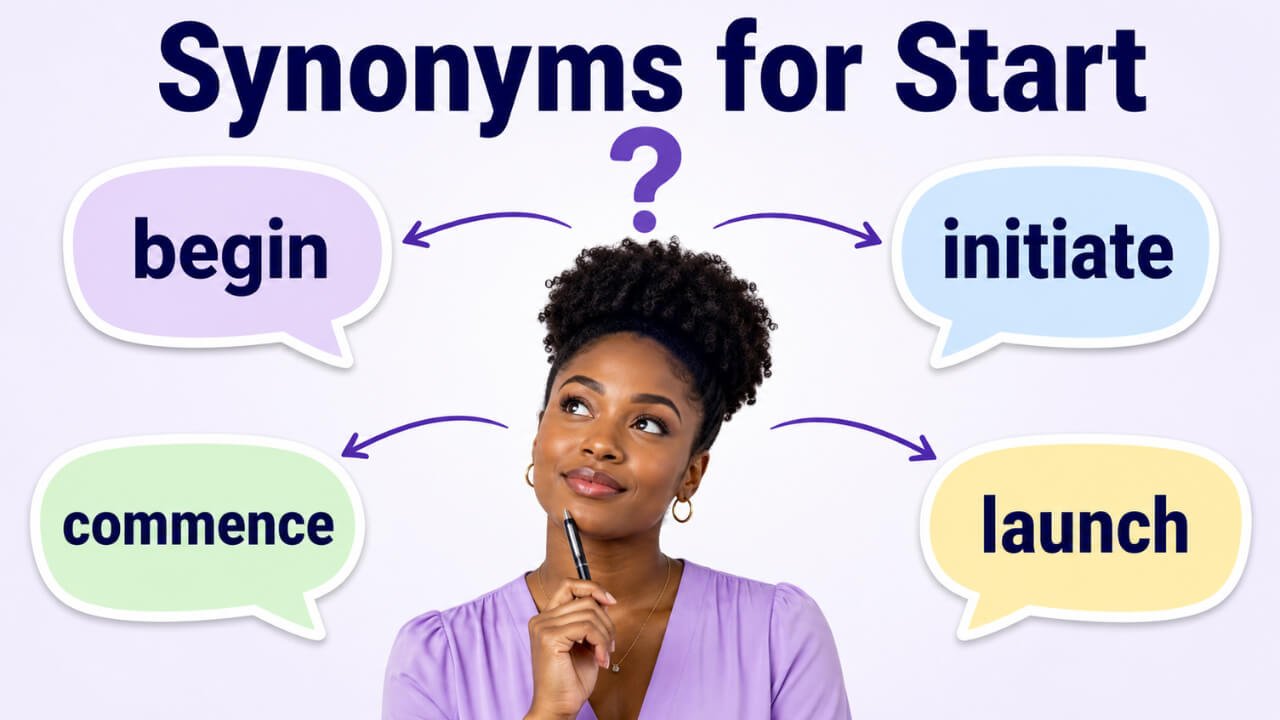
Quick Answer: The best synonyms for start include begin, commence, initiate, launch, open, create, introduce, establish, trigger, and set up. For everyday speech, begin is the most natural choice. For formal writing, commence and initiate work well. For business, launch is strong when talking about a product, project, or campaign. For causes and reactions, trigger is more accurate. For building something new, establish or create is often the better synonym.
Pronunciation and Word Details
Word: Start
Pronunciation: /stɑːrt/
Part of Speech: Verb and noun
Meaning: To begin doing something, cause something to begin, or refer to the first point of an action, event, or process.
US Pronunciation:
UK Pronunciation:
What Does “Start” Mean?
Start means to begin, to make something begin, or to mark the first point of an action, event, process, journey, or activity. It can work as a verb or a noun.
As a verb, start describes an action beginning. For example, you can start a meeting, start a job, start a project, or start learning a language. As a noun, start refers to the beginning point. For example, a race has a start, a story has a start, and a business can have a strong start.
Start is a common and flexible word. It works in casual speech, business writing, instructions, stories, academic writing, and daily conversation.
Meaning, Tone, and Context of “Start”
Start has a neutral and natural tone. It is not too formal or too casual, so it fits many situations. In conversation, people often use start because it is simple and clear. In formal writing, words like begin, commence, initiate, or launch may sound more precise.
Start can be used in practical, emotional, technical, and professional contexts. You can start a car, start a conversation, start a habit, start a company, start a problem, or start a new chapter in life.
The tone changes by context. In “start a fight,” the word feels negative. In “start a new career,” it feels hopeful. In “start the engine,” it sounds technical. In “start the meeting,” it sounds professional.
When and How to Use “Start”
For Beginning an Action: Use start when an activity begins.
Example: We will start the lesson at nine o’clock.
For Creating Something New: Use start when someone forms, builds, or opens something.
Example: She wants to start a small business this year.
For Causing a Reaction: Use start when one thing causes another thing to happen.
Example: The loud noise started a panic in the crowd.
For Machines and Systems: Use start when turning on an engine, program, or device.
Example: Press the button to start the machine.
For Life Changes: Use start when describing a new stage, habit, routine, or direction.
Example: He decided to start exercising every morning.
For Events and Meetings: Use start when an event officially begins.
Example: The conference will start after lunch.
Best Synonyms for Start
Begin: To do the first part of something.
Example: Let us begin the discussion with the main issue.
Commence: To begin in a formal or official way.
Example: The ceremony will commence at noon.
Initiate: To cause a process, plan, or action to begin.
Example: The manager initiated a new training program.
Launch: To start a product, project, business, or campaign.
Example: The company plans to launch a new service.
Open: To begin an event, meeting, speech, or activity.
Example: She opened the meeting with a short welcome.
Create: To bring something new into existence.
Example: They created a new system for tracking orders.
Establish: To start something that is meant to last.
Example: The group established a new community center.
Introduce: To bring something new into use, discussion, or practice.
Example: The school introduced a new reading program.
Trigger: To cause something to start suddenly.
Example: The announcement triggered a strong public reaction.
Set Up: To prepare and start a system, plan, business, or arrangement.
Example: They set up a new office in the city.
50 Synonyms for Start with Short Meanings
- Begin: To do the first part of something.
- Commence: To start formally or officially.
- Initiate: To cause something to begin.
- Launch: To start a project, product, or campaign.
- Open: To begin an event, meeting, or discussion.
- Create: To make something new begin to exist.
- Establish: To start something lasting or organized.
- Introduce: To bring something new into use.
- Trigger: To cause something to begin suddenly.
- Set Up: To arrange and start something.
- Found: To start an organization or institution.
- Form: To create or bring together.
- Develop: To start and gradually improve something.
- Generate: To produce or cause something to begin.
- Activate: To make a system or process start working.
- Turn On: To start a device, machine, or system.
- Ignite: To start a fire, emotion, or strong reaction.
- Spark: To start interest, activity, or emotion.
- Provoke: To cause a reaction, often a negative one.
- Prompt: To cause someone to act or respond.
- Begin Again: To start another time after stopping.
- Restart: To start again after a pause or failure.
- Resume: To start again after an interruption.
- Open Up: To begin or make something available.
- Get Going: To begin moving or taking action.
- Get Started: To begin an activity or task.
- Kick Off: To begin an event, project, or activity.
- Lead Off: To begin a speech, list, event, or performance.
- Embark On: To begin a journey, project, or serious effort.
- Enter Into: To begin a formal agreement, process, or relationship.
- Undertake: To begin and accept responsibility for a task.
- Set In Motion: To cause a process to begin.
- Put in Motion: To make a plan or process begin.
- Start Up: To begin operating, especially for a machine or business.
- Institute: To start a rule, system, or program officially.
- Inaugurate: To officially begin a period, service, or position.
- Originate: To begin or come from a source.
- Arise: To begin to exist or appear.
- Emerge: To begin to appear or become known.
- Dawn: To begin or become clear gradually.
- Open Fire: To start shooting or attacking.
- Break Out: To begin suddenly, often for conflict, illness, or fire.
- Come Into Being: To begin to exist.
- Take Shape: To begin to develop into a clear form.
- Take Off: To start becoming successful or active.
- Start Out: To begin in a particular way.
- Proceed: To begin or continue with an action.
- Move Into: To begin a new activity, stage, or area.
- Give Rise To: To cause something to begin or exist.
- Bring About: To cause something to happen or begin.
Read Also:
Synonyms for Fantastic

Synonyms for Start by Context
When Start Means Begin an Action
Use these synonyms when someone begins doing something.
Begin: We will begin the test after the instructions.
Get Started: Let us get started before the room gets busy.
Get Going: She got going early to finish the report.
Kick Off: The team kicked off the project with a planning session.
Lead Off: He led off the meeting with a short update.
When Start Means Create Something New
Use these synonyms when something new is made, formed, or brought into existence.
Create: They created a new training guide for employees.
Establish: The charity established a support center.
Found: She founded a school for young artists.
Form: The neighbors formed a local safety group.
Set Up: He set up a small online store.
When Start Means Officially Begin
Use these synonyms in formal, legal, academic, or official situations.
Commence: The hearing will commence at ten o’clock.
Initiate: The department initiated a review of the policy.
Institute: The board instituted a new rule.
Inaugurate: The city inaugurated a new public library.
Enter Into: Both parties entered into a formal agreement.
When Start Means Cause Something to Happen
Use these synonyms when one action causes a result, reaction, or process.
Trigger: The mistake triggered a long delay.
Spark: Her speech sparked a useful discussion.
Generate: The campaign generated new interest.
Prompt: The warning prompted people to leave the area.
Bring About: The change brought about better results.
When Start Means Begin Again
Use these synonyms when something begins after stopping.
Restart: Please restart the computer.
Resume: Classes will resume after the break.
Begin Again: After the error, they began again with a fresh plan.
Start Over: He started over after losing the file.
When Start Means Machine or System Operation
Use these synonyms when a device, engine, program, or system begins working.
Activate: Activate the alarm before leaving.
Turn On: Turn on the lights when you enter.
Start Up: The system started up slowly.
Power Up: The device powered up after charging.
Another Word for Start
Another word for start is begin. It is the best general replacement because it works in most everyday and formal contexts. However, the best alternative depends on the sentence. Use commence for official events, initiate for processes, launch for products or projects, and trigger for causes.
Original: We will start the meeting at ten.
Better Option: We will begin the meeting at ten.
Original: The company will start a new product next month.
Better Option: The company will launch a new product next month.
Original: The loud sound started a reaction.
Better Option: The loud sound triggered a reaction.
Original: She started a charity in her hometown.
Better Option: She founded a charity in her hometown.
When Not to Use “Start”
Avoid using start when a more specific synonym would make the sentence clearer. Start is useful, but it can sound plain or repetitive if used too often.
Weak: The company started a product in June.
Better: The company launched a product in June.
Weak: The new law started better safety rules.
Better: The new law introduced better safety rules.
Weak: The professor started a formal lecture at noon.
Better: The professor commenced the lecture at noon.
Weak: The accident started traffic problems.
Better: The accident triggered traffic problems.
Weak: She started a university in the city.
Better: She founded a university in the city.
Use start for general meaning. Use a stronger synonym when the sentence needs precision, formality, or a specific type of beginning.
Words Commonly Confused With Start
Start vs Begin: Start and begin often mean the same thing. Begin sounds slightly smoother in formal writing, while start is common in everyday speech.
Start vs Commence: Commence means start in a formal or official way. It is better for ceremonies, legal actions, academic events, and official notices.
Start vs Initiate: Initiate means to cause a process, plan, or system to begin. It sounds more deliberate and organized than start.
Start vs Launch: Launch means to start something publicly or actively, especially a business, product, campaign, or project.
Start vs Create: Create means to make something new. Start focuses on the beginning, while create focuses on producing something.
Start vs Trigger: Trigger means to cause something to begin, often suddenly. It is common for reactions, problems, emotions, and events.
Start vs Establish: Establish means to start something that is organized, stable, or meant to last.
Which Synonym Should You Choose?
Choose begin when you want a clear and natural alternative for most sentences.
Choose commence when writing about formal events, ceremonies, official processes, or legal actions.
Choose initiate when writing about plans, programs, systems, investigations, or processes.
Choose launch when writing about products, businesses, campaigns, projects, websites, or public efforts.
Choose establish when writing about organizations, institutions, systems, rules, or long term arrangements.
Choose create when the focus is on making something new.
Choose trigger when one event causes another event, reaction, emotion, or problem.
Choose open when beginning a speech, meeting, event, discussion, or performance.
Choose set up when you mean prepare and start something practical, such as an account, office, system, or business.
Choose resume when something starts again after a break or interruption.
Real Life Examples of “Start” in Sentences
Original: We will start the class with a short review.
Better Option: We will begin the class with a short review.
Original: The company will start a new branch next year.
Better Option: The company will establish a new branch next year.
Original: She started a campaign for cleaner streets.
Better Option: She launched a campaign for cleaner streets.
Original: The teacher started a discussion about grammar.
Better Option: The teacher opened a discussion about grammar.
Original: The report started a debate among the staff.
Better Option: The report sparked a debate among the staff.
Original: They started the machine after checking the wires.
Better Option: They activated the machine after checking the wires.
Original: He started a small business from home.
Better Option: He set up a small business from home.
Original: The delay started more complaints from customers.
Better Option: The delay triggered more complaints from customers.
Original: The group started a new support program.
Better Option: The group initiated a new support program.
Original: Classes will start again next week.
Better Option: Classes will resume next week.
Synonym Groups and Usage Differences
Beginning Group
This group includes words that simply mean to begin an action or activity. Begin, get started, get going, and kick off are useful when the focus is on the first step.
Example: Let us begin the training with the basics.
Formal Start Group
This group includes commence, initiate, institute, and inaugurate. These synonyms work best in official, academic, legal, or professional writing.
Example: The committee will initiate a review next month.
Creation Group
This group includes create, form, found, establish, and set up. These words are useful when someone brings something new into existence.
Example: She founded a small education center.
Cause Group
This group includes trigger, spark, prompt, generate, and bring about. These words show that one thing causes another thing to begin.
Example: The news sparked a serious conversation.
Machine and System Group
This group includes activate, turn on, start up, and power up. These words are best for machines, devices, engines, programs, and systems.
Example: Press this switch to activate the device.
Continue After Pause Group
This group includes restart, resume, begin again, and start over. These synonyms work when something begins after stopping.
Example: Work will resume after the holiday.
Antonyms of Start
Antonyms of start depend on whether start means begin, create, activate, or cause.
End: To finish or stop completely.
Stop: To no longer continue an action.
Finish: To complete something.
Conclude: To bring something to an end formally.
Close: To end an event, business, meeting, or process.
Cease: To stop happening or operating.
Halt: To stop movement, progress, or action.
Pause: To stop for a short time.
Suspend: To stop something temporarily.
Terminate: To end something officially or permanently.
Shut Down: To stop a machine, system, or organization from operating.
Abandon: To stop doing or supporting something before it is complete.
Comparison: Start vs Related Words
Start vs Begin
Start and begin are very close in meaning. Start is more common in daily speech. Begin sounds slightly more polished in writing.
Example With Start: We will start the lesson now.
Example With Begin: We will begin the lesson now.
Start vs Commence
Commence is more formal than start. Use it for official events, ceremonies, legal actions, and formal notices.
Example With Start: The event will start at six.
Example With Commence: The event will commence at six.
Start vs Initiate
Initiate means to start something intentionally, especially a plan, process, or system.
Example With Start: The manager started a review.
Example With Initiate: The manager initiated a review.
Start vs Launch
Launch is stronger than start when something begins publicly or with planning, such as a product, business, campaign, or project.
Example With Start: They started a new service.
Example With Launch: They launched a new service.
Start vs Establish
Establish means to start something stable or long lasting. It is often used for institutions, systems, companies, and rules.
Example With Start: They started a local club.
Example With Establish: They established a local club.
Start vs Trigger
Trigger means to cause something to begin, usually a reaction, result, problem, or event.
Example With Start: The speech started a debate.
Example With Trigger: The speech triggered a debate.
Common Phrases and Expressions With Start
Start Over: Begin again from the beginning.
Start Again: Begin another time after stopping.
Start From Scratch: Begin with nothing already prepared.
Start Strong: Begin with energy, success, or confidence.
Start Small: Begin with a simple or limited first step.
Start Early: Begin before the usual or expected time.
Start a Conversation: Begin talking about a topic.
Start a Business: Create and begin operating a business.
Start a Fire: Cause a fire to begin.
Start a Habit: Begin doing something regularly.
Start the Day: Begin the day in a certain way.
Start at the Beginning: Begin from the first part.
Common Mistakes to Avoid
One common mistake is using start too often in the same paragraph. Repetition can make writing sound basic. Replace some uses with begin, launch, initiate, establish, or trigger depending on context.
Another mistake is choosing a synonym that does not fit the meaning. Do not use launch for every kind of beginning. Launch works for products, campaigns, projects, and public efforts, but not for simple actions like starting breakfast.
Avoid using commence in casual sentences where it sounds too formal. “Let us commence eating” sounds unnatural in everyday speech. “Let us start eating” or “Let us begin eating” sounds better.
Be careful with trigger. It does not simply mean begin. It means cause something to begin, especially a reaction, result, or event.
Also avoid vague phrasing. Instead of “start something,” explain what begins. Clear writing helps readers understand the action, purpose, and result.
Conclusion
The best synonyms for start depend on meaning and context. Begin is the strongest general replacement, while commence fits formal writing, initiate fits processes, launch fits projects or products, and trigger fits causes or reactions. Use establish when something is meant to last, create when something new is made, and resume when something begins again. Learning synonyms for start helps you write with more accuracy, variety, and natural flow without repeating the same word too often.
FAQs About Synonyms for Start
What are the best synonyms for start?
The best synonyms for start are begin, commence, initiate, launch, open, create, establish, introduce, trigger, and set up.
What is the most common synonym for start?
Begin is the most common and useful synonym for start. It works well in both speech and writing.
What is a formal synonym for start?
Commence is a formal synonym for start. Initiate is also formal when talking about a process, plan, or action.
What is another word for start a business?
Good alternatives include launch a business, start up a business, set up a business, establish a business, or found a business.
What is another word for start a project?
Useful options include launch, begin, initiate, kick off, set up, or undertake, depending on tone and context.
What is the difference between start and trigger?
Start means to begin. Trigger means to cause something to begin, often suddenly, such as a reaction, problem, or event.
Can start be a noun and a verb?
Yes. As a verb, start means to begin. As a noun, start means the beginning point of an event, process, activity, or period.
