
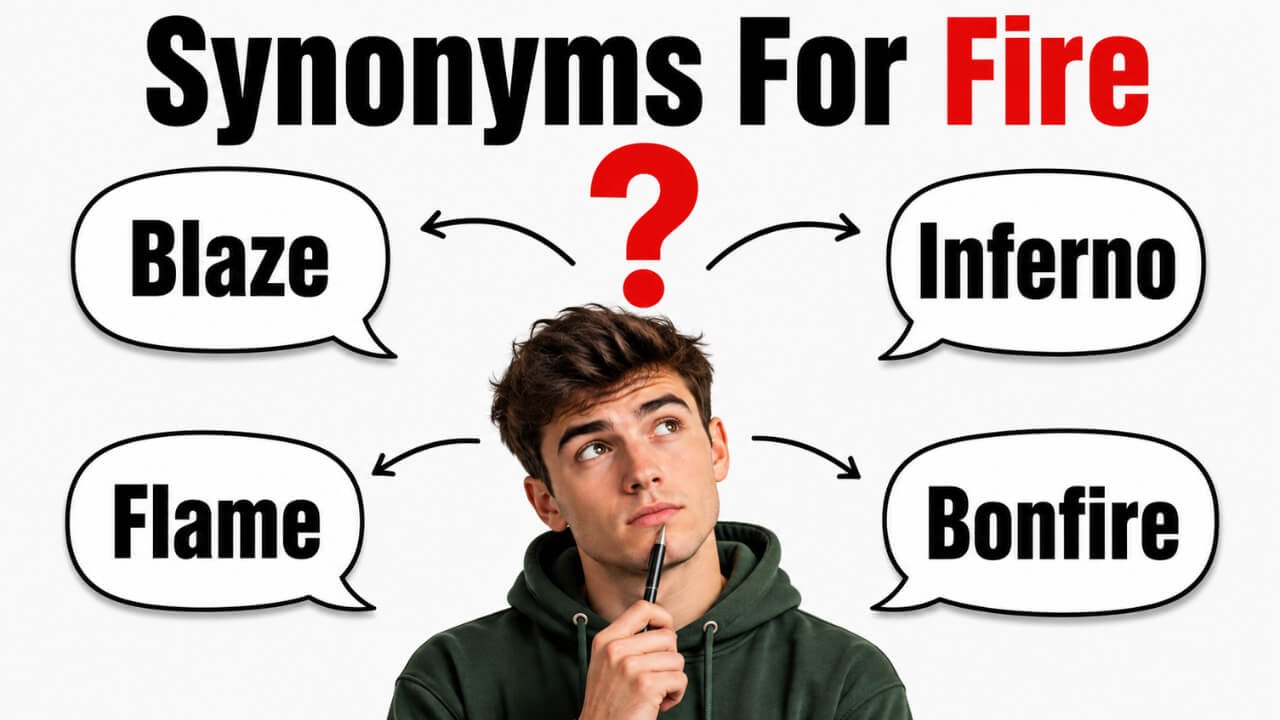
Quick Answer: The best synonyms for fire are flame, blaze, inferno, combustion, heat, passion, energy, ignite, shoot, and dismiss. Use flame for a visible burning light, blaze for a strong or fast burning fire, inferno for a huge destructive fire, ignite when something starts burning, passion or energy for emotional fire, shoot when a weapon fires, and dismiss when fire means remove someone from a job. These synonyms for fire depend strongly on whether fire is used as a noun, verb, emotion, action, or workplace term.
Pronunciation and Word Details
Word: Fire.
Pronunciation: /faɪr/.
Part of Speech: Noun and verb.
Meaning: Fire means burning heat and light, or it can mean to ignite, shoot, dismiss from work, or fill with strong emotion.
US Pronunciation:
UK Pronunciation:
What Does “Fire” Mean?
Fire means burning heat and light produced when something is burning. As a noun, it can describe flames, heat, a blaze, or a destructive burning event. As a verb, fire can mean to set something burning, shoot a weapon, remove someone from a job, or excite strong emotion.
The word fire is flexible because it works in physical, emotional, professional, and action based contexts. A candle has fire, a forest can catch fire, a leader can fire an employee, a soldier can fire a weapon, and a speech can fire the imagination.
Because fire has many meanings, the best synonym depends on the sentence.
Meaning, Tone, and Context of “Fire”
Fire is a common, neutral, and powerful word. It can be literal, emotional, technical, casual, formal, or dramatic depending on context.
In everyday speech, fire often means flames or burning. In professional writing, it can mean dismissal from employment. In military, security, or action writing, it can mean shoot or discharge. In emotional writing, fire can mean passion, energy, anger, courage, or inspiration.
The tone can be warm and positive when fire means enthusiasm. It can be dangerous or urgent when it refers to burning. It can be serious and formal when it means job termination. It can sound intense when used in action scenes, warnings, speeches, and descriptions.
When and How to Use “Fire”
For Burning Flames: Use fire when describing heat, light, flames, smoke, burning wood, candles, stoves, or accidents.
Example: The fire spread quickly through the dry grass.
For Starting Something Burning: Use fire as a verb when something is lit, ignited, or set burning.
Example: The dry leaves fired easily in the strong wind.
For Workplace Dismissal: Use fire when someone is removed from a job, often for poor performance, misconduct, or company decisions.
Example: The company decided to fire the employee after repeated warnings.
For Shooting or Discharging: Use fire when a weapon, cannon, or device releases a shot or force.
Example: The guard was ordered not to fire unless there was danger.
For Passion and Energy: Use fire when describing strong emotion, motivation, courage, or enthusiasm.
Example: Her words filled the team with fire and confidence.
For Anger or Intensity: Use fire when showing a strong emotional reaction.
Example: His eyes showed fire when he heard the unfair comment.
Best Synonyms for Fire
Flame: A visible part of fire that gives light and heat.
Example: A small flame danced above the candle.
Blaze: A strong, bright, or fast burning fire.
Example: The firefighters worked for hours to control the blaze.
Inferno: A very large, dangerous, and destructive fire.
Example: The abandoned building became an inferno within minutes.
Combustion: The process of burning, often used in scientific or technical writing.
Example: Combustion produces heat, light, and gases.
Heat: Warmth or high temperature created by fire.
Example: The heat from the fire filled the room.
Passion: Strong feeling, desire, or enthusiasm.
Example: She spoke with passion about the project.
Energy: Strong activity, force, or excitement.
Example: His speech brought new energy to the group.
Ignite: To start burning or cause something to burn.
Example: A single spark can ignite dry wood.
Shoot: To fire a gun or weapon.
Example: The officer did not shoot because the area was crowded.
Dismiss: To remove someone from a job or position.
Example: The manager had to dismiss the worker for repeated violations.
50 Synonyms for Fire with Short Meanings
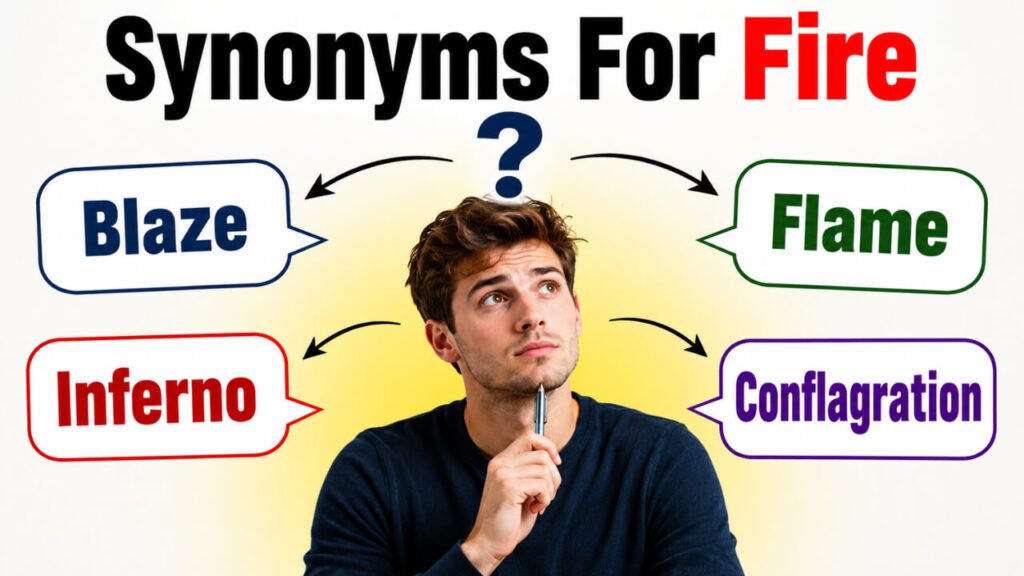
- Flame: Visible burning light and heat.
- Blaze: A strong or bright fire.
- Inferno: A huge and destructive fire.
- Conflagration: A large and damaging fire.
- Combustion: The process of burning.
- Burning: The act or state of being on fire.
- Heat: Warmth produced by fire.
- Glow: Soft light from heat or flame.
- Spark: A tiny piece of fire or sudden cause.
- Ember: A small glowing piece of burned material.
- Bonfire: A large outdoor fire.
- Campfire: A small outdoor fire for warmth or cooking.
- Wildfire: A fast spreading fire in nature.
- Hearth: A fireplace area used for fire.
- Pyre: A pile of wood used for burning.
- Coals: Burned pieces that still give heat.
- Flare: A sudden bright burst of flame.
- Flash: A brief burst of light or flame.
- Torch: A burning light carried by hand.
- Light: To start a fire.
- Ignite: To cause something to burn.
- Kindle: To start a fire gently.
- Set Alight: To make something begin burning.
- Set Ablaze: To make something burn strongly.
- Spark: To cause something to begin.
- Fuel: To make fire or emotion stronger.
- Enflame: To make stronger, hotter, or more emotional.
- Inflame: To excite anger, emotion, or conflict.
- Arouse: To awaken strong feeling or interest.
- Excite: To create strong emotion or activity.
- Inspire: To fill someone with feeling or motivation.
- Energize: To give strength, action, or enthusiasm.
- Motivate: To give someone a reason to act.
- Passion: Strong emotion or desire.
- Zeal: Strong eager interest or effort.
- Fervor: Intense feeling or enthusiasm.
- Ardor: Warmth, passion, or strong feeling.
- Intensity: Strong force, feeling, or effect.
- Spirit: Energy, courage, or inner force.
- Drive: Strong motivation to act.
- Shoot: To fire a weapon.
- Discharge: To release a shot, force, or load.
- Launch: To send or release something forcefully.
- Blast: To shoot, explode, or strike forcefully.
- Fire Off: To send, shoot, or say quickly.
- Dismiss: To remove someone from a job.
- Terminate: To end employment formally.
- Discharge: To release someone from duty or employment.
- Remove: To take someone out of a position.
- Let Go: To dismiss someone from a job in softer language.
Read Also:
Synonyms For Emphasize

Synonyms for Fire by Context
When Fire Means Flame or Burning
Useful Synonyms: Flame, blaze, combustion, burning, heat, glow.
Example: The flame grew brighter as the wood caught.
These words are best for physical fire. Use flame for visible burning, blaze for a stronger fire, combustion for technical writing, and heat when focusing on temperature.
When Fire Means a Large Dangerous Blaze
Useful Synonyms: Inferno, conflagration, wildfire, blaze, flare.
Example: The small fire turned into a dangerous blaze.
Use these synonyms when fire is destructive, large, fast moving, or hard to control. Inferno is dramatic, while conflagration sounds formal and serious.
When Fire Means to Start Burning
Useful Synonyms: Ignite, kindle, light, set alight, set ablaze.
Example: The match ignited the dry paper.
These words work when fire is used as a verb meaning to start a flame. Ignite is the strongest general choice, while kindle sounds gentler and more gradual.
When Fire Means Passion or Energy
Useful Synonyms: Passion, zeal, fervor, ardor, energy, drive.
Example: Her passion for learning inspired the whole class.
These synonyms are useful when fire means inner strength, excitement, desire, courage, or enthusiasm. Passion is emotional, while drive is more focused on action.
When Fire Means to Shoot
Useful Synonyms: Shoot, discharge, launch, blast, fire off.
Example: The device discharged a signal into the air.
These words fit weapons, tools, signals, or objects released with force. Shoot is common, while discharge is more technical or formal.
When Fire Means to Dismiss From a Job
Useful Synonyms: Dismiss, terminate, discharge, remove, let go.
Example: The supervisor dismissed the worker after repeated problems.
These options are used in employment contexts. Dismiss is professional, terminate is formal, and let go sounds softer and less direct.
Another Word for Fire
The best single replacement for fire is flame when the word means burning heat and light. However, the best alternative depends on context. Use ignite when fire means start burning, dismiss when fire means remove from a job, shoot when fire means discharge a weapon, and passion when fire means strong emotion.
Original: The fire burned brightly in the fireplace.
Better Option: The flame burned brightly in the fireplace.
Original: The dry grass began to fire in the heat.
Better Option: The dry grass began to ignite in the heat.
Original: The company may fire him next week.
Better Option: The company may dismiss him next week.
Original: Her speech gave the audience fire.
Better Option: Her speech gave the audience passion.
When Not to Use “Fire”
Do not use fire when the meaning may be unclear. Because fire can mean flames, dismissal, shooting, or emotion, the sentence should give enough context. If the meaning is employment related, use dismiss or terminate in formal writing. If the meaning is physical burning, use flame or blaze when you need more detail.
Weak: The manager said he would fire soon.
Better: The manager said he would dismiss the employee soon.
Weak: The fire in her voice was nice.
Better: The passion in her voice was inspiring.
Weak: The fire moved through the machine.
Better: The combustion process moved through the machine.
Weak: The soldier had to fire the object.
Better: The soldier had to shoot the target.
Weak: The fire was very fire.
Better: The blaze was intense and difficult to control.
Words Commonly Confused With Fire
Fire vs Flame: Fire is the general burning process, while flame is the visible moving part of fire.
Fire vs Blaze: Fire can be small or large, while blaze usually means a strong, bright, or uncontrolled fire.
Fire vs Inferno: Fire is general, while inferno means a huge, dangerous, and destructive fire.
Fire vs Combustion: Fire is common everyday language, while combustion is a technical term for the chemical process of burning.
Fire vs Ignite: Fire can be a noun or verb, while ignite specifically means to start burning.
Fire vs Heat: Fire produces heat, but heat is temperature, not always flame.
Fire vs Passion: Fire can describe strong emotion in figurative writing, while passion directly names that emotion.
Fire vs Dismiss: Fire is a common workplace verb, while dismiss sounds more formal and professional.
Fire vs Shoot: Fire can mean shoot when talking about weapons, but shoot is clearer in everyday action descriptions.
Which Synonym Should You Choose?
Choose flame when writing about visible burning light.
Choose blaze when describing a strong, bright, or spreading fire.
Choose inferno when writing about a huge and dangerous fire.
Choose combustion when writing in a scientific, technical, or mechanical context.
Choose ignite when something starts burning.
Choose kindle when a fire begins gently or gradually.
Choose passion when fire means strong feeling, desire, or love for something.
Choose energy when fire means excitement, movement, or liveliness.
Choose shoot when fire means use a weapon.
Choose discharge when writing formally about releasing a shot, force, or duty.
Choose dismiss when fire means remove someone from a job.
Choose terminate when writing about employment in a formal or official tone.
Real Life Examples of “Fire” in Sentences
Original: The fire warmed the small room.
Better Option: The flame warmed the small room.
Original: The fire spread across the dry field.
Better Option: The blaze spread across the dry field.
Original: The whole building was swallowed by fire.
Better Option: The whole building was swallowed by an inferno.
Original: The match helped fire the paper.
Better Option: The match helped ignite the paper.
Original: Her speech filled the crowd with fire.
Better Option: Her speech filled the crowd with passion.
Original: The officer was told not to fire.
Better Option: The officer was told not to shoot.
Original: The company decided to fire several workers.
Better Option: The company decided to dismiss several workers.
Original: The machine can fire a signal instantly.
Better Option: The machine can discharge a signal instantly.
Original: His words fired their imagination.
Better Option: His words inspired their imagination.
Original: The leader fired the team with confidence.
Better Option: The leader energized the team with confidence.
Synonym Groups and Usage Differences
Burning Group
This group includes words that describe real flames, heat, and burning. Use flame, blaze, combustion, ember, glow, and heat when describing physical fire.
Example: The glowing embers stayed warm long after the flame disappeared.
Destructive Fire Group
This group describes large, dangerous, or uncontrolled fire. Use inferno, conflagration, wildfire, blaze, and flare for serious burning events.
Example: The wildfire moved quickly through the dry forest.
Starting Fire Group
This group describes the action of beginning a fire. Use ignite, light, kindle, set alight, and set ablaze when something begins burning.
Example: A spark can ignite dry leaves in seconds.
Emotion Group
This group describes strong inner feeling. Use passion, zeal, fervor, ardor, energy, and drive when fire means motivation, excitement, or emotional force.
Example: Her zeal helped the team stay focused.
Weapon Action Group
This group describes shooting or releasing force. Use shoot, discharge, launch, blast, and fire off when fire means to release a shot or force.
Example: The device discharged a warning flare.
Employment Group
This group describes job removal. Use dismiss, terminate, discharge, remove, and let go when fire means ending someone’s employment.
Example: The director had to terminate the contract after repeated issues.
Antonyms of Fire
The opposite of fire depends on the meaning. For burning, antonyms relate to cooling, putting out, or preventing flames. For employment, antonyms relate to hiring or keeping someone. For emotion, antonyms relate to calmness or lack of energy.
Water: A liquid often used to put out fire.
Extinguish: To put out a fire or flame.
Quench: To put out fire, thirst, or strong desire.
Cool: To reduce heat or intensity.
Freeze: To become extremely cold.
Douse: To pour liquid over something, often to stop fire.
Smother: To cover a fire so it loses air.
Suppress: To control or stop fire, emotion, or action.
Hire: To give someone a job.
Employ: To keep or place someone in work.
Retain: To keep someone in a position.
Calm: To reduce emotion, anger, or excitement.
Dullness: Lack of energy, passion, or brightness.
Stillness: Lack of movement, action, or excitement.
Comparison: Fire vs Related Words
Fire vs Flame
Fire is the general burning process, while flame is the visible part that moves, glows, and gives light.
Example With Fire: The fire kept everyone warm during the night.
Example With Flame: The candle flame flickered in the window.
Fire vs Blaze
Fire can be small, controlled, or general. Blaze usually suggests a strong, bright, or spreading fire.
Example With Fire: The fire burned quietly in the hearth.
Example With Blaze: The blaze destroyed the empty shed.
Fire vs Inferno
Fire is a broad word. Inferno is stronger and describes an extremely large, dangerous, or terrifying fire.
Example With Fire: The fire damaged the kitchen.
Example With Inferno: The factory became an inferno after the explosion.
Fire vs Combustion
Fire is everyday language. Combustion is technical and refers to the chemical process of burning.
Example With Fire: The fire produced heat and smoke.
Example With Combustion: Combustion produced heat and gases.
Fire vs Ignite
Fire can name the burning thing or describe an action. Ignite means to start burning.
Example With Fire: The campers built a fire before sunset.
Example With Ignite: The campers used dry wood to ignite the flame.
Fire vs Heat
Fire creates heat, but heat can exist without visible flames. Heat refers to temperature, warmth, or intensity.
Example With Fire: The fire crackled in the fireplace.
Example With Heat: The heat from the fireplace filled the room.
Fire vs Passion
Fire can be figurative for strong emotion. Passion directly means strong feeling, love, or enthusiasm.
Example With Fire: His words had fire and courage.
Example With Passion: His words had passion and courage.
Fire vs Dismiss
Fire is common and direct in job contexts. Dismiss is more formal and professional.
Example With Fire: The owner decided to fire the assistant.
Example With Dismiss: The owner decided to dismiss the assistant.
Fire vs Shoot
Fire can mean shoot in weapon contexts. Shoot is clearer when describing the direct action.
Example With Fire: The guard refused to fire.
Example With Shoot: The guard refused to shoot.
Common Phrases and Expressions With Fire
On Fire: Burning, very successful, or full of energy.
Catch Fire: To begin burning.
Set Fire To: To make something burn.
Play With Fire: To take a dangerous risk.
Under Fire: Being attacked, criticized, or pressured.
Fire Away: Start asking or speaking freely.
Fire in the Belly: Strong ambition, courage, or determination.
Light a Fire: To motivate someone to act.
Add Fuel to the Fire: To make a problem, argument, or emotion worse.
Fight Fire With Fire: To respond to a strong action with equal strength.
Common Mistakes to Avoid
A common mistake is using fire without enough context. The word can mean burning, shooting, dismissal, or emotion, so unclear sentences may confuse readers.
Another mistake is using flame, blaze, and inferno as if they are always the same. A flame can be small, a blaze is stronger, and an inferno is huge and destructive.
Writers also confuse fire with heat. Heat is warmth or temperature, while fire is burning that usually produces heat and light.
Avoid using fire in formal employment writing when dismiss or terminate is more professional. Also avoid using exaggerated synonyms such as inferno for a small candle flame.
Do not repeat fire too often in one paragraph. Mix in clearer synonyms only when they match the meaning.
Conclusion
The best synonyms for fire depend on the sentence. Use flame for visible burning, blaze for a strong fire, inferno for a destructive fire, ignite for starting a flame, passion for emotion, shoot for weapons, and dismiss for employment. This guide to synonyms for fire helps you choose precise words for physical descriptions, workplace language, emotional writing, action scenes, and technical explanations. Strong synonym choice makes your writing clearer, sharper, and more natural.
FAQs About Synonyms for Fire
What are the best synonyms for fire?
The best synonyms for fire are flame, blaze, inferno, combustion, heat, ignite, passion, energy, shoot, and dismiss. The right word depends on context.
What is another word for fire as a noun?
Another word for fire as a noun is flame. You can also use blaze for a stronger fire and inferno for a huge destructive fire.
What is another word for fire as a verb?
Another word for fire as a verb can be ignite, shoot, dismiss, discharge, or inspire, depending on the meaning of the sentence.
What is a formal synonym for fire someone?
A formal synonym for fire someone is terminate or dismiss. These words are more suitable for workplace, legal, or official writing.
What is a stronger word than fire?
A stronger word than fire is inferno when describing a huge destructive fire. Blaze is also stronger than fire when the burning is bright or intense.
Is passion a synonym for fire?
Yes, passion can be a synonym for fire when fire means strong emotion, desire, enthusiasm, courage, or inner energy.
What is the difference between fire and flame?
Fire is the general burning process, while flame is the visible part of fire that gives light and heat.
