
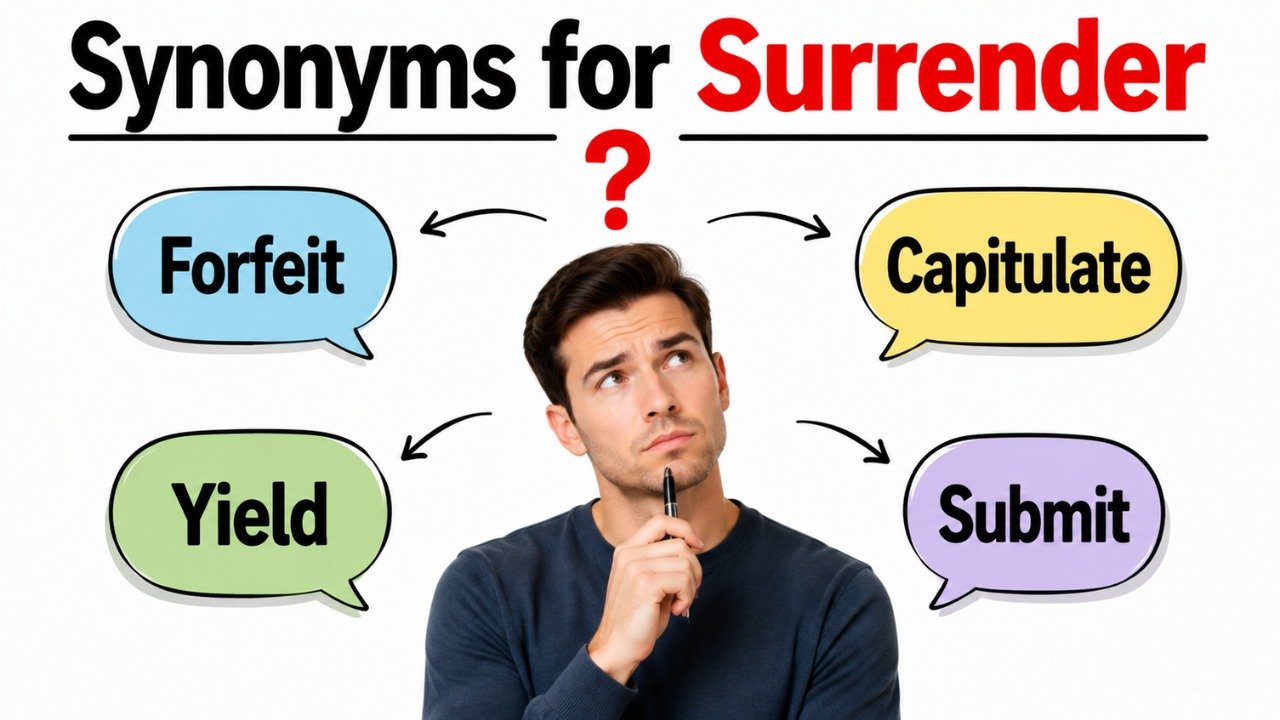
Quick Answer: Useful synonyms for surrender include yield, submit, capitulate, concede, relinquish, abandon, forfeit, give up, hand over, and succumb. The best choice depends on context. Use yield when stopping resistance, submit when accepting another person’s authority, capitulate for formal defeat, concede when admitting loss or accepting a point, relinquish when voluntarily giving up control or possession, abandon when leaving something behind, forfeit when losing a right or possession, give up in casual speech, hand over when transferring an object or control, and succumb when resistance finally fails.
Pronunciation and Word Details
Word: Surrender.
Pronunciation: /səˈrɛn.dɚ/
Part of Speech: Verb and noun.
Meaning: To stop resisting, admit defeat, or give control, possession, or authority to another person or force.
US Pronunciation:
UK Pronunciation:
What Does “Surrender” Mean?
Surrender means to stop resisting and accept defeat, control, authority, or loss. It can function as both a verb and a noun.
As a verb, surrender can describe giving up during a conflict, handing over possession, abandoning control, or accepting that continued resistance is impossible.
Example: The soldiers decided to surrender after their supplies were exhausted.
As a noun, surrender refers to the act of giving up resistance, control, possession, or a claim.
Example: The agreement called for the surrender of the territory.
The word also appears in everyday situations that have nothing to do with conflict.
Example: She surrendered control of the project to a more experienced manager.
In emotional contexts, surrender may describe accepting a feeling, situation, or force instead of trying to resist it.
Example: He finally surrendered to exhaustion and went to sleep.
Meaning, Tone, and Context of “Surrender”
Surrender is generally a neutral to strong word. Its tone depends heavily on the situation.
In military, legal, political, and historical writing, surrender often sounds formal and serious because it describes the end of resistance or the transfer of authority.
In ordinary conversation, surrender can sound dramatic when used for small personal situations. For casual situations, give up, give in, or let go may sound more natural.
In emotional or literary writing, surrender can suggest acceptance, vulnerability, release, or the decision to stop fighting against circumstances.
Formal Context: The commander announced the surrender of the remaining forces.
Casual Context: I finally gave up trying to repair the old printer.
Emotional Context: She surrendered to the feeling of relief.
Legal Context: The court ordered the surrender of the documents.
Competitive Context: The defending champion refused to concede the match.
When and How to Use “Surrender”
For Accepting Defeat
Use surrender when someone stops fighting, competing, or resisting because victory is no longer possible.
Example: The army refused to surrender despite heavy losses.
For Giving Up Control
Use surrender when a person transfers control, authority, or responsibility to someone else.
Example: He surrendered control of the company to the new leadership team.
For Handing Over Property
Surrender can describe officially giving an object, document, possession, or right to another person or authority.
Example: The driver was required to surrender his license.
For Ending Resistance
Use surrender when someone stops opposing pressure, demands, or authority.
Example: After hours of negotiation, the group surrendered to the conditions.
For Giving Up a Claim
Surrender can refer to abandoning a right, position, advantage, or claim.
Example: She refused to surrender her claim to the property.
For Emotional Acceptance
In figurative writing, surrender can describe allowing a feeling or experience to take over.
Example: He surrendered to sleep before finishing the book.
Best Synonyms for Surrender
Yield: To stop resisting or give way under pressure.
Example: The defenders finally yielded after a long struggle.
Submit: To accept the authority, decision, or control of another person.
Example: The group agreed to submit to the ruling.
Capitulate: To formally stop resisting and accept an opponent’s terms.
Example: The weakened forces were forced to capitulate.
Concede: To admit defeat, accept a point, or acknowledge that another side has won.
Example: The candidate conceded after the final results were announced.
Relinquish: To voluntarily give up possession, control, authority, or a right.
Example: She agreed to relinquish control of the account.
Abandon: To leave behind or stop supporting something completely.
Example: They abandoned the plan after discovering serious problems.
Forfeit: To lose or give up a right, possession, privilege, or opportunity.
Example: A violation of the rules could cause the player to forfeit the prize.
Give Up: To stop trying, resisting, or holding something.
Example: He refused to give up despite repeated setbacks.
Hand Over: To transfer possession, control, or responsibility to another person.
Example: She handed over the keys to the new owner.
Succumb: To stop resisting a powerful force, pressure, illness, emotion, or temptation.
Example: He eventually succumbed to fatigue.
50 Synonyms for Surrender with Short Meanings
- Yield: Stop resisting or give way.
- Submit: Accept another person’s authority or control.
- Capitulate: Formally accept defeat or terms.
- Concede: Admit defeat or accept a point.
- Relinquish: Give up possession, control, or a right.
- Abandon: Leave or give up completely.
- Forfeit: Lose or give up a right or possession.
- Give Up: Stop trying, resisting, or holding on.
- Hand Over: Transfer possession or control.
- Succumb: Stop resisting a stronger force.
- Give In: Stop opposing pressure or demands.
- Cede: Formally give territory, power, or rights to another.
- Waive: Voluntarily give up a right or claim.
- Resign: Give up a position or office.
- Renounce: Formally reject or give up a claim, belief, or right.
- Forsake: Abandon or leave something behind.
- Drop: Stop pursuing or continuing something.
- Quit: Stop an activity, effort, or attempt.
- Desist: Stop doing or continuing something.
- Cease Resistance: Stop opposing another force or authority.
- Accept Defeat: Admit that victory is no longer possible.
- Admit Defeat: Acknowledge that one has lost.
- Give Way: Stop resisting pressure or force.
- Back Down: Withdraw from a position or challenge.
- Stand Down: Stop active resistance or action.
- Withdraw: Move away from a contest, conflict, or position.
- Retreat: Move back from opposition or danger.
- Bow: Accept another person’s authority or superior position.
- Bow Out: Withdraw from participation or competition.
- Step Aside: Give up a role, position, or responsibility.
- Let Go: Release control, possession, or emotional resistance.
- Release: Give up control or possession of something.
- Turn Over: Transfer control, possession, or responsibility.
- Transfer: Move possession, control, or authority to another.
- Deliver Up: Formally hand something over.
- Part With: Give up possession of something.
- Give Away: Transfer something to another person.
- Sign Away: Formally surrender a legal right through an agreement.
- Disclaim: Give up or deny a claim or responsibility.
- Disavow: Reject or give up association with something.
- Sacrifice: Give up something valued for another purpose.
- Forego: Choose to do without something.
- Forswear: Formally renounce or reject something.
- Acquiesce: Accept something reluctantly without further resistance.
- Comply: Act according to a demand, rule, or request.
- Consent: Agree voluntarily to something.
- Accept: Stop resisting and acknowledge a situation or decision.
- Submit Oneself: Place oneself under another person’s authority.
- Lay Down Arms: Stop fighting and accept defeat.
- Throw in the Towel: Informally stop trying and admit defeat.
Read Also:
Synonyms for Last

Synonyms for Surrender by Context
When Surrender Means Accepting Defeat
The strongest choices include yield, capitulate, concede, give up, admit defeat, accept defeat, and lay down arms.
Yield: Best when resistance stops because the opposing force is stronger.
Example: The defenders yielded after their position became impossible to hold.
Capitulate: Best for formal or serious defeat.
Example: The government refused to capitulate to the invading force.
Concede: Best for contests, arguments, elections, and competitions.
Example: The losing candidate conceded after the results became clear.
When Surrender Means Giving Up Control
Useful alternatives include relinquish, cede, transfer, turn over, hand over, release, and step aside.
Relinquish: Suitable when someone voluntarily gives up control or authority.
Example: The director relinquished control of the department.
Cede: Suitable for formal transfers of territory, rights, or power.
Example: The agreement required the state to cede part of the territory.
Hand Over: Natural when physically or practically transferring control.
Example: He handed over responsibility to his replacement.
When Surrender Means Giving Up a Right
Useful choices include waive, renounce, forfeit, relinquish, disclaim, and sign away.
Waive: Best when voluntarily giving up a legal right or requirement.
Example: She agreed to waive her right to an additional hearing.
Renounce: Stronger and more formal, often involving a claim, title, belief, or allegiance.
Example: He formally renounced his claim to the position.
Forfeit: Best when a right or benefit is lost because of an action or rule.
Example: Players who break the rules may forfeit their eligibility.
When Surrender Means Giving In to Pressure
Useful synonyms include submit, succumb, give in, acquiesce, comply, and bow.
Submit: Suggests accepting another person’s authority.
Example: They eventually submitted to the court’s decision.
Acquiesce: Means accepting something, often reluctantly, without further argument.
Example: She reluctantly acquiesced to the revised arrangement.
Give In: A natural conversational choice for stopping resistance.
Example: He finally gave in after hours of discussion.
When Surrender Means Letting Go Emotionally
Good alternatives include accept, let go, release, succumb, and yield.
Let Go: Best for emotional release or giving up control.
Example: She learned to let go of the anger she had carried for years.
Accept: Best when acknowledging circumstances rather than fighting against them.
Example: He eventually accepted that the plan had failed.
Succumb: Suitable when a powerful emotion, need, or physical condition becomes impossible to resist.
Example: She succumbed to exhaustion and fell asleep.
Another Word for Surrender
Another word for surrender is yield, especially when the meaning is to stop resisting a stronger person, force, or pressure. However, the best alternative depends on context. Concede works better for admitting defeat, relinquish suits giving up control, and hand over is better when transferring possession.
Original: The troops were ordered to surrender.
Better Option: The troops were ordered to yield.
Original: He surrendered control of the organization.
Better Option: He relinquished control of the organization.
Original: The candidate finally surrendered the contest.
Better Option: The candidate finally conceded the contest.
Original: She surrendered the documents to the officer.
Better Option: She handed over the documents to the officer.
When Not to Use “Surrender”
Surrender can sound overly dramatic when the situation involves a minor choice, ordinary transfer, or simple change of plans. A more specific synonym often makes the sentence clearer.
Weak: I surrendered my seat to another passenger.
Better: I gave my seat to another passenger.
Surrender may also be too strong when someone is simply transferring responsibility.
Weak: She surrendered the weekly report to her coworker.
Better: She handed the weekly report to her coworker.
Avoid surrender when the meaning is specifically to admit that another person’s argument is correct.
Weak: He surrendered that her explanation made sense.
Better: He conceded that her explanation made sense.
Avoid using surrender repeatedly in formal writing when more precise words are available.
Weak: The leader surrendered authority, surrendered his title, and surrendered his legal claims.
Better: The leader relinquished authority, resigned his title, and renounced his legal claims.
Words Commonly Confused With Surrender
Surrender vs Yield: Surrender usually suggests giving up resistance completely, while yield can mean giving way temporarily or because of pressure.
Surrender vs Submit: Surrender focuses on ending resistance, while submit emphasizes accepting another person’s authority, judgment, or control.
Surrender vs Capitulate: Capitulate is more formal and often describes accepting an opponent’s terms after resistance.
Surrender vs Concede: Concede commonly means admitting defeat or acknowledging that another person is correct. Surrender has a broader meaning that can include giving up control or possession.
Surrender vs Relinquish: Relinquish usually means voluntarily giving up possession, authority, or a right. It does not necessarily suggest defeat.
Surrender vs Abandon: Abandon means leaving something behind or stopping support for it. Surrender emphasizes giving up resistance or control.
Surrender vs Forfeit: Forfeit usually describes losing a right, benefit, possession, or opportunity because of a rule, action, or failure.
Surrender vs Succumb: Succumb means becoming unable to resist a powerful force, emotion, temptation, illness, or pressure.
Which Synonym Should You Choose?
Choose yield when someone stops resisting pressure, force, or opposition.
Choose submit when someone accepts another person’s authority, judgment, or control.
Choose capitulate in formal, historical, military, or political writing when one side accepts defeat or terms.
Choose concede when someone admits defeat in an argument, election, competition, or dispute.
Choose relinquish when someone voluntarily gives up control, authority, ownership, or a right.
Choose abandon when someone completely leaves a plan, effort, place, or position behind.
Choose forfeit when a person loses a right, privilege, possession, or opportunity because of a rule or action.
Choose give up in casual speech when someone stops trying or resisting.
Choose hand over when possession, documents, responsibility, or control passes from one person to another.
Choose acquiesce in formal writing when someone accepts a decision or demand without continuing to object.
Choose succumb when resistance fails because of pressure, exhaustion, temptation, emotion, or another powerful force.
For reports and essays, precise choices such as concede, relinquish, capitulate, or cede usually communicate the intended meaning more clearly than the broader word surrender.
For conversation, give up, give in, let go, and hand over often sound more natural.
Real Life Examples of “Surrender” in Sentences
Original: The soldiers surrendered after several days of fighting.
Better Option: The soldiers capitulated after several days of fighting.
Original: She surrendered her position as chairperson.
Better Option: She relinquished her position as chairperson.
Original: The candidate refused to surrender after the first results appeared.
Better Option: The candidate refused to concede after the first results appeared.
Original: He surrendered the keys to the building manager.
Better Option: He handed over the keys to the building manager.
Original: The company surrendered its claim to the disputed property.
Better Option: The company renounced its claim to the disputed property.
Original: The exhausted runner finally surrendered to fatigue.
Better Option: The exhausted runner finally succumbed to fatigue.
Original: She surrendered her right to challenge the decision.
Better Option: She waived her right to challenge the decision.
Original: The team would not surrender despite being behind.
Better Option: The team would not give up despite being behind.
Original: The leader surrendered control of the organization.
Better Option: The leader relinquished control of the organization.
Original: He surrendered to the pressure from the committee.
Better Option: He gave in to the pressure from the committee.
Synonym Groups and Usage Differences
Defeat Group
Yield, capitulate, concede, give up, admit defeat, accept defeat, and lay down arms describe ending a struggle or recognizing that victory is no longer possible.
Capitulate is especially formal, while give up is conversational.
Example: The defending side capitulated after negotiations failed.
Authority Group
Submit, comply, acquiesce, bow, and submit oneself involve accepting authority, pressure, a demand, or another person’s decision.
Submit is stronger than comply because it can imply broader acceptance of control.
Example: The organization agreed to comply with the ruling.
Control Group
Relinquish, cede, transfer, turn over, hand over, and release describe giving control, possession, or responsibility to someone else.
Relinquish is useful in formal writing, while hand over sounds more natural in everyday language.
Example: She relinquished authority to her successor.
Rights Group
Waive, renounce, forfeit, disclaim, sign away, and relinquish relate to giving up claims, rights, privileges, or legal interests.
Waive is often voluntary, while forfeit commonly suggests losing something because of a condition or action.
Example: He waived his right to make another appeal.
Withdrawal Group
Withdraw, retreat, back down, bow out, stand down, and step aside describe moving away from a conflict, role, position, or challenge.
These words do not always mean complete surrender.
Example: She decided to step aside and allow another candidate to lead.
Emotional Acceptance Group
Succumb, yield, accept, let go, and release can describe giving up emotional resistance or allowing an experience to take over.
Example: He finally let go of his need to control every detail.
Antonyms of Surrender
The opposite of surrender depends on whether the word refers to resistance, control, possession, or determination.
Resist: Continue opposing pressure or force.
Defy: Openly refuse to obey or submit.
Fight: Continue struggling against an opponent.
Persist: Continue despite difficulty or opposition.
Persevere: Keep making an effort despite challenges.
Withstand: Successfully resist force or pressure.
Maintain: Continue holding a position, condition, or claim.
Retain: Keep possession, control, or a right.
Defend: Protect something against attack or challenge.
Oppose: Act against a person, idea, demand, or force.
Refuse: Decline to accept a demand or request.
Hold Out: Continue resisting despite pressure.
Stand Firm: Refuse to change a position under pressure.
Keep: Continue possessing or controlling something.
Assert: State or defend a right, claim, or position confidently.
Comparison: Surrender vs Related Words
Surrender vs Yield
Surrender generally means stopping resistance completely. Yield can mean giving way because of force or pressure and may not always indicate total defeat.
Example With Surrender: The surrounded soldiers chose to surrender.
Example With Yield: The driver yielded to approaching traffic.
Surrender vs Submit
Surrender focuses on giving up resistance, while submit focuses on placing oneself under authority or accepting a decision.
Example With Surrender: The rebels agreed to surrender.
Example With Submit: All participants must submit to the final ruling.
Surrender vs Capitulate
Both can describe defeat, but capitulate is more formal and usually suggests accepting specific terms after resistance.
Example With Surrender: The army surrendered before dawn.
Example With Capitulate: The government capitulated after prolonged negotiations.
Surrender vs Concede
Concede is commonly used when someone admits losing a contest, argument, or disagreement. Surrender can include broader loss of control or possession.
Example With Surrender: The group surrendered control of the building.
Example With Concede: The candidate conceded the election.
Surrender vs Relinquish
Relinquish emphasizes voluntarily giving something up. Surrender can suggest pressure, defeat, or lack of alternatives.
Example With Surrender: He surrendered control after intense pressure.
Example With Relinquish: She voluntarily relinquished her leadership role.
Surrender vs Give Up
Give up is more conversational and flexible. Surrender tends to sound stronger and more serious.
Example With Surrender: The defenders refused to surrender.
Example With Give Up: Do not give up after one unsuccessful attempt.
Surrender vs Succumb
Surrender often involves a conscious decision to stop resisting. Succumb suggests being overcome by something powerful.
Example With Surrender: The group surrendered after negotiations.
Example With Succumb: He succumbed to exhaustion after working all night.
Common Phrases and Expressions With Surrender
Surrender Control: Give authority or decision making power to someone else.
Surrender Power: Give up political, professional, or personal authority.
Surrender Possession: Give something that one owns or holds to another person.
Surrender a Claim: Give up a stated right or demand.
Surrender a Right: Voluntarily stop exercising or possessing a right.
Surrender to Authority: Stop resisting and accept official control.
Surrender to Temptation: Stop resisting a desire or impulse.
Surrender to Fear: Allow fear to control one’s actions.
Surrender Unconditionally: Give up without demanding conditions.
Demand Surrender: Require another side to stop resisting and accept defeat.
Common Mistakes to Avoid
One common mistake is treating every synonym for surrender as interchangeable. Words such as concede, relinquish, submit, and capitulate have different meanings and should be chosen according to context.
Wrong Synonym Choice: She capitulated her keys to the receptionist.
Better Choice: She handed over her keys to the receptionist.
Avoid using surrender when you simply mean transfer.
Unnatural: The employee surrendered the report to his supervisor.
Natural: The employee handed the report to his supervisor.
Do not use concede when physical possession is being transferred.
Incorrect: He conceded his passport to the officer.
Correct: He surrendered his passport to the officer.
Avoid repeating surrender several times in nearby sentences when more precise alternatives improve clarity.
Repetitive: The ruler surrendered power, surrendered his title, and surrendered his claim.
Improved: The ruler relinquished power, gave up his title, and renounced his claim.
Be careful with informal phrases in formal writing. Throw in the towel may work in conversation, but concede, withdraw, or capitulate is usually more appropriate in reports, essays, and professional writing.
Vague use can also cause confusion.
Vague: She surrendered everything.
Clearer: She relinquished control of the project and withdrew her claim to its ownership.
Conclusion
Synonyms for surrender range from strong terms of defeat to precise words for giving up control, rights, or resistance. Use yield for stopping resistance, capitulate for formal defeat, concede for admitting loss, relinquish for giving up control, and hand over for transferring possession. Give up and give in suit casual conversation, while cede, waive, and renounce work well in more specific formal contexts. Choosing the right synonym makes your meaning clearer and gives each sentence the appropriate tone.
FAQs About Synonyms for Surrender
What is the best synonym for surrender?
The best general synonym is yield when surrender means to stop resisting. Concede, submit, and relinquish may be better in more specific contexts.
What is another word for surrender in a battle?
Capitulate, yield, submit, and lay down arms are useful alternatives when surrender refers to ending military resistance.
What is a formal synonym for surrender?
Capitulate, relinquish, cede, renounce, and acquiesce are formal alternatives, depending on the intended meaning.
What is a casual synonym for surrender?
Give up and give in are common conversational alternatives. They sound more natural than surrender in many everyday situations.
Is concede the same as surrender?
Not exactly. Concede usually means admitting defeat or acknowledging a point, while surrender can also mean giving up control, possession, or resistance.
What is the difference between surrender and relinquish?
Surrender can imply defeat or pressure. Relinquish usually means voluntarily giving up control, possession, authority, or a right.
What is the opposite of surrender?
Common antonyms include resist, fight, defy, persist, persevere, retain, and withstand. The best opposite depends on the context.
