
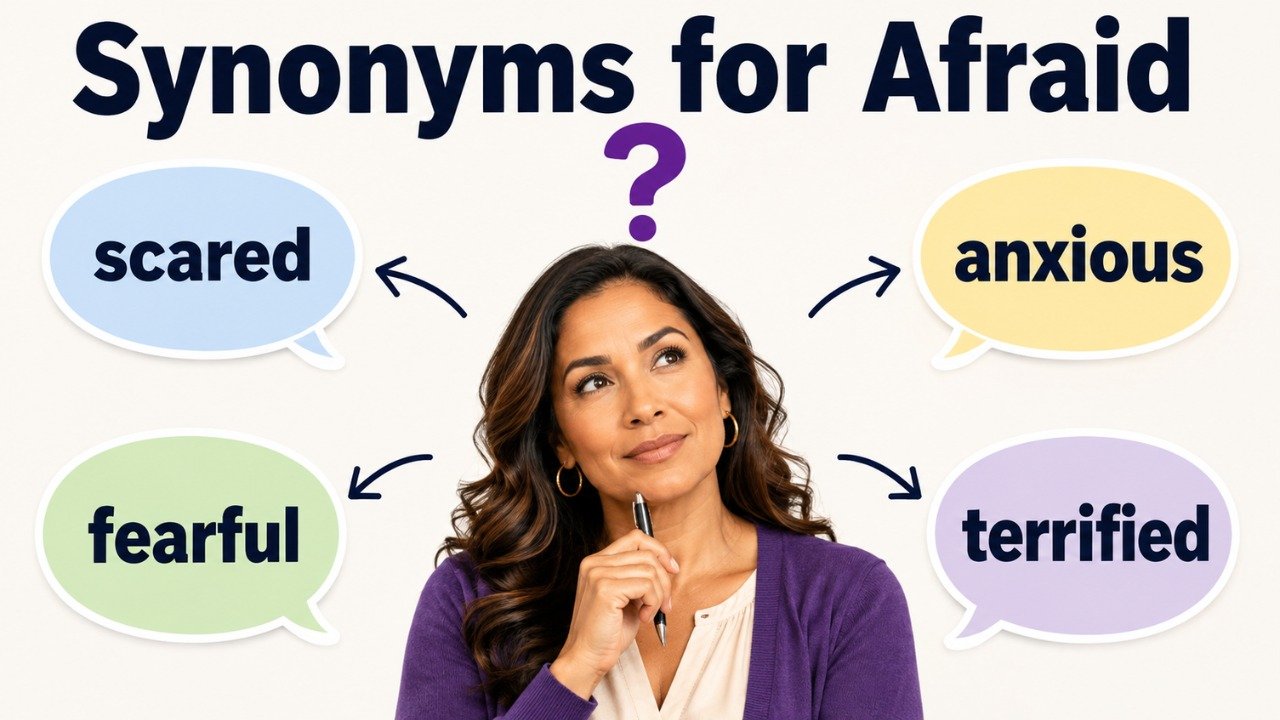
Quick Answer: Useful synonyms for afraid include scared, frightened, fearful, terrified, anxious, nervous, alarmed, apprehensive, uneasy, and intimidated. The best choice depends on intensity and context. Scared is natural in casual speech, frightened works in both conversation and writing, fearful suits formal descriptions, terrified expresses extreme fear, apprehensive fits worry about something that may happen, anxious emphasizes nervous concern, and intimidated works when fear comes from a powerful person, situation, or challenge.
Pronunciation and Word Details
Word: Afraid
Pronunciation: /əˈfreɪd/
Part of Speech: Adjective
Meaning: Afraid means feeling fear, worry, nervousness, or concern about danger, harm, difficulty, or an uncertain situation.
US Pronunciation:
UK Pronunciation:
What Does “Afraid” Mean?
Afraid means feeling fear or worry because something seems dangerous, threatening, unpleasant, or uncertain.
It is an adjective and commonly follows linking verbs such as be, feel, seem, or become.
Example: She was afraid of the storm.
Afraid can describe immediate fear caused by danger.
Example: The child was afraid when the lights suddenly went out.
It can also describe worry about a future event.
Example: He was afraid that he might miss the deadline.
In polite conversation, the phrase “I am afraid” can introduce disappointing or negative information without literally describing fear.
Example: I am afraid we cannot continue with the plan.
The exact meaning therefore depends on whether afraid refers to physical danger, emotional worry, uncertainty, social discomfort, or polite regret.
Meaning, Tone, and Context of “Afraid”
Afraid is a common, neutral, and conversational adjective. It is widely used in everyday speech, storytelling, personal writing, and general communication.
It is emotional because it directly describes fear, but it is not automatically extreme. Someone can be slightly afraid, very afraid, or deeply afraid.
In casual conversation, afraid often overlaps with scared.
Example: I was afraid to open the door.
In more formal writing, fearful, apprehensive, concerned, or anxious may sometimes be more precise.
Example: Residents were apprehensive about the approaching storm.
In descriptions of strong fear, terrified, horrified, or panic stricken can communicate much greater intensity.
Example: She was terrified when she heard the explosion.
Afraid can also carry a polite tone when used to express regret or disagreement.
Example: I am afraid that your information is incorrect.
When and How to Use “Afraid”
For Immediate Fear
For Immediate Danger: Use afraid when someone feels fear because of something happening now.
Example: She was afraid when she heard footsteps behind her.
For Future Worry
For Uncertainty: Use afraid when someone worries that something unpleasant may happen later.
Example: He was afraid that the flight would be canceled.
For Physical Danger
For Safety Concerns: Afraid works well when a person fears injury, danger, or harm.
Example: The hikers were afraid to cross the unstable bridge.
For Social Situations
For Social Fear: Use afraid when someone feels nervous about speaking, asking, disagreeing, or being judged.
Example: She was afraid to ask her manager for clarification.
For Emotional Concerns
For Personal Worry: Afraid can describe fear of rejection, loss, failure, or disappointment.
Example: He was afraid of disappointing his family.
For Polite Regret
For Polite Communication: The phrase “I am afraid” can introduce bad news, disagreement, or an unfortunate fact.
Example: I am afraid the office is already closed.
Best Synonyms for Afraid
Scared
Synonym: Scared means feeling fear, especially in everyday or informal situations.
Example: She felt scared when the lights went out.
Frightened
Synonym: Frightened means experiencing fear because of danger, surprise, or uncertainty.
Example: The frightened child stayed close to his mother.
Fearful
Synonym: Fearful means feeling or showing fear and is often more formal than scared.
Example: He was fearful of what might happen next.
Terrified
Synonym: Terrified means extremely afraid.
Example: She was terrified during the severe storm.
Anxious
Synonym: Anxious means worried, nervous, or uneasy about something uncertain.
Example: He felt anxious before the medical appointment.
Nervous
Synonym: Nervous means worried or uneasy, often before a difficult or important event.
Example: She was nervous about speaking in front of the audience.
Alarmed
Synonym: Alarmed means suddenly frightened or concerned by something unexpected.
Example: Residents were alarmed by the loud explosion.
Apprehensive
Synonym: Apprehensive means worried or fearful about something that may happen in the future.
Example: She felt apprehensive about starting a new job.
Uneasy
Synonym: Uneasy means slightly worried, uncomfortable, or afraid.
Example: He felt uneasy walking through the empty street.
Intimidated
Synonym: Intimidated means afraid or lacking confidence because someone or something seems powerful or difficult.
Example: The new employee felt intimidated by the large audience.
50 Synonyms for Afraid with Short Meanings
- Scared: Feeling fear in a general or informal sense.
- Frightened: Feeling fear because of danger or uncertainty.
- Fearful: Full of fear or concern.
- Terrified: Extremely afraid.
- Anxious: Worried about something uncertain.
- Nervous: Uneasy or worried about what may happen.
- Alarmed: Suddenly frightened or concerned.
- Apprehensive: Worried about a future possibility.
- Uneasy: Slightly worried or uncomfortable.
- Intimidated: Afraid because something seems powerful or difficult.
- Panicked: Overcome by sudden intense fear.
- Horrified: Extremely shocked and frightened.
- Petrified: So frightened that movement or action feels difficult.
- Terror Stricken: Overwhelmed by extreme fear.
- Panic Stricken: Filled with sudden uncontrollable fear.
- Fear Stricken: Deeply affected by fear.
- Shaken: Emotionally disturbed by a frightening experience.
- Startled: Suddenly surprised and briefly frightened.
- Spooked: Suddenly made nervous or afraid.
- Disturbed: Emotionally unsettled by something troubling.
- Worried: Concerned about a possible problem.
- Concerned: Troubled about a situation or outcome.
- Troubled: Feeling worry, fear, or emotional discomfort.
- Tense: Unable to relax because of worry or fear.
- Restless: Unable to relax because of anxiety or concern.
- Jittery: Nervous and unable to remain calm.
- Edgy: Nervous, tense, or easily disturbed.
- Fretful: Worried and unable to relax.
- Timid: Easily frightened and lacking confidence.
- Timorous: Shy and easily frightened.
- Cowardly: Showing an unwillingness to face danger.
- Wary: Cautious because of possible danger.
- Cautious: Careful because of possible risk.
- Suspicious: Uneasy because something seems untrustworthy.
- Doubtful: Uncertain and concerned about an outcome.
- Insecure: Lacking confidence or a sense of safety.
- Vulnerable: Feeling exposed to danger or harm.
- Threatened: Feeling that danger or harm may occur.
- Overawed: Intimidated by something impressive or powerful.
- Daunted: Discouraged or frightened by difficulty.
- Hesitant: Uncertain or reluctant because of fear or doubt.
- Reluctant: Unwilling to act because of concern or fear.
- Leery: Suspicious and cautious because of possible danger.
- Distrustful: Unwilling to trust because of fear or suspicion.
- Nervy: Nervous or tense in some contexts.
- Agitated: Emotionally disturbed and unable to stay calm.
- Distressed: Deeply worried, upset, or frightened.
- Unnerved: Made less confident or calm by fear.
- Overwhelmed: Emotionally overcome by fear or pressure.
- Dismayed: Troubled or alarmed by something unexpected.
Read Also:
Synonyms for Took

Synonyms for Afraid by Context
When Afraid Means Scared
Scared, frightened, fearful, spooked, and startled work well for general fear.
Scared is especially natural in conversation, while frightened can sound slightly more descriptive.
Example: She was scared by the sudden sound.
Example: The dog became frightened during the storm.
When Afraid Means Extremely Frightened
Terrified, petrified, horrified, terror stricken, fear stricken, and panic stricken express intense fear.
Example: He was terrified when the car began sliding.
Example: She stood petrified when she saw the snake.
When Afraid Means Worried About the Future
Apprehensive, anxious, worried, uneasy, and concerned work well when fear is connected to uncertainty.
Example: She felt apprehensive about the interview.
Example: He was anxious about the final result.
When Afraid Means Nervous
Nervous, tense, jittery, edgy, and uneasy describe lower levels of fear mixed with stress or anticipation.
Example: He felt nervous before giving the presentation.
Example: She became tense as the deadline approached.
When Afraid Means Intimidated
Intimidated, daunted, overawed, insecure, and unnerved fit situations where a person loses confidence because someone or something seems powerful.
Example: The student felt intimidated by the difficult examination.
Example: She was daunted by the scale of the project.
When Afraid Means Cautious About Danger
Wary, cautious, leery, suspicious, and distrustful are useful when fear produces careful behavior.
Example: Travelers were wary of the unstable conditions.
Example: He remained cautious around the unfamiliar animal.
Another Word for Afraid
Scared is one of the best everyday replacements for afraid because it is natural, clear, and widely understood. However, the strongest replacement depends on intensity and situation.
Use frightened for general fear, terrified for extreme fear, apprehensive for future worry, nervous for mild anxiety, and intimidated when fear reduces confidence.
Original: She was afraid of the strange sound.
Better Option: She was frightened by the strange sound.
Original: He was afraid before the interview.
Better Option: He was nervous before the interview.
Original: They were afraid about what might happen next.
Better Option: They were apprehensive about what might happen next.
Original: The child was very afraid during the storm.
Better Option: The child was terrified during the storm.
When Not to Use “Afraid”
Afraid is useful but can sometimes be too general. A more specific synonym may communicate the intensity, cause, or type of fear more effectively.
When the Fear Is Extreme
Terrified or petrified may be more precise than afraid when fear is overwhelming.
Weak: She was afraid when the building began to shake.
Better: She was terrified when the building began to shake.
When the Feeling Is Mild Nervousness
Nervous or uneasy may sound more natural if the situation does not involve real danger.
Weak: He was afraid before meeting the new team.
Better: He was nervous before meeting the new team.
When the Fear Concerns the Future
Apprehensive or anxious can explain the feeling more precisely.
Weak: She was afraid about starting university.
Better: She was apprehensive about starting university.
When Someone Feels Overpowered
Intimidated may be better when the fear comes from another person’s authority, confidence, or power.
Weak: He felt afraid around the experienced negotiators.
Better: He felt intimidated by the experienced negotiators.
When Caution Is More Important Than Fear
Wary or cautious may be more accurate when someone is alert rather than frightened.
Weak: She was afraid of trusting unfamiliar offers.
Better: She was wary of trusting unfamiliar offers.
Words Commonly Confused With Afraid
Afraid vs Scared: Both describe fear. Scared is more informal, while afraid works naturally in both casual and general writing.
Afraid vs Frightened: Frightened often suggests that something specific caused the fear, while afraid can describe a continuing state.
Afraid vs Anxious: Afraid focuses more directly on fear. Anxious often describes worry about uncertainty or future events.
Afraid vs Nervous: Nervous usually describes mild worry, tension, or anticipation rather than strong fear.
Afraid vs Apprehensive: Apprehensive refers mainly to fear or worry about something that may happen later.
Afraid vs Terrified: Terrified is much stronger and describes extreme fear.
Afraid vs Intimidated: Intimidated means feeling fearful or less confident because someone or something seems powerful, impressive, or difficult.
Afraid vs Wary: Afraid describes an emotion, while wary emphasizes careful attention to possible danger.
Afraid vs Concerned: Concerned usually suggests worry without the stronger emotional sense of fear.
Which Synonym Should You Choose?
Choose scared for natural casual conversation and simple descriptions of fear.
Choose frightened for general fear in both conversation and descriptive writing.
Choose fearful for formal, literary, or serious descriptions.
Choose terrified when the fear is extremely strong.
Choose nervous when someone is tense before an interview, test, speech, meeting, or unfamiliar situation.
Choose anxious when worry comes from uncertainty or concern about what may happen.
Choose apprehensive in formal writing, reports, essays, and professional communication when describing future worry.
Choose alarmed when fear begins suddenly because of unexpected information or danger.
Choose intimidated when a person feels less confident because someone, a task, or a situation seems powerful.
Choose wary when fear leads to careful observation and caution.
Choose uneasy when the feeling is mild, uncertain, or difficult to explain.
Real Life Examples of “Afraid” in Sentences
Original: She was afraid to walk home alone.
Better Option: She was frightened to walk home alone.
Original: He was afraid before his first presentation.
Better Option: He was nervous before his first presentation.
Original: The children were afraid during the storm.
Better Option: The children were terrified during the storm.
Original: She was afraid that the plan might fail.
Better Option: She was apprehensive that the plan might fail.
Original: He felt afraid when the alarm started.
Better Option: He felt alarmed when the alarm started.
Original: The new employee was afraid of speaking to the director.
Better Option: The new employee felt intimidated about speaking to the director.
Original: She was afraid to trust the unfamiliar caller.
Better Option: She was wary of trusting the unfamiliar caller.
Original: He felt afraid after hearing the strange noise.
Better Option: He felt uneasy after hearing the strange noise.
Original: They were afraid about the upcoming changes.
Better Option: They were anxious about the upcoming changes.
Original: She was afraid after the frightening experience.
Better Option: She remained shaken after the frightening experience.
Synonym Groups and Usage Differences
General Fear Group
Scared, frightened, fearful, and afraid describe ordinary fear.
Scared is conversational, frightened is descriptive, and fearful can sound more formal.
Example: The child looked frightened when the thunder began.
Extreme Fear Group
Terrified, petrified, horrified, panic stricken, and terror stricken communicate intense fear.
Terrified is the most broadly useful, while petrified often suggests being unable to act because of fear.
Example: She was terrified when smoke filled the hallway.
Future Worry Group
Apprehensive, anxious, worried, concerned, and uneasy describe fear connected to uncertainty.
Apprehensive is especially useful when something difficult is expected in the future.
Example: He felt apprehensive about the upcoming surgery.
Nervousness Group
Nervous, tense, jittery, edgy, and fretful describe stress that may be weaker than direct fear.
Example: She felt jittery before the performance.
Intimidation Group
Intimidated, daunted, overawed, unnerved, and insecure describe fear that reduces confidence.
Example: He was daunted by the amount of work ahead.
Caution Group
Wary, cautious, leery, suspicious, and distrustful describe fear or uncertainty that encourages careful behavior.
Example: She remained wary of making promises too quickly.
Antonyms of Afraid
The main antonyms of afraid describe courage, confidence, calmness, or freedom from fear.
Brave: Willing to face danger or difficulty.
Fearless: Not afraid of danger.
Courageous: Able to act despite fear.
Confident: Feeling sure of yourself or an outcome.
Calm: Free from strong worry or fear.
Relaxed: Comfortable and not tense.
Secure: Feeling safe and protected.
Untroubled: Not worried or disturbed.
Bold: Willing to take action without being easily frightened.
Daring: Willing to face risk or danger.
Assured: Confident and certain.
Composed: Calm and emotionally controlled.
Comparison: Afraid vs Related Words
Afraid vs Scared
Afraid and scared are very similar, but scared is more informal and common in everyday conversation.
Example With Afraid: She was afraid of the dark.
Example With Scared: She was scared of the dark.
Afraid vs Frightened
Frightened often focuses on fear caused by a particular event or experience.
Example With Afraid: He was afraid of dogs.
Example With Frightened: He became frightened when the dog ran toward him.
Afraid vs Terrified
Terrified describes much stronger fear than afraid.
Example With Afraid: She was afraid during the storm.
Example With Terrified: She was terrified when lightning struck nearby.
Afraid vs Nervous
Nervous usually refers to worry or tension rather than direct danger.
Example With Afraid: He was afraid to enter the abandoned building.
Example With Nervous: He was nervous before the interview.
Afraid vs Anxious
Anxious focuses on uncertainty, anticipation, or worry about possible outcomes.
Example With Afraid: She was afraid of the approaching animal.
Example With Anxious: She was anxious about the examination results.
Afraid vs Apprehensive
Apprehensive is usually more formal and often describes worry about something in the future.
Example With Afraid: He was afraid to begin the difficult task.
Example With Apprehensive: He felt apprehensive about beginning the difficult task.
Afraid vs Intimidated
Intimidated describes fear combined with reduced confidence caused by power, authority, or difficulty.
Example With Afraid: She was afraid of speaking.
Example With Intimidated: She felt intimidated by the large audience.
Common Phrases and Expressions With Afraid
Afraid Of: Feeling fear toward a person, thing, event, or situation.
Afraid To: Feeling too fearful or nervous to perform an action.
Afraid That: Worried that something unpleasant may happen or be true.
Very Afraid: Experiencing a strong level of fear.
Too Afraid To Move: So frightened that action feels difficult.
Not Afraid: Feeling confident or free from fear.
Deeply Afraid: Experiencing serious or intense fear.
Naturally Afraid: Feeling fear that is understandable in a particular situation.
I Am Afraid: A polite expression used before disappointing or negative information.
Afraid For Someone: Worried about another person’s safety or well being.
Common Mistakes to Avoid
Using Afraid Before a Noun
Afraid usually comes after a linking verb rather than directly before a noun.
Unnatural: An afraid child stood by the door.
Better: A frightened child stood by the door.
Better: The child was afraid.
Confusing Afraid and Scary
Afraid describes the person experiencing fear. Scary describes the thing causing fear.
Incorrect: The movie was afraid.
Better: The movie was scary.
Correct: The child was afraid of the movie.
Using Terrified for Mild Nervousness
Terrified is very strong and should match the intensity of the situation.
Weak Choice: She was terrified about introducing herself at the meeting.
Better: She was nervous about introducing herself at the meeting.
Confusing Anxious With Immediate Fear
Anxious is often better for worry about uncertain future events.
Less Precise: He was anxious when the dangerous animal charged toward him.
Better: He was terrified when the dangerous animal charged toward him.
Repeating Afraid Too Often
Repeated use can make a paragraph sound flat.
Repetitive: He was afraid of the test, afraid of failing, and afraid of disappointing his teacher.
Better: He was nervous about the test, worried about failing, and afraid of disappointing his teacher.
Using Intimidated Without a Source of Pressure
Intimidated usually implies that someone or something seems powerful, impressive, difficult, or threatening.
Weak: She was intimidated because it was raining.
Better: She was intimidated by the experienced group of competitors.
Choosing Wary When You Mean Frightened
Wary describes caution rather than strong emotional fear.
Incorrect Meaning: He was wary when the building suddenly caught fire.
Better: He was terrified when the building suddenly caught fire.
Conclusion
The most useful synonyms for afraid include scared, frightened, fearful, terrified, anxious, nervous, apprehensive, alarmed, uneasy, and intimidated. Scared and frightened fit general fear, terrified expresses extreme fear, nervous and anxious suit worry or tension, and apprehensive is especially useful for uncertainty about the future. Intimidated works when fear reduces confidence, while wary emphasizes caution. Choosing the right synonyms for afraid helps readers understand both the intensity of fear and the situation causing it.
FAQs About Synonyms for Afraid
What Is the Best Synonym for Afraid?
Scared and frightened are the closest general synonyms for afraid. Scared is more conversational, while frightened works well in both speech and writing.
What Is a Stronger Word for Afraid?
Terrified, petrified, horrified, and panic stricken are stronger words for intense fear.
What Is a Formal Synonym for Afraid?
Fearful and apprehensive are useful formal alternatives. Apprehensive is especially appropriate when the fear concerns a future event.
What Is a Casual Synonym for Afraid?
Scared is the most common casual synonym for afraid.
Example: I was scared to enter the dark room.
What Is a Synonym for Slightly Afraid?
Uneasy, nervous, apprehensive, and wary can describe milder forms of fear.
What Is a Synonym for Afraid of the Future?
Apprehensive, anxious, worried, and concerned work well when fear relates to something that may happen later.
What Is the Opposite of Afraid?
Common opposites of afraid include brave, fearless, courageous, confident, calm, secure, and composed.
