
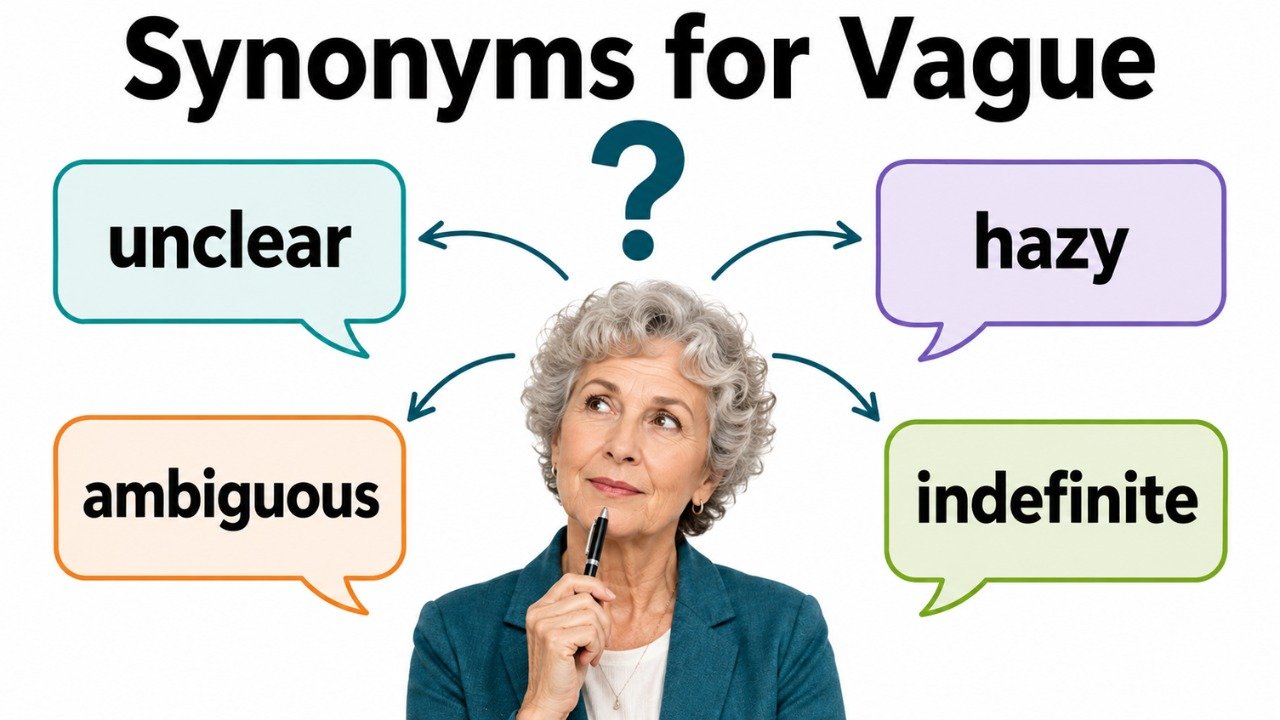
Quick Answer: The best synonyms for vague include unclear, ambiguous, imprecise, indefinite, indistinct, obscure, hazy, nebulous, uncertain, and nonspecific. The best choice depends on context. Use unclear when information is difficult to understand, ambiguous when something has more than one possible meaning, imprecise for inaccurate detail, indefinite for information without clear limits, and nebulous for ideas that are difficult to define.
Pronunciation and Word Details
Word: Vague
Pronunciation: /veɪɡ/
Part of Speech: Adjective
Meaning: Not clearly expressed, defined, understood, remembered, or described.
US Pronunciation:
UK Pronunciation:
What Does “Vague” Mean?
Vague means not clear, exact, definite, or sufficiently detailed. It is an adjective used to describe information, memories, statements, ideas, descriptions, plans, feelings, or impressions that lack precision or clarity.
A vague answer does not provide enough useful detail. A vague memory is incomplete or difficult to recall. A vague plan may lack specific dates, actions, or goals.
Example: She gave a vague explanation of what happened.
In this sentence, vague suggests that the explanation lacked enough clear information.
Example: I have a vague memory of visiting that place.
Here, vague means the memory exists but is not sharp or detailed.
The word can therefore describe both unclear communication and things that are mentally difficult to define or remember.
Meaning, Tone, and Context of “Vague”
Vague is generally neutral, although it can become mildly negative when it suggests that someone should have provided clearer information.
Neutral Use: Vague can simply describe something that is naturally uncertain or difficult to remember.
Example: He had only a vague recollection of the conversation.
Critical Use: Vague can suggest that instructions, answers, or explanations are insufficient.
Example: The directions were too vague to be useful.
Formal Writing: Vague is common in essays, reports, analysis, professional communication, and academic discussions when describing a lack of specificity.
Conversational Use: It is equally natural in everyday speech when discussing uncertain memories, incomplete plans, or unclear comments.
Emotional Context: Vague may describe uncertain feelings or impressions that a person cannot fully explain.
Example: She felt a vague sense of uneasiness.
The exact meaning changes slightly according to what is being described, so selecting the right synonym requires attention to context.
When and How to Use “Vague”
For Unclear Information: Use vague when a statement does not communicate its meaning clearly.
Example: His response was vague and left several questions unanswered.
For Missing Detail: Use vague when a description lacks specific facts, names, numbers, or explanations.
Example: The report was vague about how the funds would be used.
For Uncertain Memories: Use vague when someone remembers something only partially.
Example: I have a vague recollection of meeting her years ago.
For Undefined Plans: Use vague when arrangements have not been clearly established.
Example: Their plans for the weekend are still vague.
For General Impressions: Use vague when a feeling, thought, or impression exists but is difficult to describe precisely.
Example: He had a vague feeling that something had changed.
For Ambiguous Language: Use vague when wording allows uncertainty about the intended meaning.
Example: The instructions were vague enough to cause confusion.
Best Synonyms for Vague
Unclear: Difficult to understand, recognize, or interpret.
Example: The instructions were unclear, so several people asked for clarification.
Ambiguous: Capable of being understood in more than one way.
Example: The wording was ambiguous and could support two interpretations.
Imprecise: Lacking exactness or accuracy.
Example: Her estimate was imprecise because she did not have the final figures.
Indefinite: Not clearly fixed, limited, or decided.
Example: They postponed the project for an indefinite period.
Indistinct: Not clearly visible, heard, remembered, or recognized.
Example: He saw an indistinct figure through the fog.
Obscure: Difficult to understand or not clearly expressed.
Example: The final sentence was obscure and required further explanation.
Hazy: Unclear in thought, memory, appearance, or understanding.
Example: My memory of that afternoon is hazy.
Nebulous: Difficult to define or understand because it lacks a clear form.
Example: The proposal began with a nebulous idea rather than a specific objective.
Uncertain: Not definite, established, or known.
Example: The date of the meeting remains uncertain.
Nonspecific: Not providing exact or particular information.
Example: The feedback was too nonspecific to help the writer improve.
50 Synonyms for Vague with Short Meanings
- Unclear: Not easy to understand.
- Ambiguous: Open to more than one interpretation.
- Imprecise: Lacking exact detail or accuracy.
- Indefinite: Not clearly fixed or defined.
- Indistinct: Not sharply recognizable or understandable.
- Obscure: Difficult to understand clearly.
- Hazy: Mentally or visually unclear.
- Nebulous: Difficult to define precisely.
- Uncertain: Not definitely known or established.
- Nonspecific: Lacking particular details.
- Fuzzy: Not sharply defined or understood.
- Blurred: Lacking clear boundaries or detail.
- Cloudy: Confused or difficult to understand.
- Dim: Faint or not clearly remembered.
- Misty: Unclear or lacking sharp definition.
- General: Broad rather than specific.
- Broad: Covering a wide area without precise detail.
- Loose: Not strictly or precisely defined.
- Approximate: Close but not completely exact.
- Inexact: Not completely accurate or precise.
- Undefined: Not given a clear meaning or boundary.
- Unspecified: Not clearly stated or identified.
- Unexplained: Not clearly accounted for.
- Unexpressed: Not clearly put into words.
- Unfocused: Lacking a clear central idea or direction.
- Sketchy: Providing only limited or incomplete detail.
- Elusive: Difficult to describe, define, or grasp.
- Equivocal: Open to different interpretations.
- Cryptic: Mysterious or difficult to interpret.
- Amorphous: Lacking a clearly defined form or structure.
- Formless: Without a definite shape or structure.
- Unformed: Not fully developed or clearly established.
- Unresolved: Not clearly settled or determined.
- Unsettled: Not firmly decided or established.
- Unclear cut: Without an obvious distinction or conclusion.
- Ill defined: Lacking precise boundaries or meaning.
- Confusing: Difficult to understand clearly.
- Puzzling: Difficult to explain or interpret.
- Perplexing: Causing uncertainty or confusion.
- Muddled: Confused and poorly organized.
- Murkish: Somewhat dark, obscure, or difficult to perceive.
- Murky: Difficult to see through or understand.
- Shadowy: Indistinct, uncertain, or insufficiently known.
- Faint: Weak, slight, or difficult to perceive.
- Tentative: Not fully decided or certain.
- Noncommittal: Avoiding a definite position or answer.
- Evasive: Deliberately avoiding a clear answer.
- Abstract: Existing mainly as an idea rather than a concrete detail.
- Approximate: Giving a close rather than exact value.
- Unelaborated: Stated without enough supporting detail.
Read Also:
Synonyms for Distraught
Synonyms for Vague by Context
When Vague Means Unclear
Use these words when something is difficult to understand.
Unclear: The most direct replacement for vague when meaning is difficult to understand.
Example: The explanation remained unclear even after the second meeting.
Obscure: Best for language, concepts, or explanations that are difficult to interpret.
Example: The author used several obscure expressions.
Confusing: Suitable when information actively causes misunderstanding.
Example: The instructions were confusing because two steps contradicted each other.
Muddled: Best when ideas are disorganized as well as unclear.
Example: His argument became muddled near the end.
When Vague Means Lacking Specific Detail
These synonyms work well when information is too general.
Nonspecific: Best when exact details have not been provided.
Example: The manager gave nonspecific feedback about the proposal.
General: Useful when information covers a topic broadly instead of precisely.
Example: She provided a general description of the event.
Broad: Suitable for statements that cover a large subject without detailed limits.
Example: The research question was too broad for a short paper.
Sketchy: Useful for incomplete information containing only a few details.
Example: We received only sketchy information about the schedule.
When Vague Means Not Exact
These words emphasize lack of precision.
Imprecise: Best when wording, measurements, estimates, or descriptions are not exact.
Example: The calculation was based on imprecise figures.
Inexact: Suitable when something is approximately correct but not fully accurate.
Example: His description of the distance was inexact.
Approximate: Best for numbers, quantities, measurements, and estimates that are close but not exact.
Example: She gave an approximate arrival time.
Indefinite: Useful when limits, duration, or decisions have not been clearly fixed.
Example: The closure will continue for an indefinite period.
When Vague Describes a Memory or Impression
These synonyms describe thoughts or memories that are difficult to grasp.
Hazy: Natural for incomplete memories and uncertain understanding.
Example: My memories of the first few days are hazy.
Fuzzy: Conversational and suitable for unclear memories or details.
Example: The exact sequence of events is still fuzzy in my mind.
Dim: Often used for weak or distant memories.
Example: He had a dim recollection of hearing the story as a child.
Faint: Useful for a weak impression, memory, sound, or feeling.
Example: She had a faint memory of the song.
When Vague Means Difficult to Define
These alternatives work for abstract or poorly developed ideas.
Nebulous: Best for ideas, concepts, goals, or plans without clear definition.
Example: Their original goal was too nebulous to measure.
Amorphous: Suitable for ideas or structures without a clear form.
Example: The proposal remained amorphous during the early discussion.
Elusive: Useful when a definition, explanation, or meaning is difficult to capture.
Example: A simple explanation of the concept proved elusive.
Undefined: Appropriate when no clear definition or boundary has been established.
Example: Several responsibilities remained undefined.
Another Word for Vague
The best general replacement for vague is unclear because it works naturally in many situations involving communication, instructions, descriptions, and ideas. However, the strongest alternative depends on why something is vague.
Use ambiguous when there are multiple possible meanings. Use imprecise when exactness is missing. Use hazy for memories. Use nonspecific when details are absent.
Original: The instructions were vague.
Better Option: The instructions were unclear.
Original: Her answer was vague about the exact cost.
Better Option: Her answer was nonspecific about the exact cost.
Original: I have a vague memory of the event.
Better Option: I have a hazy memory of the event.
Original: His explanation of the measurement was vague.
Better Option: His explanation of the measurement was imprecise.
When Not to Use “Vague”
Avoid vague when a more precise word can explain exactly what is wrong with the information.
If a sentence has two possible meanings, ambiguous is usually more accurate than vague. If numbers are inaccurate, imprecise or inexact may communicate the problem more clearly. If someone is deliberately avoiding a direct answer, evasive may be stronger.
Weak: The measurement was vague.
Better: The measurement was imprecise.
Weak: Her statement was vague because it could mean two different things.
Better: Her statement was ambiguous because it could mean two different things.
Weak: He gave a vague response because he did not want to reveal his opinion.
Better: He gave an evasive response because he did not want to reveal his opinion.
Weak: My memory of the trip is vague.
Better: My memory of the trip is hazy.
Vague is useful as a general description, but more specific synonyms often make writing stronger.
Words Commonly Confused With Vague
Vague vs Ambiguous: Vague means lacking clarity or detail. Ambiguous specifically means having two or more possible interpretations.
Vague vs Unclear: Unclear is a broad term for something that is difficult to understand. Vague often suggests that the problem comes from insufficient detail or definition.
Vague vs Imprecise: Imprecise refers to a lack of exactness. Vague can refer to unclear meaning even when numerical accuracy is not involved.
Vague vs Uncertain: Vague describes something lacking clarity, while uncertain describes something that is not definitely known, decided, or believed.
Vague vs Obscure: Obscure often suggests that something is difficult to understand because it is unfamiliar, complex, hidden, or poorly expressed.
Vague vs Hazy: Hazy is particularly natural for memories, impressions, thoughts, or visual scenes that lack sharpness.
Vague vs General: General means broad rather than detailed. General information is not necessarily unclear, while vague information often fails to communicate enough detail.
Which Synonym Should You Choose?
Choose unclear when you need a simple, natural replacement for vague in everyday or professional writing.
Choose ambiguous when a statement can reasonably have more than one meaning.
Choose imprecise when discussing measurements, wording, estimates, descriptions, numbers, or factual accuracy.
Choose indefinite when a time, limit, duration, or decision has not been fixed.
Choose nonspecific when information lacks particular names, facts, examples, or details.
Choose hazy when describing memories, thoughts, impressions, or understanding.
Choose nebulous when discussing abstract ideas, goals, concepts, or plans that are difficult to define.
Choose obscure when meaning is difficult to understand or recognize.
Choose evasive when someone intentionally avoids giving a direct answer.
Choose general when information is broad but not necessarily confusing.
For reports and essays, imprecise, ambiguous, nonspecific, and undefined often provide greater precision.
For emails and professional communication, unclear and nonspecific are usually natural choices.
For casual conversation, unclear, fuzzy, and hazy often sound most natural.
Real Life Examples of “Vague” in Sentences
Original: The teacher’s instructions were vague.
Better Option: The teacher’s instructions were unclear.
Original: His answer was vague about when he would return.
Better Option: His answer was nonspecific about when he would return.
Original: I have a vague memory of seeing that building.
Better Option: I have a hazy memory of seeing that building.
Original: The proposal contains several vague objectives.
Better Option: The proposal contains several undefined objectives.
Original: Her description of the amount was vague.
Better Option: Her description of the amount was imprecise.
Original: The statement was vague and could be interpreted in two ways.
Better Option: The statement was ambiguous and could be interpreted in two ways.
Original: We received only vague information about the changes.
Better Option: We received only sketchy information about the changes.
Original: His plans for the future are vague.
Better Option: His plans for the future are indefinite.
Original: She expressed a vague concern about the arrangement.
Better Option: She expressed an undefined concern about the arrangement.
Original: Their original concept was vague and difficult to develop.
Better Option: Their original concept was nebulous and difficult to develop.
Synonym Groups and Usage Differences
Clarity Group
This group includes unclear, obscure, confusing, muddled, and cryptic. These words focus on difficulty understanding something.
Example: The final paragraph was unclear and required revision.
Precision Group
This group includes imprecise, inexact, approximate, indefinite, and nonspecific. They are useful when information lacks exact detail.
Example: The estimate was imprecise because several costs were unknown.
Memory and Perception Group
This group includes hazy, fuzzy, dim, faint, misty, and indistinct. These words work well for memories, sounds, images, impressions, and perceptions.
Example: She had only a faint recollection of the conversation.
Definition Group
This group includes nebulous, amorphous, undefined, unformed, and elusive. They describe ideas or concepts that lack clear boundaries or structure.
Example: The team’s long term objective remained nebulous.
Ambiguity Group
This group includes ambiguous, equivocal, obscure, and cryptic. These words are useful when meaning is uncertain or can be interpreted in different ways.
Example: His response was equivocal and revealed no definite position.
Avoidance Group
This group includes evasive and noncommittal. These words describe deliberately indirect or undecided communication.
Example: The spokesperson remained noncommittal about the proposed date.
Antonyms of Vague
The opposite of vague depends on whether the intended meaning involves clarity, precision, certainty, or detail.
Clear: Easy to understand.
Specific: Providing particular details.
Precise: Exact and carefully defined.
Definite: Clearly fixed or established.
Explicit: Clearly and directly stated.
Detailed: Containing substantial specific information.
Exact: Completely accurate or precise.
Distinct: Clearly recognizable or different.
Certain: Definitely known or established.
Concrete: Clearly defined and based on particular facts or examples.
Unambiguous: Having only one clear interpretation.
Focused: Directed toward a clear subject or objective.
Comparison: Vague vs Related Words
Vague vs Unclear
Vague usually suggests insufficient detail or definition. Unclear simply means difficult to understand.
Example With Vague: The announcement was vague about when the new policy would begin.
Example With Unclear: The announcement was unclear because the wording was confusing.
Vague vs Ambiguous
Vague means lacking precision or detail. Ambiguous means capable of more than one interpretation.
Example With Vague: She gave a vague description of the suspect.
Example With Ambiguous: The sentence was ambiguous because the pronoun could refer to two people.
Vague vs Imprecise
Vague is broader, while imprecise emphasizes a lack of exactness.
Example With Vague: His explanation of the process was vague.
Example With Imprecise: His estimate of the distance was imprecise.
Vague vs Hazy
Vague can describe many types of unclear information. Hazy is particularly suitable for memories, impressions, understanding, or visual perception.
Example With Vague: She had a vague idea of what the job involved.
Example With Hazy: She had a hazy memory of her first day at school.
Vague vs Nebulous
Vague is common and general. Nebulous is stronger and often describes abstract ideas or plans with no definite structure.
Example With Vague: They discussed a vague plan for expansion.
Example With Nebulous: Their vision for the new project remained nebulous.
Vague vs Nonspecific
Vague suggests insufficient clarity overall. Nonspecific emphasizes the absence of particular details.
Example With Vague: His explanation was vague.
Example With Nonspecific: His explanation was nonspecific about dates, costs, and responsibilities.
Common Phrases and Expressions With Vague
Vague Idea: An idea that is not fully developed or clearly defined.
Vague Memory: A memory that lacks clear details.
Vague Feeling: An emotion or impression that is difficult to identify precisely.
Vague Sense: A weak or uncertain awareness of something.
Vague Answer: A response that does not provide enough clear information.
Vague Description: An account lacking specific or useful detail.
Vague Reference: A mention that does not clearly identify its subject.
Vague Impression: A general feeling or understanding without firm details.
Vague Language: Wording that lacks precision or clear meaning.
Vague Terms: Words or conditions that have not been clearly defined.
Common Mistakes to Avoid
One common mistake is using vague when a more precise synonym would communicate the exact problem more effectively.
Wrong Synonym Choice: Do not automatically replace vague with ambiguous. Something can be vague without having multiple meanings.
Example: A description containing too few details is vague or nonspecific, but it is not necessarily ambiguous.
Confusing Vague With Imprecise: Use imprecise when exact measurements, numbers, estimates, or wording are involved.
Unnecessary Repetition: Avoid repeatedly using vague in the same paragraph. Alternate with suitable words such as unclear, nonspecific, hazy, or undefined when their meanings fit.
Overusing Strong Synonyms: Words such as cryptic and nebulous have more specific meanings. They should not replace vague in every sentence.
Using Informal Words in Formal Writing: Fuzzy can be useful in conversation, but unclear, imprecise, or undefined may be more appropriate in academic or professional writing.
Being Vague About Why Something Is Vague: Strong writing identifies the exact problem. Instead of saying a paragraph is vague, explain whether it lacks evidence, examples, dates, definitions, or specific details.
Unnatural Phrasing: Choose synonyms according to normal usage. A hazy memory sounds natural, while a hazy measurement usually does not.
Conclusion
Synonyms for vague include unclear, ambiguous, imprecise, indefinite, hazy, nonspecific, obscure, and nebulous. The best replacement depends on what lacks clarity. Use unclear for difficult communication, ambiguous for multiple meanings, imprecise for inaccurate detail, hazy for uncertain memories, and nonspecific for missing particulars. Choosing a precise synonym helps readers understand whether the problem involves clarity, accuracy, definition, detail, memory, or uncertainty, making both everyday and formal writing stronger.
FAQs About Synonyms for Vague
What is the best synonym for vague?
The best general synonym is unclear. However, ambiguous, imprecise, nonspecific, hazy, and indefinite can be more accurate in specific contexts.
What is another word for a vague answer?
A vague answer can be described as unclear, nonspecific, evasive, ambiguous, or noncommittal depending on why the answer lacks clarity.
What is a formal synonym for vague?
Imprecise, indefinite, ambiguous, undefined, and nonspecific are useful formal alternatives to vague.
Is ambiguous the same as vague?
No. Vague means lacking clarity or detail, while ambiguous means having more than one possible interpretation.
What word describes a vague memory?
Hazy is one of the most natural choices for a vague memory. Fuzzy, dim, indistinct, and faint can also work.
What is the opposite of vague?
Common antonyms include clear, specific, precise, definite, explicit, exact, detailed, and unambiguous.
Which synonym for vague is best in an essay?
Use unclear for general lack of clarity, imprecise for inaccurate detail, ambiguous for multiple interpretations, nonspecific for missing particulars, and undefined for concepts that have not been clearly established.
