
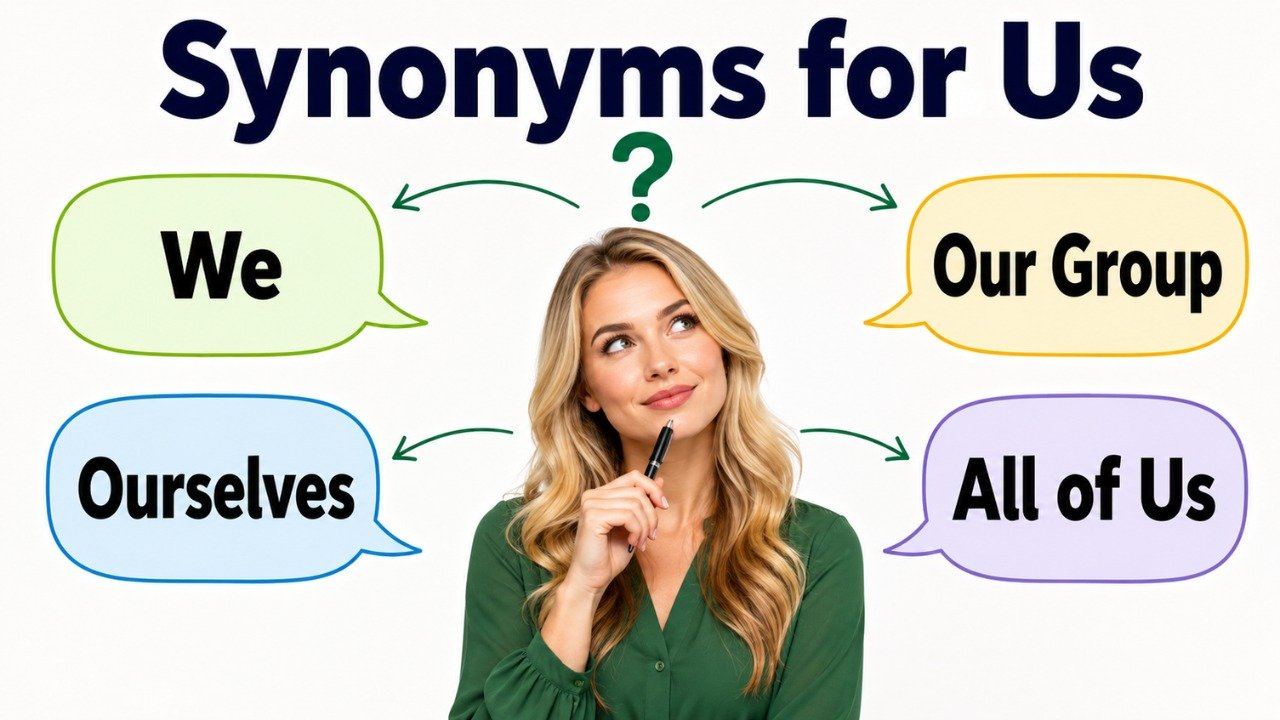
Quick Answer: The best synonyms for us include me and you, you and me, both of us, the two of us, all of us, everyone here, our group, our team, the group, and ourselves. However, us is a personal pronoun, so it has no single replacement that works in every sentence. Use both of us or the two of us for two people, all of us for an entire group, our team or our group for a clearly identified collective, and ourselves when the action returns to the same people.
Pronunciation and Word Details
Word: Us.
Pronunciation: /ʌs/ or /əs/.
Part of Speech: First person plural object pronoun.
Meaning: The word us refers to the speaker and one or more other people when they receive an action or follow a preposition.
US Pronunciation:
UK Pronunciation:
What Does “Us” Mean?
Us is the object form of we. It refers to the speaker together with at least one other person when that group receives an action.
In the sentence “The teacher called us,” the word us receives the action of called. In “She sat beside us,” it appears after the preposition beside.
Us can refer to two people, a small group, a team, a family, a community, or a much larger population. Its exact meaning depends on who the speaker includes.
The pronoun is commonly used as a direct object, an indirect object, or the object of a preposition.
Direct Object: The guide welcomed us.
Indirect Object: The guide gave us a map.
Object of a Preposition: The guide walked with us.
Unlike a specific noun such as team or family, us does not identify the group by name. The surrounding sentence must make the intended group clear.
Meaning, Tone, and Context of “Us”
Us has a neutral and natural tone. It appears frequently in casual conversations, formal writing, speeches, stories, instructions, emails, reports, and academic discussions.
The word can sound warm and inclusive when it brings people together.
Example: This decision affects all of us.
It can also create a contrast between one group and another.
Example: They competed against us.
In personal communication, us often refers to the speaker and the listener.
Example: This photograph reminds me of us.
In group communication, it may refer to a family, class, team, committee, or community.
Example: The new schedule works well for us.
Us is clear when the audience already knows which people are included. When the group is uncertain, a more specific expression such as our team, the committee, or everyone involved may be more precise.
When and How to Use “Us”
For People Receiving an Action
Use us when the speaker and other people receive the action of a verb.
Example: The manager thanked us for our effort.
After a Preposition
Use us after prepositions such as with, for, to, beside, among, between, and against.
Example: Please share the information with us.
For Two People
Use us when referring to the speaker and one other person. Both of us or the two of us can make the number clearer.
Example: The invitation was addressed to us.
For an Entire Group
Use all of us when every member of the speaker’s group is included.
Example: The change surprised all of us.
For Part of a Group
Use some of us, many of us, or those of us when only part of a larger group is included.
Example: Some of us stayed after the meeting.
For Shared Experiences
Use us when talking about something experienced by the speaker and other people together.
Example: The journey taught us to be patient.
For Group Identity
Use us when contrasting the speaker’s group with another group.
Example: The final round placed them against us.
For Reflexive Actions
Use ourselves, not us, when the subject and object refer to the same group.
Example: We prepared ourselves for the challenge.
For Invitations and Suggestions
The phrase let us can introduce a formal suggestion or invitation.
Example: Let us consider another solution.
Best Synonyms for Us
Me and You
Synonym: A direct phrase referring to the speaker and the listener.
Example: The decision concerns me and you.
You and Me
Synonym: A natural alternative used when the speaker and listener are objects in a sentence.
Example: She reserved two seats for you and me.
Both of Us
Synonym: The speaker and exactly one other person.
Example: Both of us agreed with the proposal.
The Two of Us
Synonym: A clear and often more personal expression for two people.
Example: The two of us completed the project together.
All of Us
Synonym: Every person in the speaker’s group.
Example: All of us benefited from the new system.
Everyone Here
Synonym: Every person present in the current place or situation.
Example: The announcement surprised everyone here.
Our Group
Synonym: The specific collection of people that includes the speaker.
Example: The guide assigned our group the first task.
Our Team
Synonym: A group working or competing together with the speaker.
Example: The result gave our team greater confidence.
The Group
Synonym: A known collection of people previously identified in the context.
Example: The instructor asked the group to remain seated.
Ourselves
Synonym: A reflexive alternative used when the action returns to the speaker’s group.
Example: We taught ourselves how to solve the problem.
50 Synonyms for Us with Short Meanings
The following expressions are contextual alternatives rather than perfect synonyms. The correct replacement depends on the number of people, the relationship among them, and the sentence structure.
- Me and You: The speaker and the listener.
- You and Me: The listener and the speaker as objects.
- Both of Us: Exactly two people including the speaker.
- The Two of Us: The speaker and one other person.
- The Pair of Us: Two people considered together.
- All of Us: Every member of the speaker’s group.
- Each of Us: Every person considered individually.
- Every One of Us: Every member without exception.
- Some of Us: Part of the speaker’s group.
- Many of Us: A large number within the group.
- Most of Us: The majority of the group.
- None of Us: Not one person in the speaker’s group.
- Those of Us: A selected part of the group that includes the speaker.
- People Like Us: People who share similar qualities or experiences.
- Everyone Here: All people present.
- Everyone Present: Every person attending an event or gathering.
- Everyone Involved: All people participating in a situation.
- The Whole Group: Every member of a known group.
- Our Group: A collection of people that includes the speaker.
- Our Team: People working or competing with the speaker.
- Our Family: Family members including the speaker.
- Our Household: People living together with the speaker.
- Our Community: People belonging to the speaker’s local or social group.
- Our Class: Students learning with the speaker.
- Our Department: Members of the speaker’s work or study division.
- Our Committee: Committee members including the speaker.
- Our Organization: Members of an organized body that includes the speaker.
- Our Staff: Workers belonging to the speaker’s workplace group.
- Our Crew: People working closely together with the speaker.
- Our Circle: The speaker’s close social group.
- Our Side: The group supported by or including the speaker.
- Our Party: People travelling, meeting, or acting together.
- Our Delegation: Representatives travelling or speaking together.
- Our Members: People belonging to the speaker’s group.
- The Group: A previously identified collection of people.
- The Team: A known group working or competing together.
- The Family: A known family that includes the speaker.
- The Household: A known group living in one home.
- The Community: A known population or social group.
- The Class: A known group of students.
- The Department: A known division within an institution.
- The Committee: A known group appointed for a purpose.
- The Staff: The workers in a known workplace.
- The Members: The people belonging to a known group.
- The Participants: The people taking part in an activity.
- The Residents: The people living in a particular place.
- The Students: The learners in a particular group.
- The Workers: The people performing a job or task.
- Each Other: A reciprocal expression for actions between two or more people.
- Ourselves: A reflexive form used when the action returns to the speaker’s group.
Read Also:
Synonyms for Focuses
Synonyms for Us by Context
When Us Means Two People
When us refers to the speaker and one other person, use both of us, the two of us, the pair of us, me and you, or you and me.
Both of Us: Emphasizes that exactly two people are included.
Example: Both of us submitted the application.
The Two of Us: Often sounds personal, warm, or reflective.
Example: The two of us have known each other for years.
The Pair of Us: A conversational expression for two people together.
Example: The pair of us carried the table upstairs.
You and Me: Correct when the phrase receives an action or follows a preposition.
Example: The message was intended for you and me.
When Us Means an Entire Group
Use all of us, every one of us, everyone here, everyone present, or the whole group when every member is included.
All of Us: The most natural general alternative.
Example: All of us welcomed the change.
Every One of Us: Adds strong emphasis and leaves no exceptions.
Example: Every one of us has a role to play.
Everyone Present: Best for meetings, ceremonies, and gatherings.
Example: The speaker thanked everyone present.
The Whole Group: Best when the group has already been identified.
Example: The whole group completed the exercise.
When Us Means Part of a Larger Group
Use some of us, many of us, most of us, or those of us when the speaker belongs to a selected part of a larger group.
Some of Us: Refers to an unspecified smaller number.
Example: Some of us preferred the earlier design.
Many of Us: Refers to a substantial number.
Example: Many of us shared the same concern.
Most of Us: Refers to the majority.
Example: Most of us supported the final decision.
Those of Us: Identifies members who share a condition or experience.
Example: Those of us who arrived early found seats easily.
When Us Means a Named Group
Use our team, our family, our class, our department, our community, or another specific noun phrase when readers need to know exactly who is included.
Our Team: Suitable for work, sport, or collaborative projects.
Example: The award encouraged our team.
Our Family: Suitable for shared family experiences.
Example: The news brought joy to our family.
Our Class: Suitable for educational settings.
Example: The teacher gave our class extra time.
Our Community: Suitable for local or collective concerns.
Example: The new center will benefit our community.
When Us Requires a Reflexive Form
Use ourselves when the people performing the action are also receiving it.
Ourselves: The correct reflexive form of we.
Example: We reminded ourselves to remain patient.
Do not use ourselves merely to make a sentence sound formal.
Incorrect: Please contact ourselves with your questions.
Correct: Please contact us with your questions.
When Us Describes Reciprocal Action
Use each other when members of the group perform the same action toward one another.
Each Other: Shows a shared action between people.
Example: We helped each other during the difficult task.
This is not a direct synonym for us, but it can replace a structure in which the intended meaning is reciprocal.
Another Word for Us
The best general replacement for us is often all of us, especially when the speaker means every member of a group. For two people, both of us is more precise. When the identity of the group matters, a specific phrase such as our team, our family, or our class is usually clearer.
Original: The announcement surprised us.
Better Option: The announcement surprised all of us.
Original: The guide spoke to us before the tour.
Better Option: The guide spoke to the whole group before the tour.
Original: The result encouraged us.
Better Option: The result encouraged our team.
Original: The gift was intended for us.
Better Option: The gift was intended for both of us.
When Not to Use “Us”
When the Pronoun Is the Subject
Do not use us as the subject of a standard sentence. Use we instead.
Weak: Us completed the assignment early.
Better: We completed the assignment early.
When the Group Is Unclear
Us may sound vague when readers do not know who is included. Name the group when precision matters.
Weak: The new rule will affect us.
Better: The new rule will affect all employees in our department.
When Only Two People Are Included
Us is grammatically correct, but both of us or the two of us may provide useful detail.
Weak: The instructor selected us.
Better: The instructor selected both of us.
When the Action Is Reflexive
Use ourselves when the subject and object refer to the same people.
Weak: We prepared us for the interview.
Better: We prepared ourselves for the interview.
When Formal Writing Requires Specificity
In reports, instructions, and official communication, a named group can be clearer than us.
Weak: The results gave us useful information.
Better: The results gave the research team useful information.
When the Intended Group Excludes the Reader
Us can sometimes sound inclusive even when the listener is not included. Use a specific noun phrase to prevent confusion.
Weak: This policy applies to us.
Better: This policy applies to the committee members.
When a Sentence Becomes Repetitive
Repeated use of us can make a paragraph sound monotonous. Replace some instances with a clear noun phrase.
Weak: The coach called us, spoke to us, and gave us new instructions.
Better: The coach called the team together, spoke to us, and provided new instructions.
Words Commonly Confused With Us
Us vs We: We is a subject pronoun, while us is an object pronoun. Write “We arrived early,” but write “The driver collected us early.”
Us vs Our: Us refers to people receiving an action. Our shows possession before a noun. Write “They invited us” and “They visited our home.”
Us vs Ours: Us is an object pronoun, while ours is a possessive pronoun. Write “The teacher helped us” and “The final decision was ours.”
Us vs Ourselves: Us is the ordinary object form. Ourselves is used when the action returns to the same group. Write “She advised us,” but write “We reminded ourselves.”
Us vs Them: Us refers to the speaker’s group. Them refers to another person or group that does not include the speaker.
Us vs You and Me: You and me can replace us when only the speaker and listener are included. It cannot replace us when the group contains additional people.
Us vs You and I: You and I is normally used as a subject, while you and me is used as an object. Write “You and I should talk,” but write “This concerns you and me.”
Us vs Each Other: Us identifies the people receiving an action. Each other describes reciprocal action between members of a group.
Which Synonym Should You Choose?
Choose me and you when you want to identify the speaker and listener directly.
Choose you and me when the phrase receives an action or follows a preposition.
Choose both of us when exactly two people are included and the number matters.
Choose the two of us when you want a personal or conversational expression.
Choose all of us when every member of the speaker’s group is included.
Choose every one of us when you want strong emphasis and no exceptions.
Choose some of us when only part of the group is included.
Choose those of us when identifying people who share a particular experience or condition.
Choose everyone here when referring to all people in the current place.
Choose everyone involved when referring to all participants in an activity or situation.
Choose our group when the people form a general collection.
Choose our team for work, sport, projects, competitions, and shared goals.
Choose our family when discussing relatives and household experiences.
Choose our community for local issues, shared interests, or collective concerns.
Choose the committee, the staff, or the participants in formal writing when the group should be named precisely.
Choose ourselves when the action returns to the same people who perform it.
Choose each other when the action moves reciprocally between members of the group.
Real Life Examples of “Us” in Sentences
Original: The teacher gave us more time.
Better Option: The teacher gave our class more time.
Original: The news surprised us.
Better Option: The news surprised all of us.
Original: She bought tickets for us.
Better Option: She bought tickets for both of us.
Original: The coach encouraged us before the match.
Better Option: The coach encouraged the team before the match.
Original: The guide waited for us near the entrance.
Better Option: The guide waited for the whole group near the entrance.
Original: This decision will affect us.
Better Option: This decision will affect everyone involved.
Original: The project taught us several useful lessons.
Better Option: The project taught our team several useful lessons.
Original: The photograph reminded her of us.
Better Option: The photograph reminded her of the two of us.
Original: The organizers welcomed us warmly.
Better Option: The organizers welcomed all the participants warmly.
Original: We trained us to remain calm.
Better Option: We trained ourselves to remain calm.
Synonym Groups and Usage Differences
Two Person Group
This group includes me and you, you and me, both of us, the two of us, and the pair of us.
Use these alternatives when us refers to exactly two people. Both of us emphasizes the number, while the two of us often sounds more personal.
Example: The two of us planned the journey together.
Complete Group
This group includes all of us, every one of us, everyone here, everyone present, and the whole group.
Use these expressions when no member is excluded. Every one of us carries stronger individual emphasis than all of us.
Example: Every one of us received a certificate.
Partial Group
This group includes some of us, many of us, most of us, and those of us.
Use these expressions when only part of the speaker’s larger group is relevant.
Example: Many of us preferred the quieter location.
Named Group
This group includes our team, our family, our class, our department, our committee, and our community.
Use a named group when the pronoun us would be too vague or when the group’s identity is important.
Example: The new schedule gives our department more flexibility.
Formal Collective Group
This group includes the staff, the participants, the members, the residents, and the committee.
These noun phrases work well in reports, announcements, instructions, and formal documents.
Example: The revised plan was presented to the committee.
Reflexive Group
The main alternative in this group is ourselves.
Use ourselves when the subject performs an action that returns to the same group.
Example: We introduced ourselves to the new members.
Reciprocal Group
The main expression in this group is each other.
Use each other when two or more people perform the same action toward one another.
Example: We supported each other throughout the project.
Antonyms of Us
Us has no perfect dictionary antonym because it is a personal pronoun. However, several words can express an opposite or contrasting group.
Them: People outside the speaker’s group.
Others: People different from or separate from the speaker’s group.
You: The listener or listeners without the speaker.
Him: One male person who is not part of the speaker’s group.
Her: One female person who is not part of the speaker’s group.
Outsiders: People who do not belong to the group.
Opponents: People competing against the speaker’s group.
Strangers: People who are not known to the speaker’s group.
Another Group: A separate collection of people.
The Other Side: A group with a different position, interest, or goal.
Comparison Between Us and Related Words
Us vs We
We performs the action, while us receives the action or follows a preposition.
Example With Us: The driver took us to the station.
Example With We: We travelled to the station.
Us vs Ourselves
Us is the regular object form. Ourselves is reflexive and refers back to we.
Example With Us: The instructor taught us a new method.
Example With Ourselves: We taught ourselves a new method.
Us vs All of Us
Us may refer to an understood group without emphasizing every member. All of us makes complete inclusion explicit.
Example With Us: The announcement affected us.
Example With All of Us: The announcement affected all of us.
Us vs Both of Us
Us can refer to two or more people. Both of us always refers to exactly two.
Example With Us: The manager invited us to attend.
Example With Both of Us: The manager invited both of us to attend.
Us vs Our Team
Us is shorter but may be vague. Our team clearly identifies the group.
Example With Us: The result motivated us.
Example With Our Team: The result motivated our team.
Us vs Them
Us includes the speaker. Them refers to people who do not include the speaker.
Example With Us: The judge asked us to wait.
Example With Them: The judge asked them to wait.
Us vs You and Me
Us can represent any group containing the speaker. You and me normally refers only to the speaker and listener.
Example With Us: The guide showed us the building.
Example With You and Me: The guide showed you and me the building.
Us vs Each Other
Us identifies an object of an action. Each other expresses a reciprocal relationship.
Example With Us: The teacher helped us.
Example With Each Other: We helped each other.
Common Phrases and Expressions With Us
All of Us: Every person in the speaker’s group.
Both of Us: The speaker and exactly one other person.
The Two of Us: Two people including the speaker.
One of Us: A single member of the speaker’s group.
Some of Us: Part of the speaker’s group.
Many of Us: A large number of the group.
Most of Us: The majority of the group.
None of Us: Not one member of the group.
Between Us: Shared privately or existing within the group.
With Us: Accompanying or joining the speaker’s group.
For Us: Intended to help or benefit the speaker’s group.
Let Us: A formal way to introduce a suggestion, request, or shared action.
Common Mistakes to Avoid
Using Us as a Subject
Us should not normally perform the action in a standard sentence.
Incorrect: Us need to leave now.
Correct: We need to leave now.
Using We After a Preposition
A preposition requires the object form us.
Incorrect: The decision was difficult for we.
Correct: The decision was difficult for us.
Replacing Us With Ourselves Unnecessarily
Ourselves is not a more formal version of us. It should be used only reflexively or for emphasis.
Incorrect: Please send the documents to ourselves.
Correct: Please send the documents to us.
Writing You and I as an Object
Use you and me when the phrase receives an action or follows a preposition.
Incorrect: She spoke to you and I.
Correct: She spoke to you and me.
Leaving the Group Unclear
Readers may not know whether us includes the listener, a team, a family, or another group.
Unclear: The rule applies to us.
Clear: The rule applies to all members of our class.
Choosing a Replacement That Changes the Number
Both of us means exactly two people, while all of us may refer to any complete group of two or more.
Incorrect Meaning: All of us attended, when only two selected people attended.
Clearer Meaning: Both of us attended.
Confusing Possessive and Object Forms
Do not use our when the sentence requires an object pronoun.
Incorrect: The teacher called our.
Correct: The teacher called us.
Repeating Us Too Frequently
Use a specific noun phrase occasionally to improve clarity and sentence variety.
Repetitive: The leader called us, thanked us, and gave us instructions.
Improved: The leader called the group together, thanked us, and provided new instructions.
Conclusion
The most useful synonyms for us depend on the people and situation being described. Use both of us or the two of us for exactly two people, all of us for a complete group, and some of us or those of us for part of a group. Specific expressions such as our team, our family, and the participants improve clarity in formal writing. When exploring synonyms for us, remember that ourselves is only appropriate for reflexive actions, while each other describes reciprocal actions.
FAQs About Synonyms for Us
What Is the Best Synonym for Us?
All of us is the best general alternative when every member of the group is included. For a specific group, use our team, our family, or another clear noun phrase.
Can We Replace Us With We?
Not in the same grammatical position. We is a subject pronoun, while us is an object pronoun.
Is Ourselves a Synonym for Us?
Ourselves is a contextual alternative, but it is only correct when the action returns to the same group or when emphasis is needed.
What Can I Use Instead of Us for Two People?
Use both of us, the two of us, me and you, or you and me, depending on the sentence structure.
Is You and Me Grammatically Correct?
Yes. You and me is correct when the phrase receives an action or follows a preposition.
What Is a Formal Alternative to Us?
Use a specific noun phrase such as the committee, the participants, our department, or the staff when formal writing requires precision.
Does Us Always Include the Listener?
No. Us always includes the speaker, but it may or may not include the listener. The surrounding context determines who belongs to the group.
