
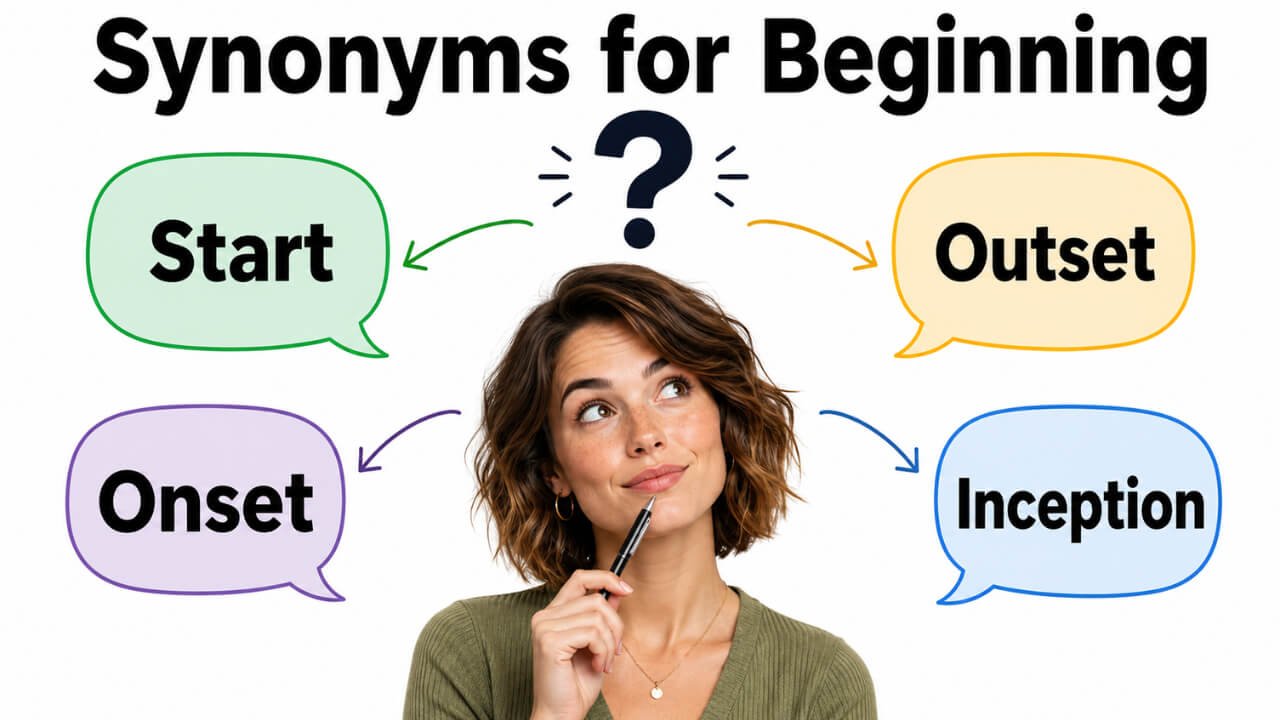
Quick Answer: Synonyms for beginning include start, outset, commencement, inception, onset, origin, opening, dawn, launch, and genesis. Use start as the most natural general replacement, outset for the earliest part of an experience, commencement in formal writing, inception for the creation of an organization or idea, onset for symptoms or conditions, origin for the source of something, opening for an event or story, dawn for a new period, launch for a project or product, and genesis for the first formation of an idea or system.
Pronunciation and Word Details
Word: Beginning
Pronunciation: /bɪˈɡɪn.ɪŋ/
Part of Speech: Noun, adjective, and present participle
Meaning: Beginning means the first part, starting point, origin, or earliest stage of something.
US Pronunciation:
UK Pronunciation:
What Does “Beginning” Mean?
Beginning means the first point, earliest stage, or initial part of an action, event, period, story, process, or existence. It is most commonly used as a noun.
In the sentence “The beginning of the book was exciting,” beginning refers to the first part of the book. In “They are beginning the lesson,” it functions as part of the verb phrase and describes an action that is starting.
The word can also describe something introductory or early. A beginning student, for example, is someone who has only recently started learning a subject or skill.
Beginning can refer to time, origin, creation, movement, development, or the opening part of a sequence. Its exact meaning depends on what is starting.
Meaning, Tone, and Context of “Beginning”
Beginning has a neutral and widely understood tone. It works naturally in formal writing, casual speech, academic explanations, stories, instructions, reports, and everyday conversation.
In casual communication, beginning often means the same as start. In formal writing, commencement, inception, or initiation may sound more appropriate. In historical or creative contexts, origin, genesis, birth, or dawn can add greater depth.
The word can carry an emotional tone when it describes a fresh opportunity. A new beginning often suggests hope, recovery, personal growth, or positive change.
Beginning may also sound serious when it refers to an unwanted condition. The beginning of a conflict, illness, decline, or crisis describes the point when a difficult situation first develops.
Because the word has several meanings, choosing a synonym requires attention to context. The beginning of a meeting, the beginning of a disease, and the beginning of a civilization all need different alternatives.
When and How to Use “Beginning”
For the First Part of an Event: Use beginning when referring to the earliest section of a meeting, lesson, ceremony, journey, or performance.
Example: The speaker explained the main purpose at the beginning of the meeting.
For the Start of a Process: Use beginning when an action, plan, or period is entering its first stage.
Example: The team is beginning a detailed review of the project.
For the Origin of Something: Use beginning when describing how an idea, tradition, organization, or relationship first developed.
Example: The small workshop marked the beginning of a successful partnership.
For the Opening of a Story: Use beginning for the first scenes, chapters, sentences, or events in a narrative.
Example: The beginning of the novel introduces the central conflict.
For a New Life Stage: Use beginning when someone enters a new period of personal, educational, or professional development.
Example: Moving to a new city represented the beginning of an exciting chapter.
For Symptoms or Conditions: Beginning can describe the point when a physical condition, social problem, or difficult situation first appears.
Example: A sudden drop in temperature marked the beginning of the storm.
For Instructions: Use beginning to identify the first step in a sequence.
Example: At the beginning of the exercise, read every instruction carefully.
Best Synonyms for Beginning
Start: The first point of an action, event, period, or process.
Example: The start of the lesson was delayed by a few minutes.
Outset: The earliest part of an experience, activity, or situation.
Example: The goals were explained clearly at the outset of the project.
Commencement: A formal word for the start of an event, process, or period.
Example: The commencement of construction is planned for early spring.
Inception: The point when an idea, organization, plan, or system is first created.
Example: The program has expanded considerably since its inception.
Onset: The point when something, especially a condition or unpleasant event, begins.
Example: The onset of winter brought heavy rain and colder nights.
Origin: The place, cause, or point from which something develops.
Example: Researchers examined the origin of the ancient tradition.
Opening: The first section of a book, speech, event, performance, or activity.
Example: The opening of the presentation captured everyone’s attention.
Dawn: The beginning of a new period, age, movement, or development.
Example: The invention marked the dawn of a new era.
Launch: The organized beginning of a project, campaign, service, or activity.
Example: The launch of the community program attracted strong interest.
Genesis: The earliest formation or creation of an idea, system, movement, or situation.
Example: The discussion explored the genesis of the educational reform.
50 Synonyms for Beginning with Short Meanings
- Start: The first point of an action or event.
- Outset: The earliest part of a situation or experience.
- Commencement: A formal beginning of an event or process.
- Opening: The first part of something.
- Inception: The point when an idea or organization is created.
- Onset: The first appearance of a condition or event.
- Origin: The source or earliest point of something.
- Dawn: The beginning of a new period or development.
- Birth: The creation or first existence of something.
- Genesis: The original formation of an idea or system.
- Initiation: The act of causing a process or activity to begin.
- Launch: The organized start of a project or activity.
- Kickoff: The energetic start of an event or plan.
- Introduction: The opening section that presents a topic.
- Prelude: An action or event that introduces something larger.
- First Step: The earliest action in a process.
- Starting Point: The place or stage from which something begins.
- Initial Stage: The first period of development.
- Early Stage: A period near the start of a process.
- First Phase: The opening part of a planned sequence.
- Emergence: The point when something begins to appear.
- Creation: The act of bringing something into existence.
- Formation: The process through which something begins to take shape.
- Establishment: The act of creating something lasting or organized.
- Foundation: The first basis on which something develops.
- Debut: The first public appearance of a person or work.
- Arrival: The first appearance of something important or expected.
- Advent: The beginning or arrival of a notable period or development.
- Inauguration: The formal beginning of an institution, period, or activity.
- Activation: The act of making a system or process begin operating.
- Awakening: The beginning of awareness, interest, or understanding.
- Rise: The beginning of growth, power, popularity, or influence.
- Appearance: The point when something first becomes visible.
- Entry: The act of entering a new stage, field, or situation.
- Threshold: The point at which a new experience or period begins.
- Infancy: The earliest stage of growth or development.
- Seed: The small original idea from which something develops.
- Root: The basic source or earliest cause of something.
- Source: The point from which something comes or develops.
- Spring: A source or place from which something begins to flow.
- Cradle: The place where a movement, culture, or idea first developed.
- Head: The first or leading part of something.
- Lead: The opening position or first part of a sequence.
- First Chapter: The opening stage of a story or life experience.
- Initial Moment: The exact moment when something starts.
- Takeoff: The point when an activity begins to progress rapidly.
- Breakout: The sudden beginning of strong activity, growth, or success.
- Opening Move: The first planned action in a process or strategy.
- Starting Line: The point from which an activity or journey begins.
- First Appearance: The earliest time someone or something is seen.
Read Also:
Synonyms for Framework

Synonyms for Beginning by Context
When Beginning Means the First Point
Start is the strongest everyday replacement when beginning refers to the first point of an action, event, journey, or period.
Outset emphasizes the earliest part of an experience. Commencement is more formal, while starting point identifies a particular place or stage.
Example With Start: The start of the race was exciting.
Example With Outset: The rules were explained at the outset.
Example With Commencement: The commencement of the program was officially announced.
When Beginning Means Origin
Origin, source, root, genesis, and birth describe where something came from or how it first developed.
Origin works well for customs, words, ideas, and objects. Genesis has a more formal or literary tone. Root often points to a deeper cause.
Example With Origin: The origin of the expression remains uncertain.
Example With Genesis: The report describes the genesis of the new policy.
Example With Root: Trust was at the root of their partnership.
When Beginning Means Creation
Inception, creation, formation, establishment, foundation, and initiation describe the creation of a plan, organization, system, or process.
Inception refers to the first moment of existence. Formation emphasizes development, while establishment suggests that something has been officially created.
Example With Inception: The service has improved since its inception.
Example With Formation: Several experts assisted with the formation of the committee.
Example With Establishment: The establishment of the center improved local education.
When Beginning Means the Start of an Event
Opening, kickoff, inauguration, commencement, and launch work well for organized events.
Opening is suitable for ceremonies, performances, exhibitions, and speeches. Kickoff sounds energetic and conversational. Inauguration is reserved for formal beginnings.
Example With Opening: The opening of the ceremony included a short welcome.
Example With Kickoff: The kickoff meeting introduced the project goals.
Example With Inauguration: The inauguration marked the official beginning of the institution.
When Beginning Means the First Appearance of a Condition
Onset, emergence, appearance, rise, and arrival describe something that begins to develop or become noticeable.
Onset is commonly used for symptoms, weather, conflict, and difficult conditions. Emergence describes gradual appearance, while rise often suggests increasing influence or activity.
Example With Onset: The onset of fatigue made concentration difficult.
Example With Emergence: The emergence of new evidence changed the investigation.
Example With Rise: The rise of local industries created new opportunities.
When Beginning Means a New Period
Dawn, advent, awakening, threshold, and new chapter suggest the start of a meaningful period.
Dawn often carries a hopeful or historical tone. Advent introduces an important arrival. Threshold describes the point just before entering a new stage.
Example With Dawn: The discovery signaled the dawn of a new age.
Example With Advent: The advent of new methods changed the field.
Example With Threshold: The students stood at the threshold of their professional lives.
When Beginning Means the First Part of Writing
Opening, introduction, prelude, first chapter, and lead describe the initial section of written or spoken material.
Opening is the most flexible option. Introduction presents the topic directly, while prelude prepares the reader for what follows.
Example With Opening: The opening of the essay presents a surprising fact.
Example With Introduction: The introduction explains the central argument.
Example With Prelude: The short scene serves as a prelude to the main story.
Another Word for Beginning
The best general word for beginning is start. It is clear, natural, and suitable for most everyday sentences. However, the best alternative depends on whether you are discussing time, origin, symptoms, events, stories, or formal processes.
Original: The beginning of the class was quiet.
Better Option: The start of the class was quiet.
Original: The beginning of the organization occurred in a small office.
Better Option: The inception of the organization occurred in a small office.
Original: The beginning of the illness was difficult to recognize.
Better Option: The onset of the illness was difficult to recognize.
Original: The beginning of the novel creates immediate suspense.
Better Option: The opening of the novel creates immediate suspense.
When Not to Use “Beginning”
Avoid beginning when a more precise word can explain exactly what is starting. Repeating beginning several times in one paragraph can make writing sound plain or vague.
Use onset for symptoms and difficult conditions. Use inception for organizations and ideas. Use origin when discussing the source of something. Use opening for the first part of a book, speech, or event.
Weak: The beginning of the storm caused fear because the beginning was sudden.
Better: The sudden onset of the storm caused fear.
Beginning may also sound too general in formal reports.
Weak: The beginning of the program happened in March.
Better: The official commencement of the program took place in March.
Do not use a formal synonym when a simple word is more natural.
Weak: We arrived before the commencement of dinner.
Better: We arrived before the start of dinner.
Avoid using origin when you only mean the first part.
Weak: The origin of the movie was exciting.
Better: The opening of the movie was exciting.
Words Commonly Confused With Beginning
Beginning vs Start: Both refer to the first point of something. Start is shorter and more conversational, while beginning can refer to either the first moment or a longer introductory period.
Beginning vs Origin: Beginning describes when something starts. Origin describes where it came from or what caused it.
Beginning vs Onset: Beginning is general. Onset is more precise for symptoms, weather, conflict, decline, or other developing conditions.
Beginning vs Opening: Beginning can describe any first stage. Opening usually refers to the first part of a book, speech, performance, event, or opportunity.
Beginning vs Inception: Beginning is suitable in most contexts. Inception is more formal and usually describes the creation of an idea, organization, project, or system.
Beginning vs Introduction: Beginning means the first part. Introduction is a specific opening section that presents a person, subject, argument, or idea.
Beginning vs Foundation: Beginning refers to when something starts. Foundation refers to the base or support on which later development depends.
Beginning vs Genesis: Beginning is neutral and common. Genesis sounds more formal or literary and emphasizes original creation.
Which Synonym Should You Choose?
Choose start for everyday speech, simple explanations, instructions, schedules, journeys, lessons, and activities.
Choose outset when discussing the earliest part of an experience, agreement, project, or situation.
Choose commencement for formal announcements, official processes, ceremonies, reports, and planned activities.
Choose inception when writing about the creation of an organization, idea, plan, service, or system.
Choose onset for symptoms, illness, weather, conflict, decline, or an unwelcome condition.
Choose origin when explaining the source, history, cause, or earliest form of something.
Choose opening for the first section of a book, speech, event, film, performance, or discussion.
Choose launch for a project, campaign, program, publication, or organized activity.
Choose dawn when describing the hopeful or important beginning of a new period.
Choose genesis when explaining the earliest development of a complex idea, movement, system, or historical change.
Choose foundation when the first stage provides support for future growth.
Choose introduction when the beginning presents a topic, person, argument, or subject to an audience.
Real Life Examples of “Beginning” in Sentences
Original: The beginning of the meeting focused on safety.
Better Option: The opening of the meeting focused on safety.
Original: She felt nervous at the beginning of her journey.
Better Option: She felt nervous at the outset of her journey.
Original: The beginning of the organization was supported by local volunteers.
Better Option: The inception of the organization was supported by local volunteers.
Original: The beginning of the storm brought strong winds.
Better Option: The onset of the storm brought strong winds.
Original: The beginning of the book introduces a mysterious character.
Better Option: The opening of the book introduces a mysterious character.
Original: The beginning of the program will occur next month.
Better Option: The launch of the program will occur next month.
Original: Historians studied the beginning of the tradition.
Better Option: Historians studied the origin of the tradition.
Original: The beginning of the new era brought major changes.
Better Option: The dawn of the new era brought major changes.
Original: The beginning of the plan involved careful research.
Better Option: The first phase of the plan involved careful research.
Original: Their first conversation was the beginning of a lasting friendship.
Better Option: Their first conversation was the start of a lasting friendship.
Synonym Groups and Usage Differences
General Start Group
Start, outset, commencement, starting point, and first step all refer to the first part of something.
Start is the most flexible choice. Outset emphasizes the earliest period, while commencement adds a formal tone.
Example: Clear expectations were established at the outset of the project.
Origin Group
Origin, source, root, genesis, birth, and cradle explain where something first came from.
Origin is suitable for history and development. Root often identifies a deeper cause. Cradle refers to a place where a culture, movement, or tradition developed.
Example: The region is often described as the cradle of the artistic movement.
Creation Group
Inception, formation, creation, establishment, foundation, and initiation describe the act of bringing something into existence.
Inception emphasizes the first moment. Formation focuses on gradual development. Establishment suggests official or lasting creation.
Example: The project has changed significantly since its inception.
Event Group
Opening, kickoff, inauguration, commencement, launch, and debut refer to organized or public beginnings.
Opening is broad, kickoff is energetic, inauguration is formal, and debut describes a first public appearance.
Example: Her debut attracted attention from experienced professionals.
Condition Group
Onset, emergence, appearance, arrival, and rise describe the first sign or development of a condition.
Onset often refers to something unwanted. Emergence can describe gradual development, while rise suggests growing strength or influence.
Example: The emergence of new problems required immediate action.
New Period Group
Dawn, advent, awakening, threshold, and first chapter suggest the beginning of a meaningful stage.
These words often carry emotional, historical, or hopeful meaning.
Example: The agreement marked the dawn of a more peaceful period.
Writing Group
Opening, introduction, prelude, lead, and first chapter describe the initial section of a text or presentation.
Introduction directly presents the subject. Prelude prepares the audience for the central material.
Example: The introduction clearly states the purpose of the report.
Antonyms of Beginning
The opposite of beginning changes according to context. End and conclusion oppose the first point of an event or text. Completion opposes the start of a process. Decline may oppose the rise or birth of a period.
End: The final point of an event, period, or process.
Finish: The point when an activity stops.
Conclusion: The final section or result of something.
Completion: The state of being fully finished.
Ending: The last part of a story, event, or experience.
Close: The final stage of an event or period.
Termination: A formal ending of an activity, agreement, or process.
Finale: The last and often most important part of a performance.
Outcome: The result produced at the end of a process.
Result: The final effect of an action or situation.
Decline: A movement toward weakness rather than new growth.
Cessation: The act of stopping completely.
Expiration: The point when a period or agreement ends.
Departure: The act of leaving rather than arriving or entering.
Completion Point: The stage at which all necessary work is finished.
Comparison: Beginning vs Related Words
Beginning vs Start
Beginning and start are often interchangeable. Start is more direct and conversational. Beginning can refer to a wider introductory period rather than one exact moment.
Example With Beginning: The beginning of the course covers basic concepts.
Example With Start: The course will start at nine in the morning.
Beginning vs Outset
Beginning can refer to any early part. Outset specifically means the earliest stage of an experience, plan, or situation.
Example With Beginning: The beginning of the journey was difficult.
Example With Outset: We understood the risks from the outset.
Beginning vs Commencement
Beginning is neutral, while commencement is formal and often used for official events or processes.
Example With Beginning: The beginning of construction was delayed.
Example With Commencement: Officials approved the commencement of construction.
Beginning vs Inception
Beginning can describe almost anything that starts. Inception usually refers to the creation of an organization, project, idea, or system.
Example With Beginning: The beginning of the project was challenging.
Example With Inception: The project has faced several changes since its inception.
Beginning vs Onset
Beginning is general. Onset describes the first appearance of a condition, especially an illness, symptom, season, conflict, or problem.
Example With Beginning: The beginning of winter was unusually cold.
Example With Onset: The onset of winter caused travel difficulties.
Beginning vs Origin
Beginning explains when something starts. Origin explains where it came from or why it exists.
Example With Beginning: The beginning of the tradition was simple.
Example With Origin: The origin of the tradition can be traced to a farming community.
Beginning vs Opening
Beginning can describe the first stage of any process. Opening is more suitable for stories, speeches, events, performances, and ceremonies.
Example With Beginning: The beginning of the discussion was calm.
Example With Opening: Her opening statement explained the main concern.
Beginning vs Genesis
Beginning is common and neutral. Genesis is formal or literary and focuses on original creation.
Example With Beginning: The beginning of the movement attracted little attention.
Example With Genesis: The book examines the genesis of the movement.
Common Phrases and Expressions With “Beginning”
At the Beginning: At the first point or early part of something.
From the Beginning: Starting at the earliest point.
In the Beginning: During the first stage of a period or experience.
A New Beginning: A fresh opportunity or new stage of life.
The Beginning of the End: The first event in a process that will eventually lead to failure or completion.
Beginning to End: Covering the entire period or process.
Beginning Stages: The earliest periods of growth or development.
Humble Beginning: A simple or modest starting point.
Right From the Beginning: From the very first moment.
Only the Beginning: An early event that will be followed by much more.
Common Mistakes to Avoid
One common mistake is using beginning repeatedly when more specific synonyms would improve clarity. Choose onset for symptoms, opening for a story, inception for an organization, and origin for historical development.
Writers also confuse at the beginning with in the beginning. At the beginning usually identifies the first part of a particular event or object.
Example: At the beginning of the lesson, the teacher reviewed the rules.
In the beginning often describes the earliest period of a larger situation or story.
Example: In the beginning, the business had only two workers.
Another mistake is writing “in the beginning of.” In most cases, “at the beginning of” sounds more natural.
Unnatural: In the beginning of the book, a stranger arrives.
Better: At the beginning of the book, a stranger arrives.
Do not confuse beginning with origin. The beginning of a film is its first scene, while the origin of a film idea is the source from which the idea developed.
Avoid formal synonyms in casual situations. Commencement may sound unnatural when discussing a meal, conversation, or ordinary activity.
Unnatural: We spoke before the commencement of lunch.
Better: We spoke before the start of lunch.
Check the spelling carefully. Beginning contains a double n in the middle. “Begining” is incorrect.
Use the correct grammatical form. Beginning can be a noun, adjective, or part of a verb phrase.
Noun Example: The beginning was memorable.
Adjective Example: This is a beginning language course.
Verb Phrase Example: The children are beginning their work.
Conclusion
Synonyms for beginning help writers describe different kinds of starts with greater accuracy. Start is the best general alternative, while outset suits an early experience, commencement fits formal situations, inception describes creation, and onset introduces a condition. Origin and genesis explain where something developed, while opening works for stories, speeches, and events. Dawn adds a hopeful or historical tone, and launch suits organized projects. Choosing a synonym according to context makes every sentence clearer, more natural, and more expressive.
FAQs About Synonyms for Beginning
What Is the Best Synonym for Beginning?
Start is the best general synonym because it works naturally in most everyday contexts.
What Is a Formal Synonym for Beginning?
Commencement is a formal alternative. Inception and initiation also work in professional or academic writing.
What Is Another Word for the Beginning of a Story?
Opening is the clearest choice. Introduction, prelude, and first chapter may also fit the context.
What Is a Synonym for the Beginning of a Problem?
Onset is useful for a problem, illness, conflict, decline, or difficult condition that has started to develop.
What Is a Synonym for a New Beginning?
Fresh start, new chapter, dawn, awakening, and renewal can describe a positive new beginning.
Are Beginning and Origin the Same?
Not always. Beginning refers to the first point, while origin refers to the source, cause, or place from which something developed.
Can Inception Replace Beginning?
Inception can replace beginning when discussing the creation of an idea, organization, plan, program, or system. It is less natural for ordinary activities.
