
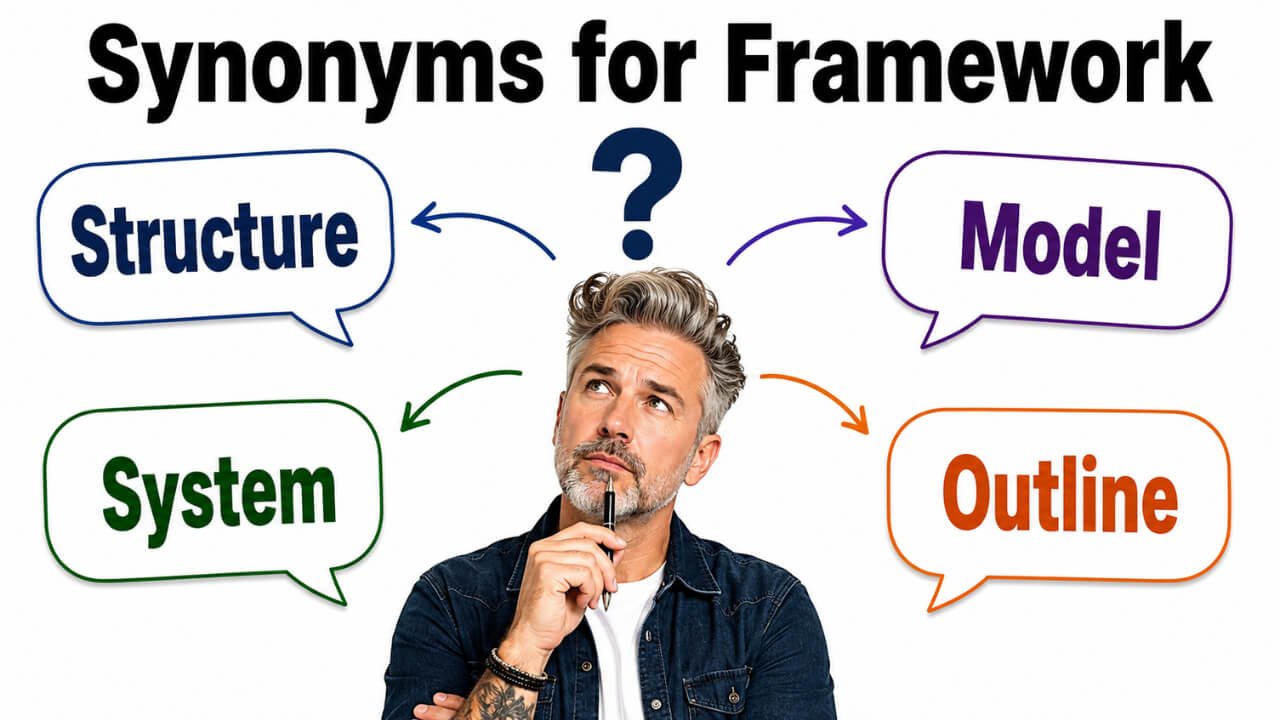
Quick Answer: Synonyms for framework include structure, system, model, architecture, outline, blueprint, foundation, scaffold, methodology, and scheme. Use structure for an organized arrangement, system for connected processes, model for a simplified representation, and architecture for complex technical design. Outline works best for an early plan, while blueprint suggests detailed instructions. Foundation describes an underlying basis, scaffold suggests supporting elements, methodology suits research or analysis, and scheme describes an organized plan.
Pronunciation and Word Details
Word: Framework
Pronunciation: /ˈfreɪm.wɜːrk/
Part of Speech: Noun
Meaning: A framework is an organized structure of ideas, rules, parts, or methods that supports a system, plan, or activity.
US Pronunciation:
UK Pronunciation:
What Does “Framework” Mean?
Framework means a basic structure that supports, organizes, or guides something. It is mainly used as a noun and can describe a physical structure, a system of ideas, a set of rules, or an organized method for completing a task.
In a physical context, a framework may be the supporting structure of a building or object. In academic writing, it may refer to a group of theories or concepts used to examine a subject. In business, law, education, technology, and planning, it often describes a system that guides decisions and actions.
The word helps readers understand that something has an organized foundation. A framework does not always include every detail. Instead, it provides the main parts, relationships, boundaries, or principles upon which further work can be developed.
Meaning, Tone, and Context of “Framework”
Framework has a neutral, formal, and often technical tone. It is common in academic papers, professional reports, policy discussions, research studies, organizational planning, technical documents, and educational materials.
In everyday conversation, framework may sound more formal than words such as plan, structure, or system. A person might say, “We need a plan,” in casual speech but use, “We need a clear framework,” in a professional meeting.
In academic contexts, framework often describes the theories, concepts, or methods that guide an investigation. In technical contexts, it may refer to an organized collection of components and rules. In management, it can describe a decision process, operating structure, or strategic system.
The word usually suggests order, support, consistency, and clear relationships. It is less emotional than words such as vision or inspiration. Its purpose is to explain how something is arranged or how it should operate.
When and How to Use “Framework”
For Organizational Structure: Use framework when describing how responsibilities, departments, processes, or roles are arranged.
Example: The organization introduced a new framework for assigning responsibilities.
For Academic Research: Use framework for the theories, concepts, or assumptions that guide a study.
Example: The researcher developed a conceptual framework for examining student motivation.
For Planning: Use framework when presenting the main structure of a plan without discussing every detail.
Example: The proposal provides a framework for improving public services.
For Policies and Rules: Use framework for an organized collection of principles, standards, or regulations.
Example: The policy framework explains how complaints should be handled.
For Technical Design: Use framework when describing connected components that support a larger technical system.
Example: The engineers created a flexible framework for managing information.
For Decision Making: Use framework for an organized method that helps people compare options and make consistent choices.
Example: The team followed a decision making framework before selecting the final proposal.
Best Synonyms for Framework
Structure: An organized arrangement of connected parts.
Example: The course has a clear structure that guides students through each topic.
System: A set of connected parts or processes that work together.
Example: The company introduced a system for reviewing customer requests.
Model: A simplified representation that explains how something works.
Example: The model shows how different economic factors influence one another.
Architecture: The planned design and organization of a complex structure or system.
Example: The technical architecture supports secure communication between departments.
Outline: A summary of the main ideas, stages, or sections.
Example: The teacher provided an outline for the final assignment.
Blueprint: A detailed plan that explains how something should be created or achieved.
Example: The strategy serves as a blueprint for future growth.
Foundation: The basic principles or support upon which something is built.
Example: Trust is the foundation of a productive working relationship.
Scaffold: A supporting structure that helps something develop gradually.
Example: The learning scaffold helps students understand difficult concepts.
Methodology: An organized collection of methods used in research or professional work.
Example: The study explains the methodology used to collect and examine the data.
Scheme: An organized plan or arrangement designed for a particular purpose.
Example: The training scheme gives employees a clear path for professional development.
50 Synonyms for Framework with Short Meanings
- Structure: An organized arrangement of connected parts.
- System: A collection of parts that work together.
- Model: A representation of an idea, process, or object.
- Scheme: An organized plan or arrangement.
- Outline: A summary of the main points or stages.
- Plan: A prepared method for achieving a goal.
- Architecture: The overall design of a complex system.
- Scaffold: A supporting structure for growth or development.
- Skeleton: The basic form without complete details.
- Foundation: The underlying support or starting basis.
- Basis: The main principle or reason supporting something.
- Arrangement: The way parts are organized or positioned.
- Organization: An orderly structure of related parts.
- Configuration: A particular arrangement of components.
- Design: A planned form or structure.
- Setup: The way something is arranged or prepared.
- Format: The organized form in which something appears.
- Template: A prepared pattern used to create similar work.
- Matrix: An organized arrangement of related elements.
- Network: A connected structure of people, ideas, or components.
- Infrastructure: The basic systems and structures supporting an activity.
- Mechanism: A process or arrangement through which something operates.
- Methodology: A structured collection of methods and principles.
- Method: An organized way of completing a task.
- Approach: A particular way of dealing with a subject or problem.
- Strategy: A carefully developed plan for reaching a goal.
- Protocol: A defined set of procedures or rules.
- Standard: An accepted level, rule, or model.
- Guideline: A principle that directs actions or decisions.
- Pattern: A repeated or recognizable arrangement.
- Blueprint: A detailed plan for development or action.
- Road Map: A plan showing stages and future direction.
- Reference Model: A standard representation used for comparison or guidance.
- Conceptual Model: A structure showing relationships between ideas.
- Theoretical Model: A theory based explanation of how something works.
- Analytical Model: A structured method for examining information.
- Paradigm: A recognized model or pattern of thought.
- Doctrine: A collection of accepted beliefs or principles.
- Body of Principles: A group of ideas that guide decisions.
- Set of Rules: An organized collection of requirements.
- System of Ideas: A connected arrangement of concepts.
- Structure of Ideas: An organized relationship between concepts.
- Operating Model: A description of how an organization performs its work.
- Organizational Model: A structure defining roles, responsibilities, and relationships.
- Support System: A group of connected elements that provides assistance.
- Schema: An organized representation of concepts or information.
- Frame of Reference: A set of ideas used to understand a subject.
- Groundwork: The preparation or basis for later development.
- Rubric: A structured guide for judging or evaluating work.
- Taxonomy: A system for organizing items into related categories.
Read Also:
Synonyms for Tough

Synonyms for Framework by Context
When Framework Means an Organized Structure
Structure, arrangement, organization, configuration, setup, and architecture describe the way different parts are connected or positioned.
Structure is the most general alternative. Arrangement focuses on placement, while configuration is common when discussing technical components. Architecture suggests a carefully designed and often complex organization.
Example: The department created a clear organizational structure for managing its projects.
When Framework Means a System of Ideas
Conceptual model, theoretical model, paradigm, schema, frame of reference, and system of ideas are useful in academic and intellectual contexts.
A conceptual model presents relationships between important concepts. A theoretical model is based on established theories. A paradigm is a broader pattern of beliefs or assumptions that shapes how a subject is understood.
Example: The study uses a theoretical model to explain changes in human behavior.
When Framework Means a Plan
Plan, strategy, scheme, outline, blueprint, and road map work well when framework describes preparation for future action.
An outline provides the main points without extensive detail. A blueprint is more detailed and practical. A strategy focuses on choices intended to achieve a particular result.
Example: The proposal offers a practical road map for improving the service.
When Framework Means Rules or Guidance
Protocol, standard, guideline, doctrine, set of rules, and body of principles describe organized expectations or instructions.
A protocol gives specific procedures. A guideline offers direction but may allow flexibility. A standard defines an expected level of performance or quality.
Example: The department follows a strict protocol for protecting confidential information.
When Framework Means a Working Process
Methodology, method, approach, mechanism, operating model, and analytical model describe how work is performed.
Methodology is especially useful in research. Approach is broader and less technical. Mechanism explains the process through which an action or result occurs.
Example: The researchers selected an analytical model for reviewing the findings.
Another Word for Framework
The best general replacement for framework is structure. Both words describe an organized arrangement that supports or guides something. However, the best alternative depends on whether you are discussing ideas, rules, planning, research, or technical design.
Original: The report presents a framework for understanding customer behavior.
Better Option: The report presents a model for understanding customer behavior.
Original: We need a framework for completing the project.
Better Option: We need a plan for completing the project.
Original: The policy creates a framework for employee conduct.
Better Option: The policy creates a set of guidelines for employee conduct.
Original: The application uses a flexible framework.
Better Option: The application uses a flexible architecture.
When Not to Use “Framework”
Do not use framework when a more precise word would make the sentence easier to understand. The word can sound vague when the reader does not know whether it refers to a plan, structure, theory, method, or set of rules.
Avoid using it repeatedly in nearby sentences. Repetition can make formal writing sound mechanical. Choose model, system, plan, methodology, or structure when one of these words describes the meaning more accurately.
Framework may also sound unnecessarily formal in simple conversation. In everyday situations, plan or approach is often more natural.
Weak: We need a framework for deciding where to meet.
Better: We need a simple plan for deciding where to meet.
Weak: The researcher used a framework to collect the responses.
Better: The researcher used a methodology to collect the responses.
Weak: The machine has a strong framework.
Better: The machine has a strong supporting structure.
Weak: The framework explains every step employees must follow.
Better: The protocol explains every step employees must follow.
Words Commonly Confused With Framework
Framework vs Structure: Framework often refers to an organizing system that guides development, while structure describes the actual arrangement of parts. A framework can support a structure, but the words are not always interchangeable.
Framework vs System: A framework provides guiding principles or an organized foundation. A system includes connected parts and processes that actively work together.
Framework vs Model: A framework organizes ideas or actions. A model represents, explains, or predicts how something works.
Framework vs Methodology: A framework provides the general structure for a study or process. A methodology explains the specific methods and principles used to perform the work.
Framework vs Foundation: A foundation is the underlying support or starting basis. A framework includes organized parts built upon that foundation.
Framework vs Architecture: Framework is broad and may refer to concepts, rules, or plans. Architecture usually emphasizes the detailed design of a complex physical or technical system.
Framework vs Template: A framework guides organization while allowing flexibility. A template provides a prepared format that users often follow more directly.
Which Synonym Should You Choose?
Choose structure when describing the general organization of parts, roles, concepts, or sections.
Choose system when the parts interact and perform connected functions.
Choose model when explaining, representing, or predicting how something works.
Choose architecture when discussing the detailed design of a complex technical or physical system.
Choose outline when presenting the main points of an essay, report, speech, or project.
Choose blueprint when describing a detailed plan for creating or achieving something.
Choose methodology when explaining research methods, data collection, analysis, or professional procedures.
Choose strategy when discussing choices and actions intended to reach a goal.
Choose protocol when describing official procedures that must be followed.
Choose guideline when offering flexible advice or recommended practices.
Choose rubric when describing criteria used to evaluate performance or quality.
Choose taxonomy when classifying ideas, objects, or information into categories.
Choose plan in casual speech, everyday communication, and straightforward workplace discussions.
Real Life Examples of “Framework” in Sentences
Original: The school introduced a framework for improving student performance.
Better Option: The school introduced a strategy for improving student performance.
Original: The report provides a framework for understanding the problem.
Better Option: The report provides a model for understanding the problem.
Original: The team needs a framework for managing its weekly tasks.
Better Option: The team needs a system for managing its weekly tasks.
Original: The researchers followed a framework for collecting information.
Better Option: The researchers followed a methodology for collecting information.
Original: The policy establishes a framework for safe working practices.
Better Option: The policy establishes guidelines for safe working practices.
Original: The project framework includes four major stages.
Better Option: The project plan includes four major stages.
Original: The engineers reviewed the framework of the new system.
Better Option: The engineers reviewed the architecture of the new system.
Original: The lesson framework helps teachers organize classroom activities.
Better Option: The lesson template helps teachers organize classroom activities.
Original: The legal framework defines the responsibilities of each party.
Better Option: The legal structure defines the responsibilities of each party.
Original: The manager created a framework for evaluating employee progress.
Better Option: The manager created a rubric for evaluating employee progress.
Synonym Groups and Usage Differences
Structural Group
Structure, architecture, configuration, arrangement, skeleton, and infrastructure describe how parts are connected or supported.
Structure is broad and neutral. Architecture suggests intentional and complex design. Skeleton refers only to the basic form, while infrastructure describes the essential systems that support continued activity.
Example: The basic structure of the report contains five sections.
Conceptual Group
Conceptual model, theoretical model, paradigm, schema, frame of reference, and system of ideas organize knowledge and explain relationships.
These alternatives are common in research, education, psychology, philosophy, and analytical writing. They help readers understand how ideas are connected.
Example: The conceptual model shows the relationship between motivation and performance.
Planning Group
Plan, strategy, blueprint, scheme, road map, and outline describe organized preparation.
A plan states intended actions. A strategy focuses on achieving a goal. A blueprint includes detailed guidance, while an outline presents only the main points.
Example: The development strategy identifies the most important priorities.
Process Group
Methodology, method, approach, mechanism, protocol, and operating model explain how an activity is completed.
Methodology is formal and research focused. Method is more general. Protocol describes required procedures, while approach allows greater flexibility.
Example: The new approach encourages employees to solve problems collaboratively.
Guidance Group
Guideline, standard, doctrine, body of principles, rubric, and set of rules provide direction or expectations.
Guidelines usually allow judgment. Standards establish expected quality. Rules are more binding, while a rubric provides criteria for evaluation.
Example: The assessment rubric explains how each assignment will be graded.
Technical Group
Architecture, network, infrastructure, configuration, matrix, and reference model are useful in technical and organizational discussions.
Architecture describes the overall design. Configuration refers to the specific arrangement of components. A reference model provides a standard structure that can guide further development.
Example: The system architecture separates storage, processing, and communication functions.
Antonyms of Framework
The opposite of framework depends on the intended meaning. When framework means an organized structure, its opposites suggest disorder or a lack of support. When it means a plan or system, its opposites suggest unplanned or inconsistent action.
Chaos: A state with no clear order or control.
Disorder: A lack of organization or proper arrangement.
Disorganization: Poor coordination between parts, tasks, or people.
Randomness: The absence of a planned pattern or method.
Improvisation: Action created immediately without a prepared structure.
Confusion: A state in which ideas or instructions are unclear.
Fragmentation: Division into disconnected or incomplete parts.
Shapelessness: The absence of a clear form or structure.
Collapse: The failure or destruction of a supporting structure.
Inconsistency: A lack of stable rules, patterns, or methods.
Absence of Structure: A condition in which no organizing system exists.
Unplanned Action: Activity performed without an established plan.
Comparison: Framework vs Related Words
Framework vs Structure
Framework provides an organizing foundation that guides development. Structure describes the actual way parts are arranged.
Example With Framework: The committee developed a framework for reviewing new proposals.
Example With Structure: The committee changed its leadership structure.
Framework vs System
A framework provides guidance, principles, or organization. A system actively connects processes, people, or components that work together.
Example With Framework: The policy framework guides financial decisions.
Example With System: The payment system processes customer requests automatically.
Framework vs Model
A framework organizes ideas, rules, or activities. A model represents a concept and may help explain or predict results.
Example With Framework: The study follows a framework based on social behavior.
Example With Model: The study uses a model to predict social behavior.
Framework vs Architecture
Framework is broader and can describe conceptual or practical organization. Architecture refers to a detailed and deliberately designed structure.
Example With Framework: The team adopted a framework for developing the service.
Example With Architecture: The team redesigned the technical architecture of the service.
Framework vs Methodology
Framework provides the general boundaries and concepts guiding research. Methodology describes the methods, procedures, and reasoning used to conduct it.
Example With Framework: The theoretical framework identifies the main concepts in the study.
Example With Methodology: The methodology explains how participants were selected.
Framework vs Blueprint
A framework offers an organized basis that may remain flexible. A blueprint provides a more detailed plan for construction, development, or action.
Example With Framework: The document offers a framework for future reform.
Example With Blueprint: The document offers a detailed blueprint for carrying out the reform.
Framework vs Foundation
A framework is the organized structure built around key parts or principles. A foundation is the underlying support upon which that structure depends.
Example With Framework: The course framework organizes lessons into major themes.
Example With Foundation: Basic reading skills provide the foundation for the course.
Common Phrases and Expressions With Framework
Conceptual Framework: A structure that organizes concepts and shows their relationships.
Theoretical Framework: A group of theories used to guide research or analysis.
Legal Framework: The laws and principles governing an activity or relationship.
Regulatory Framework: The official rules and procedures controlling a field.
Policy Framework: A structured collection of principles guiding policy decisions.
Analytical Framework: A method for organizing and examining information.
Organizational Framework: A structure defining roles, responsibilities, and relationships.
Decision Making Framework: A process used to compare options and make consistent choices.
Technical Framework: An organized structure of technical components, rules, or processes.
Supporting Framework: A structure that provides stability, guidance, or assistance.
Common Mistakes to Avoid
Using Framework Too Vaguely: Explain what kind of framework you mean. Terms such as policy framework, conceptual framework, and evaluation framework provide useful detail.
Repeating the Word: Avoid using framework several times in one paragraph. Replace it with structure, system, model, plan, or approach when appropriate.
Choosing an Inaccurate Synonym: Do not replace framework with methodology unless you are discussing methods and procedures. Do not use architecture unless the context involves deliberate and complex design.
Confusing Framework With Foundation: A foundation supports something at its base. A framework organizes the parts that are built upon that base.
Using Formal Language in Simple Situations: Framework can sound unnecessarily technical in casual conversation. Plan, method, or approach may sound more natural.
Treating Every Plan as a Framework: A simple plan lists intended actions. A framework usually provides broader principles, categories, relationships, or boundaries.
Ignoring the Context: The correct synonym depends on whether the subject involves research, planning, technology, rules, organization, or physical construction.
Using Unnatural Phrasing: Write “a framework for evaluating performance” rather than “a framework to performance evaluation.” The phrase should clearly connect the structure with its purpose.
Conclusion
Understanding synonyms for framework helps you choose a word that clearly matches your intended meaning. Structure is the best general alternative, while system describes connected processes and model represents an idea or process. Use architecture for complex design, methodology for research procedures, blueprint for a detailed plan, and guideline for flexible direction. The strongest choice depends on whether you are describing organization, planning, theories, rules, evaluation, or technical development. A precise synonym makes your writing clearer, more natural, and easier to understand.
FAQs About Synonyms for Framework
What Is the Best Synonym for Framework?
Structure is the best general synonym because it describes an organized arrangement of connected parts. The ideal replacement still depends on the sentence context.
Is System a Synonym for Framework?
Yes, system can replace framework when referring to connected processes or parts. A system usually emphasizes active operation, while a framework emphasizes organization and guidance.
What Is Another Word for Framework in Academic Writing?
Conceptual model, theoretical model, methodology, paradigm, and frame of reference are useful academic alternatives. Choose the term that matches the purpose of the research.
What Is Another Word for a Planning Framework?
Plan, strategy, blueprint, outline, scheme, and road map are suitable choices. Blueprint is best when the plan includes detailed steps.
Can Architecture Replace Framework?
Architecture can replace framework in technical, structural, or design contexts. It is less suitable when discussing general rules, policies, or research concepts.
What Is the Difference Between a Framework and a Model?
A framework organizes ideas, principles, or activities. A model represents or explains how something works and may also be used to predict results.
Is Framework a Formal Word?
Framework is neutral but often sounds formal or technical. In casual conversation, plan, structure, method, or approach may sound more natural.
