
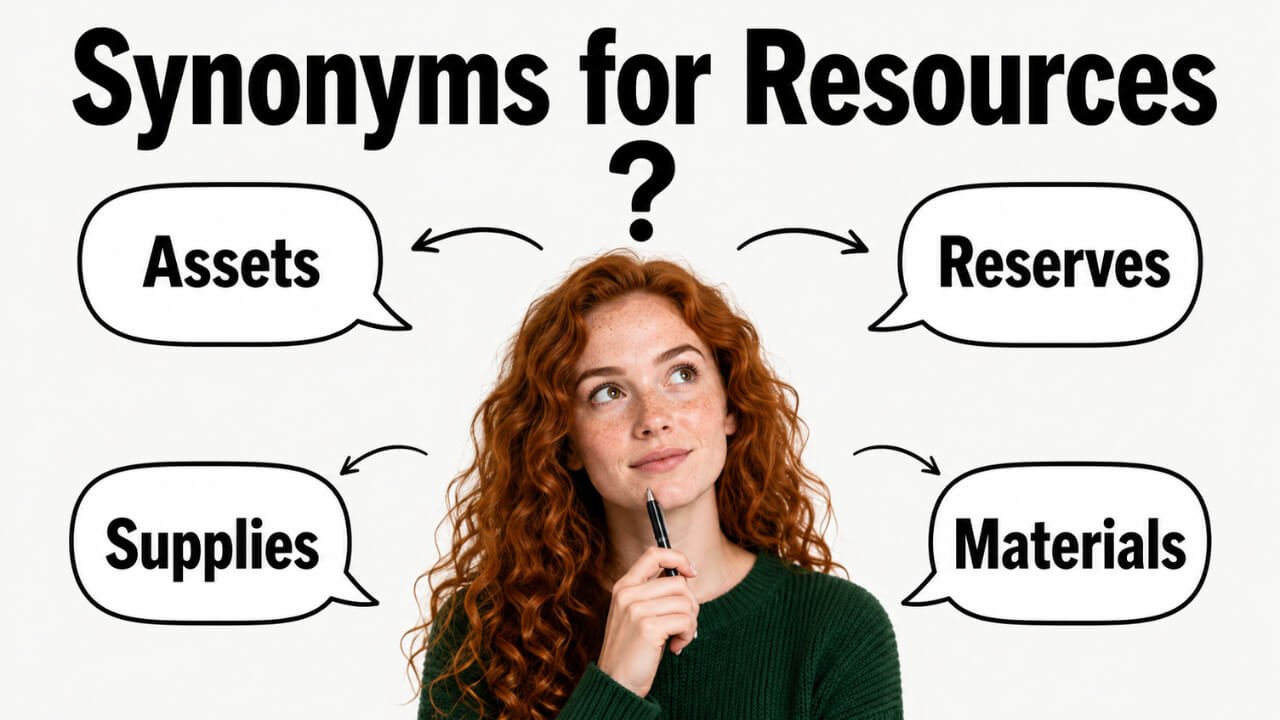
Quick Answer: Common synonyms for resources include assets, means, supplies, materials, funds, tools, support, reserves, references, and facilities. The best choice depends on the context. Use assets for valuable possessions, funds for available money, supplies for necessary items, materials for physical or educational content, tools for practical equipment, support for assistance, reserves for stored quantities, references for information sources, and facilities for buildings or operational spaces.
Pronunciation and Word Details
Word: Resources.
Pronunciation: /ˈriːsɔːrsɪz/
Part of Speech: Plural noun.
Meaning: Resources are useful supplies, assets, abilities, information, people, or sources of support that help someone achieve a goal.
US Pronunciation:
UK Pronunciation:
What Does “Resources” Mean?
Resources are useful things that people, organizations, communities, or systems can use to meet needs, solve problems, complete work, or achieve goals.
Resources is the plural form of resource. It is mainly used as a noun and can describe money, materials, equipment, time, information, knowledge, natural substances, or skilled people.
The exact meaning changes according to the sentence. In a financial context, resources may mean money or capital. In education, the word can describe books, lessons, references, and learning materials. In a workplace, it may refer to staff, tools, facilities, time, and available support.
Financial Context: The organization needs more resources to complete the project.
Educational Context: Students were given additional resources for independent study.
Natural Context: Water and forests are important natural resources.
Workplace Context: The team used its available resources efficiently.
Meaning, Tone, and Context of “Resources”
Resources is a neutral and widely used word. It can sound formal, academic, technical, professional, or conversational depending on the subject.
In formal writing, resources commonly refers to finances, personnel, equipment, information, or organizational capabilities. Reports may discuss resource allocation, limited resources, financial resources, or available resources.
In academic and educational writing, the word often describes books, references, research materials, learning tools, and sources of information. In environmental discussions, resources may refer to water, land, forests, minerals, energy, and other parts of nature.
In casual conversation, resources can simply mean useful help or things that are available.
Formal Use: The department must manage its resources carefully.
Academic Use: The library provides valuable research resources.
Technical Use: The system requires additional computing resources.
Conversational Use: We have enough resources to finish the work.
The word usually has a practical and positive tone because it emphasizes usefulness, availability, and potential. However, phrases such as limited resources or depleted resources can express concern, pressure, or scarcity.
When and How to Use “Resources”
For Money and Finances
Use resources when discussing money, capital, budgets, or other financial assets that can support an activity.
Example: The organization lacks the financial resources needed for expansion.
For Materials and Supplies
Use resources for physical items required to complete work, provide services, or meet basic needs.
Example: The emergency team delivered essential resources to the affected area.
For Information and Learning
Use resources when referring to books, guides, research, references, or educational materials.
Example: The teacher shared useful resources with the class.
For People and Skills
Resources can describe the employees, experts, abilities, and talents available to a group.
Example: Skilled workers are among the organization’s most valuable resources.
For Tools and Equipment
Use the word for practical items, technology, machines, or facilities used to perform a task.
Example: The workshop provides the resources needed for practical training.
For Time and Energy
Resources may also refer to personal qualities or limited capacities such as time, attention, and energy.
Example: She devoted most of her resources to completing the assignment.
For Natural Materials
Use natural resources for useful substances and features found in nature.
Example: Clean water is one of the region’s most important resources.
For Help and Support
Resources can describe services, assistance, and support systems available to people.
Example: The community center offers resources for families who need assistance.
Best Synonyms for Resources
Assets
Synonym: Valuable possessions, abilities, or advantages that can be used effectively.
Example: Experienced employees are valuable assets to the organization.
Means
Synonym: Money, abilities, methods, or opportunities available for achieving something.
Example: The family did not have the means to pay for the repairs.
Supplies
Synonym: Items stored or provided for a particular need or activity.
Example: The team gathered enough supplies for the journey.
Materials
Synonym: Physical items or information used to create, teach, build, or complete something.
Example: The instructor prepared the course materials in advance.
Funds
Synonym: Money available for a particular purpose.
Example: Additional funds were approved for the project.
Tools
Synonym: Equipment, methods, or systems used to perform work or solve problems.
Example: Writers need the right tools to organize their ideas.
Support
Synonym: Help, encouragement, or practical assistance.
Example: The new employees received support during their training.
Reserves
Synonym: Supplies, money, or materials saved for future use.
Example: The region has large reserves of fresh water.
References
Synonym: Sources of information used for learning, research, or verification.
Example: The report includes several useful references.
Facilities
Synonym: Buildings, rooms, equipment, or services provided for a particular activity.
Example: The training facilities can accommodate a large group.
50 Synonyms for Resources with Short Meanings
- Assets: Valuable things, qualities, or abilities that can be used.
- Means: Available money, methods, or abilities.
- Supplies: Items kept for a particular purpose.
- Materials: Physical or informational items used for work or study.
- Funds: Money available for a specific need.
- Capital: Money or property used to support activity or growth.
- Finances: Money and financial arrangements available to someone.
- Money: Currency or wealth available for spending.
- Budget: An amount of money planned for a purpose.
- Wealth: A large amount of money, property, or valuable assets.
- Reserves: Supplies or funds stored for future use.
- Provisions: Necessary items supplied for future needs.
- Stock: A quantity of goods kept for use or sale.
- Inventory: A detailed supply of available goods or materials.
- Equipment: Tools and machines needed for an activity.
- Tools: Objects or methods used to complete a task.
- Facilities: Buildings, spaces, or services provided for use.
- Infrastructure: Basic systems and structures that support activity.
- Personnel: People employed by an organization.
- Workforce: The complete group of available workers.
- Staff: Employees who work for an organization.
- Talent: People with valuable skills or natural abilities.
- Expertise: Advanced knowledge or skill in a subject.
- Skills: Learned abilities used to perform tasks.
- Capabilities: Abilities or powers to perform successfully.
- Capacity: The ability to handle work, demand, or responsibility.
- Strengths: Useful qualities or abilities that create an advantage.
- Support: Help or assistance provided to someone.
- Assistance: Practical help given to complete something.
- Aid: Help supplied during difficulty or need.
- Help: Support that makes a task or situation easier.
- Services: Useful work or assistance provided to others.
- Information: Facts and details that improve understanding.
- Data: Collected facts used for study or decision making.
- Knowledge: Information and understanding gained through experience.
- References: Sources consulted for useful information.
- Sources: Places, people, or materials from which information comes.
- Guides: Resources that provide directions or explanations.
- Documentation: Written information explaining a subject or process.
- Research: Careful study used to discover reliable information.
- Evidence: Facts or material that support a conclusion.
- Options: Available choices or possible courses of action.
- Opportunities: Favorable situations that can be used for progress.
- Solutions: Methods or answers that resolve problems.
- Networks: Connected people or systems that provide help and information.
- Connections: Relationships that offer access, advice, or assistance.
- Time: Available periods that can be used productively.
- Energy: Physical or mental power available for action.
- Access: The ability or permission to use something valuable.
- Holdings: Property, investments, or valuable possessions owned by someone.
Read Also:
Synonyms for Leave

Synonyms for Resources by Context
When Resources Means Money
Funds, finances, capital, money, budget, wealth, means, and reserves are suitable when resources refers to financial ability.
Funds is the clearest choice for money assigned to a purpose. Capital is common when money is used for business activity or growth. Budget refers to a planned amount, while means describes a person’s general ability to afford something.
Example: The project requires more financial resources.
Alternative: The project requires more funds.
Example: They lacked the resources to purchase new equipment.
Alternative: They lacked the means to purchase new equipment.
When Resources Means Materials or Supplies
Supplies, materials, provisions, stock, inventory, and equipment work when resources describes physical items.
Supplies refers to items needed for an activity. Materials is useful for construction, education, production, and creative work. Provisions commonly describes items prepared for future needs.
Example: The school purchased additional resources for the classroom.
Alternative: The school purchased additional supplies for the classroom.
Example: The workers gathered the necessary resources.
Alternative: The workers gathered the necessary materials.
When Resources Means Information
Information, data, knowledge, sources, references, guides, documentation, research, and evidence fit informational contexts.
References and sources are especially useful in academic writing. Documentation is appropriate for technical instructions and records. Data refers to collected facts, while knowledge refers to understanding.
Example: The website contains useful resources for researchers.
Alternative: The collection contains useful references for researchers.
Example: Students should consult several resources.
Alternative: Students should consult several sources.
When Resources Means People
Personnel, workforce, staff, talent, expertise, skills, and capabilities describe human ability within a group.
Personnel is formal and refers to employees collectively. Staff is more common in everyday workplace language. Talent emphasizes capable people, while expertise focuses on specialized knowledge.
Example: The organization needs additional human resources.
Alternative: The organization needs additional personnel.
Example: The team has the resources to handle the task.
Alternative: The team has the expertise to handle the task.
When Resources Means Tools or Facilities
Tools, equipment, facilities, infrastructure, systems, and technology can describe practical resources used for work.
Tools may be physical objects or methods. Equipment usually refers to physical items. Facilities includes buildings, rooms, and services. Infrastructure describes the wider systems that make operations possible.
Example: The center provides modern resources for training.
Alternative: The center provides modern facilities for training.
Example: Employees received the resources needed to work safely.
Alternative: Employees received the equipment needed to work safely.
When Resources Means Help
Support, assistance, aid, help, services, networks, and connections are strong choices when resources refers to help.
Support is broad and can be practical or emotional. Assistance sounds more formal. Aid often appears in urgent or charitable contexts. Networks and connections describe useful relationships.
Example: Families can access local resources.
Alternative: Families can access local support services.
Example: She used every available resource during the crisis.
Alternative: She used every available source of assistance during the crisis.
When Resources Means Personal Capacity
Time, energy, capacity, strengths, skills, and capabilities describe personal resources.
Time and energy are limited personal resources. Capacity describes how much responsibility or work a person can manage. Strengths refer to useful personal qualities.
Example: The assignment demanded all of his resources.
Alternative: The assignment demanded all of his time and energy.
When Resources Means Natural Materials
Reserves, supplies, materials, wealth, assets, and provisions can describe useful parts of nature.
Reserves is common for stored or known quantities of water, fuel, or minerals. Natural wealth refers more broadly to valuable environmental features.
Example: The country has rich natural resources.
Alternative: The country has rich natural reserves.
Another Word for Resources
Assets is often the best general replacement for resources because it can describe valuable money, property, abilities, people, or advantages. However, the strongest alternative depends on what kind of resource the sentence describes.
Use funds for money, supplies for necessary items, materials for educational or physical content, staff for employees, references for information, and facilities for buildings or equipment.
Original: The organization has enough resources to expand.
Better Option: The organization has enough assets to expand.
Original: The department needs more resources for the program.
Better Option: The department needs more funds for the program.
Original: The teacher provided helpful resources.
Better Option: The teacher provided helpful learning materials.
Original: The center offers resources for local families.
Better Option: The center offers support services for local families.
When Not to Use “Resources”
Resources is broad and may sound vague when a more precise noun would communicate the meaning better. Readers may not know whether it refers to money, people, equipment, information, time, or assistance.
Use a specific synonym whenever the exact type of resource is important.
When You Mean Money
Use funds, finances, capital, or budget instead of the general word resources.
Weak: We need more resources to pay for the repairs.
Better: We need more funds to pay for the repairs.
When You Mean Employees
Use staff, personnel, workforce, or specialists when discussing people.
Weak: The office needs more resources to answer customer questions.
Better: The office needs more staff to answer customer questions.
When You Mean Information
Use sources, references, data, documentation, or research when discussing knowledge.
Weak: The essay should include more resources.
Better: The essay should include more reliable references.
When You Mean Equipment
Use tools, equipment, machinery, or facilities for physical items.
Weak: The workers did not have the right resources.
Better: The workers did not have the right equipment.
When You Mean Support
Use assistance, aid, services, or support when referring to help.
Weak: The family received useful resources.
Better: The family received practical assistance.
When the Word Becomes Repetitive
Repeated use of resources can make professional or academic writing sound general and monotonous.
Weak: The resources team reviewed the resources and requested more resources.
Better: The planning team reviewed the available materials and requested additional funding.
Words Commonly Confused With Resources
Resources vs Assets: Resources includes anything useful for reaching a goal. Assets usually refers to valuable possessions, abilities, or advantages.
Resources vs Supplies: Resources is broad, while supplies specifically refers to items stored or provided for use.
Resources vs Materials: Resources may include money, people, time, and information. Materials usually refers to physical items or educational content.
Resources vs Sources: Resources are useful things available for action or learning. Sources are the origins of information, materials, or evidence.
Resources vs References: Resources may include any useful assistance or material. References are sources consulted for information or verification.
Resources vs Funds: Resources can include money, people, skills, and tools. Funds specifically means money available for a purpose.
Resources vs Capital: Resources is a general term. Capital usually refers to money or property used to create value or support growth.
Resources vs Reserves: Resources are currently available or potentially useful. Reserves are quantities intentionally saved for later use.
Resources vs Facilities: Resources may include facilities, but facilities specifically describes buildings, spaces, equipment, and services designed for an activity.
Resources vs Personnel: Resources can describe many kinds of support. Personnel refers only to the people employed by an organization.
Which Synonym Should You Choose?
Choose assets when referring broadly to valuable possessions, abilities, advantages, or property.
Choose funds when writing about money available for a project, program, purchase, or activity.
Choose capital when discussing money or property used for growth, production, or investment.
Choose budget when referring to a planned amount of money.
Choose supplies when discussing items required for daily work, travel, care, or emergency needs.
Choose materials when referring to construction items, learning content, production items, or creative components.
Choose equipment when discussing physical tools, machines, or devices.
Choose facilities when referring to buildings, rooms, equipment, and services available at a location.
Choose staff in ordinary workplace conversations and professional emails about employees.
Choose personnel in formal reports, policies, and organizational writing.
Choose expertise when the main resource is specialized knowledge.
Choose skills when emphasizing learned abilities.
Choose support for general help in professional or personal contexts.
Choose assistance for polite, formal, or practical help.
Choose aid when discussing urgent help, relief, or essential support.
Choose sources for essays, research, and factual writing.
Choose references when discussing materials consulted for information.
Choose data for collected facts, measurements, and results.
Choose tools when describing objects, methods, or systems used to complete work.
Choose reserves when discussing something stored for future use.
Choose time and energy when discussing personal limitations or effort.
Real Life Examples of “Resources” in Sentences
Original: The school needs more resources for its students.
Better Option: The school needs more learning materials for its students.
Original: The organization has limited resources.
Better Option: The organization has limited funds and staff.
Original: She used several resources while writing the report.
Better Option: She used several references while writing the report.
Original: The workers lacked the resources to complete the repair.
Better Option: The workers lacked the equipment to complete the repair.
Original: The community provides resources for older residents.
Better Option: The community provides support services for older residents.
Original: The project consumed most of our resources.
Better Option: The project consumed most of our time and budget.
Original: The country is rich in natural resources.
Better Option: The country has extensive natural reserves.
Original: The team has enough resources to solve the problem.
Better Option: The team has enough expertise to solve the problem.
Original: We should use our resources wisely.
Better Option: We should use our available assets wisely.
Original: The department requested additional resources.
Better Option: The department requested additional funding and personnel.
Synonym Groups and Usage Differences
Financial Group
Funds, capital, finances, money, budget, wealth, means, and reserves describe financial resources.
Funds is best for money set aside for a purpose. Capital often supports growth or production. Budget is a planned spending limit. Means describes general financial ability.
Example: The program cannot continue without additional funding.
Material Group
Supplies, materials, provisions, stock, inventory, equipment, and tools describe physical resources.
Supplies are consumed or regularly replaced. Equipment is normally used repeatedly. Inventory refers to an organized quantity of goods. Provisions are prepared for future needs.
Example: The shelter stored emergency provisions before the storm.
Information Group
Information, data, knowledge, references, sources, guides, documentation, research, and evidence support understanding.
Data consists of collected facts. Knowledge includes understanding. References and sources support research. Documentation records instructions, processes, or technical details.
Example: The researcher reviewed the available evidence before reaching a conclusion.
Human Group
Personnel, workforce, staff, talent, expertise, skills, capabilities, and capacity describe people and their abilities.
Staff and personnel refer to employees. Talent emphasizes capable individuals. Expertise describes advanced knowledge. Capacity refers to the amount of work a person or group can manage.
Example: The project requires staff with technical expertise.
Support Group
Support, assistance, aid, help, services, networks, and connections describe help available to individuals or groups.
Support is the broadest term. Assistance is polite and formal. Aid often describes urgent help. Networks and connections provide access to people, knowledge, or opportunities.
Example: Local support helped the family recover.
Operational Group
Facilities, infrastructure, equipment, tools, services, and systems support practical operations.
Facilities include physical spaces and services. Infrastructure refers to the basic structures that support wider activity. Tools and equipment help people perform particular tasks.
Example: Improved infrastructure made the service more reliable.
Personal Group
Time, energy, skills, strengths, knowledge, and capacity describe resources belonging to an individual.
Time and energy are limited. Skills and knowledge can develop through learning. Strengths are useful qualities that help a person succeed.
Example: She used her communication skills to resolve the disagreement.
Antonyms of Resources
The opposite of resources depends on whether the word refers to money, supplies, ability, information, or support. Many of these words are contextual opposites rather than exact replacements.
Scarcity: A situation in which useful supplies are limited.
Shortage: An insufficient amount of something needed.
Lack: The absence of something necessary or useful.
Deficit: An amount that is smaller than what is required.
Insufficiency: A condition in which available resources are inadequate.
Deprivation: A state of being without basic needs or advantages.
Poverty: A serious lack of financial resources.
Need: A condition requiring support, money, or supplies.
Limitation: A restriction on ability, availability, or capacity.
Weakness: A quality that reduces effectiveness or ability.
Depletion: The reduction or exhaustion of available supplies.
Exhaustion: The complete or near complete use of energy or supplies.
Obstruction: Something that prevents access to useful support.
Disadvantage: A condition that makes success more difficult.
Comparison: Resources vs Related Words
Resources vs Assets
Resources includes anything useful for achieving a purpose. Assets are valuable things, qualities, or possessions that provide an advantage.
Example With Resources: The team used all available resources to complete the task.
Example With Assets: Experienced workers are among the team’s greatest assets.
Resources vs Supplies
Resources can include money, time, information, and people. Supplies refers mainly to physical items needed for an activity.
Example With Resources: The center provides resources for new learners.
Example With Supplies: The center provides notebooks and other school supplies.
Resources vs Materials
Resources is a broad term. Materials usually refers to physical substances or informational content used to produce, build, teach, or learn.
Example With Resources: The teacher shared several useful resources.
Example With Materials: The teacher distributed the lesson materials.
Resources vs Sources
Resources are useful things that support action or understanding. Sources are the people, places, or documents from which information or materials originate.
Example With Resources: Students can access useful research resources.
Example With Sources: Students should evaluate the reliability of their sources.
Resources vs Funds
Resources can include money as well as people, equipment, information, and time. Funds refers specifically to money.
Example With Resources: The program needs more resources.
Example With Funds: The program needs more funds to purchase equipment.
Resources vs Capital
Resources is general, while capital often refers to money or property used for investment, production, or growth.
Example With Resources: The organization manages its resources carefully.
Example With Capital: The organization raised capital for expansion.
Resources vs Reserves
Resources are useful and available. Reserves are resources stored or protected for possible future use.
Example With Resources: The region has valuable water resources.
Example With Reserves: The region maintains emergency water reserves.
Resources vs Facilities
Resources may include money, people, information, and equipment. Facilities refers to buildings, rooms, services, and physical spaces.
Example With Resources: The college provides excellent educational resources.
Example With Facilities: The college provides modern laboratory facilities.
Resources vs Personnel
Resources is broad. Personnel refers specifically to the people working for an organization.
Example With Resources: The department requires additional resources.
Example With Personnel: The department requires additional personnel.
Common Phrases and Expressions With “Resources”
Natural Resources: Useful materials and features found in nature, such as water, land, forests, and minerals.
Financial Resources: Money, capital, funds, and financial assets available for use.
Human Resources: Employees, workers, skills, and abilities available within an organization.
Educational Resources: Materials and tools that support teaching and learning.
Learning Resources: Books, lessons, guides, exercises, and other materials that help people learn.
Available Resources: Supplies, money, people, or information that can currently be used.
Limited Resources: An insufficient or restricted amount of useful support or materials.
Shared Resources: Tools, information, facilities, or supplies used by several people or groups.
Local Resources: Services, facilities, information, or support available within a particular area.
Additional Resources: Extra information, money, staff, tools, or assistance provided beyond the original amount.
Common Mistakes to Avoid
A common mistake is using resources without explaining what kind of resources are being discussed. The word can refer to money, people, supplies, information, equipment, time, or support. Use a more precise synonym when clarity matters.
Avoid confusing resources with sources. A source is where information or material comes from, while a resource is something useful for achieving a goal.
Remember that resources is plural and normally takes a plural verb.
Incorrect: The available resources is limited.
Correct: The available resources are limited.
Use resource when discussing one useful item and resources when discussing several items or a collection.
Singular: This handbook is a useful resource.
Plural: These handbooks are useful resources.
Do not automatically replace resources with supplies. Supplies only works when the sentence refers to physical items.
Unclear: The organization needs more resources.
Clear: The organization needs more funding and trained staff.
Avoid repeating resources several times in one paragraph. Replace it with specific words such as assets, funds, materials, staff, tools, or support.
Repetitive: We reviewed our resources and decided that our resources were not enough, so we requested more resources.
Improved: We reviewed our budget and staffing levels, found them insufficient, and requested additional support.
Conclusion
The best synonyms for resources depend on what is available and how it will be used. Choose assets for valuable possessions or advantages, funds for money, supplies for necessary items, materials for physical or educational content, staff for employees, and references for information. Tools, facilities, support, reserves, time, and expertise are also useful alternatives. Understanding these synonyms for resources helps you write clearer reports, essays, instructions, emails, and everyday sentences without relying on a broad or repetitive word.
FAQs About Synonyms for Resources
What Is the Best Synonym for Resources?
Assets is the best general synonym. However, funds, supplies, materials, staff, or references may be more precise in particular contexts.
What Is a Formal Synonym for Resources?
Assets, capital, personnel, facilities, infrastructure, and provisions are useful formal alternatives.
What Is Another Word for Financial Resources?
Funds, finances, capital, money, budget, means, and financial assets are strong choices.
What Is Another Word for Educational Resources?
Learning materials, references, guides, lessons, sources, documentation, and study materials are suitable alternatives.
Can Assets Be Used as a Synonym for Resources?
Yes. Assets works well when resources refers to valuable property, money, abilities, people, or advantages.
What Is the Difference Between Resources and Sources?
Resources are useful things that support a goal. Sources are the origins of information, evidence, supplies, or materials.
Is Resources Singular or Plural?
Resources is plural. The singular form is resource, as in “This guide is a useful resource.”
