
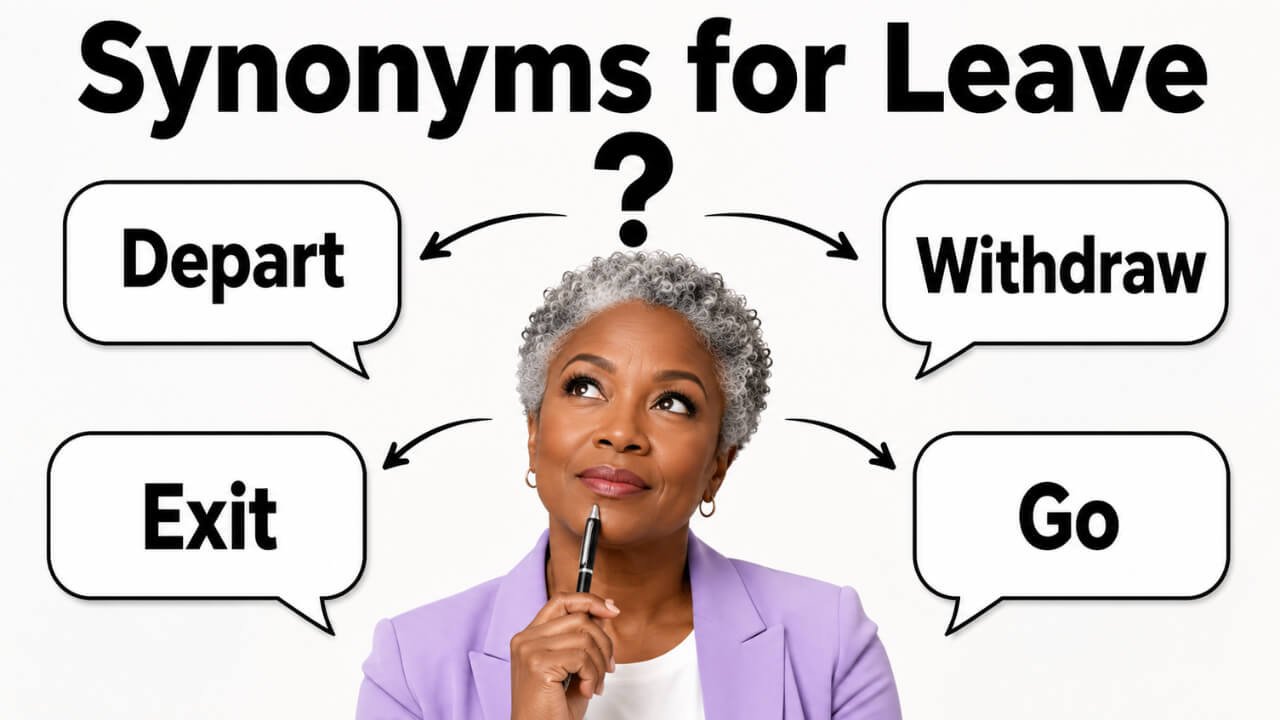
Quick Answer: Synonyms for leave include depart, go, exit, withdraw, vacate, abandon, quit, resign, omit, and bequeath. Use depart or exit when someone moves away from a place. Choose withdraw when leaving a group or activity, resign when leaving a job, and abandon when leaving someone or something permanently. Omit works when information is excluded, while bequeath refers to leaving property to someone after death. The most accurate synonym depends on the intended meaning and sentence context.
Pronunciation and Word Details
Word: Leave
Pronunciation: /liːv/
Part of Speech: Verb and noun
Meaning: To go away from a place, allow something to remain, stop participating, or give something to another person.
US Pronunciation:
UK Pronunciation:
What Does “Leave” Mean?
Leave means to go away from a person, place, activity, job, or situation. It is commonly used as a verb, but it can also function as a noun when referring to permission to be absent from work or duty.
As a verb, leave can describe physical departure, as in “They leave the office at six.” It can also mean abandoning something, allowing something to remain, excluding information, or giving property to another person.
As a noun, leave means an approved period of absence. For example, an employee may request leave to handle a personal matter.
The meaning of leave changes according to its object and surrounding context. Someone can leave a room, leave a job, leave a message, leave food untouched, leave someone alone, or leave money to a relative.
Meaning, Tone, and Context of “Leave”
Leave is a neutral and highly flexible word used in formal writing, casual speech, workplace communication, stories, instructions, and everyday conversation.
When it describes ordinary movement, leave sounds natural and conversational. A person may leave home, leave school, or leave a meeting. Depart is a more formal alternative in these situations.
Leave can sound emotional when it describes abandonment or separation. Saying that someone left their family may suggest pain, rejection, or permanent separation. In such contexts, abandon or desert may communicate the meaning more clearly.
In professional settings, leave may refer to ending employment or receiving permission to be absent. Resign is more precise when someone voluntarily ends a job, while leave as a noun describes approved time away.
Leave can also have a legal or formal meaning when property is given through a will. In that context, bequeath or devise may be more accurate.
When and How to Use “Leave”
For Physical Departure: Use leave when someone goes away from a place.
Example: We need to leave the building before sunset.
For Ending Employment: Use leave when someone stops working for an organization, especially when the exact reason is unimportant.
Example: She decided to leave her position after five years.
For Abandonment: Use leave when someone separates from a person, responsibility, or situation.
Example: He would never leave his friends during a difficult time.
For Allowing Something to Remain: Use leave when an object stays in its current position or condition.
Example: Please leave the documents on my desk.
For Excluding Information: Use leave out when something is not included.
Example: Do not leave any important details out of the report.
For Giving Responsibility: Use leave when a duty or decision is placed in another person’s control.
Example: I will leave the final decision to the manager.
For Giving Property: Use leave when money, land, or possessions are given to someone through a will.
Example: She plans to leave the house to her children.
For Permission to Be Absent: Use leave as a noun when someone receives approved time away from work or duty.
Example: He requested leave to care for a family member.
Best Synonyms for Leave
Depart: To go away from a place, often in formal communication.
Example: The train will depart at nine in the morning.
Exit: To go out of a room, building, or enclosed area.
Example: Visitors must exit through the front door.
Go: To move away from the current place.
Example: We should go before the weather becomes worse.
Withdraw: To remove yourself from a group, activity, agreement, or situation.
Example: The candidate decided to withdraw from the competition.
Vacate: To leave a room, building, seat, or position so that it becomes available.
Example: Residents were asked to vacate the building immediately.
Abandon: To leave someone or something without intending to return.
Example: The hikers had to abandon their damaged equipment.
Quit: To stop doing an activity or leave a job.
Example: He chose to quit his job and continue his education.
Resign: To formally give up a job or official position.
Example: The director plans to resign at the end of the month.
Omit: To leave something out of writing, speech, or a collection.
Example: Please do not omit the final paragraph from the document.
Bequeath: To leave money or property to someone through a will.
Example: She decided to bequeath her artwork to her niece.
50 Synonyms for Leave with Short Meanings
- Depart: To go away from a place.
- Go: To move away from the present location.
- Exit: To go out of a building or area.
- Withdraw: To remove yourself from an activity or group.
- Vacate: To leave a place so it becomes empty.
- Abandon: To leave permanently without support or protection.
- Desert: To leave someone who depends on you.
- Forsake: To give up or leave someone completely.
- Quit: To stop an activity, habit, or job.
- Resign: To formally leave an official position.
- Retire: To permanently stop working because of age or choice.
- Escape: To leave a dangerous or restrictive situation.
- Flee: To leave quickly because of danger or fear.
- Evacuate: To leave a dangerous place for safety.
- Move Out: To stop living in a particular place.
- Walk Away: To leave a situation or relationship voluntarily.
- Take Off: To leave quickly or begin a journey.
- Set Out: To begin travelling toward a destination.
- Head Out: To begin leaving a place.
- Go Away: To move away or stop being present.
- Step Out: To leave briefly.
- Pull Out: To stop participating in an activity or agreement.
- Check Out: To officially leave a hotel or similar place.
- Break Away: To separate from a group or controlling situation.
- Part: To separate from another person.
- Separate: To move apart or end a connection.
- Relinquish: To give up control, ownership, or responsibility.
- Give Up: To stop holding, doing, or pursuing something.
- Surrender: To give up control or possession.
- Drop: To stop doing or supporting something.
- Omit: To fail to include something.
- Exclude: To deliberately keep something out.
- Remove: To take something away from its place.
- Skip: To intentionally leave something undone or unmentioned.
- Allow: To let something remain or happen.
- Let: To permit someone or something to stay.
- Permit: To give permission for an action.
- Entrust: To leave a responsibility in someone’s care.
- Bequeath: To leave property through a will.
- Devise: To leave land or property through a legal will.
- Hand Down: To give something to a younger generation.
- Pass On: To give something to another person.
- Grant: To formally give permission or a right.
- Assign: To leave a task or duty with someone.
- Preserve: To leave something unchanged or protected.
- Spare: To leave someone or something unharmed.
- Ignore: To leave something without attention.
- Neglect: To leave someone or something without proper care.
- Absence: A period during which someone is away.
- Time Off: An approved period away from work or duties.
Read Also:
Synonyms for Teamwork

Synonyms for Leave by Context
When Leave Means Depart
Depart, go, exit, head out, set out, and take off describe moving away from a place.
Depart is formal and commonly used for scheduled travel. Go is simple and conversational. Exit is most suitable for buildings, rooms, vehicles, and enclosed spaces.
Example: We will depart for the airport at seven.
Example: Please exit the room quietly.
Example: I need to head out before the traffic becomes heavy.
When Leave Means Abandon
Abandon, desert, forsake, walk away, and neglect describe leaving someone, something, or a responsibility behind.
Abandon is strong and may suggest that there is no intention to return. Desert is often used when someone leaves another person who needs help. Forsake has a serious or emotional tone.
Example: They refused to abandon the injured animal.
Example: A responsible person should not desert those who depend on them.
Example: She would never forsake her closest friend.
When Leave Means Stop a Job or Activity
Quit, resign, retire, withdraw, drop, and pull out describe ending participation.
Quit is common in casual conversation. Resign is the best formal word for voluntarily leaving a job or official role. Retire usually means permanently ending a career. Withdraw works well for competitions, applications, courses, and agreements.
Example: He plans to resign from his position.
Example: She withdrew from the course before the final examination.
Example: My uncle will retire next year.
When Leave Means Allow to Remain
Let, allow, preserve, spare, and keep in place describe allowing something to stay unchanged or untouched.
Use let in ordinary conversation. Allow sounds slightly more formal. Preserve suggests protecting the present condition. Spare means avoiding damage, punishment, or destruction.
Example: Leave the window open for a few minutes.
Example: The repairs will preserve the original structure.
Example: The storm spared several homes near the coast.
When Leave Means Exclude
Omit, exclude, skip, drop, and remove describe leaving something out.
Omit is suitable for formal writing and reports. Exclude suggests a deliberate decision not to include something. Skip is more casual and may refer to an action, section, meal, or activity.
Example: Do not omit the date from your application.
Example: The editor excluded information that was not relevant.
Example: You may skip this section if it does not apply to you.
When Leave Means Give Through a Will
Bequeath, devise, pass on, and hand down describe giving property, money, rights, or possessions to another person.
Bequeath usually refers to personal property or money. Devise is commonly associated with land or real property. Pass on and hand down are more conversational.
Example: He plans to bequeath his savings to his grandchildren.
Example: The farm was handed down through several generations.
When Leave Means Approved Absence
Absence, time off, vacation, permission, and break can describe time spent away from work, school, or duty.
Leave is often used in formal workplace communication. Time off is more conversational. Absence simply describes the state of not being present.
Example: She requested leave for a personal matter.
Example: He is taking time off to rest.
Another Word for Leave
Depart is often the best single replacement when leave means to go away from a place. However, the most accurate alternative depends on whether the sentence describes movement, resignation, abandonment, omission, permission, or inheritance.
Original: We will leave the hotel before noon.
Better Option: We will depart from the hotel before noon.
Original: She will leave her job next month.
Better Option: She will resign from her job next month.
Original: Do not leave the final detail out.
Better Option: Do not omit the final detail.
Original: He will leave his property to his children.
Better Option: He will bequeath his property to his children.
When Not to Use “Leave”
Avoid leave when the sentence needs a more exact explanation. Because leave has several meanings, it may create confusion when the context is incomplete.
Weak: Daniel left the company yesterday.
Better: Daniel resigned from the company yesterday.
The weak sentence could mean that Daniel went home, resigned, or was temporarily absent. Resigned clearly explains what happened.
Avoid leave when describing serious abandonment because it may sound too mild.
Weak: The owner left the animals without food.
Better: The owner abandoned the animals without food.
Avoid leave when formal writing requires a precise word for missing information.
Weak: The writer left several facts out of the report.
Better: The writer omitted several facts from the report.
Do not use leave repeatedly in the same paragraph when depart, exit, resign, abandon, omit, or allow would improve clarity.
Weak: She left her desk, left the building, and left the event early.
Better: She stepped away from her desk, exited the building, and departed from the event early.
Words Commonly Confused With Leave
Leave vs Let: Leave can mean going away or allowing something to remain. Let mainly means allowing or permitting an action.
Example: Leave the package near the door.
Example: Let me open the package.
Leave vs Depart: Leave is neutral and common in everyday language. Depart is more formal and usually refers only to going away.
Example: We will leave after breakfast.
Example: The flight will depart after breakfast.
Leave vs Abandon: Leave does not always suggest permanence or neglect. Abandon strongly suggests giving something up without intending to return.
Example: She left her bag in the car.
Example: They abandoned the vehicle beside the road.
Leave vs Quit: Leave may describe movement or separation. Quit means to stop an activity, habit, or job.
Example: He left the office at five.
Example: He quit his job on Friday.
Leave vs Resign: Leave is general, while resign specifically means formally giving up a job or official position.
Example: She may leave the organization soon.
Example: She plans to resign from her position soon.
Leave vs Remain: Leave means to go away, while remain means to continue staying in the same place or condition.
Example: Most guests will leave after dinner.
Example: A few guests will remain after dinner.
Which Synonym Should You Choose?
Choose depart when writing formally about travel, schedules, or movement from one place to another.
Choose go in casual speech when no special emphasis or precision is required.
Choose exit when referring to movement out of a room, building, vehicle, or enclosed area.
Choose vacate when someone must make a place, seat, office, or property available.
Choose withdraw when someone stops participating in a course, contest, agreement, application, or organization.
Choose quit in casual speech when someone stops a job, habit, or activity.
Choose resign in formal writing, reports, emails, or announcements about voluntarily ending employment.
Choose retire when someone permanently ends a career, usually after many years of work.
Choose abandon when someone leaves a person, plan, object, or responsibility without intending to return.
Choose omit when information, words, facts, or details are left out of essays, reports, forms, or instructions.
Choose bequeath when discussing money or personal property given through a will.
Choose allow or let when leave means permitting something to remain in a certain condition.
Choose time off or absence when referring to a period away from work, school, or duty.
Real Life Examples of “Leave” in Sentences
Original: We need to leave the restaurant before ten.
Better Option: We need to depart from the restaurant before ten.
Original: Please leave through the rear door.
Better Option: Please exit through the rear door.
Original: She decided to leave the competition.
Better Option: She decided to withdraw from the competition.
Original: They had to leave their home during the storm.
Better Option: They had to evacuate their home during the storm.
Original: He may leave his job at the end of the year.
Better Option: He may resign from his job at the end of the year.
Original: The family left the damaged car beside the road.
Better Option: The family abandoned the damaged car beside the road.
Original: Please leave this sentence out of the final version.
Better Option: Please omit this sentence from the final version.
Original: She left the project in her assistant’s care.
Better Option: She entrusted the project to her assistant.
Original: My grandfather left his watch to me.
Better Option: My grandfather bequeathed his watch to me.
Original: The teacher told us to leave the final question.
Better Option: The teacher told us to skip the final question.
Synonym Groups and Usage Differences
Departure Group
Depart, go, exit, head out, take off, and set out all describe movement away from a place.
Go is the most general option. Depart is formal, exit focuses on moving out, and set out suggests beginning a journey.
Example: The group will set out early tomorrow morning.
Abandonment Group
Abandon, desert, forsake, neglect, and walk away describe leaving a person, responsibility, plan, or possession.
Abandon is the most common strong term. Desert often applies to people or duties, while neglect focuses on failing to provide proper care or attention.
Example: The team refused to abandon the project after one setback.
Employment Group
Quit, resign, retire, and step down describe leaving work or an official position.
Quit is informal and general. Resign is formal and voluntary. Retire usually marks the permanent end of a career. Step down refers to giving up authority or leadership.
Example: The chairperson chose to resign after the meeting.
Withdrawal Group
Withdraw, pull out, drop, and break away describe ending participation or separating from a group.
Withdraw sounds formal and deliberate. Pull out is common in business and conversation. Drop is informal and often applies to courses, activities, or plans.
Example: Two participants withdrew from the event.
Omission Group
Omit, exclude, skip, remove, and leave out describe information or items that are not included.
Omit is best for formal writing. Exclude suggests a deliberate decision, while skip usually describes passing over something without completing it.
Example: The summary omitted several important findings.
Permission Group
Let, allow, permit, and grant describe giving someone permission to act or allowing something to remain.
Let is casual. Allow is neutral. Permit and grant are more formal and may refer to official approval.
Example: The rules permit visitors to enter during working hours.
Inheritance Group
Bequeath, devise, pass on, and hand down describe transferring possessions, money, property, or traditions to another person.
Bequeath and devise are formal. Pass on and hand down are natural in everyday conversation.
Example: The family business was handed down to the next generation.
Absence Group
Leave, absence, time off, break, and vacation describe a period away from work or regular duties.
Leave sounds formal and is commonly used for approved workplace absence. Time off and break are more conversational.
Example: She requested time off to attend an important family event.
Antonyms of Leave
The opposite of leave depends on its meaning. Leave can mean going away, abandoning, excluding, or giving something up, so different contexts require different antonyms.
Arrive: To reach a destination.
Enter: To go into a place.
Stay: To continue being in the same place.
Remain: To continue in the same position or condition.
Return: To come back to a previous place.
Join: To become part of a group or activity.
Continue: To keep doing an activity.
Keep: To continue possessing something.
Retain: To keep control, ownership, or employment.
Include: To make something part of a group, text, or collection.
Accept: To agree to take responsibility or participate.
Occupy: To continue using or living in a place.
Comparison: Leave vs Related Words
Leave vs Depart
Leave is common in both casual and formal communication. Depart sounds more formal and is often used for scheduled travel.
Example With Leave: We will leave the station at noon.
Example With Depart: The train will depart from the station at noon.
Leave vs Exit
Leave can refer to moving away from any place or situation. Exit specifically means going out of an enclosed place.
Example With Leave: She left the neighbourhood early.
Example With Exit: She exited the building through the side door.
Leave vs Abandon
Leave may be temporary, accidental, or neutral. Abandon usually suggests permanent separation and a lack of intention to return.
Example With Leave: He left his bicycle outside the shop.
Example With Abandon: He abandoned the broken bicycle beside the road.
Leave vs Quit
Leave has many meanings, while quit focuses on stopping a job, habit, or activity.
Example With Leave: She left the office after lunch.
Example With Quit: She quit her job after receiving another offer.
Leave vs Resign
Leave can simply mean going away from the workplace. Resign means formally ending employment or giving up an official role.
Example With Leave: The manager left the office at four.
Example With Resign: The manager resigned from the position on Monday.
Leave vs Withdraw
Leave is broad and conversational. Withdraw suggests a deliberate and often formal removal from participation.
Example With Leave: He left the discussion before it ended.
Example With Withdraw: He withdrew from the negotiations.
Leave vs Omit
Leave can mean failing to include something, but omit is more precise in formal writing.
Example With Leave: She left one detail out of the letter.
Example With Omit: She omitted one detail from the letter.
Leave vs Let
Leave can describe going away or allowing something to remain. Let mainly means allowing an action.
Example With Leave: Leave the books on the table.
Example With Let: Let the students read the books.
Leave vs Bequeath
Leave is natural in everyday discussions about inheritance. Bequeath is a formal term for giving property or possessions through a will.
Example With Leave: She will leave her jewellery to her daughter.
Example With Bequeath: She will bequeath her jewellery to her daughter.
Common Phrases and Expressions With “Leave”
Leave Home: To go away from the place where someone lives.
Leave Work: To finish working and go away from the workplace.
Leave Behind: To go away without taking someone or something.
Leave Alone: To stop disturbing or interfering with someone or something.
Leave Out: To exclude a person, detail, or item.
Leave a Message: To provide information for someone who is unavailable.
Leave for Somewhere: To begin travelling toward a destination.
Leave Someone Waiting: To make someone wait without attention or an explanation.
Leave No Doubt: To make something completely clear or certain.
Take Leave: To receive permission to be absent from work or duty.
Common Mistakes to Avoid
One common mistake is using leave when a more precise synonym is needed. A sentence such as “She left the organization” may refer to resignation, temporary absence, or physical departure. Use resigned, withdrew, or departed when the intended meaning must be clear.
Another mistake is confusing leave with let. Leave often means to go away or allow something to remain. Let means to permit an action.
Incorrect: Leave me explain the problem.
Correct: Let me explain the problem.
Writers may also confuse the present and past forms. Leave is the present form, while left is the past form and past participle.
Incorrect: He leave the office yesterday.
Correct: He left the office yesterday.
Avoid using leave from when a direct object is more natural.
Less Natural: She left from the office at five.
Better: She left the office at five.
Do not confuse leave for with leave to. Leave for introduces a destination, while leave to often introduces a person receiving responsibility or authority.
Destination: We will leave for the airport soon.
Responsibility: I will leave the decision to you.
Avoid repeating leave several times within one paragraph. Replace it with depart, exit, resign, withdraw, omit, abandon, or another context specific synonym where appropriate.
Conclusion
Synonyms for leave vary because the word can describe departure, abandonment, resignation, omission, permission, or inheritance. Depart, go, and exit work well for physical movement. Resign and quit are useful for employment, while withdraw suits formal removal from an activity. Abandon expresses permanent separation, omit describes missing information, and bequeath refers to property given through a will. Choosing the right alternative makes each sentence clearer, more precise, and easier for readers to understand.
FAQs About Synonyms for Leave
What is the most common synonym for leave?
Go is the most common general synonym for leave in casual conversation. Depart is a more formal alternative.
What is a formal synonym for leave?
Depart is formal when referring to movement. Resign is formal for ending employment, while withdraw is formal for ending participation.
What is another word for leaving a job?
Resign is the best formal choice. Quit is more common in casual speech, while retire means permanently ending a career.
What synonym means leaving someone permanently?
Abandon is the strongest common synonym for leaving someone or something without intending to return. Desert and forsake have similar meanings.
What is a synonym for leaving information out?
Omit is the best formal synonym. Exclude, skip, remove, and leave out are also useful depending on the context.
What is another word for leave in a will?
Bequeath is used for leaving money or personal possessions through a will. Devise is commonly used for land or real property.
Is leave a verb or a noun?
Leave can be both. As a verb, it means to go away, allow something to remain, or give something to another person. As a noun, it means approved time away from work or duty.
