
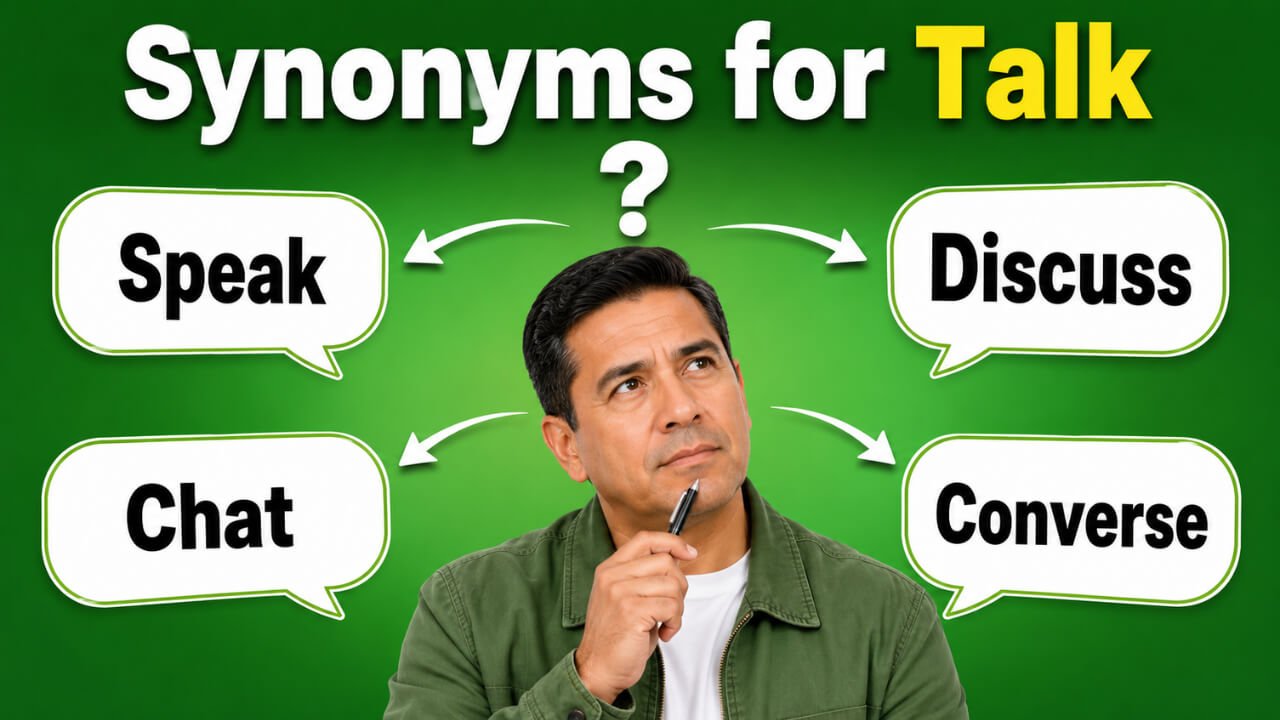
Quick Answer: The best synonyms for talk include speak, chat, discuss, converse, communicate, mention, explain, address, lecture, and negotiate. Use speak for general verbal expression, chat for casual conversation, discuss for serious exchange, converse for polite or formal dialogue, explain for giving details, address for formal speech, and negotiate for problem solving or agreement.
Pronunciation and Word Details
Word: Talk.
Pronunciation: /tɔːk/
Part of Speech: Verb and noun.
Meaning: Talk means to use words to communicate, share ideas, discuss something, or have a conversation.
US Pronunciation:
UK Pronunciation:
What Does “Talk” Mean?
Talk means to speak with someone or express ideas using words. It can be used as a verb or a noun.
As a verb, talk means to communicate through speech, such as “They talk every morning.” As a noun, talk can mean a conversation, speech, discussion, or lecture, such as “We had a short talk.” The word works in casual, formal, personal, professional, educational, and emotional sentence contexts. It may describe friendly chatting, serious discussion, public speaking, private conversation, or planned communication.
Meaning, Tone, and Context of “Talk”
Talk is a common and neutral word. It is more conversational than formal, but it can still appear in business, academic, and professional contexts when the meaning is simple. Talk can sound friendly in daily speech, serious in phrases like “We need to talk,” and formal in phrases like “give a talk.”
The tone depends on context. A talk with a friend feels casual. A talk with a manager feels professional. A talk at an event feels more formal. In writing, talk is useful, but more precise synonyms such as discuss, explain, address, present, or negotiate may sound stronger when the situation needs detail.
When and How to Use “Talk”
For Conversation: Use talk when people are speaking with each other in a general way.
Example: We need to talk about tomorrow’s plan.
For Casual Speech: Use talk when the tone is friendly, relaxed, or everyday.
Example: They like to talk after class.
For Serious Discussion: Use talk when people need to deal with an issue or share important thoughts.
Example: The family decided to talk about the problem calmly.
For Public Speaking: Use talk as a noun when referring to a speech, lecture, or presentation.
Example: She gave a talk about better study habits.
For Communication: Use talk when the focus is on sharing ideas, feelings, or information.
Example: Good teams talk openly about their goals.
For Negotiation: Use talk when people are trying to solve a disagreement or reach an agreement.
Example: Both sides agreed to talk before making a final decision.
Best Synonyms for Talk
Speak: To say words or express thoughts verbally.
Example: She will speak to the class about the topic.
Chat: To talk in a friendly and casual way.
Example: We chatted for a few minutes after the meeting.
Discuss: To talk about a subject in detail.
Example: The team discussed the new plan carefully.
Converse: To have a polite or thoughtful conversation.
Example: The guests conversed quietly during dinner.
Communicate: To share information, thoughts, or feelings.
Example: Good leaders communicate clearly with their teams.
Mention: To refer to something briefly in speech or writing.
Example: He mentioned the deadline during the call.
Explain: To make something clear by giving details.
Example: The teacher explained the answer step by step.
Address: To speak about a subject formally or directly.
Example: The manager addressed the issue in the meeting.
Lecture: To give a formal educational talk.
Example: The professor lectured about language development.
Negotiate: To talk in order to reach an agreement.
Example: The two groups negotiated a fair solution.
50 Synonyms for Talk with Short Meanings
- Speak: To use words aloud.
- Chat: To talk casually and lightly.
- Discuss: To talk about something in detail.
- Converse: To exchange thoughts politely.
- Communicate: To share information or feelings.
- Mention: To refer to something briefly.
- Explain: To make something clear.
- Address: To speak about a topic directly.
- Lecture: To give an educational talk.
- Negotiate: To talk to reach agreement.
- Debate: To discuss opposing views.
- Argue: To give reasons or disagree strongly.
- Consult: To talk for advice or guidance.
- Confer: To discuss something formally.
- Speak Up: To express an opinion clearly.
- Say: To express words.
- Tell: To give information to someone.
- Share: To communicate thoughts or feelings.
- Express: To show ideas through words.
- State: To say something clearly.
- Declare: To say something firmly or officially.
- Announce: To make information known publicly.
- Remark: To make a short comment.
- Comment: To give an opinion or response.
- Respond: To answer or reply.
- Reply: To answer someone.
- Ask: To request information.
- Question: To ask about something.
- Explain Further: To give more detail.
- Elaborate: To explain with added detail.
- Describe: To say what something is like.
- Narrate: To tell a story or event.
- Relate: To tell or describe an experience.
- Report: To give information about something.
- Inform: To give facts or knowledge.
- Brief: To give short important information.
- Present: To speak about information formally.
- Deliver: To give a speech or message.
- Preach: To speak with strong moral instruction.
- Persuade: To talk to influence someone.
- Advise: To talk with guidance or suggestions.
- Counsel: To give serious advice.
- Interview: To ask questions in a formal exchange.
- Gossip: To talk about other people casually.
- Whisper: To talk very quietly.
- Murmur: To speak softly and unclearly.
- Mutter: To speak quietly, often with irritation.
- Shout: To speak loudly.
- Yell: To speak very loudly, often emotionally.
- Chatter: To talk quickly or continuously.
Read Also:
Synonyms for Long

Synonyms for Talk by Context
When Talk Means Speak
Use these synonyms when talk simply means using words aloud. They work in daily conversation, classroom settings, public speaking, and general communication.
Synonyms: Speak, say, tell, state, express.
Example: She spoke clearly during the interview.
When Talk Means Chat Casually
Use these words when the conversation is friendly, light, relaxed, or informal. These choices fit daily speech and natural social situations.
Synonyms: Chat, chatter, converse, gossip, catch up.
Example: They chatted about their weekend plans.
When Talk Means Discuss Seriously
Use these alternatives when people are exchanging ideas, solving problems, or reviewing a topic in detail.
Synonyms: Discuss, debate, confer, consult, address.
Example: The group discussed the issue before making a decision.
When Talk Means Explain
Use these synonyms when talk means making something easier to understand through details, examples, or reasons.
Synonyms: Explain, describe, elaborate, clarify, inform.
Example: The instructor explained the rule with simple examples.
When Talk Means Give a Speech
Use these words when the context involves public speaking, teaching, presenting, or formal communication.
Synonyms: Lecture, present, address, deliver, speak.
Example: The expert delivered a talk on better communication.
When Talk Means Negotiate
Use these alternatives when talk means discussing terms, solving conflict, or trying to reach an agreement.
Synonyms: Negotiate, consult, confer, bargain, reason.
Example: Both teams negotiated until they found a fair solution.
When Talk Means Speak Emotionally
Use these words when the tone is strong, quiet, nervous, angry, or emotional.
Synonyms: Whisper, murmur, mutter, shout, yell.
Example: He whispered because he did not want to interrupt anyone.
Another Word for Talk
Another word for talk is speak, but the best replacement depends on context. Use chat for casual conversation, discuss for serious topics, explain for giving details, and address for formal speech.
Original: We need to talk about the project.
Better Option: We need to discuss the project.
Original: She will talk at the event.
Better Option: She will speak at the event.
Original: They talked for a few minutes after class.
Better Option: They chatted for a few minutes after class.
Original: The teacher talked about the grammar rule.
Better Option: The teacher explained the grammar rule.
When Not to Use “Talk”
Do not use talk when a more exact word would make the sentence clearer. Talk can sound weak in formal writing if the meaning is really discuss, explain, address, negotiate, present, or lecture. It may also sound too casual in academic or professional writing.
Weak: The report talks about the results.
Better: The report discusses the results.
Weak: The professor talked about language change.
Better: The professor lectured about language change.
Weak: The manager talked about the complaint.
Better: The manager addressed the complaint.
Weak: They talked about the contract.
Better: They negotiated the contract.
Weak: The guide talks about each step.
Better: The guide explains each step.
Words Commonly Confused With Talk
Talk vs Speak: Talk often means conversation, while speak can mean using words aloud or giving a formal speech.
Talk vs Chat: Talk is general, while chat is casual, friendly, and light.
Talk vs Discuss: Talk can be casual or general, while discuss means to examine a topic in detail.
Talk vs Tell: Talk means to communicate or converse, while tell means to give information to someone.
Talk vs Say: Say focuses on the exact words spoken, while talk focuses on the act of communication.
Talk vs Explain: Talk means to speak about something, while explain means to make something clear.
Talk vs Address: Talk is broad and neutral, while address means to speak about a topic directly, often formally.
Talk vs Communicate: Talk usually involves words, while communicate can include words, writing, signs, tone, or actions.
Which Synonym Should You Choose?
Choose speak when referring to verbal expression or formal public speaking.
Choose chat when the tone is casual, friendly, and relaxed.
Choose discuss when writing about a serious topic, meeting, issue, report, or detailed exchange.
Choose converse when the conversation is polite, thoughtful, or slightly formal.
Choose communicate when the focus is sharing information, feelings, or ideas.
Choose explain when the purpose is to make something clear.
Choose address when someone speaks about a problem, issue, question, or audience directly.
Choose lecture when the talk is educational or formal.
Choose negotiate when people talk to reach an agreement.
Choose mention when someone refers to a topic briefly.
Choose shout, yell, whisper, mutter, or murmur when the manner of speaking matters.
Real Life Examples of “Talk” in Sentences
Original: We need to talk about your progress.
Better Option: We need to discuss your progress.
Original: She talked clearly during the meeting.
Better Option: She spoke clearly during the meeting.
Original: They talked after lunch.
Better Option: They chatted after lunch.
Original: The teacher talked about the answer.
Better Option: The teacher explained the answer.
Original: The leader talked about the concern.
Better Option: The leader addressed the concern.
Original: The two companies talked about the price.
Better Option: The two companies negotiated the price.
Original: He talked about his childhood memories.
Better Option: He described his childhood memories.
Original: The speaker talked to the audience for an hour.
Better Option: The speaker presented to the audience for an hour.
Original: She talked quietly to her friend.
Better Option: She whispered to her friend.
Original: The article talks about grammar mistakes.
Better Option: The article discusses grammar mistakes.
Synonym Groups and Usage Differences
Conversation Group
This group includes words for everyday communication between people. These synonyms work well when the tone is natural, friendly, or relaxed.
Synonyms: Talk, chat, converse, chatter.
Example: We chatted about simple ways to improve vocabulary.
Discussion Group
This group works when the topic is serious, planned, or detailed. These choices are better for meetings, essays, reports, and problem solving.
Synonyms: Discuss, debate, consult, confer.
Example: The committee discussed the proposal before voting.
Explanation Group
This group fits teaching, guiding, and clarifying. Use these words when the goal is to help someone understand.
Synonyms: Explain, clarify, describe, elaborate.
Example: The tutor explained the rule with practical examples.
Speech Group
This group is used for public speaking, formal talks, lectures, and presentations.
Synonyms: Speak, address, lecture, present, deliver.
Example: The speaker addressed the audience with confidence.
Information Group
This group focuses on giving facts, updates, or useful details.
Synonyms: Inform, report, brief, tell, announce.
Example: The assistant informed the team about the new schedule.
Emotional Speech Group
This group describes how words are spoken emotionally or physically.
Synonyms: Whisper, murmur, mutter, shout, yell.
Example: She whispered the answer because the room was quiet.
Agreement Group
This group works when people talk to solve an issue or reach a shared decision.
Synonyms: Negotiate, bargain, reason, consult.
Example: The two sides negotiated until they reached an agreement.
Antonyms of Talk
Silence: No speech or sound.
Quiet: Low sound or no talking.
Listen: To receive sound or speech instead of speaking.
Hear: To become aware of sound.
Ignore: To pay no attention to someone or something.
Withhold: To keep back information or speech.
Conceal: To hide information.
Suppress: To prevent expression.
Mute: Unable or unwilling to speak.
Pause: A short stop in speaking or action.
Comparison: Talk vs Related Words
Talk vs Speak
Talk often suggests conversation or communication between people. Speak can mean using words aloud or giving a formal speech.
Example With Talk: We should talk about the problem.
Example With Speak: She will speak at the ceremony.
Talk vs Chat
Talk is general and can be casual or serious. Chat is always more casual and friendly.
Example With Talk: They need to talk about the decision.
Example With Chat: They chatted about their plans for the evening.
Talk vs Discuss
Talk is broad, while discuss means to examine a topic carefully.
Example With Talk: We talked about the lesson.
Example With Discuss: We discussed the lesson in detail.
Talk vs Tell
Talk focuses on communication. Tell focuses on giving information to someone.
Example With Talk: I need to talk to you.
Example With Tell: I need to tell you the truth.
Talk vs Explain
Talk means to speak about something. Explain means to make the meaning clear.
Example With Talk: The teacher talked about the exercise.
Example With Explain: The teacher explained the exercise.
Talk vs Address
Talk is simple and general. Address is more formal and direct, especially for problems or audiences.
Example With Talk: The manager talked about the issue.
Example With Address: The manager addressed the issue.
Talk vs Communicate
Talk usually means using spoken words. Communicate means sharing meaning through speech, writing, signs, tone, or behavior.
Example With Talk: They talked for ten minutes.
Example With Communicate: They communicated clearly throughout the project.
Common Phrases and Expressions With Talk
Small Talk: Light conversation about simple topics.
Talk Back: To reply rudely or argue with authority.
Talk Over: To discuss something carefully.
Talk Through: To explain or discuss step by step.
Talk Into: To persuade someone to do something.
Talk Out Of: To persuade someone not to do something.
Table Talk: Conversation during a meal or meeting.
Straight Talk: Honest and direct speech.
Heart to Heart Talk: A sincere emotional conversation.
Give a Talk: To deliver a speech or presentation.
Common Mistakes to Avoid
Avoid using talk when the sentence needs a more precise verb. In formal writing, discuss is often better for topics, explain is better for instructions, address is better for issues, and present is better for speeches.
Do not confuse talk with tell. You talk to someone, but you tell someone something.
Do not overuse talk in the same paragraph. Repetition can make writing sound plain. Replace it with speak, discuss, explain, chat, address, or communicate when the meaning is clearer.
Avoid using chat for serious or formal topics. Chat sounds light and casual.
Avoid using lecture when the meaning is only a normal conversation. Lecture suggests teaching, formal instruction, or sometimes unwanted advice.
Avoid vague sentences like “The article talks about grammar.” A stronger sentence is “The article explains grammar rules” or “The article discusses grammar mistakes.”
Conclusion
Synonyms for talk help you choose a clearer word for each situation. Use speak for general verbal expression, chat for casual conversation, discuss for serious topics, explain for clarity, address for formal issues, and negotiate for agreement. Talk is useful and natural, but stronger alternatives can make writing more exact, polished, and meaningful. The best choice depends on tone, purpose, audience, and whether the sentence describes conversation, speech, explanation, or discussion.
FAQs About Synonyms for Talk
What are the best synonyms for talk?
The best synonyms for talk are speak, chat, discuss, converse, communicate, explain, mention, address, lecture, and negotiate.
What is another word for talk in formal writing?
Discuss is often the best formal replacement for talk when the sentence is about a topic, issue, report, or meeting.
Is chat a synonym for talk?
Yes. Chat means to talk in a casual, friendly, and relaxed way. It is best for informal conversations.
What is the difference between talk and speak?
Talk often means having a conversation, while speak can mean using words aloud or giving a formal speech.
What is a better word than talk for essays?
Discuss, explain, address, examine, and describe are often better than talk in essays because they sound more specific and formal.
Can talk be used as a noun?
Yes. Talk can be a noun, as in “a short talk,” “a serious talk,” or “a public talk.”
What is the opposite of talk?
The opposite of talk depends on context. Useful opposites include silence, listen, quiet, ignore, withhold, and conceal.
