
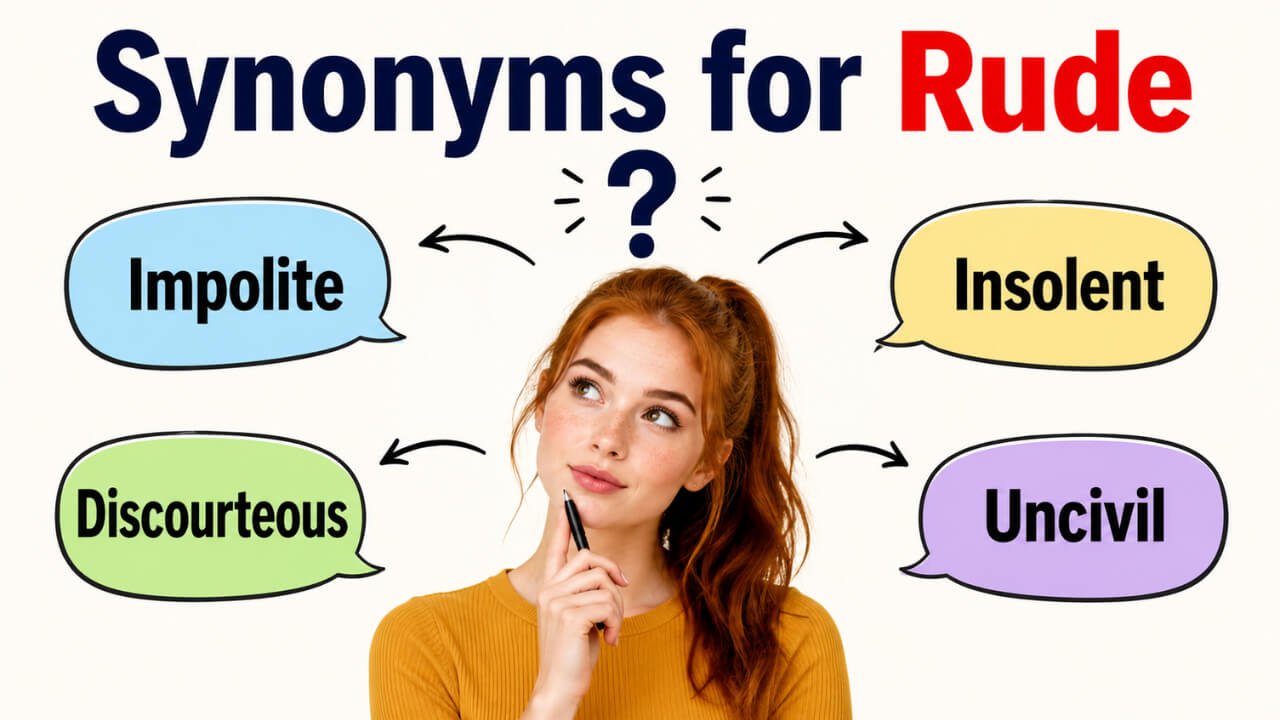
Quick Answer: Synonyms for rude include impolite, disrespectful, discourteous, offensive, insulting, crude, harsh, uncivil, tactless, and ill mannered. The best synonym depends on context. Use impolite for general behavior, disrespectful for a lack of respect, offensive for words that upset people, tactless for careless comments, crude for rough language, and discourteous in more formal writing.
Pronunciation and Word Details
Word: Rude
Pronunciation: /ruːd/
Part of Speech: Adjective
Meaning: Rude means showing bad manners, disrespect, or a lack of politeness.
US Pronunciation:
UK Pronunciation:
What Does “Rude” Mean?
Rude: Means impolite, disrespectful, or badly mannered in speech, behavior, or attitude. It is an adjective used to describe a person, comment, action, tone, reply, gesture, interruption, or habit.
A rude person may speak harshly, ignore basic manners, interrupt others, make insulting remarks, or act without care for someone else’s feelings. The word can describe small social mistakes, such as not saying thank you, or stronger behavior, such as mocking, insulting, or humiliating someone.
Meaning, Tone, and Context of “Rude”
Tone: Rude is a common, direct, and conversational word. It is not highly formal, but it is clear and widely understood in both speech and writing.
Context: Rude is often used in everyday conversation, workplace communication, school writing, customer service, behavior descriptions, and personal situations.
Strength: Rude can be mild or strong depending on the situation. Saying someone forgot to reply may be mildly rude. Calling someone names or mocking them is strongly rude.
Use: The word works well when you want to describe behavior that lacks politeness, kindness, respect, or social awareness.
When and How to Use “Rude”
For Bad Manners: Use rude when someone behaves without basic politeness.
Example: It was rude to leave without saying goodbye.
For Disrespect: Use rude when someone speaks or acts as if another person does not deserve respect.
Example: His rude tone made the meeting uncomfortable.
For Hurtful Comments: Use rude when a comment sounds insulting, careless, or offensive.
Example: That was a rude thing to say about her work.
For Social Behavior: Use rude when someone breaks normal rules of polite behavior.
Example: Interrupting the speaker was rude.
For Tone of Voice: Use rude when speech sounds sharp, dismissive, or unfriendly.
Example: She answered in a rude voice.
Best Synonyms for Rude
Impolite: Not showing good manners.
Example: It was impolite to ignore the guest.
Disrespectful: Showing a lack of respect.
Example: His disrespectful reply upset the teacher.
Discourteous: Lacking courtesy, especially in formal situations.
Example: The message sounded discourteous and cold.
Offensive: Likely to hurt, anger, or insult someone.
Example: His offensive joke made everyone uncomfortable.
Insulting: Directly rude in a way that attacks or belittles someone.
Example: Her insulting comment damaged the conversation.
Tactless: Careless with words or feelings.
Example: Asking that question at dinner was tactless.
Crude: Rough, vulgar, or lacking refinement.
Example: The crude remark was not suitable for the event.
Uncivil: Not polite, respectful, or socially proper.
Example: The debate became uncivil very quickly.
Harsh: Severe, sharp, or unkind in tone.
Example: His harsh words hurt her confidence.
Ill mannered: Showing poor manners.
Example: The ill mannered guest talked over everyone.
50 Synonyms for Rude with Short Meanings
- Impolite: Lacking good manners.
- Disrespectful: Showing no respect.
- Discourteous: Not courteous or considerate.
- Offensive: Likely to upset or insult.
- Insulting: Directly hurtful or belittling.
- Tactless: Careless about others’ feelings.
- Crude: Rough or vulgar in manner.
- Uncivil: Not polite or respectful.
- Harsh: Sharp or unkind in expression.
- Ill mannered: Having poor manners.
- Bad mannered: Behaving without politeness.
- Inconsiderate: Not thinking about others.
- Unkind: Lacking kindness or warmth.
- Disagreeable: Unpleasant in attitude or behavior.
- Abrupt: Too sudden or sharp in speech.
- Blunt: Direct in a way that may feel rude.
- Brusque: Short, sharp, and unfriendly.
- Curt: Brief in a rude or cold way.
- Sharp: Severe or cutting in tone.
- Snappish: Irritable and rude in speech.
- Sarcastic: Mocking in a hurtful way.
- Mocking: Making fun of someone.
- Derisive: Showing contempt through ridicule.
- Contemptuous: Showing strong disrespect.
- Scornful: Showing dislike or disrespect.
- Dismissive: Treating someone as unimportant.
- Condescending: Acting superior to others.
- Patronizing: Speaking down to someone.
- Insolent: Boldly disrespectful.
- Impertinent: Rude by being too bold.
- Cheeky: Bold or disrespectful in a light way.
- Fresh: Too bold or disrespectful in speech.
- Sassy: Bold, sharp, or disrespectful in tone.
- Mouthy: Talking in a rude or bold way.
- Vulgar: Lacking taste or refinement.
- Coarse: Rough, crude, or unrefined.
- Boorish: Rough and badly behaved.
- Unrefined: Lacking polished manners.
- Unpolished: Not socially graceful.
- Ungraceful: Lacking social elegance.
- Unpleasant: Not nice or agreeable.
- Nasty: Mean, rude, or unpleasant.
- Mean: Unkind or hurtful.
- Callous: Uncaring about others’ feelings.
- Insensitive: Not aware of emotional impact.
- Thoughtless: Acting without care for others.
- Unfriendly: Not warm or kind.
- Hostile: Openly unfriendly or aggressive.
- Aggressive: Forceful in a rude way.
- Disparaging: Speaking negatively or disrespectfully.
Read Also:
Synonyms for Which
Synonyms for Rude by Context
When Rude Means Impolite
Use these words when the main idea is poor manners or lack of courtesy.
Useful Synonyms: Impolite, discourteous, ill mannered, bad mannered, uncivil.
Example: It was discourteous to ignore the invitation.
When Rude Means Disrespectful
Use these words when someone shows a lack of respect toward another person.
Useful Synonyms: Disrespectful, insolent, impertinent, contemptuous, dismissive.
Example: His dismissive answer made the customer feel ignored.
When Rude Means Hurtful
Use these words when a rude comment causes emotional pain or embarrassment.
Useful Synonyms: Insulting, offensive, harsh, unkind, nasty.
Example: Her harsh criticism sounded more personal than helpful.
When Rude Means Careless With Feelings
Use these words when someone does not think before speaking or acting.
Useful Synonyms: Tactless, insensitive, thoughtless, inconsiderate, blunt.
Example: His tactless question made the room quiet.
When Rude Means Crude or Unrefined
Use these words when the behavior or language sounds rough, vulgar, or socially improper.
Useful Synonyms: Crude, coarse, vulgar, boorish, unrefined.
Example: The crude joke was not suitable for a formal dinner.
Another Word for Rude
Best Single Replacement: The best general replacement for rude is impolite because it is clear, natural, and suitable for many situations. However, the best synonym depends on the meaning you want. Choose disrespectful for attitude, offensive for hurtful language, tactless for careless comments, and crude for vulgar behavior.
Original: His rude reply ended the conversation.
Better Option: His disrespectful reply ended the conversation.
Original: That was a rude comment during dinner.
Better Option: That was a tactless comment during dinner.
Original: The joke sounded rude to many people.
Better Option: The joke sounded offensive to many people.
Original: She used rude language at the event.
Better Option: She used crude language at the event.
When Not to Use “Rude”
Avoid Repetition: Do not repeat rude too often when a more specific synonym gives clearer meaning.
Weak: He was rude, and his rude words made the moment rude.
Better: He was disrespectful, and his harsh words made the moment uncomfortable.
Avoid Overstatement: Do not use rude for serious abuse, threats, or cruelty when stronger words are needed.
Weak: The attack was rude.
Better: The attack was cruel and aggressive.
Avoid Vague Meaning: Rude can be too general when you need to explain the exact problem.
Weak: Her response was rude.
Better: Her response was dismissive and insensitive.
Avoid Formal Weakness: In formal writing, use more precise words when needed.
Weak: The employee gave a rude answer.
Better: The employee gave a discourteous and unprofessional answer.
Words Commonly Confused With Rude
Rude vs Impolite: Rude is broader and can include disrespect, harshness, or offensive behavior. Impolite mainly means lacking manners.
Rude vs Disrespectful: Rude can be about manners or tone. Disrespectful focuses on lack of respect.
Rude vs Offensive: Rude behavior may be unpleasant. Offensive words or actions are more likely to hurt, anger, or insult someone.
Rude vs Tactless: Rude can be intentional or unintentional. Tactless usually means careless, awkward, or insensitive without enough awareness.
Rude vs Crude: Rude means impolite or disrespectful. Crude often means vulgar, rough, or lacking refinement.
Rude vs Harsh: Rude describes poor manners or disrespect. Harsh describes severity, sharpness, or unkindness in tone.
Which Synonym Should You Choose?
Choose impolite: When writing about ordinary bad manners or social behavior.
Choose disrespectful: When the person shows a lack of respect toward someone.
Choose discourteous: When writing formally about manners, service, messages, or professional behavior.
Choose offensive: When words, jokes, or actions may upset or insult others.
Choose insulting: When the language directly attacks or belittles someone.
Choose tactless: When someone says something careless or socially awkward.
Choose crude: When the language or behavior is rough, vulgar, or unrefined.
Choose harsh: When the tone is sharp, severe, or emotionally painful.
Choose dismissive: When someone treats another person’s opinion as unimportant.
Choose insolent: When someone is boldly and openly disrespectful.
Real Life Examples of “Rude” in Sentences
Original: It was rude to interrupt her during the meeting.
Better Option: It was impolite to interrupt her during the meeting.
Original: His rude answer shocked the guests.
Better Option: His disrespectful answer shocked the guests.
Original: That rude joke was not appropriate.
Better Option: That offensive joke was not appropriate.
Original: She made a rude comment about his clothes.
Better Option: She made an insulting comment about his clothes.
Original: The waiter sounded rude on the phone.
Better Option: The waiter sounded discourteous on the phone.
Original: His rude question embarrassed everyone.
Better Option: His tactless question embarrassed everyone.
Original: They used rude language in the hallway.
Better Option: They used crude language in the hallway.
Original: Her rude tone made the message feel cold.
Better Option: Her harsh tone made the message feel cold.
Original: The reply was rude and unhelpful.
Better Option: The reply was dismissive and unhelpful.
Original: His rude behavior ruined the discussion.
Better Option: His uncivil behavior ruined the discussion.
Synonym Groups and Usage Differences
Manners Group
Use: Impolite, discourteous, ill mannered, bad mannered, and uncivil describe poor manners.
Example: The guest was ill mannered and kept interrupting others.
Respect Group
Use: Disrespectful, insolent, impertinent, contemptuous, and dismissive describe a lack of respect.
Example: His insolent reply showed no respect for the rules.
Hurtful Language Group
Use: Offensive, insulting, harsh, nasty, and mean describe words that hurt or upset people.
Example: The insulting message damaged their friendship.
Careless Speech Group
Use: Tactless, insensitive, thoughtless, blunt, and inconsiderate describe words that ignore feelings.
Example: Her insensitive remark made the situation worse.
Rough Behavior Group
Use: Crude, coarse, vulgar, boorish, and unrefined describe rough or socially improper behavior.
Example: His boorish behavior embarrassed the group.
Antonyms of Rude
Polite: Showing good manners and respect.
Respectful: Treating others with care and honor.
Courteous: Showing formal politeness and consideration.
Kind: Warm, gentle, and caring.
Considerate: Thoughtful about other people’s feelings.
Tactful: Careful and sensitive in speech.
Civil: Polite and respectful, especially during disagreement.
Gracious: Pleasant, kind, and socially graceful.
Refined: Polished and well mannered.
Friendly: Warm and pleasant toward others.
Comparison: Rude vs Related Words
Rude vs Impolite
Difference: Rude can include disrespect, harshness, or offensive behavior. Impolite mainly means not following good manners.
Example With Rude: His rude comment hurt her feelings.
Example With Impolite: It was impolite to arrive late without calling.
Rude vs Disrespectful
Difference: Rude may describe poor manners, while disrespectful clearly shows a lack of respect.
Example With Rude: She gave a rude reply.
Example With Disrespectful: She gave a disrespectful reply to her manager.
Rude vs Offensive
Difference: Rude is often about manners or tone. Offensive is stronger and means likely to insult or upset.
Example With Rude: The remark was rude.
Example With Offensive: The remark was offensive to many listeners.
Rude vs Tactless
Difference: Rude may be intentional or careless. Tactless means lacking sensitivity or good judgment in a situation.
Example With Rude: It was rude to laugh at him.
Example With Tactless: It was tactless to mention the mistake in public.
Rude vs Crude
Difference: Rude means impolite or disrespectful. Crude means rough, vulgar, or lacking refinement.
Example With Rude: His rude behavior bothered the guests.
Example With Crude: His crude language was not suitable for the event.
Common Phrases and Expressions With Rude
Rude Behavior: Actions that show bad manners or disrespect.
Rude Comment: A remark that sounds impolite or hurtful.
Rude Reply: An answer that sounds sharp, cold, or disrespectful.
Rude Tone: A way of speaking that feels harsh or unfriendly.
Rude Awakening: A sudden unpleasant realization.
Rude Interruption: Cutting into someone’s speech in an impolite way.
Rude Gesture: A disrespectful body movement or signal.
Rude Attitude: A disrespectful or unpleasant manner.
Rude Remark: A spoken or written comment that lacks politeness.
Rude Shock: A sudden unpleasant surprise.
Common Mistakes to Avoid
Using Rude Too Generally: Rude is useful, but it can be vague. Choose a clearer synonym when possible.
Better Choice: Use disrespectful for lack of respect, offensive for hurtful language, and tactless for careless comments.
Repeating Rude Too Often: Repetition makes writing sound weak.
Better Choice: Use related words such as impolite, harsh, uncivil, or dismissive to add variety.
Choosing a Word That Is Too Strong: Offensive, insulting, and vulgar are stronger than rude.
Better Choice: Use impolite for mild behavior and offensive for serious hurtful language.
Choosing a Word That Is Too Formal: Discourteous may sound too formal in casual speech.
Better Choice: Use impolite or rude in everyday conversation.
Confusing Blunt With Rude: Blunt means very direct. It becomes rude only when the directness feels careless or unkind.
Better Choice: Say blunt for direct honesty and rude for disrespectful behavior.
Conclusion
Conclusion: Synonyms for rude help you describe impolite behavior with more accuracy and variety. Use impolite for general bad manners, disrespectful for lack of respect, offensive for hurtful words, tactless for careless speech, and crude for vulgar behavior. In formal writing, discourteous and uncivil often sound more polished. In everyday conversation, impolite, harsh, mean, and insensitive are natural choices. The best synonym always depends on the tone, situation, and exact type of behavior you want to describe.
FAQs About Synonyms for Rude
What are the best synonyms for rude?
Answer: The best synonyms for rude are impolite, disrespectful, discourteous, offensive, insulting, tactless, crude, harsh, uncivil, and ill mannered.
What is a polite way to say someone is rude?
Answer: A polite way to say someone is rude is impolite, discourteous, inconsiderate, or unprofessional, depending on the situation.
Is disrespectful the same as rude?
Answer: Disrespectful is close to rude, but it focuses more on lack of respect. Rude can also mean bad manners, harsh tone, or offensive behavior.
What is a formal synonym for rude?
Answer: Formal synonyms for rude include discourteous, uncivil, disrespectful, inconsiderate, and impertinent.
What is a softer word than rude?
Answer: Softer words than rude include impolite, inconsiderate, thoughtless, tactless, and unfriendly.
What is a stronger word than rude?
Answer: Stronger words than rude include offensive, insulting, contemptuous, insolent, nasty, and vulgar.
What is another word for a rude comment?
Answer: Another word for a rude comment is an insulting comment, offensive remark, harsh statement, tactless remark, or disrespectful comment.
