
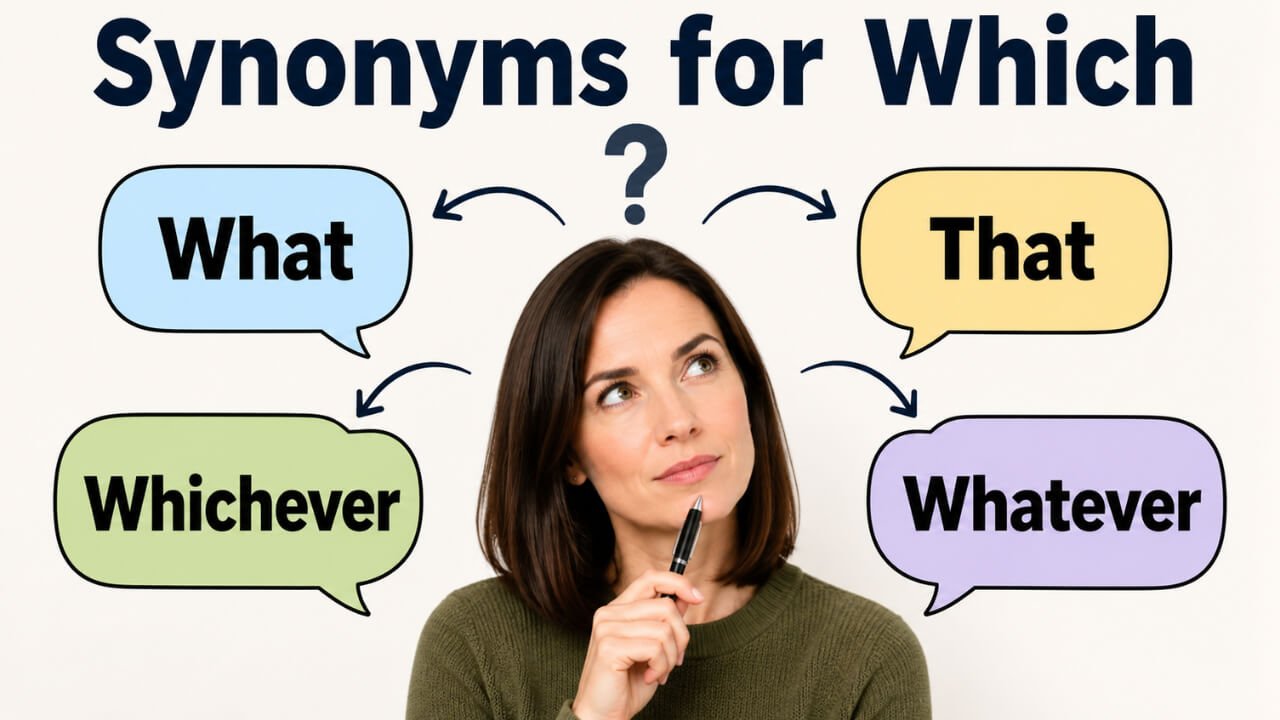
Quick Answer: Synonyms for which include that, what, whichever, whatever, who, whom, whose, where, when, and the one that. The best replacement depends on grammar and context. Use that in many identifying relative clauses, what in open questions, whichever when any choice is acceptable, who or whom for people, where for places, when for time, and the one that for clear casual speech.
Pronunciation and Word Details
Word: Which.
Pronunciation: /wɪtʃ/
Part of Speech: Pronoun and determiner.
Meaning: Used to ask about a choice or to introduce extra information about a person, thing, idea, place, or situation.
US Pronunciation:
UK Pronunciation:
What Does “Which” Mean?
Direct Answer: Which means what one, what ones, or the one that, especially when asking about a choice or adding information.
Which is used as a pronoun and determiner. As a question word, it helps ask someone to choose from known options. As a relative word, it connects extra information to a noun, idea, or full clause. For example, in “Which book do you want?” it asks about a choice. In “The book, which I bought yesterday, is excellent,” it adds extra detail.
Which can work before a noun, as in “which color,” or stand alone, as in “Which is better?” It is common in questions, explanations, academic writing, formal writing, everyday speech, and grammar based sentence structures.
Meaning, Tone, and Context of “Which”
Meaning: Which points to a choice, option, item, idea, or detail from a known or limited group.
Tone: Which is neutral, clear, and grammatically standard.
Formality: Which works in both formal and casual writing, but some alternatives sound more natural in specific contexts.
Academic Use: Which is common in essays, definitions, comparisons, explanations, and complex sentences.
Conversational Use: Which is common in everyday questions like “Which one do you like?”
Grammar Context: Which can introduce questions, relative clauses, added details, and references to earlier ideas.
Main Function: It helps identify, select, compare, or explain something.
When and How to Use “Which”
For Asking About Choices: Use which when the answer should come from a known set of options.
Example: Which dress do you prefer?
For Comparing Options: Use which when asking someone to select the better, stronger, cheaper, easier, or more useful option.
Example: Which plan is more affordable?
For Adding Extra Information: Use which when adding non essential detail about a thing, idea, or situation.
Example: The guide, which explains the rules clearly, is useful for beginners.
For Referring to Things: Use which for objects, ideas, animals, groups, and situations.
Example: The machine, which was old, stopped working.
For Formal Writing: Use which to create clear, polished relative clauses.
Example: The policy, which was updated recently, affects all workers.
For Specific Detail: Use which when the sentence needs to point to a specific item or option.
Example: Tell me which answer is correct.
Best Synonyms for Which
That: Used to introduce identifying information about a person, thing, or idea.
Example: The article that you sent is helpful.
What: Used in open questions when the choices are not limited or already known.
Example: What color do you want?
Whichever: Used when any choice from a group is acceptable.
Example: Choose whichever seat you like.
Whatever: Used when any thing, idea, or option is acceptable.
Example: Take whatever you need.
Who: Used instead of which when referring to people as the subject.
Example: The teacher who helped me was very patient.
Whom: Used instead of which when referring to people as the object in formal writing.
Example: The manager whom we contacted replied quickly.
Whose: Used to show possession or connection.
Example: The student whose project won was very excited.
Where: Used when the meaning points to a place.
Example: This is the room where we studied.
When: Used when the meaning points to time.
Example: Monday is the day when the course begins.
The One That: Used as a clear phrase replacement in casual or explanatory writing.
Example: Pick the one that fits your budget.
50 Synonyms for Which with Short Meanings
- That: Used to identify a person, thing, or idea.
- What: Used to ask about an unknown thing or choice.
- Whichever: Any one from a group of choices.
- Whatever: Any thing or option without restriction.
- Who: Used for a person as the subject.
- Whom: Used for a person as the object.
- Whose: Used to show possession or connection.
- Where: Used for a place or location.
- When: Used for a time or occasion.
- The One That: The specific option that matches.
- The Thing That: The object or idea that matches.
- The Person Who: The person being identified.
- The People Who: The people being identified.
- The Place Where: The location being identified.
- The Time When: The time being identified.
- The Reason Why: The cause being explained.
- The Way That: The method being described.
- The Option That: The choice being selected.
- The Choice That: The selected possibility.
- The Item That: The object being identified.
- The Answer That: The answer being selected.
- The Question That: The question being discussed.
- The Case That: The situation being described.
- The Point That: The idea being explained.
- The Fact That: The fact being introduced.
- The Idea That: The thought being identified.
- The Method That: The process being described.
- The Rule That: The rule being explained.
- The Reason That: The cause being given.
- The Result That: The outcome being identified.
- The Part That: The section being named.
- The Type That: The kind being selected.
- The Kind That: The category being identified.
- The Sort That: The type being described.
- The Version That: The form being chosen.
- The Form That: The shape or type being identified.
- The Example That: The sample being discussed.
- The Detail That: The specific point being described.
- The Matter That: The issue being referred to.
- The Subject That: The topic being discussed.
- The Topic That: The subject being identified.
- The Object That: The thing being referred to.
- The Tool That: The instrument being chosen.
- The Book That: The book being identified.
- The Day When: The day being specified.
- The Moment When: The exact time being described.
- The Area Where: The place being described.
- The Situation Where: The condition being explained.
- The Manner That: The way something is done.
- The Selection That: The chosen option.
Read Also:
Synonyms For Kind Hearted

Synonyms for Which by Context
When Which Means That
Synonyms: That, the one that, the thing that, the item that, the option that.
Use: Choose these alternatives when which introduces identifying information.
Example: The laptop which I bought is fast.
Better Option: The laptop that I bought is fast.
Example: Select the form which matches your case.
Better Option: Select the form that matches your case.
When Which Means What
Synonyms: What, what one, what kind, what type, what option.
Use: Choose these alternatives when asking an open question or asking about a choice.
Example: Which color do you want?
Better Option: What color do you want?
Example: Which type of writing is easier?
Better Option: What type of writing is easier?
When Which Means Whichever
Synonyms: Whichever, any one that, any option that, the choice that, whatever one.
Use: Choose these alternatives when the exact choice does not matter.
Example: You can take which one you like.
Better Option: You can take whichever one you like.
Example: Pick which option feels right.
Better Option: Pick whichever option feels right.
When Which Refers to People
Synonyms: Who, whom, whose, the person who, the people who.
Use: Choose these alternatives when the sentence refers to a person or people.
Example: The student which answered first was correct.
Better Option: The student who answered first was correct.
Example: The client which we called was unavailable.
Better Option: The client whom we called was unavailable.
When Which Refers to Places or Time
Synonyms: Where, when, the place where, the day when, the time when.
Use: Choose these alternatives when the meaning points to location or time.
Example: This is the city which I was born in.
Better Option: This is the city where I was born.
Example: Friday is the day which we will meet.
Better Option: Friday is the day when we will meet.
Another Word for Which
Direct Answer: Another word for which is that in many relative clauses.
Explanation: That is often the best replacement when which identifies a specific thing, person, option, or idea. However, the best alternative depends on the sentence. Use what for open questions, whichever for any acceptable choice, who for people, and where for places.
Original: The phone which I bought is expensive.
Better Option: The phone that I bought is expensive.
Original: Which size do you need?
Better Option: What size do you need?
Original: Choose which seat you like.
Better Option: Choose whichever seat you like.
Original: The person which called you is waiting.
Better Option: The person who called you is waiting.
When Not to Use “Which”
When Referring to People: Do not use which for people in standard modern grammar. Use who, whom, or whose.
Weak: The woman which helped me was kind.
Better: The woman who helped me was kind.
When the Question Is Open: Use what when the answer is not from a known set of options.
Weak: Which is your favorite food in the world?
Better: What is your favorite food in the world?
When the Sentence Needs a Place Word: Use where when the meaning is clearly about location.
Weak: This is the shop which I met him.
Better: This is the shop where I met him.
When the Sentence Needs a Time Word: Use when when the meaning is about time.
Weak: Sunday is the day which we rest.
Better: Sunday is the day when we rest.
When It Sounds Repetitive: Avoid repeating which too often in one paragraph.
Weak: The guide, which is short, explains a rule which many learners forget.
Better: The short guide explains a rule that many learners forget.
Words Commonly Confused With Which
Which vs That: Which often adds extra information, while that often identifies necessary information. In casual writing, that is often clearer for essential details.
Which vs What: Which is usually used when choices are known or limited. What is used when the answer is more open.
Which vs Who: Which is used for things, animals, ideas, or situations. Who is used for people.
Which vs Whom: Which does not refer to people. Whom is used for a person as the object in formal grammar.
Which vs Whose: Which asks about choice, while whose asks about ownership or connection.
Which vs Where: Which can refer to a thing or place in some sentence structures, but where is clearer when location is the main meaning.
Which vs When: Which can refer to a time word, but when is usually clearer for dates, days, and moments.
Which Synonym Should You Choose?
Choose that: When introducing essential identifying information about a thing, person, idea, or option.
Choose what: When asking an open question without a limited set of choices.
Choose whichever: When any option from a group is acceptable.
Choose whatever: When any thing or action is acceptable.
Choose who: When referring to a person as the subject.
Choose whom: When referring to a person as the object in formal writing.
Choose whose: When showing possession or connection.
Choose where: When the meaning is about a place.
Choose when: When the meaning is about time.
Choose the one that: When you want a clear and natural phrase in casual speech.
Real Life Examples of “Which” in Sentences
Original: Which dress do you like?
Better Option: What dress do you like?
Original: The chair which broke is in the garage.
Better Option: The chair that broke is in the garage.
Original: Choose which one you want.
Better Option: Choose whichever one you want.
Original: The man which lives next door is friendly.
Better Option: The man who lives next door is friendly.
Original: The student which I helped passed the test.
Better Option: The student whom I helped passed the test.
Original: This is the house which I grew up.
Better Option: This is the house where I grew up.
Original: Monday is the day which we start the project.
Better Option: Monday is the day when we start the project.
Original: I do not know which answer is correct.
Better Option: I do not know what answer is correct.
Original: The plan which we discussed is ready.
Better Option: The plan that we discussed is ready.
Original: Tell me which option saves more time.
Better Option: Tell me the option that saves more time.
Synonym Groups and Usage Differences
Question Group
Use: Which, what, what one, what type, and what kind are used to ask questions about choices or information.
Example: What type of course do you need?
Relative Clause Group
Use: Which, that, the one that, the thing that, and the option that connect information to a noun or idea.
Example: The file that you sent is clear.
People Group
Use: Who, whom, whose, the person who, and the people who refer to people instead of things.
Example: The person who answered was correct.
Place Group
Use: Where, the place where, the area where, and the situation where refer to location or setting.
Example: This is the place where we met.
Time Group
Use: When, the day when, the time when, and the moment when refer to time.
Example: That was the moment when everything changed.
Choice Group
Use: Whichever, whatever, any option that, and the choice that show flexible selection.
Example: Take whichever route is faster.
Antonyms of Which
Direct Note: Which has no true antonym because it is a function word used for questions and relative clauses. However, some words can express opposite or contrasting ideas depending on context.
All: Refers to every option instead of asking for one option.
None: Refers to no option instead of selecting one.
Neither: Refers to not one and not the other from two choices.
Both: Refers to two options together instead of choosing one.
Every: Refers to all members of a group instead of one selected item.
Any: Refers to one or more options without asking for a specific choice.
No: Denies a choice, option, or item.
Other: Refers to a different option, not the one being identified.
Comparison: Which vs Related Words
Which vs That
Difference: Which often adds extra information, while that usually identifies information needed to understand the noun.
Example With Which: The car, which was parked outside, belongs to my uncle.
Example With That: The car that was parked outside belongs to my uncle.
Which vs What
Difference: Which is better for limited choices. What is better for open questions.
Example With Which: Which of these shirts do you prefer?
Example With What: What shirt do you want to buy?
Which vs Who
Difference: Which refers to things, animals, ideas, or situations. Who refers to people.
Example With Which: The book which won the prize is popular.
Example With Who: The writer who won the prize is popular.
Which vs Whom
Difference: Which does not refer to people. Whom refers to a person receiving the action in formal grammar.
Example With Which: The report which we reviewed was detailed.
Example With Whom: The expert whom we interviewed was helpful.
Which vs Whose
Difference: Which asks about selection or introduces a thing. Whose shows ownership or connection.
Example With Which: Which notebook is yours?
Example With Whose: Whose notebook is this?
Which vs Where
Difference: Which may refer to a place as a thing, but where directly points to location.
Example With Which: The city which attracts tourists is beautiful.
Example With Where: The city where I stayed is beautiful.
Which vs When
Difference: Which can refer to a time word, but when is clearer for days, dates, and moments.
Example With Which: The date which you selected is available.
Example With When: The day when we arrived was rainy.
Common Phrases and Expressions With Which
Which One: Asks someone to choose one option.
Which Of These: Asks for a choice from nearby or listed options.
Which Of Those: Asks for a choice from options already mentioned.
Which Is Better: Asks for comparison between options.
Which Means: Introduces an explanation or result.
Which Is Why: Explains the reason something happened.
Which Way: Asks about direction, method, or choice.
Which Type: Asks about category or kind.
Which Kind: Asks about the nature or category of something.
Which Option: Asks for a selected choice from several possibilities.
Common Mistakes to Avoid
Mistake One: Using which for people when who is correct.
Advice: Use who for people as subjects and whom for people as objects in formal sentences.
Mistake Two: Using which when what sounds more natural.
Advice: Use what when the possible answers are not limited or already known.
Mistake Three: Using which for places when where is clearer.
Advice: Use where when the sentence is mainly about location.
Mistake Four: Using which for time when when is clearer.
Advice: Use when for days, dates, moments, and periods.
Mistake Five: Repeating which too often.
Advice: Use that, who, where, when, or a clear noun phrase to reduce repetition.
Mistake Six: Choosing a synonym that changes the grammar.
Advice: Check whether the sentence needs a question word, relative pronoun, determiner, person word, place word, or time word.
Conclusion
Synonyms for which are useful when you want clearer questions, smoother relative clauses, and more accurate sentence structure. Use that for identifying details, what for open questions, whichever for flexible choices, who or whom for people, where for places, and when for time. Since which is a grammar function word, not every alternative works in every sentence. The best choice depends on whether you are asking, selecting, identifying, or adding information.
FAQs About Synonyms for Which
What is the best synonym for which?
Answer: The best synonym for which is that in many relative clauses. In questions, what or which one may be better depending on the context.
Can I use that instead of which?
Answer: Yes, you can often use that instead of which when the information identifies the noun. Use which when adding extra detail.
What is another word for which in questions?
Answer: Another word for which in questions is what, especially when the answer is open or not limited to a known group.
Should I use which or who for people?
Answer: Use who for people. Which is usually used for things, animals, ideas, choices, and situations.
Is whichever a synonym for which?
Answer: Yes, whichever can be a synonym when the sentence means any one from a group of choices.
What is a formal alternative to which?
Answer: Formal alternatives depend on the sentence. Use that for essential clauses, whom for people as objects, and wherein only in very formal legal or academic contexts.
Does which have an antonym?
Answer: No, which has no true antonym because it is a function word. Words like all, none, both, and neither can express contrast in some choice based contexts.
