
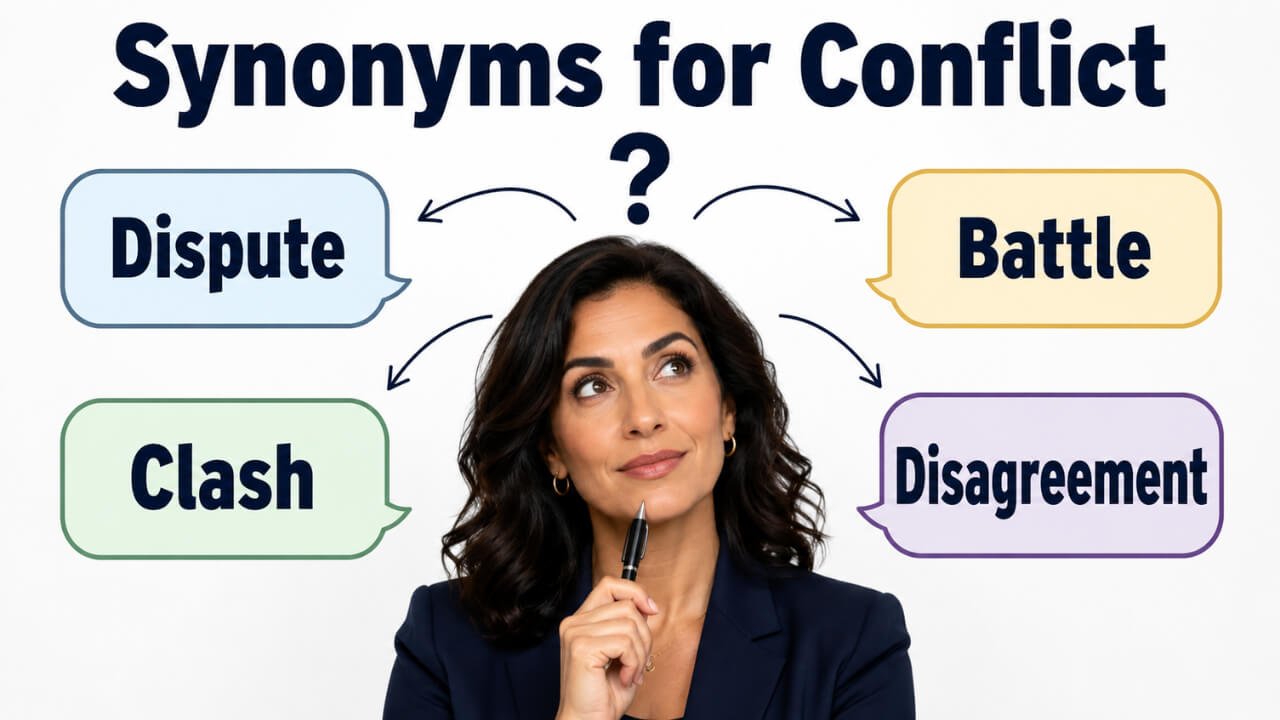
Quick Answer: The best synonyms for conflict include dispute, disagreement, argument, clash, struggle, fight, battle, tension, friction, and opposition. Use dispute in formal writing, argument in everyday speech, clash for strong differences, struggle for difficulty or internal conflict, fight for physical or emotional opposition, and tension for an uncomfortable situation between people or ideas.
Pronunciation and Word Details
Word: Conflict
Pronunciation: /ˈkɒn.flɪkt/ as a noun and /kənˈflɪkt/ as a verb
Part of Speech: Noun and verb
Meaning: Conflict means a serious disagreement, clash, struggle, or opposition between people, ideas, goals, feelings, or forces.
US Pronunciation:
UK Pronunciation:
What Does “Conflict” Mean?
Conflict means a disagreement, clash, or struggle between two or more sides. It can be used as a noun or a verb. As a noun, conflict refers to an argument, dispute, battle, tension, or opposition. As a verb, conflict means to be different from or incompatible with something.
Conflict can appear in personal relationships, workplace discussions, stories, politics, law, emotions, beliefs, schedules, goals, and decisions. For example, two people may have a conflict, two ideas may conflict, or a character in a story may face inner conflict.
Meaning, Tone, and Context of “Conflict”
Conflict is a neutral but serious word. It is more formal than argument and broader than fight. It can describe emotional disagreement, physical fighting, legal disputes, social tension, moral struggle, or opposing ideas. Because of this range, conflict is common in academic writing, business communication, literature, psychology, education, and everyday conversation.
The tone depends on context. In a workplace, conflict may sound professional and manageable. In a war or violence context, it sounds serious and intense. In writing about feelings, conflict can sound emotional or internal. In grammar and vocabulary, conflict often means that two ideas, statements, duties, or schedules do not agree with each other.
When and How to Use “Conflict”
For Disagreement: Use conflict when people, groups, or ideas strongly disagree.
Example: The meeting ended in conflict over the new policy.
For Opposition: Use conflict when two goals, values, or plans work against each other.
Example: Her personal goals conflict with the company schedule.
For Emotional Struggle: Use conflict when a person feels pulled between choices, feelings, or beliefs.
Example: He felt conflict between loyalty and honesty.
For Story Writing: Use conflict when describing the problem that drives a plot.
Example: The main conflict begins when the hero loses trust in his friend.
For Workplace Issues: Use conflict when describing tension, disagreement, or competing interests professionally.
Example: The manager tried to resolve the conflict between team members.
For Formal Analysis: Use conflict when discussing opposing evidence, laws, duties, or viewpoints.
Example: The two reports conflict in their explanation of the results.
Best Synonyms for Conflict
Dispute: A serious disagreement, often formal or official.
Example: The dispute between the neighbors lasted for months.
Disagreement: A difference of opinion or belief.
Example: Their disagreement was about how to spend the budget.
Argument: A spoken disagreement, often emotional or direct.
Example: They had an argument about the missed deadline.
Clash: A strong conflict between people, ideas, values, or forces.
Example: The plan caused a clash between tradition and change.
Struggle: A difficult fight, effort, or inner conflict.
Example: She faced a struggle between fear and ambition.
Fight: A physical, verbal, or emotional conflict.
Example: The two friends had a fight over a misunderstanding.
Battle: A serious conflict, often physical, legal, emotional, or competitive.
Example: The company faced a legal battle over ownership.
Tension: An uncomfortable feeling caused by possible conflict.
Example: There was tension in the room after the decision.
Friction: Small but repeated conflict or irritation.
Example: Friction grew between the two departments.
Opposition: Resistance or disagreement against someone or something.
Example: The proposal faced strong opposition from residents.
50 Synonyms for Conflict with Short Meanings
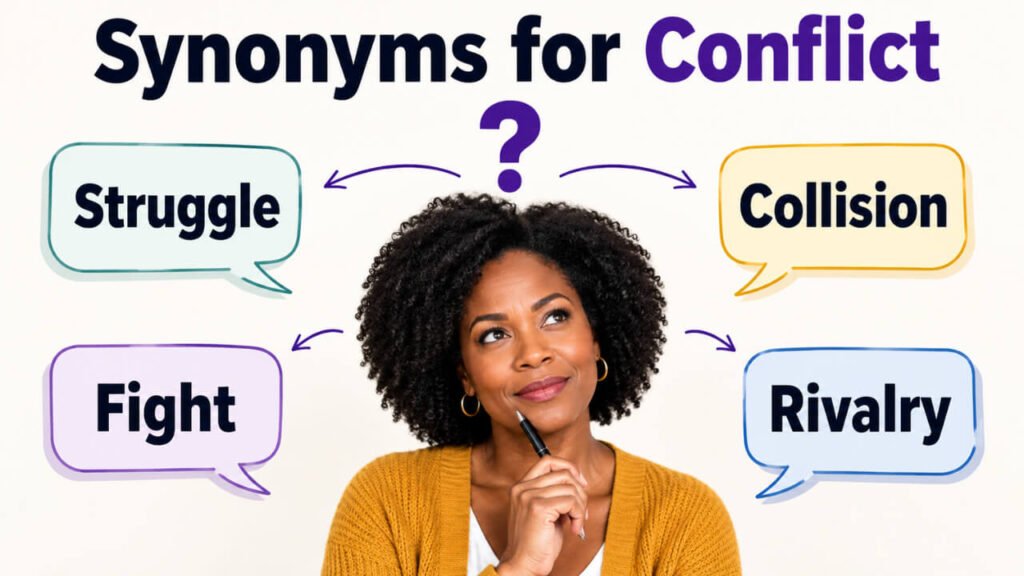
- Dispute: A serious disagreement.
- Disagreement: A difference in opinion.
- Argument: A spoken conflict or debate.
- Clash: A strong disagreement or collision.
- Struggle: A difficult fight or effort.
- Fight: A direct conflict or battle.
- Battle: A serious fight or contest.
- Tension: Strain caused by disagreement.
- Friction: Repeated irritation or disagreement.
- Opposition: Resistance against someone or something.
- Confrontation: A direct meeting of opposing sides.
- Controversy: Public disagreement or debate.
- Contention: Strong disagreement or dispute.
- Discord: Lack of agreement or harmony.
- Strife: Bitter conflict or trouble.
- Quarrel: A personal argument.
- Feud: A long lasting conflict.
- Rift: A serious break in a relationship.
- Division: Separation caused by disagreement.
- Split: A break between sides or groups.
- Hostility: Unfriendly opposition or anger.
- Antagonism: Active dislike or opposition.
- Enmity: Deep dislike or hostility.
- Rivalry: Competition between opponents.
- Competition: A contest for the same goal.
- Contest: A struggle to win or succeed.
- Resistance: Refusal to accept or obey.
- Dissent: Disagreement with an opinion or decision.
- Contradiction: A direct conflict between statements or ideas.
- Incompatibility: Inability to exist or work together.
- Inconsistency: Lack of agreement or logical fit.
- Discrepancy: A difference between facts or details.
- Variance: Difference or disagreement.
- Divergence: A movement away from agreement.
- Collision: A forceful clash or conflict.
- Impasse: A situation where agreement is impossible.
- Deadlock: A complete stop caused by disagreement.
- Standoff: A situation where neither side gives in.
- Altercation: A heated argument.
- Spat: A small argument.
- Tiff: A minor personal disagreement.
- Row: A noisy argument.
- Brawl: A rough physical fight.
- Skirmish: A small fight or brief conflict.
- Combat: Physical fighting or struggle.
- Warfare: Armed conflict or ongoing struggle.
- Turmoil: Confused conflict or disorder.
- Unrest: Public tension or disturbance.
- Disharmony: Lack of peace or agreement.
- Discordance: Lack of agreement between things.
Read Also:
Synonyms For Need

Synonyms for Conflict by Context
When Conflict Means Disagreement
Use these words when conflict means a difference in opinion, belief, or decision.
Disagreement: The disagreement began during the planning meeting.
Dispute: The contract dispute delayed the project.
Argument: Their argument started over a small mistake.
Contention: The main point of contention was the final cost.
Dissent: Several members expressed dissent during the vote.
When Conflict Means Clash
Use these synonyms when conflict means two people, values, goals, or systems are opposed.
Clash: His views clash with the new policy.
Opposition: The plan met strong opposition.
Contradiction: There is a contradiction between the two statements.
Incompatibility: The conflict came from incompatibility between their goals.
Collision: The decision created a collision of interests.
When Conflict Means Fight
Use these words when conflict involves physical struggle, verbal aggression, or direct confrontation.
Fight: The fight broke out after the argument.
Battle: The legal battle lasted for years.
Combat: The soldiers were trained for combat.
Skirmish: A small skirmish occurred near the border.
Brawl: The brawl ended when security arrived.
When Conflict Means Tension
Use these synonyms when conflict is not open yet but creates discomfort or pressure.
Tension: Tension grew between the coworkers.
Friction: The new rules caused friction in the team.
Hostility: Hostility made the discussion difficult.
Antagonism: There was clear antagonism between the two leaders.
Unrest: The decision caused unrest among the workers.
When Conflict Means Inner Struggle
Use these words when conflict happens inside a person’s mind, heart, or values.
Struggle: She felt a struggle between duty and desire.
Turmoil: His mind was in turmoil after the news.
Dilemma: The decision created a moral dilemma.
Tension: He felt tension between ambition and family responsibility.
Contradiction: Her actions revealed a contradiction in her beliefs.
Another Word for Conflict
Another word for conflict is dispute when you mean a serious disagreement. However, the best alternative depends on context. Use argument for everyday disagreement, clash for strong opposition, struggle for inner difficulty, and tension for an uncomfortable relationship or situation.
Original: The conflict between the two teams slowed the project.
Better Option: The dispute between the two teams slowed the project.
Original: The story has a strong conflict.
Better Option: The story has a strong struggle.
Original: Their opinions are in conflict.
Better Option: Their opinions clash.
Original: There was conflict in the office.
Better Option: There was tension in the office.
When Not to Use “Conflict”
Do not use conflict when a more specific word would make the meaning clearer. Conflict can sound too broad if you are talking about a small argument, a legal dispute, a physical fight, or emotional discomfort. In casual speech, argument or fight may sound more natural. In formal writing, dispute, opposition, contradiction, or incompatibility may be more precise.
Weak: They had a conflict last night.
Better: They had an argument last night.
Weak: The two numbers show a conflict.
Better: The two numbers show a discrepancy.
Weak: The workers started a conflict.
Better: The workers started a dispute.
Weak: The report has conflict with the earlier data.
Better: The report contradicts the earlier data.
Weak: There was conflict in her mind.
Better: She felt inner turmoil about the decision.
Words Commonly Confused With Conflict
Conflict vs Dispute: Conflict is broad and can include any serious clash. Dispute usually means a specific disagreement between people, groups, or organizations.
Conflict vs Argument: Conflict can be silent, emotional, social, legal, or physical. Argument usually means a spoken disagreement.
Conflict vs Fight: Conflict may involve ideas, feelings, or interests. Fight suggests direct physical or verbal struggle.
Conflict vs Tension: Conflict is an active disagreement or clash. Tension is the pressure or discomfort that may lead to conflict.
Conflict vs Controversy: Conflict can be private or public. Controversy usually means public disagreement about an issue.
Conflict vs Contradiction: Conflict can involve people, values, or actions. Contradiction means two statements, facts, or ideas cannot both be true.
Conflict vs Incompatibility: Conflict may happen between opposing sides. Incompatibility means two things cannot work well together.
Which Synonym Should You Choose?
Choose dispute when writing about formal disagreements, legal issues, contracts, policies, or official problems.
Choose argument when describing a spoken disagreement in everyday conversation.
Choose clash when two people, ideas, values, or plans strongly oppose each other.
Choose struggle when describing inner conflict, emotional difficulty, or a hard effort.
Choose fight when the conflict is direct, emotional, physical, or personal.
Choose battle when the conflict is serious, long, legal, competitive, or difficult.
Choose tension when the disagreement is felt but not fully expressed.
Choose friction when small repeated problems create conflict over time.
Choose opposition when one side resists another side, idea, rule, or decision.
Choose contradiction when facts, statements, or ideas do not agree.
Real Life Examples of “Conflict” in Sentences
Original: The conflict between the neighbors became worse.
Better Option: The dispute between the neighbors became worse.
Original: Their conflict started after the meeting.
Better Option: Their argument started after the meeting.
Original: The new rule created conflict in the office.
Better Option: The new rule created tension in the office.
Original: His words conflict with his actions.
Better Option: His words contradict his actions.
Original: The story needs a stronger conflict.
Better Option: The story needs a stronger struggle.
Original: The teams are in conflict over the budget.
Better Option: The teams are in disagreement over the budget.
Original: The two schedules conflict.
Better Option: The two schedules clash.
Original: The policy caused conflict among workers.
Better Option: The policy caused friction among workers.
Original: She felt conflict about leaving home.
Better Option: She felt inner turmoil about leaving home.
Original: The conflict lasted for several years.
Better Option: The feud lasted for several years.
Synonym Groups and Usage Differences
Disagreement Group
This group includes words for differences in opinion, discussion, and decision making. Disagreement, dispute, argument, contention, and dissent are useful when people do not agree.
Example: The disagreement centered on the final price.
Clash Group
This group is useful when two ideas, values, goals, or systems are opposed. Clash, opposition, contradiction, collision, and incompatibility show stronger differences than simple disagreement.
Example: The plan created a clash between safety and speed.
Fight Group
This group describes direct struggle. Fight, battle, combat, brawl, and skirmish work when the conflict is physical, aggressive, or intense.
Example: The legal battle continued for months.
Tension Group
This group describes pressure before or during conflict. Tension, friction, hostility, antagonism, and unrest are useful when the atmosphere feels uncomfortable or unstable.
Example: Friction between the departments slowed progress.
Relationship Group
This group focuses on personal or social conflict. Quarrel, feud, rift, split, and division describe damaged relationships or separated sides.
Example: The disagreement caused a rift in the family.
Inner Struggle Group
This group describes conflict inside a person. Struggle, turmoil, dilemma, tension, and contradiction are useful for emotions, choices, and moral questions.
Example: He faced a struggle between honesty and loyalty.
Antonyms of Conflict
Agreement: A shared decision or opinion.
Harmony: Peaceful agreement between people or things.
Peace: Absence of fighting or serious disagreement.
Unity: Togetherness and shared purpose.
Accord: Formal or natural agreement.
Cooperation: Working together toward a goal.
Consent: Permission or agreement.
Understanding: Mutual clarity and agreement.
Reconciliation: Repair of a damaged relationship.
Concord: Peaceful agreement or harmony.
Compatibility: Ability to work or exist together well.
Truce: A pause or end to conflict.
Comparison: Conflict vs Related Words
Conflict vs Dispute
Conflict is broader than dispute. A conflict can be emotional, physical, social, internal, or ideological. A dispute is usually a specific disagreement over a clear issue.
Example With Conflict: The conflict between tradition and change shaped the story.
Example With Dispute: The dispute over the contract delayed the work.
Conflict vs Argument
Conflict can be open or hidden. Argument usually means people are speaking against each other directly.
Example With Conflict: There was conflict between the two departments.
Example With Argument: They had an argument during lunch.
Conflict vs Clash
Conflict is a general word for disagreement or struggle. Clash is stronger and often suggests direct opposition between values, ideas, personalities, or forces.
Example With Conflict: Their goals were in conflict.
Example With Clash: Their goals clashed from the beginning.
Conflict vs Fight
Conflict can involve ideas, emotions, schedules, or beliefs. Fight usually suggests active struggle, anger, or physical action.
Example With Conflict: The policy created conflict among employees.
Example With Fight: The two players got into a fight after the match.
Conflict vs Tension
Conflict is the disagreement or clash itself. Tension is the strain, pressure, or discomfort caused by possible conflict.
Example With Conflict: The conflict became public after the vote.
Example With Tension: Tension filled the room before the vote.
Conflict vs Contradiction
Conflict can involve people or situations. Contradiction is mainly about statements, facts, ideas, or actions that do not agree.
Example With Conflict: The rules created conflict between managers and staff.
Example With Contradiction: The witness statement contained a contradiction.
Common Phrases and Expressions With Conflict
Conflict of Interest: A situation where personal interest may affect fair judgment.
Inner Conflict: A struggle inside a person’s mind or emotions.
Armed Conflict: Fighting between armed groups or forces.
Conflict Resolution: The process of solving a disagreement.
Conflict Management: Handling disagreement in a calm and productive way.
Open Conflict: A disagreement that is clear and visible.
Direct Conflict: A clear clash between two sides.
Personal Conflict: A disagreement between individuals.
Workplace Conflict: A disagreement or tension at work.
Conflict Between Ideas: Opposition between beliefs, opinions, or concepts.
Common Mistakes to Avoid
A common mistake is using conflict for every kind of disagreement. Small personal disagreements may be better called arguments, spats, or tiffs. Legal or official disagreements may be better called disputes. Physical struggles may be better called fights, battles, or combat.
Another mistake is confusing conflict with contradiction. People, groups, and goals can be in conflict, while statements, facts, and evidence often contradict each other. Avoid repeating conflict too often in one paragraph. Use precise synonyms such as tension, friction, opposition, dispute, or clash to make your writing clearer.
Conclusion
Synonyms for conflict help you describe disagreement, tension, opposition, fighting, and inner struggle with better accuracy. Use dispute for formal disagreements, argument for everyday speech, clash for strong opposition, struggle for emotional or internal difficulty, and tension for uncomfortable situations. Conflict is a useful general word, but stronger synonyms can make your writing more specific, natural, and meaningful. Choose the word that best matches the situation, tone, and level of seriousness.
FAQs About Synonyms for Conflict
What is the best synonym for conflict?
The best synonym for conflict is dispute when you mean a serious disagreement. Clash, argument, and tension may be better depending on the context.
What is another word for conflict in writing?
Another word for conflict in writing is clash or struggle. In stories, conflict often means the main problem or struggle that drives the plot.
What is a formal synonym for conflict?
A formal synonym for conflict is dispute, opposition, contention, or incompatibility. These words work well in reports, essays, and professional writing.
What is a casual synonym for conflict?
A casual synonym for conflict is argument, fight, row, or spat. Use these words when describing everyday personal disagreements.
What is a synonym for inner conflict?
A synonym for inner conflict is struggle, turmoil, dilemma, or tension. These words describe emotional or mental difficulty.
Is conflict the same as disagreement?
Conflict and disagreement are related, but not always the same. Disagreement is a difference of opinion, while conflict is often stronger and may include tension, opposition, or struggle.
What is the opposite of conflict?
The opposite of conflict is agreement, harmony, peace, unity, or cooperation, depending on the sentence.
