
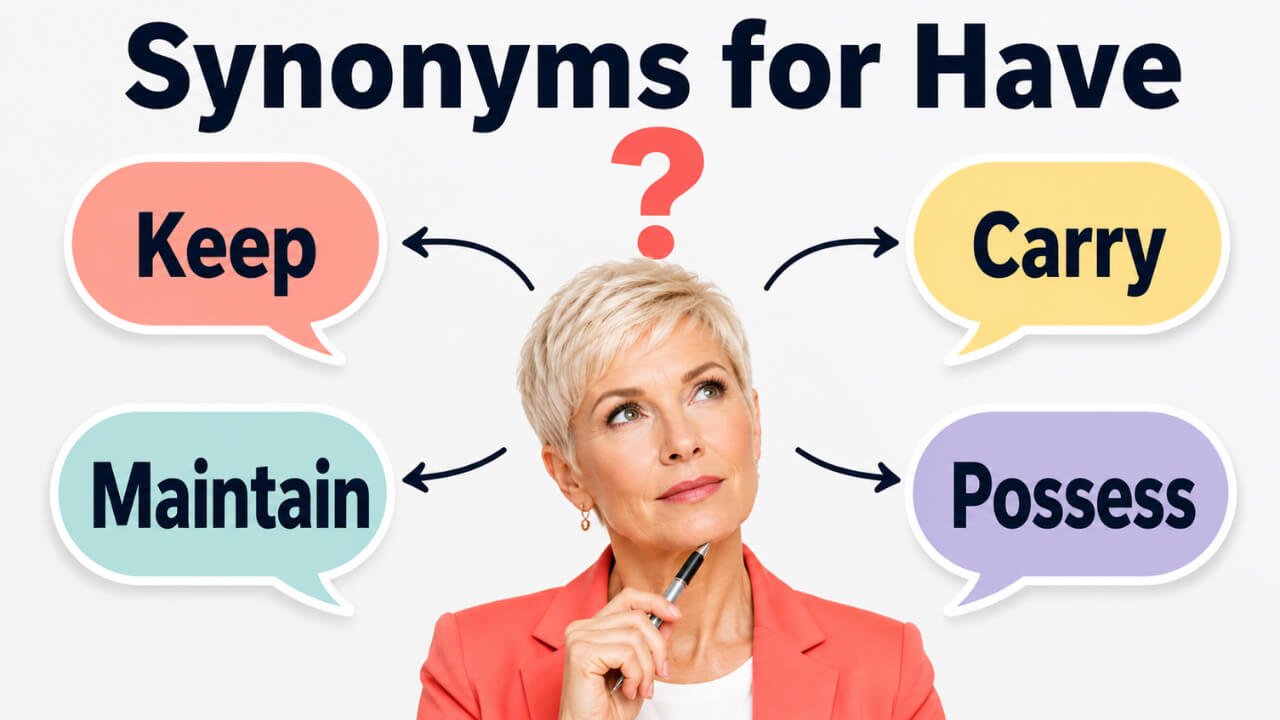
Quick Answer: The best synonyms for have include possess, own, hold, keep, retain, contain, include, experience, receive, get, acquire, consume, host, and require. Use possess or own for ownership, contain or include for parts or features, experience for feelings or situations, receive or get for taking something, consume for eating or drinking, and require or must when “have to” means obligation.
Pronunciation and Word Details
Word: Have.
Pronunciation: /hæv/ and weak form /həv/.
Part of Speech: Verb and auxiliary verb.
Meaning: To own, hold, contain, experience, receive, eat, arrange, or be required to do something.
US Pronunciation:
UK Pronunciation:
What Does “Have” Mean?
Have means to own, hold, contain, receive, experience, or be required to do something. It is a very common English verb with many uses.
As a main verb, have can show possession, relationship, features, experiences, meals, events, and actions. For example, a person can have a car, have a headache, have lunch, or have a meeting.
As an auxiliary verb, have helps form perfect tenses. For example, “I have finished the work” uses have to show a completed action connected to the present.
Meaning, Tone, and Context of “Have”
Have is neutral, common, and flexible. It works in formal writing, casual speech, academic sentences, business communication, and everyday conversation.
The tone of have depends on context. In simple speech, it sounds natural and direct. In formal writing, it can sometimes feel plain if a more exact synonym is available. For example, possess sounds more formal than have, while get sounds more casual.
Have is commonly used for ownership, body feelings, personal qualities, family relationships, meals, obligations, events, and completed actions.
When and How to Use “Have”
For Possession: Use have when someone owns, controls, or keeps something.
Example: She has a small garden behind her house.
For Features: Use have when something contains a quality, part, or detail.
Example: The room has large windows and soft lighting.
For Experience: Use have when someone goes through a feeling, event, problem, or situation.
Example: He had a difficult week at work.
For Receiving: Use have when someone gets, receives, or accepts something.
Example: I had a message from my teacher this morning.
For Eating or Drinking: Use have when talking about meals, food, or drinks.
Example: We had tea after dinner.
For Events: Use have when someone arranges, hosts, or attends an event.
Example: They had a family gathering on Sunday.
For Obligation: Use have to when something is necessary or required.
Example: You have to submit the form before Friday.
For Completed Actions: Use have as an auxiliary verb in perfect tense.
Example: I have completed the assignment.
Best Synonyms for Have
Possess: To own or hold something, often in a formal way.
Example: The museum possesses several rare paintings.
Own: To legally or personally have something.
Example: They own a small house near the river.
Hold: To keep, carry, or contain something.
Example: The box holds old family photographs.
Keep: To continue having something.
Example: She keeps a notebook beside her bed.
Retain: To continue to have or preserve something.
Example: The company retained its loyal customers.
Contain: To have something inside.
Example: The bottle contains fresh juice.
Include: To have something as part of a larger whole.
Example: The course includes grammar lessons and vocabulary practice.
Experience: To have a feeling, event, or situation happen to you.
Example: Many students experience stress before exams.
Receive: To get something given, sent, or offered.
Example: He received a letter from his cousin.
Acquire: To get something through effort, purchase, learning, or time.
Example: She acquired strong writing skills through practice.
50 Synonyms for Have with Short Meanings
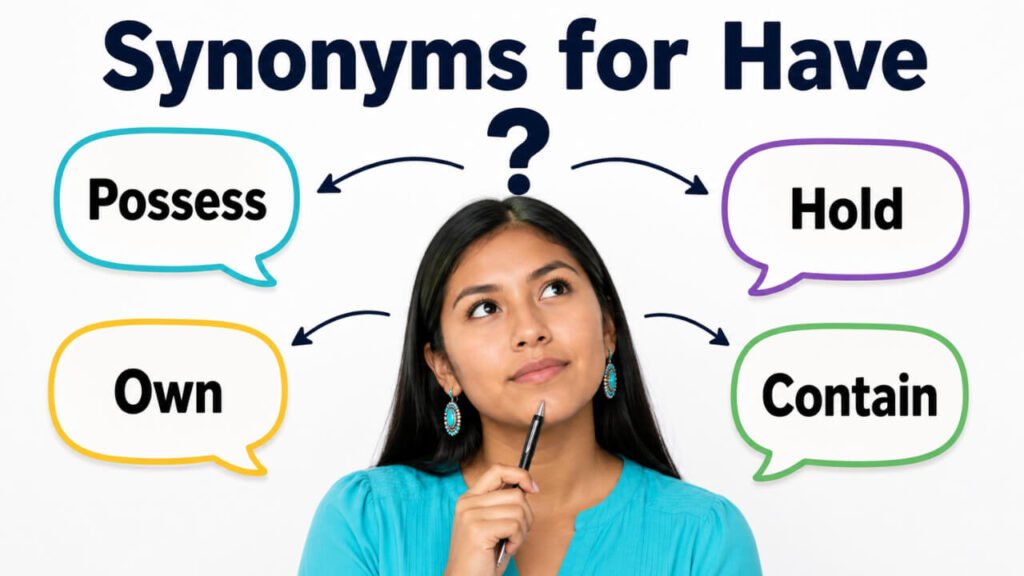
- Possess: To own or hold something.
- Own: To legally or personally have something.
- Hold: To keep, carry, or contain something.
- Keep: To continue having something.
- Retain: To keep possession or control of something.
- Carry: To have something with you or inside something.
- Contain: To have something inside.
- Include: To have something as part of a whole.
- Feature: To have as a noticeable quality or part.
- Bear: To carry, show, or have a quality.
- Maintain: To keep something in a certain state.
- Enjoy: To have the benefit of something.
- Experience: To go through a feeling, event, or situation.
- Undergo: To experience something difficult, serious, or formal.
- Feel: To have an emotion or physical condition.
- Suffer: To have pain, illness, loss, or trouble.
- Face: To have a problem, duty, or challenge before you.
- Encounter: To meet or experience something unexpectedly.
- Receive: To get something that is given or sent.
- Get: To receive, obtain, or become affected by something.
- Obtain: To get something through effort or request.
- Acquire: To gain something through effort, learning, or purchase.
- Gain: To get more of something useful or valuable.
- Secure: To successfully get or obtain something.
- Accept: To receive something willingly.
- Take: To receive, use, eat, drink, or choose something.
- Eat: To have food.
- Drink: To have a liquid.
- Consume: To eat, drink, or use something.
- Host: To have guests or an event.
- Invite: To ask someone to come or join you.
- Welcome: To receive someone warmly.
- Organize: To arrange or have an event planned.
- Arrange: To plan or prepare something.
- Conduct: To have or carry out an activity formally.
- Run: To manage or hold an activity, program, or event.
- Manage: To handle, control, or be responsible for something.
- Display: To have a quality that others can notice.
- Show: To have or express a sign, quality, or feeling.
- Exhibit: To show or have a visible quality.
- Need: To have a requirement.
- Require: To need something as necessary.
- Must: To have to do something.
- Be required to: To be officially or practically forced to do something.
- Be obliged to: To have a duty or responsibility to do something.
- Cause: To have an effect on someone or something.
- Make: To cause someone to do or feel something.
- Ask: To have someone do something by request.
- Allow: To have something happen by permission.
- Attend: To have or take part in a meeting, class, or event.
Read Also:
Synonyms for Fire

Synonyms for Have by Context
When Have Means Own or Possess
Use possess, own, hold, keep, retain, and carry when have means someone owns, keeps, or controls something.
Example: She has a beautiful old ring.
Better Option: She owns a beautiful old ring.
Example: The file has important records.
Better Option: The file holds important records.
When Have Means Contain or Include
Use contain, include, feature, bear, and carry when something has parts, details, signs, or qualities.
Example: The report has useful examples.
Better Option: The report includes useful examples.
Example: The package has three small items inside.
Better Option: The package contains three small items inside.
When Have Means Experience
Use experience, undergo, face, encounter, feel, and suffer when have refers to a feeling, condition, problem, or situation.
Example: She had a strange feeling during the meeting.
Better Option: She felt a strange feeling during the meeting.
Example: They had many problems during the project.
Better Option: They faced many problems during the project.
When Have Means Receive or Get
Use receive, get, obtain, acquire, gain, secure, accept, and take when have means to get something.
Example: He had a gift from his friend.
Better Option: He received a gift from his friend.
Example: She had new skills after the training.
Better Option: She gained new skills after the training.
When Have Means Eat or Drink
Use eat, drink, consume, take, and enjoy when have refers to food, drinks, medicine, or meals.
Example: We had breakfast early.
Better Option: We ate breakfast early.
Example: He had a glass of water.
Better Option: He drank a glass of water.
When Have Means Host or Arrange
Use host, organize, arrange, conduct, run, and hold when have refers to meetings, parties, classes, sessions, or events.
Example: They had a meeting in the afternoon.
Better Option: They held a meeting in the afternoon.
Example: She had a small dinner for her guests.
Better Option: She hosted a small dinner for her guests.
When Have Means Need or Must
Use need, require, must, be required to, and be obliged to when have to means duty, rule, or necessity.
Example: You have to wear proper shoes in the lab.
Better Option: You must wear proper shoes in the lab.
Example: Students have to complete the form.
Better Option: Students are required to complete the form.
When Have Means Cause or Ask Someone to Do Something
Use make, cause, ask, allow, and get when have means making or asking someone to do something.
Example: I will have him check the document.
Better Option: I will ask him to check the document.
Example: The joke had everyone laughing.
Better Option: The joke made everyone laugh.
Another Word for Have
A strong single replacement for have is possess when the meaning is ownership. However, the best alternative depends on context. Use experience for feelings or events, receive for getting something, contain for parts, and must for obligation.
Original: She has a natural talent for writing.
Better Option: She possesses a natural talent for writing.
Original: I had a message from the office.
Better Option: I received a message from the office.
Original: The guide has many useful examples.
Better Option: The guide includes many useful examples.
Original: You have to finish this today.
Better Option: You must finish this today.
When Not to Use “Have”
Do not overuse have when a clearer verb can make the sentence stronger. Since have has many meanings, it can sometimes sound vague or repetitive.
Weak: The article has many facts and has many examples.
Better: The article includes many facts and provides many examples.
Weak: She had a bad experience and had stress afterward.
Better: She experienced a difficult situation and felt stress afterward.
Weak: The building has a large hall and has modern rooms.
Better: The building contains a large hall and features modern rooms.
Weak: We had a meeting and had a discussion about the plan.
Better: We held a meeting and discussed the plan.
Weak: He has to have permission before entering.
Better: He must receive permission before entering.
Words Commonly Confused With Have
Have vs Own: Have can mean own, receive, experience, eat, or need. Own only means to possess something personally or legally.
Have vs Hold: Have is broader and more general. Hold usually means to keep, carry, contain, or organize an event.
Have vs Get: Have can show possession or experience. Get usually focuses on receiving, obtaining, becoming, or arriving.
Have vs Possess: Have is common and neutral. Possess is more formal and often used for qualities, ownership, skills, or abilities.
Have vs Contain: Have can be general. Contain specifically means something is inside another thing.
Have vs Include: Have can mean many things. Include means something is part of a group, list, plan, or whole.
Have vs Experience: Have can describe an event or feeling. Experience is clearer when someone goes through a situation, emotion, condition, or problem.
Have vs Must: Have to and must both show obligation. Must often sounds stronger, more direct, or more formal.
Which Synonym Should You Choose?
Choose possess when writing about ownership, ability, rights, skills, or qualities in a formal sentence.
Choose own when talking about legal or personal ownership.
Choose hold when writing about carrying something, keeping something, containing something, or arranging a meeting.
Choose retain when the meaning is keeping something over time.
Choose contain when something has material, information, or objects inside.
Choose include when something is part of a list, plan, group, or larger whole.
Choose experience when writing about feelings, events, problems, or life situations.
Choose receive when someone gets something from another person, place, or system.
Choose acquire when someone gets knowledge, skills, property, or value through effort or time.
Choose consume when talking about food, drink, medicine, or resources.
Choose host when someone has guests, a party, a dinner, or an event.
Choose must when “have to” means strong obligation or necessity.
Choose require when writing about rules, needs, instructions, or formal requirements.
Real Life Examples of “Have” in Sentences
Original: I have a small apartment near the market.
Better Option: I own a small apartment near the market.
Original: The book has a helpful chapter on grammar.
Better Option: The book includes a helpful chapter on grammar.
Original: She has a calm and confident voice.
Better Option: She possesses a calm and confident voice.
Original: We had dinner before the program.
Better Option: We ate dinner before the program.
Original: He had a serious illness last year.
Better Option: He suffered from a serious illness last year.
Original: They had a meeting with the team.
Better Option: They held a meeting with the team.
Original: I had an email from my cousin.
Better Option: I received an email from my cousin.
Original: The container has clean water inside.
Better Option: The container contains clean water inside.
Original: You have to answer all questions.
Better Option: You must answer all questions.
Original: The news had everyone worried.
Better Option: The news made everyone worried.
Synonym Groups and Usage Differences
Possession Group
This group includes possess, own, hold, keep, retain, and carry. Use these when have means ownership, control, or continued possession.
Example: She retains full control of the property.
Content Group
This group includes contain, include, feature, bear, and display. Use these when something has parts, signs, qualities, or information.
Example: The document contains clear instructions.
Experience Group
This group includes experience, undergo, feel, suffer, face, and encounter. Use these when a person goes through a situation, emotion, illness, or problem.
Example: Workers faced several challenges during the project.
Receiving Group
This group includes receive, get, obtain, acquire, gain, secure, and accept. Use these when someone gets something new.
Example: She acquired valuable skills during the course.
Eating and Drinking Group
This group includes eat, drink, consume, take, and enjoy. Use these when have refers to meals, drinks, medicine, or food.
Example: He consumed a light meal before travel.
Event Group
This group includes host, organize, arrange, conduct, run, and hold. Use these for meetings, dinners, gatherings, classes, and events.
Example: The school organized a language workshop.
Obligation Group
This group includes must, need, require, be required to, and be obliged to. Use these when have to means duty or necessity.
Example: Applicants are required to bring original documents.
Causative Group
This group includes make, cause, ask, allow, and get. Use these when have means causing, requesting, or allowing an action.
Example: The teacher asked the students to revise the paragraph.
Antonyms of Have
Antonyms of have depend on the meaning. The opposite of possession may be lack or lose. The opposite of receiving may be give or reject. The opposite of experiencing may be avoid or miss.
Lack: To not have something needed or expected.
Lose: To stop having something.
Give: To transfer something to another person.
Release: To stop holding or keeping something.
Surrender: To give up control or possession.
Relinquish: To let go of something formally.
Reject: To refuse to accept something.
Refuse: To choose not to take, do, or accept something.
Miss: To fail to receive, attend, or experience something.
Avoid: To stay away from an experience or problem.
Exclude: To leave something out.
Forgo: To choose not to have or do something.
Comparison: Have vs Related Words
Have vs Possess
Have is common and flexible. Possess is more formal and specific, especially for ownership, ability, qualities, or rights.
Example With Have: She has excellent leadership skills.
Example With Possess: She possesses excellent leadership skills.
Have vs Own
Have can mean many things, but own only means legal or personal possession.
Example With Have: He has a farm outside the city.
Example With Own: He owns a farm outside the city.
Have vs Hold
Have is general. Hold can mean to keep in hand, contain, maintain, or organize an event.
Example With Have: They had a meeting at noon.
Example With Hold: They held a meeting at noon.
Have vs Contain
Have can describe a feature or object. Contain clearly means something is inside.
Example With Have: The jar has sugar inside.
Example With Contain: The jar contains sugar inside.
Have vs Include
Have is broad. Include means something is part of a whole, list, group, or plan.
Example With Have: The lesson has practice questions.
Example With Include: The lesson includes practice questions.
Have vs Experience
Have can describe a feeling or situation. Experience makes the meaning clearer and more formal.
Example With Have: Many people have stress during exams.
Example With Experience: Many people experience stress during exams.
Have vs Receive
Have can show possession after getting something. Receive focuses on the act of getting it.
Example With Have: I had a reply from the office.
Example With Receive: I received a reply from the office.
Have vs Must
Have to means obligation. Must is shorter, stronger, and often more direct.
Example With Have: You have to follow the rules.
Example With Must: You must follow the rules.
Common Phrases and Expressions With Have
Have a Look: To look at something.
Have a Chance: To get an opportunity.
Have a Problem: To face a difficulty.
Have a Meeting: To attend or hold a meeting.
Have a Meal: To eat breakfast, lunch, or dinner.
Have an Idea: To think of a suggestion or plan.
Have a Good Time: To enjoy an experience.
Have Permission: To be allowed to do something.
Have to: To be required or forced to do something.
Have in Common: To share the same feature, interest, or quality.
Common Mistakes to Avoid
Overusing Have: Repeating have too often can make writing sound flat. Replace it with a more exact verb when the meaning is clear.
Weak Sentence: The guide has tips and has examples.
Better: The guide includes tips and provides examples.
Using Own for Every Meaning: Own only works for possession. Do not use it for experiences, meals, feelings, or obligation.
Weak Sentence: I owned a headache yesterday.
Better: I had a headache yesterday.
Using Possess Too Casually: Possess can sound too formal in everyday speech.
Weak Sentence: I possess a cup of tea every morning.
Better: I have a cup of tea every morning.
Confusing Have and Get: Get focuses on receiving or becoming. Have often focuses on possession, condition, or experience.
Weak Sentence: I got a car in my garage.
Better: I have a car in my garage.
Using Contain for People: Contain is usually for objects, places, documents, packages, and physical or written content.
Weak Sentence: She contains three children.
Better: She has three children.
Replacing Have To Incorrectly: When have to means obligation, choose must, need to, require, or be required to.
Weak Sentence: You possess to submit the report.
Better: You must submit the report.
Conclusion
The best synonyms for have depend on meaning and context. Use possess or own for ownership, contain or include for parts and details, experience for feelings or events, receive or acquire for getting something, consume for meals, host for events, and must or require for obligation. Since have is a broad word, choosing a more specific synonym can make your writing clearer, stronger, and more natural.
FAQs About Synonyms for Have
What are the best synonyms for have?
The best synonyms for have are possess, own, hold, keep, retain, contain, include, experience, receive, get, acquire, host, consume, require, and must.
What is another word for have in formal writing?
Possess is a strong formal synonym when have means own or hold. Contain, include, experience, receive, and require are also formal choices depending on context.
What is another word for have in casual speech?
In casual speech, get, keep, hold, eat, drink, need, and own often work well. For example, “I had lunch” can become “I ate lunch.”
Is possess always a synonym for have?
No. Possess only works when have means own, hold, or contain a quality. It does not work for meals, events, feelings, or obligation.
What is the difference between have and own?
Have is broader and can mean own, receive, experience, contain, eat, or need. Own only means to legally or personally possess something.
What is a better word than have for essays?
For essays, use possess, contain, include, demonstrate, experience, require, or indicate when they match the meaning. These words can sound more precise than have.
What is the opposite of have?
The opposite of have can be lack, lose, give, release, reject, refuse, avoid, exclude, or forgo, depending on the sentence meaning.
